Your team is probably doing some version of this right now. You launch fresh Meta campaigns, watch the first few days of data, pull apart winners and losers, then scramble to turn those lessons into the next round of ads. Some insights stick. Many don't. The account learns slowly because the team learns manually.
That's why the phrase what is continuous learning matters more than it first appears. In one meeting, it sounds like an HR slogan about upskilling. In another, it shows up as an AI capability inside ad platforms and campaign tools. Those are related ideas, but they're not the same thing.
For performance marketers, that distinction matters because one version helps your team get smarter over time, while the other helps your systems get smarter from campaign data. If you mix them together, you get vague thinking. If you separate them clearly, you can start building a workflow that improves ROAS, shortens launch cycles, and reduces the amount of repetitive trial-and-error inside Meta Ads.
The Two Meanings of Continuous Learning
A lot of confusion starts with the term itself. Continuous learning has two valid meanings, and marketers often hear both without anyone slowing down to define them.
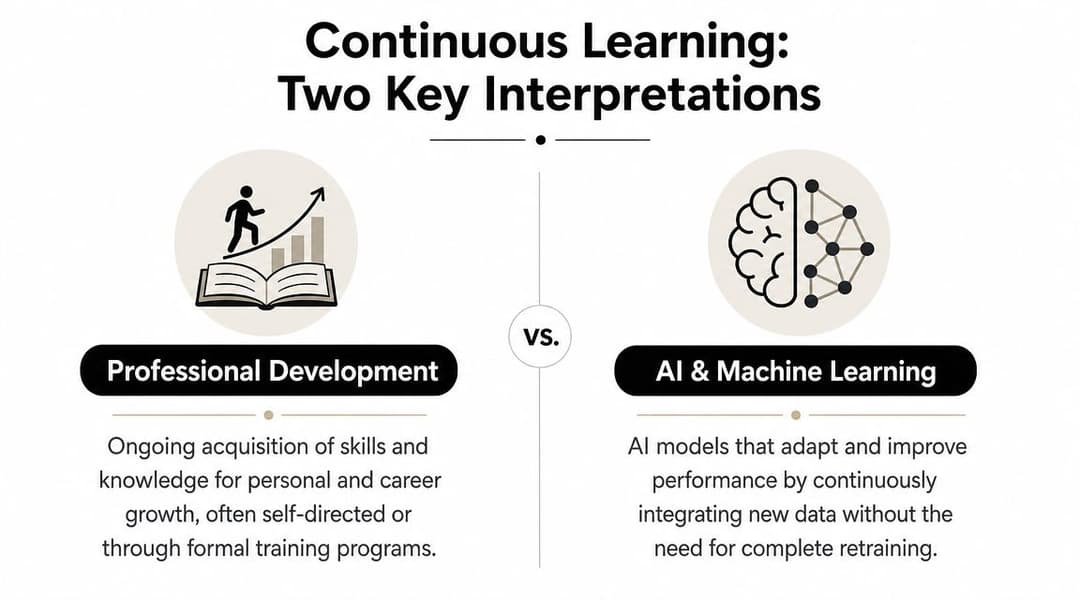
Continuous learning in people
In the workplace, continuous learning usually means an ongoing habit of skill development. That can include formal courses, peer feedback, experimentation, post-mortems, and on-the-job practice. It's the idea that people don't become effective from one training session. They improve through repeated exposure, application, and correction.
That definition matters because companies don't treat learning as a nice-to-have anymore. A widely cited workplace learning stat says 94% of employees would stay at a company longer if it invested in their career development, while 40% of employees with poor training will leave, as summarized in Edume's workplace learning overview. That's why HR teams talk about learning as a retention system, not just a training calendar.
For a marketing team, this human version looks like:
- Creative review loops where buyers and designers examine why one hook outperformed another
- Audience debriefs after launches so insights don't die in Slack threads
- Skill stacking across copy, analytics, landing pages, and attribution
- Pattern recognition that gets sharper as the team sees more campaigns, which is closely related to how marketers build better pattern recognition
Continuous learning in machines
In AI, the phrase means something more technical. It describes a system that keeps adapting as new data arrives instead of staying fixed after one training cycle.
That's the definition performance marketers should care about most when they're evaluating ad tools, platform automation, or model-driven campaign decisions. The machine version isn't about curiosity or self-improvement. It's about whether the system can absorb fresh performance signals and become more useful without being rebuilt from scratch every time.
Continuous learning for marketers means one simple thing: the system should remember what happened, use it on the next decision, and improve future campaign choices.
Here's a clean way to separate the two meanings:
| Context | What is learning | Main goal | Marketing example |
|---|---|---|---|
| Professional development | People build skills over time | Better judgment and execution | A media buyer gets better at diagnosing creative fatigue |
| AI and machine learning | Models update from new data | Better predictions and decisions | A system shifts attention toward higher-performing ad combinations |
When marketers blur these definitions, the conversation gets muddy. Someone says “we need continuous learning,” but they might mean team training, better reporting, or adaptive automation. Those are different problems.
The useful framing is this. Human learning improves the operators. Machine learning improves the operating system around the work. Strong paid social teams need both, but they shouldn't confuse one for the other.
How AI Models Learn Continuously
The easiest way to understand AI continuous learning is to stop thinking about it as magic and start thinking about it like a GPS.
A GPS doesn't drive the car for you. It takes a destination, checks current conditions, compares route options, and recalculates when the road changes. A learning model behaves in a similar way. It starts with what it already knows, takes in fresh signals, then updates its next recommendation.
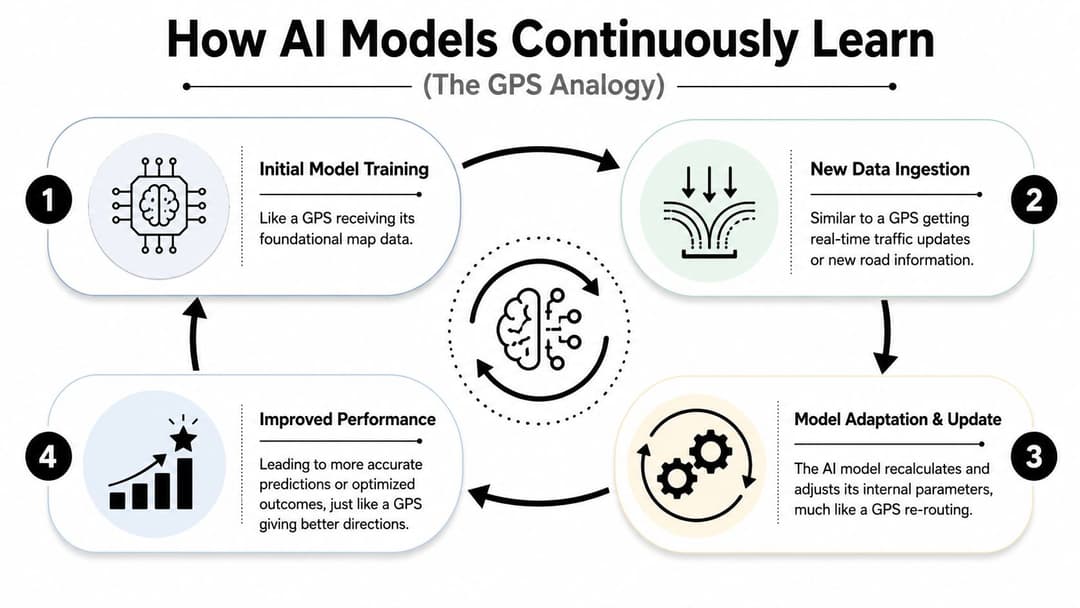
The learning loop in plain English
In machine learning, continuous learning is the ability to learn from a sequence of tasks or changing data streams while preserving prior knowledge. A classic formulation describes a learner that uses a knowledge base from earlier tasks to help learn the next one, then updates that memory after each task, as explained in this continuous learning paper from UIC.
That sounds technical, but the marketing version is straightforward:
The model starts with history
It has prior campaign data, account structure, conversion feedback, and examples of what has worked before.The model makes a decision
It helps rank creatives, identify audience patterns, or suggest which combinations deserve more spend.New performance data arrives
Clicks, conversions, cost signals, quality shifts, and behavior changes flow back into the system.The model updates its memory
It adjusts future recommendations using the new evidence instead of treating every launch like day one.
Why incremental updates matter
Static systems are easy to understand. They're also easy to outgrow. If a model only reflects last quarter's conditions, it starts making stale recommendations when your offer, audience behavior, or auction environment changes.
That's where incremental updates become valuable. Instead of retraining everything from zero whenever performance changes, the system keeps learning in smaller steps. For marketers, that can mean faster adaptation to a new creative angle, a new funnel step, or a new conversion trend.
Practical rule: If your tool can report on performance but can't use that performance to improve the next campaign decision, it isn't really learning. It's just logging history.
What this looks like inside campaign workflows
A continuous learning system for paid social should act more like a feedback engine than a dashboard. It shouldn't just tell you what happened. It should make future setup smarter.
That can include:
- Creative memory that notices which visual styles, hooks, or proof points keep surfacing in stronger ads
- Audience memory that recognizes which pockets of buyers respond under specific goals like CPA or ROAS
- Launch memory that carries prior winners into the next round of testing
- Execution support tied to tools such as AI workflows for performance automation, where historical results inform what gets built next
The key idea is simple. A static model answers, “What performed?” A continuous learning model answers, “Given what just happened, what should we try now?”
That difference is where campaign speed comes from.
Why This Is a Game Changer for Performance Marketing
Performance marketing breaks when learning is slow. Not because the team is weak, but because the environment changes faster than manual analysis can keep up with.
Creative fatigue shows up. An audience segment stops converting efficiently. A broad ad set starts outperforming a tightly defined one. If your team has to spot every shift manually, discuss it, rebuild assets, relaunch tests, and then wait again, the account loses momentum.
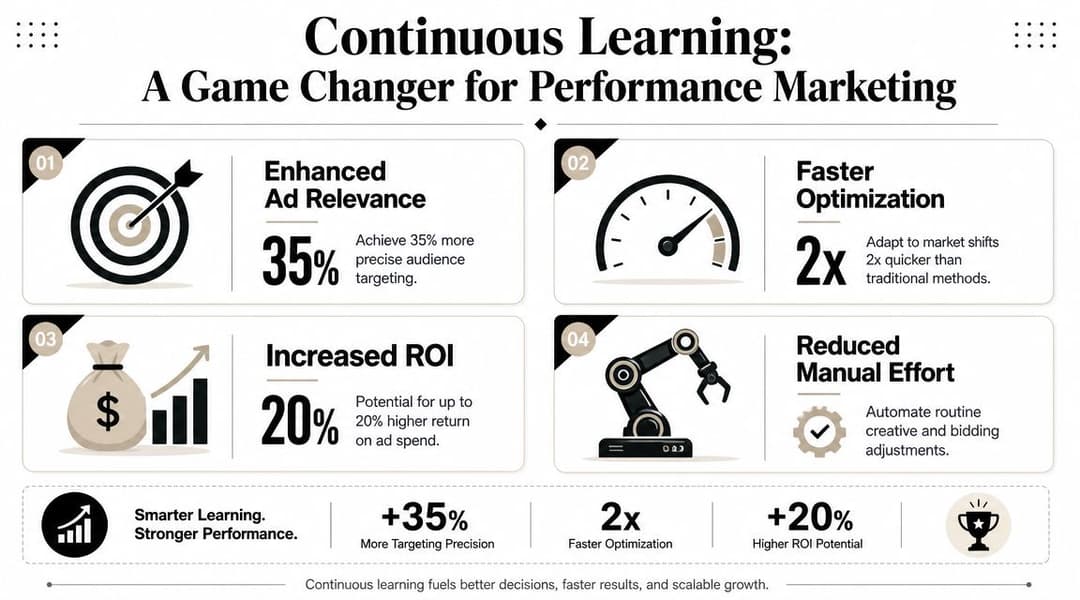
It turns lagging reports into active decisions
Data is often already available. That's not the bottleneck. The bottleneck is converting data into the next useful move before spend drifts into weaker combinations.
When a system keeps learning, it can help surface patterns earlier. That doesn't guarantee perfect decisions, but it improves the odds that your next launch reflects the latest account reality rather than old assumptions.
For marketers, that means:
- Less budget waste on combinations that looked promising in planning but fall apart in live delivery
- Faster campaign launches because past winners shape the next setup
- Better ROAS discipline because budget can move toward stronger signals sooner
- More consistent testing without relying on heroic manual effort from one senior buyer
It changes the role of the marketer
The biggest shift isn't that AI “takes over.” It's that the marketer stops acting like a spreadsheet operator and starts acting like a system manager.
You spend less time duplicating ad sets, renaming variants, and pulling fragmented breakdowns. You spend more time deciding what the model should optimize for, which tests are worth running, and when performance signals are strong enough to scale.
That's why continuous learning matters in paid social. It doesn't just automate tasks. It compounds judgment.
The strongest marketing teams don't win because they publish more reports. They win because they shorten the gap between signal, decision, and action.
Where the gains show up first
The first visible improvements usually appear in operational speed and decision quality.
A learning system can help teams:
- Launch more confidently because campaign structures reuse proven elements instead of starting from scratch
- Prioritize creative work around themes that have already shown traction
- Reduce noisy experimentation by cutting tests that don't match the account's current signals
- Coordinate media and creative teams around the same evidence base, which is the practical promise behind AI in performance marketing workflows
For a performance marketer, that's the primary value. Continuous learning isn't abstract AI language. It's a way to improve how quickly the account figures out what deserves more spend.
Continuous Learning in Action with Meta Ads
Meta is where the concept becomes tangible because the platform produces exactly the kind of feedback loop a learning system needs. You launch creative combinations, audiences respond, conversion signals come back, and each result changes what you should do next.
Here's what that can look like inside day-to-day campaign work.
Example one with creative selection
A team launches several Meta ads for the same offer. The variations differ by image style, opening hook, headline, and proof angle. In a manual workflow, the buyer waits, checks results, and tries to infer what's driving conversion quality.
A continuous learning approach does something more structured. It compares combinations against the campaign goal and starts building memory around repeated signals. Maybe customer testimonial language keeps holding up across formats. Maybe a simple product visual outlasts polished lifestyle creative. Maybe one promise attracts clicks but weakens post-click conversion quality, so the system learns not to overvalue cheap traffic.
The point isn't that the machine “likes blue backgrounds” or any other rigid rule. The point is that it can detect patterns in creative response and feed those patterns into the next build. That's especially useful in Meta, where small creative shifts can change delivery quality fast.
Example two with audience exploration
Now take audience testing. A team begins with one familiar segment because it worked last quarter. Early results are decent, but performance starts softening. In a manual setup, the team might keep spending there too long because it recognizes the audience and trusts old wins.
A learning system is less sentimental. It treats audience response as current evidence, not institutional memory. If a broader or adjacent segment starts generating stronger downstream signals, it can push the team to test and reallocate sooner.
This matters more now because the context around work is changing quickly. The World Economic Forum projects that 44% of workers' core skills will be disrupted by 2027 and 60% of workers will need training by 2027, according to The Future of Jobs Report 2023. Marketers feel that change directly in how fast platform behavior, creative norms, and optimization workflows evolve.
The Meta application marketers can actually use
Inside Meta Ads, continuous learning becomes practical when you apply it to three decisions:
What to launch next
Use previous winners as ingredients, not just archive entries.What to pause or reduce
Don't protect weak combinations because they fit your initial hypothesis.What signal matters most
Judge results by the metric tied to the business goal, whether that's CPA, CPL, or ROAS.
For teams that want a tool-driven version of this, AI systems built for Meta campaign workflows can ingest historical results, rank patterns across creatives and audiences, and help turn live campaign feedback into the next launch plan. The value isn't the interface alone. It's the loop.
A short walkthrough helps make that idea concrete:
Meta already gives you an auction and delivery engine. The opportunity is building a marketing process around it that continuously learns from what the account keeps telling you.
Best Practices for Implementing a Learning System
Teams often say they value learning. Fewer teams build a system that can prove it. That gap matters because activity alone doesn't create better campaigns.
A key insight from workplace learning is that the value comes from operationalization. It's not enough to encourage learning as a mindset. The useful shift is turning it into a repeatable loop with performance signals, as discussed in Docebo's analysis of continuous learning as a system.
Start with clean inputs
If your tracking is messy, your learning system will inherit the mess. That applies whether you're relying on native Meta reporting, internal spreadsheets, or a dedicated platform.
Focus first on:
- Conversion accuracy so the system learns from the right business outcome
- Consistent naming conventions so creatives, offers, and audiences can be compared cleanly
- UTM discipline so downstream analysis doesn't collapse into guesswork
A model can only learn from the signals you give it. If lead quality is mixed, event mapping is inconsistent, or campaign goals change mid-flight, the system won't know what “better” means.
Pick one optimization truth
Many marketing teams sabotage learning by changing the target every week. They launch for leads, then panic and optimize for volume, then shift to efficiency, then ask why the data feels noisy.
Use one primary objective per campaign cycle. If the business goal is qualified acquisitions, don't evaluate creative winners solely on cheap clicks. If the goal is efficiency, don't celebrate top-line volume that drags profitability.
A learning system needs a stable definition of success. Otherwise it's being trained to chase moving goalposts.
Build the human process around the machine process
The system should inform execution, but people still need to run the operating rhythm. That means regular review sessions, clear ownership, and a habit of turning findings into the next test plan.
A practical team checklist:
Review signal quality weekly
Check whether tracking, attribution flow, and campaign labels still support reliable analysis.Separate hypotheses from evidence
Let the team propose ideas freely, but let the data decide what advances.Archive learnings in reusable form
Don't store “winner” notes in scattered comments. Keep a simple reference for hooks, formats, audiences, and offer angles.Use outside frameworks when needed
If your PPC process is still mostly manual, this guide on how to achieve measurable growth with PPC is a useful companion for tightening optimization habits around goals, data, and testing discipline.
Choose tools that support feedback loops
This is the point where tooling matters. Some products are reporting layers. Some are workflow engines. Some reuse historical performance to shape new campaign builds.
If you evaluate platforms, ask a narrow question: does the tool help your team convert campaign outcomes into better future setup, or does it only visualize the past? A platform such as AdStellar AI fits the first category when teams need help launching, testing, and reusing performance patterns inside Meta workflows.
Measuring Success and Avoiding Common Pitfalls
If continuous learning is real, you should be able to observe it. Not as a vague feeling that the team is “getting smarter,” but as a repeatable improvement in decision quality and execution speed.
What to measure beyond ROAS
ROAS matters, but it's a lagging metric. By the time it clearly moves, you may already have wasted time or budget. A learning system should also improve how quickly and reliably your team reaches better decisions.
Watch for signals like:
Time to insight
How fast can the team identify a meaningful creative or audience winner after launch?Time to relaunch
How quickly can you turn a winning pattern into a fresh campaign iteration?Cost per experiment
Are you spending less to learn which combinations don't work?Performance stability
Are campaign results holding up with fewer dramatic swings after optimization changes?Decision reuse
Are lessons from one launch showing up in the structure of the next one?
These metrics are useful because they show whether the system is improving the process, not just the outcome.
The pitfall marketers miss most often
One major technical risk in continuous learning is catastrophic forgetting. That happens when a model updates on new data and gets worse at earlier tasks or patterns unless safeguards are in place, as explained in Splunk's overview of continual learning failure modes.
For marketers, the plain-English version is simple. The system starts chasing the newest signal so aggressively that it forgets durable lessons from the account's older performance history.
That can show up as:
- Overreacting to short-term noise
- Discarding historically strong creative patterns too early
- Misreading temporary audience shifts as permanent truths
The safeguards that matter
Good learning systems don't just update. They also protect memory and monitor drift.
That's why you should ask whether your process or vendor uses:
- Model versioning so you can compare current behavior to prior states
- Drift monitoring so major changes in performance context are visible
- Validation checks before a new pattern is treated as a true winner
- Reliable event flow supported by infrastructure like Meta tracking through Conversions API workflows, which helps preserve signal quality when browser-based tracking gets messy
Treat sudden improvement with the same skepticism as sudden decline. A learning system can be wrong in both directions.
The practical lesson is that adaptation needs restraint. If your system updates from every small fluctuation, it won't become smart. It will become unstable. Strong continuous learning balances responsiveness with memory.
Your Next Steps Toward Smarter Campaigns
If you've been asking what is continuous learning, the answer should feel more concrete now. In people, it means ongoing skill development. In AI, it means a system that learns from new data while preserving useful memory. For performance marketers, the second meaning has direct implications for Meta Ads, campaign speed, and decision quality.
The next move isn't to chase buzzwords. It's to audit your current workflow.
Look at where your team still loses learning between campaigns. Maybe winning hooks aren't documented clearly. Maybe audience insights stay trapped in ad account comments. Maybe your launch process keeps rebuilding from scratch even when strong signals already exist. Those are process leaks, and they drag down ROAS long before anyone notices.
Then look at your inputs. If tracking is inconsistent, objectives keep shifting, or test naming is chaotic, no learning system will rescue the account. Clean data and stable goals come first.
Finally, start managing campaigns with one extra question in mind: what should this launch teach the next launch? That's the habit that turns optimization from reactive account maintenance into a compounding system.
When teams think this way, they stop treating each campaign as an isolated event. They start building a marketing engine that remembers, adapts, and gets sharper over time.
If you want a practical way to apply that approach inside Meta workflows, AdStellar AI helps teams turn historical performance into new campaign builds, rank creatives and audiences against goals like ROAS or CPA, and keep learning from fresh results instead of restarting from zero each launch.