You've got campaigns running across Meta, Google, and display. New creative requests arrive daily, audience reports sit in separate dashboards, and budget changes still depend on someone checking performance manually. By the time a team identifies a promising message, the audience or auction conditions may already have shifted.
That's the practical reason using AI in advertising has moved beyond experimentation. The value isn't a chatbot producing a clever headline. It's connecting creative production, audience selection, bidding, activation, and measurement so the team can test more intelligently and act on results sooner. The teams getting durable gains aren't handing over strategy blindly. They're building controlled systems where AI handles pattern-heavy work and people retain judgment over positioning, brand, risk, and investment decisions.
The Reality of Modern Ad Campaign Management
A typical performance marketer starts the day by opening several platforms, exporting reports, checking delivery, and scanning creative-level results. One campaign may have many combinations of headlines, images, videos, audiences, placements, and calls to action. Another may need bid or budget changes before the team has finished reconciling yesterday's conversion data.
The work looks manageable when each task is viewed alone. The problem is the interaction between them. A creative can perform well with one audience but poorly with another. A low-cost click may produce weak downstream value. A winning ad can lose momentum when frequency, landing-page quality, or auction pressure changes. Manual workflows force people to evaluate these relationships in fragments.
Where human capacity breaks down
Creative volume is one of the clearest bottlenecks. A marketer might brief several concepts, request copy variations, resize assets, name files, upload them, build ad sets, and create a testing structure. Each handoff introduces delay and creates opportunities for inconsistent tracking or accidental duplication.
Media buying adds another layer. Teams adjust budgets across platforms, compare attribution windows, investigate anomalies, and decide whether a result reflects genuine demand or temporary delivery noise. Spreadsheet-based processes can document decisions, but they rarely make the decisions faster or connect them directly to activation.
Practical rule: Automate the repetition around a decision before automating the decision itself.
Start by mapping the workflow from brief to business outcome. Mark every step that involves copying data, producing variants, applying a recurring rule, or finding the same insight in multiple reports. Those steps are usually better candidates for AI assistance than a high-stakes brand judgment or a change to measurement methodology.
The adoption pattern confirms that teams are already moving in this direction, but not evenly. The Salesforce adoption benchmark reports that 87% of marketers use generative AI in at least one recurring workflow, compared with 76% the year before and 51% in early 2024. That shift makes AI operationally relevant, but it also exposes a distinction many teams miss: using AI to summarize a report is much easier than wiring its output into live campaign execution.
What AI-Driven Advertising Actually Means
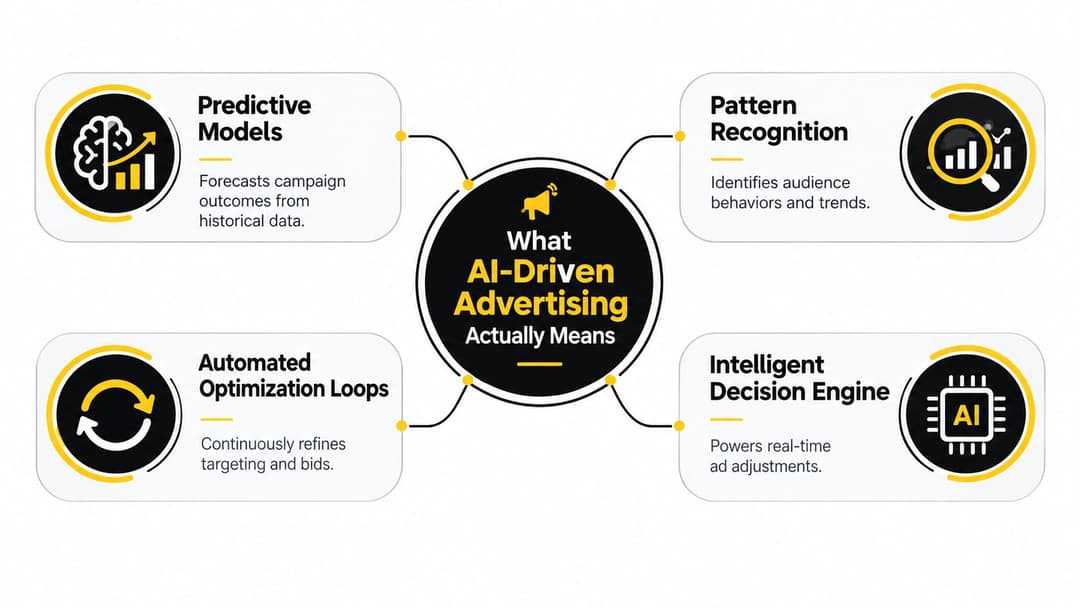
AI-driven advertising is a decision system, not an automated copywriter. It combines predictive models, pattern recognition, optimization loops, and decision engines to estimate what might happen, test alternatives, and adjust delivery based on observed outcomes.
A predictive model can estimate conversion propensity from historical signals. Pattern recognition can reveal that a message resonates with a particular combination of context, creative structure, and audience behavior. An optimization loop compares actual results with predictions, then updates how the system allocates attention or spend. A decision engine turns those estimates into actions, such as selecting an ad, changing a bid, or shifting budget.
The mechanics inside a live campaign
Consider a Meta campaign optimized for a conversion event. The platform receives feedback from impressions, clicks, landing-page visits, and conversions. Its delivery system looks for patterns among available signals and tries to show eligible ads to people more likely to complete the selected event. Your team still controls the objective, creative inputs, budget boundaries, exclusions, and quality checks. The system handles far more combinations than a buyer could evaluate manually.
That's different from rule-based automation. A rule might pause an ad whenever cost per acquisition crosses a threshold. Machine learning can evaluate several signals together and estimate whether a temporary cost increase may precede stronger conversion value. It can still be wrong, which is why guardrails and controlled tests matter.
Creative generation works similarly. AI can turn a structured brief into variations by changing the hook, proof point, offer framing, visual direction, or call to action. The useful output isn't the largest possible batch. It's a ranked set of plausible candidates that a team can review, deploy, and learn from. For a deeper explanation of the underlying approach, see this guide to machine learning in advertising.
The adoption data reflects this broader definition. Salesforce's benchmark places generative AI inside recurring marketing workflows, which means marketers increasingly use it as an operating layer rather than an occasional ideation tool. The practical question is no longer whether AI can generate an asset. It's whether your system can pass that asset into campaign structure, measurement, and optimization without losing control.
Four Core Use Cases Transforming Performance Marketing
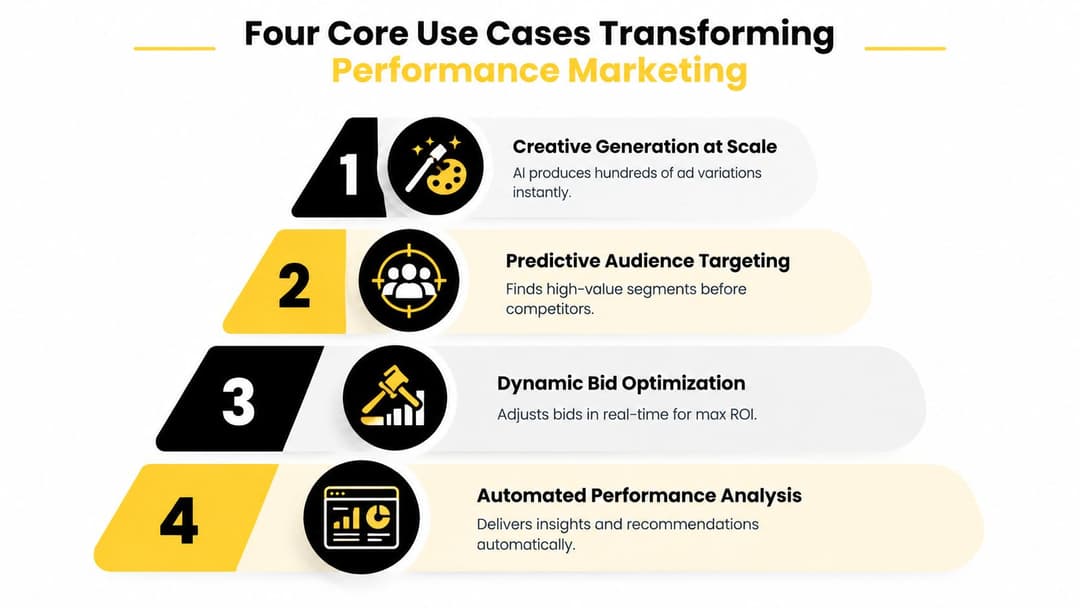
The strongest implementations connect four jobs that teams often manage separately. Each use case creates value on its own, but the workflow becomes more useful when the output of one step feeds the next.
Creative generation at scale
Begin with a clear creative matrix. Define the audience problem, offer, proof, tone, format, and conversion event before asking a model to generate variations. AI can then produce alternate hooks, scripts, primary text, headlines, and visual concepts while preserving the required claims and brand constraints.
The buyer's job is to filter for strategic fit, not to approve every grammatical sentence. Remove variants that introduce unsupported claims, flatten the brand voice, or change the offer unintentionally. Keep the approved assets tied to a naming convention that records the concept, angle, format, and version.
For teams focused on lead acquisition, Adcreative Ai for lead generation can be a useful reference point when evaluating how creative production tools fit into a broader funnel workflow.
Predictive audience targeting
AI targeting works best when the optimization event reflects business value. Feed the system reliable conversion signals, separate qualified outcomes from superficial activity, and avoid judging an audience by clicks alone. The model can then search for behavioral patterns that manual interest research may overlook.
Dynamic bid optimization
Bidding systems need room to learn, but not unlimited freedom. Set budget boundaries, define acceptable efficiency ranges, and establish rules for unusual delivery. A model should adjust bids or allocation according to predicted value, while the media buyer checks whether the underlying conversion quality remains stable.
Automated performance analysis
Automated analysis should answer operational questions, not merely describe dashboards. Ask which creative and audience combinations are driving qualified outcomes, where spend is accumulating without value, and what deserves a controlled follow-up test. The output should become a task in the campaign workflow, such as “launch these approved variants” or “review this conversion signal,” rather than another report nobody acts on.
The integration point matters more than the feature list. AI that creates assets but leaves a buyer to upload, name, structure, and measure everything manually only solves the first part of the problem.
When AI Outperforms Humans and When It Doesn't
AI wins when the task involves large search spaces, repeated evaluation, and rapid feedback. Humans win when the task depends on cultural context, emotional judgment, strategic coherence, or ethical responsibility. Treating the comparison as a contest between people and machines leads to poor implementation decisions.
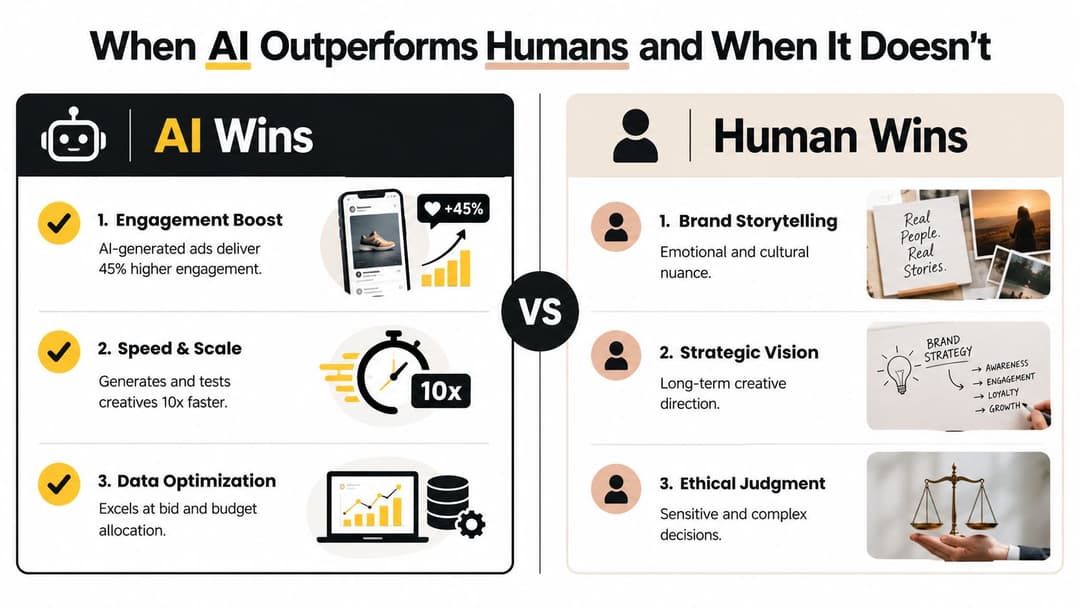
A field experiment on generative creative optimization found that the best AI-generated ad creative delivered 45.1% higher engagement than the best human-authored creative. The result, documented in the generative creative optimization field experiment, doesn't mean every AI asset will beat every human asset. It shows why AI can be valuable when it generates and filters a broad slate of candidates before controlled testing.
Where AI has an advantage
AI can evaluate combinations at a speed that human teams can't match. It can produce structured variations, identify recurring performance patterns, and reallocate attention as new data arrives. That advantage is strongest when the KPI is explicit and the feedback loop is short enough to support learning.
Where people remain essential
Human-led work matters most in the parts of advertising that require interpretation:
- Brand storytelling: People decide whether a concept expresses the brand's identity rather than merely matching a performance pattern.
- Strategic direction: Leaders choose which customer problem, market position, and offer deserve investment.
- Sensitive judgment: Teams must review claims, imagery, targeting logic, and exclusions where a technically efficient result could create reputational or compliance risk.
AI-modified creative deserves particular caution. Changing a human-made asset with AI may create a polished variation without changing the underlying idea, audience relevance, or offer strength. In contrast, a new concept can create a meaningful test of a different proposition. The distinction is easy to miss in a demo because visual novelty looks like performance progress.
Use a decision rule based on the role of the asset. Let AI expand and prioritize possibilities. Let humans define the boundaries, approve the strategic message, and interpret results in context. Then test the strongest AI and human candidates under comparable conditions instead of comparing unrelated launches.
Building Your AI Advertising Workflow
Operationalizing AI starts with the handoff between recommendation and activation. If a model produces an insight but no system turns that insight into a reviewed campaign change, adoption will stall at analysis.
The Mediaocean advertising outlook describes this execution gap clearly. 43% of marketers use AI for data analysis and 43% for market research, but only 33% use it for creative development and 19% for campaign orchestration. The pattern suggests that teams are comfortable asking AI what happened, but less prepared to let it influence what goes live.
A workable implementation sequence
Choose one measurable use case. Start with creative variation, audience analysis, budget recommendations, or reporting. Tie it to a specific business outcome and document the current manual process.
Prepare the inputs. Standardize campaign names, creative labels, conversion events, audience definitions, and spend data. AI can identify patterns only in the signals it receives. Poorly labeled assets create confident but misleading conclusions.
Create an approval gate. Route generated copy, images, audience suggestions, and budget changes to a named reviewer. Define what the reviewer checks, including claims, offer accuracy, brand fit, audience eligibility, and tracking.
Connect outputs to activation. The workflow should produce platform-ready assets, campaign structures, or prioritized actions. A recommendation trapped in a dashboard isn't orchestration.
Close the feedback loop. Feed delivery and conversion outcomes back into the system. Review whether the model's recommendations correlate with qualified results, not just surface engagement.
For practical guidance on turning prompts into campaign inputs, BAMF generative AI insights can help teams formalize briefs and review steps. AdStellar AI is one platform option for generating Meta creative and audience combinations, connecting campaign workflows with Ads Manager, and ranking results against objectives such as ROAS, CPL, or CPA. Teams should compare any tool on integration depth, data controls, approval workflows, and measurement support, not the number of assets it can generate.
A detailed AI advertising setup guide can also support the early configuration work, especially when the team needs to define permissions, inputs, and operating rules before launch.
Measuring Real ROI from AI Advertising Implementation
A convincing AI demo shows speed. A business case needs evidence that the added speed or intelligence changes the economics of acquisition.
One AI-driven advertising study reported CTR increasing from 2.4% to 5.3%, CPC decreasing from $1.25 to $0.72, and ROAS increasing from 2.7 to 5.8 when campaigns used AI for targeting and optimization. The study on AI-driven advertising performance provides a useful example of how the impact can appear across the funnel, from response rate to media cost and return.
Those figures should be treated as study results, not a promise for every account. Performance changes can come from several sources, including better creative, stronger tracking, audience changes, seasonality, offer quality, and platform learning. If all of those variables change at once, you won't know what AI contributed.
Build the measurement around decisions
Track the metrics that match the job AI is performing:
- Creative generation: Compare qualified engagement, conversion rate, and downstream value by concept, not only by asset count.
- Targeting and bidding: Monitor cost efficiency alongside lead quality, revenue, or margin. A cheaper click isn't automatically a better acquisition.
- Budget allocation: Check whether increased spend produces incremental value or merely captures conversions that would have happened anyway.
- Workflow efficiency: Record review time, launch time, error rates, and the number of meaningful tests completed. Operational gains matter when they create more learning capacity.
Use a controlled test wherever the platform and account structure allow it. Keep the objective, audience logic, offer, and measurement window consistent while changing the AI intervention. For teams that need to distinguish attributed conversions from incremental impact, incrementality testing for paid media offers a stronger framework than platform reporting alone.
The most useful reporting format connects action to outcome: what the model changed, what the buyer approved, how delivery responded, and whether qualified business results improved. That record helps stakeholders fund the workflow for the right reason, and it gives the team evidence for deciding what to scale or remove.
Governance and Ethics in AI Advertising
Automation can make a bad decision faster. That's why governance belongs inside the workflow, not in a policy document that nobody checks during campaign production.
Start with the data. Confirm what information enters the system, whether the team has permission to use it, how long it's retained, and whether the provider uses it to improve its own models. Avoid sending sensitive customer details into a tool because the prompt accepts them. A useful first-party data strategy should improve signal quality while preserving appropriate consent and access controls.
Four guardrails for live campaigns
- Data minimization: Give the model the fields required for the task, not every field available in the warehouse.
- Targeting review: Check whether audience recommendations could create unfair exclusion, exploit vulnerability, or violate platform rules.
- Creative disclosure: Review synthetic imagery, voice, and claims so the audience isn't misled about what the product delivers or how the content was produced.
- Human escalation: Require a person to approve sensitive categories, major budget shifts, unusual claims, and any recommendation that falls outside established boundaries.
Bias can enter through historical performance data. If past campaigns underserved a group, a model trained on those results may interpret the imbalance as a reason to spend less there. A high ROAS signal can hide a distribution problem when the system optimizes only for immediate return.
Brand safety also needs operational definitions. List prohibited topics, approved claims, restricted imagery, competitor rules, and escalation owners. Then encode those constraints into briefs, prompts, review checklists, and platform settings. Human oversight isn't a rejection of automation. It's the mechanism that keeps optimization aligned with the brand's obligations.
Your Strategic Roadmap for AI Advertising Success
The right roadmap depends on where your team is starting. A small growth team with clean conversion data may begin with creative testing and campaign analysis. An agency managing multiple accounts may prioritize permissions, naming standards, reusable briefs, and a review system. A mature performance organization should focus on connecting activation, measurement, and cross-channel decisions.
Use this decision sequence before buying or building anything:
- Name the bottleneck. Is the constraint production, analysis, activation, budget allocation, or measurement?
- Define the business KPI. Choose the outcome the system must improve, such as qualified leads, CPA, revenue, or ROAS.
- Assess the signal. Confirm that conversion events are reliable, consistently named, and available at the level the model needs.
- Set the human boundary. Decide what AI can recommend, what it can prepare, and what requires explicit approval.
- Design the test. Establish the comparison, decision window, and success criteria before the system goes live.
- Plan the handoff. Make sure recommendations become campaign changes, creative briefs, budget actions, or measurement tasks.
Match maturity to the next move
| Team position | Useful next move |
|---|---|
| Exploring | Use AI for structured research, reporting summaries, and controlled creative ideation. |
| Testing | Connect approved outputs to one platform and one clearly defined conversion objective. |
| Scaling | Standardize data, approval rules, naming, and feedback loops across accounts and channels. |
| Optimizing | Compare AI recommendations with human decisions and evaluate incremental business value. |
Your paid media strategy framework should treat AI as part of the operating model, not as a separate creative experiment. The goal is a repeatable loop: clean inputs, useful recommendations, human review, reliable activation, and measurement that changes the next decision.
AdStellar AI helps performance teams generate and organize Meta ad variations, connect workflows with Ads Manager, and identify creative, audience, and message patterns against goals such as ROAS, CPL, or CPA. If your team is spending more time assembling campaigns than learning from them, visit AdStellar AI to evaluate whether its workflow fits your current advertising process.