You open Meta Ads Manager on Monday morning and the numbers no longer agree with the CRM. Purchases are missing, leads appear without a clear source, retargeting audiences look smaller than expected, and the platform is optimizing toward events that don't represent revenue. The pixel still fires, but it no longer tells the whole story.
That's the operating problem behind first party data strategy. This isn't a privacy checkbox or a data warehouse exercise. It's the system that helps a performance team collect consented signals, resolve them into usable customer identities, send them into campaigns, and return real conversion outcomes to bidding and measurement.
The market has already moved. IAB reported that 71% of brands, agencies, and publishers were growing or planning to grow their first-party datasets, compared with 41% two years earlier, as summarized in IAB State of Data 2024 findings. The teams that win the next quarter won't be the ones with the largest data lake. They'll be the ones that connect owned data to daily media decisions.
The Signal Loss Problem Performance Marketers Are Solving Now
A paid social lead usually notices signal loss in fragments. Meta reports fewer purchases than the storefront. The CRM shows qualified opportunities that never appear in campaign reporting. The creative team sees clicks but can't tell which messages produce profitable customers. Finance questions the channel, while the media buyer blames attribution.
The technical causes vary. Browser restrictions reduce client-side visibility. Platform changes disrupt identifiers. Server-side events arrive without enough context, or they arrive twice. A campaign can still spend efficiently on paper while the algorithm receives a weaker description of who converted and why.
Operating rule: If the platform can't receive trustworthy downstream outcomes, it will optimize for whatever shallow event remains available.
That's why first party data should sit inside the performance operating system. Your website, app, CRM, support platform, and transaction system contain signals your business earns directly. Those signals can identify customers, separate prospects from buyers, suppress existing customers from acquisition campaigns, and distinguish a qualified lead from a form completion.
A useful Facebook Conversions API implementation guide can help your team close the gap between browser events and server-side feedback. But sending events isn't the strategy by itself. The work is deciding which events matter, resolving them to consented identities, and returning business outcomes such as qualified opportunities, purchases, or customer value.
The choice is straightforward. You can keep renting fragmented signals from platforms and accept that reporting, targeting, and optimization will drift apart. Or you can own the identity and conversion layer that feeds every channel. The rest of this playbook focuses on the second option, with decisions a growth lead can make this quarter.
What a First Party Data Strategy Actually Means
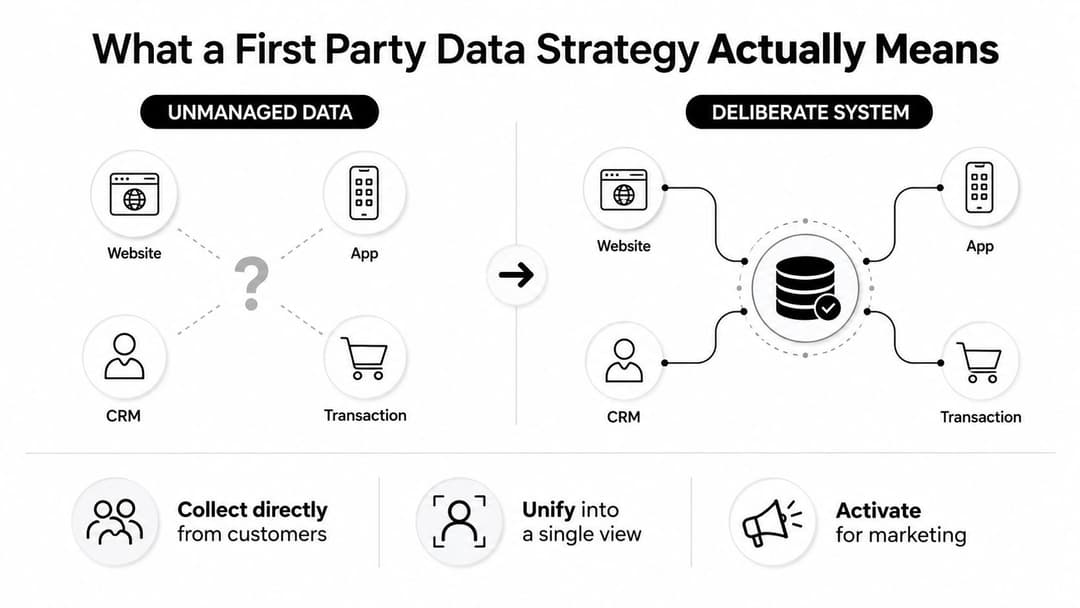
A first party data strategy is a deliberate system for collecting, unifying, and activating information your company earns directly from customers and prospects through owned interactions. That includes website behavior, app activity, account records, email permissions, customer service interactions, and transaction history.
It has three jobs:
- Collect directly from people who interact with your business, with the right consent and a clear value exchange.
- Unify records so the same person isn't treated as several unrelated users across systems.
- Activate signals in advertising, CRM journeys, personalization, and measurement.
The simplest analogy is a diner's loyalty card. First party data is the information your restaurant collects when a customer joins your own loyalty program and buys from you. Second-party data is another restaurant sharing its loyalty information with you through a direct partnership. Third-party data is a rented mailing list assembled by an outside broker.
Those sources aren't interchangeable. Your own records carry direct context about the customer relationship. A partner's data may expand reach, but you need to understand the agreement, permissions, and matching process. An external audience segment may provide scale, but it gives you less control over collection quality and identity continuity.
A CDP can support this work, but buying one doesn't create a strategy. A CRM can store valuable records, but storage alone doesn't make those records usable in Meta Ads Manager. A privacy policy can describe the rules, but it doesn't resolve duplicate customer identities or send qualified revenue events back to bidding systems.
For a practical external benchmark on how teams evaluate data collection and activation, review the Scrapeway benchmark results. Then use this plain-language explanation of first-party data to align marketing, operations, and leadership around the same definition.
First party data isn't a pile of customer records. It's the operating layer that turns customer relationships into addressable, measurable marketing.
Why the Business Case Is Quantified and Quantifiable
A CFO evaluating first-party data strategy wants a direct answer: which operating changes can improve performance, and how will the team measure them? The business case starts with two linked facts. Better activation can improve commercial performance, while fragmented identity prevents paid media, CRM, and finance teams from using the same customer evidence.
BCG reported that advanced first-party data activation can produce a 2.9x revenue uplift versus third-party-data approaches, while organizations activating first-party data see 1.5x higher customer lifetime value, according to the first-party data performance summary. Treat these figures as directional benchmarks, not a forecast for your company. The value comes from recognizing customers more accurately, building stronger audiences, and sending outcome data back to campaign decisions.
The operational problem is usually disconnected identity. Shopify records purchases. The email platform records engagement. The helpdesk records support needs. The CRM records qualified leads. Meta Ads Manager receives browser or server events. Each system may describe the same person differently, leaving the growth team to optimize against incomplete evidence.
| Outcome | Baseline, fragmented | With mature strategy |
|---|---|---|
| Revenue optimization | Platform optimizes toward incomplete or shallow events | Bidding receives consented downstream conversion outcomes |
| Customer value | Purchase history remains separated from media records | Audience and budget decisions can use lifecycle and value signals |
| Acquisition efficiency | Existing customers may remain in prospecting pools | Suppression and lifecycle exclusions reduce avoidable waste |
| Measurement | Channel reports compete with CRM and finance records | Media, CRM, and analytics use a defined identity and outcome model |
| Audience expansion | Lookalike inputs mix weak and strong records | High-value customer segments provide cleaner modeling inputs |
The adoption gap supports the case for an operating system, not another reporting layer. The referenced 2026 market dataset reports that 33% of companies had a mature first-party data strategy. It also reports that 84% of marketers considered channel engagement data important or critical, but only 68% collected it. Use that finding to set a practical priority: define the events and identifiers that influence campaigns, then connect them across the CRM, CDP, and Meta Ads Manager.
Attribution should serve the same decision process. Ask whether the model connects ad exposure to qualified revenue and supports a budget choice. Review the available marketing attribution models, then prioritize closed-loop feedback over theoretical complexity. This quarter, fix identity, event quality, and revenue feedback. Defer elaborate modeling until those foundations work.
The Five-Stage Framework From Collection to Governance
A paid social team can run a first party data strategy through five stages: collect, unify, activate, measure, and govern. Each stage should produce an artifact or workflow that another team can inspect. If a stage ends in a vague promise, it isn't operational.
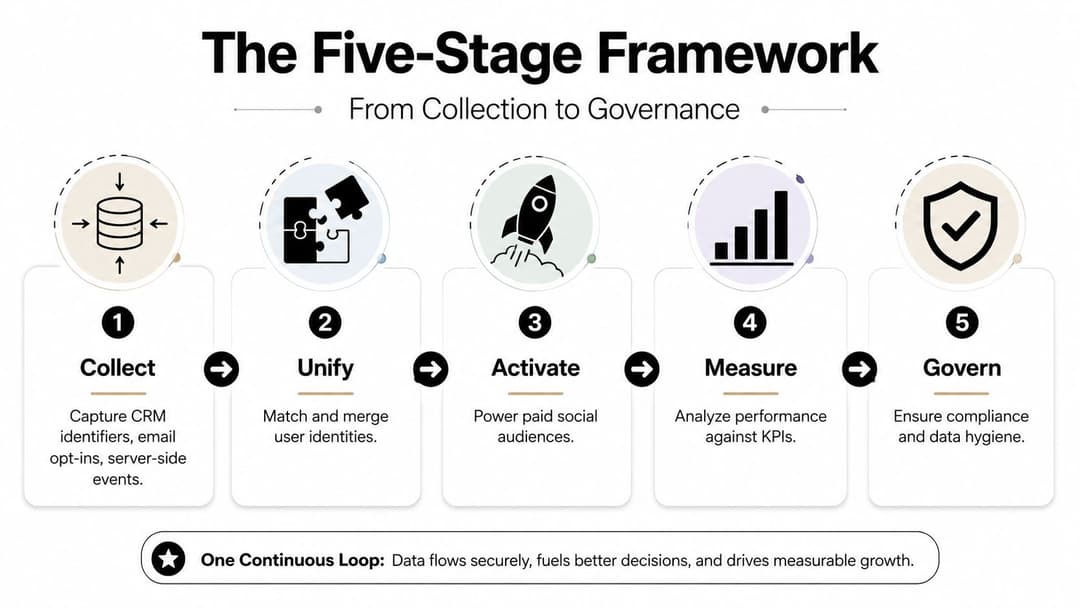
Collect the signals you can explain
Start with events tied to decisions. Capture consent status, email permissions, CRM identifiers, product views, form submissions, purchases, qualified lead updates, and refunds where relevant. Use on-site forms for explicit information and server-side events for conversion feedback. Meta Conversions API belongs here, but only after you define the event taxonomy and ownership.
A growth lead should be able to answer, “What does this event mean, who approved its use, and which campaign decision will it influence?” If nobody can answer, don't collect it yet.
Unify records around a durable identity
Use deterministic matching wherever possible, including consented email addresses, phone numbers, account IDs, and order IDs. Normalize formats before matching, document precedence rules, and separate anonymous activity from known profiles until the user provides a lawful connection.
The owned identity spine matters. A stable internal identity can support segmentation, suppression, lifecycle audiences, and measurement even when browser identifiers are unavailable, as described in Ingest Labs' identity and data activation overview.
Activate audiences with a job attached
Don't create audiences because the CDP can create them. Create them because a campaign needs one. Examples include recent purchasers for suppression, high-value customers for modeled acquisition, stalled leads for nurture, and customers due for replenishment.
Push consented, appropriately hashed audience data into Meta. Keep audience names tied to a business rule and refresh logic, not a vague label such as “engaged users.”
Measure actual outcomes
The feedback loop should move from collection to activation, then from downstream outcomes back into analytics or the CRM. Google's first-party data activation guidance emphasizes the need for measurement fundamentals before activation can deliver its full value.
Send qualified lead status, completed purchases, customer value, cancellations, and refunds back into the measurement layer. Otherwise, the platform can overvalue cheap leads and underweight customers who take longer to convert.
Govern the system before it scales
Governance covers consent logging, purpose limitation, access controls, retention rules, deletion workflows, and data quality checks. Marketing operations should own the operational controls with privacy and legal review, not hand the entire responsibility to counsel.
Use a simple control register. For every field, record its source, purpose, consent requirement, destination, retention rule, and owner. Your team can use website visitor tracking practices to review collection points, but the standard is broader than tracking. It includes every handoff from the form to the CRM, CDP, ad platform, and reporting layer.
Where CDP, CRM, and Analytics Each Fit
Teams waste money when they ask one platform to perform three different jobs. A CRM manages relationships. A CDP resolves profiles and routes audiences. Analytics explains performance and supports measurement decisions.
The distinctions matter because each system has a different owner and failure mode.
| Dimension | CDP | CRM | Analytics |
|---|---|---|---|
| Primary role | Identity resolution and audience activation | Relationship and lifecycle record | Measurement and reporting |
| Core users | Marketing operations and growth | Sales, lifecycle, and customer teams | Analytics and finance |
| Typical examples | Segment, mParticle | HubSpot | Looker |
| Useful output | Audiences, profiles, event routing | Lead stages, purchases, customer status | Attribution views, tests, KPI reporting |
| Invest when | Multiple sources need unified activation | Customer records and lifecycle workflows need structure | Leadership needs trusted performance decisions |
A CDP should ingest events, connect them to profiles, build segments, and route those segments into platforms such as Meta Ads Manager. It should also expose the rules behind a segment. “Repeat purchasers eligible for acquisition suppression” is useful. “Audience 14” is not.
The CRM remains the relationship system of record. It should hold lifecycle stage, sales status, purchase history, account ownership, and customer communications. When a lead becomes qualified or a customer changes status, the CRM should feed that outcome into campaign exclusions, nurture logic, and measurement.
Analytics is the decision layer. It should reconcile media, CRM, transaction, and product data well enough to answer questions about spend allocation, incremental impact, qualified pipeline, and revenue. A dashboard that only repeats platform-reported conversions doesn't solve the attribution problem.
For smaller teams, sequence matters. Fix duplicate records, lifecycle definitions, consent capture, and core analytics before adding a CDP. A CDP connected to broken upstream identity will process bad inputs faster. Teams evaluating broader customer engagement software should start with the workflow they need to improve, not the feature list a vendor wants to sell.
A Practical 90-Day Rollout With KPIs
A 90-day rollout must leave the team with working media infrastructure and clear operating rules. Assign one accountable owner to each workstream: the growth lead sets priorities, marketing operations manages data flows, analytics owns measurement, and legal or privacy reviews governance.
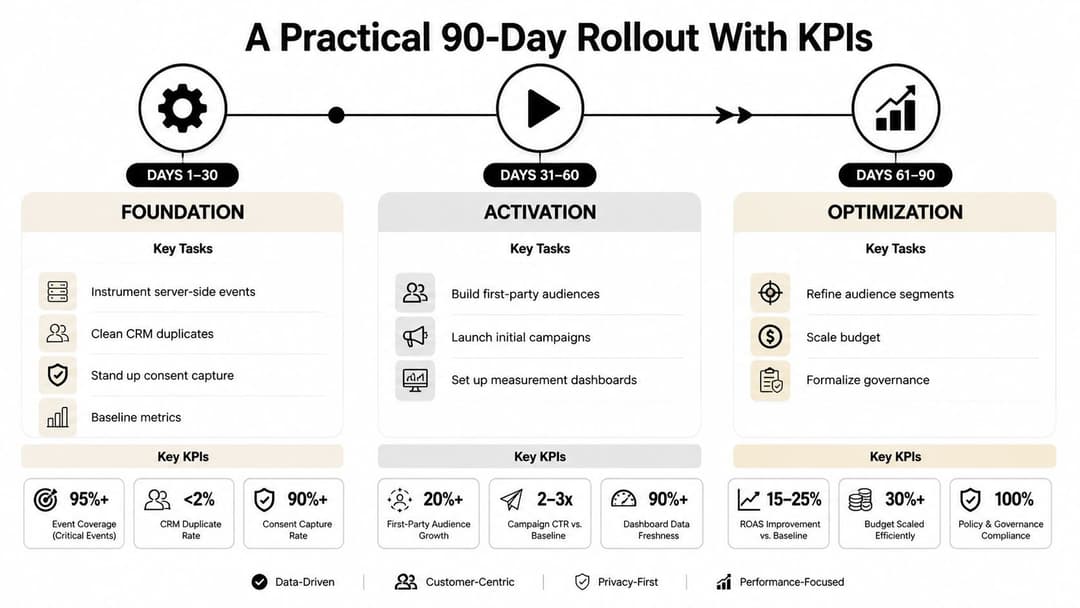
Days 1 to 30 build the foundation
Start with an event and identity audit. Inventory every customer signal entering the website, app, CRM, email platform, store, and Meta. For each signal, record consent status, identifier quality, business owner, and activation destination.
Marketing operations should remove duplicate CRM records, standardize email and phone fields, define lifecycle stages, and instrument server-side events. The growth lead should establish baseline CPA, qualified lead volume, revenue reporting, and audience match performance using definitions the team already accepts.
Legal or privacy should approve consent language, stated purposes, access rules, and deletion handling. Do not broaden collection yet. First strengthen the controls around existing data.
Days 31 to 60 connect identity to activation
Set up deterministic identity resolution for known users. Create a source-of-truth map showing how a CRM contact, ecommerce customer, ad-platform audience member, and analytics profile connect.
Sync a limited set of hashed, consented CRM audiences into Meta Ads Manager. Begin with one high-value acquisition seed, one suppression audience, and one lifecycle audience. Launch a value-based lookalike or equivalent modeled campaign only after documenting the seed definition and exclusion rules.
Monitor the pipeline, not only the campaign. Confirm that records arrive, consent rules remain attached, duplicates stay controlled, and removals reach every destination. An audience upload succeeding is not a launch approval.
Days 61 to 90 measure and optimize
Activate the strongest first-party audiences in Meta's campaign structure, including retention exclusions and high-intent acquisition inputs. Run a geo-incrementality test or another defensible holdout design. The test must show whether the audience changes qualified purchase volume or revenue, rather than merely producing inexpensive clicks.
Retire the weakest interest stack only after the test provides enough operational evidence for a decision. Keep a control campaign or holdout where possible, and record every budget change against the measurement plan.
Use a scorecard covering match rate, opt-in rate, cost per qualified lead, incremental ROAS, and consent compliance rate. Also track whether each priority audience is collected, usable, and activated across the CRM and Meta workflow. Treat missing collection as an implementation problem, then fix the responsible form, event, consent rule, or sync instead of adding more targeting options.
Three Myths That Quietly Kill These Programs
The most expensive mistakes usually begin as reasonable-sounding assumptions. Signal loss makes teams rush toward volume, ownership, or legal delegation. Each response creates a different failure.
| Myth | Operating truth | Diagnostic question |
|---|---|---|
| More data is better | Useful data is consented, relevant, resolved, and actionable | Which fields changed a campaign decision recently? |
| Owning data equals owning the customer | Data custody doesn't guarantee trust or a better experience | What value does the customer receive for sharing information? |
| Compliance is the legal team's job | Privacy controls must operate inside daily collection and activation workflows | Can a media buyer explain the consent rule for every audience? |
More data is better. Teams collect every click, field, and behavioral event after a tracking failure. The result is often a larger inventory of ambiguous records, not stronger targeting. Ask which fields your buyers, CRM managers, or lifecycle team use. The replacement rule is simple: collect the minimum data that supports a defined decision, then improve resolution and freshness before adding volume.
Owning the data equals owning the customer. A company can possess purchase history and still deliver irrelevant offers, over-message customers, or ignore support context. The data is an input to a relationship, not proof that the relationship is healthy. Ask what customers receive in exchange for sharing information. Replace the myth with a value-exchange rule: every collection point should improve convenience, relevance, service, or product experience.
Compliance is the legal team's job. Legal can define requirements, but marketing operations controls fields, destinations, audience refreshes, and deletion behavior. Media buyers can accidentally activate a segment outside its approved purpose if the workflow doesn't make the rule visible. Ask whether the person launching a campaign can identify the consent basis and exclusion logic. The practical rule is shared accountability, with legal review built into the operating process rather than added after launch.
The safest first party data strategy is the one your media, CRM, engineering, and privacy teams can execute without interpretation.
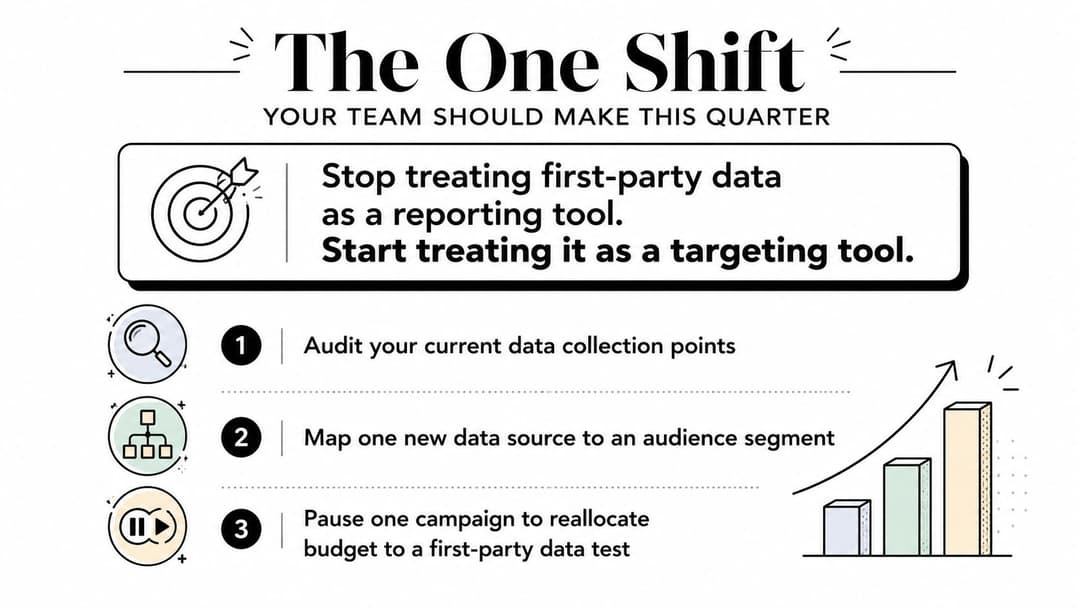
The One Shift Your Team Should Make This Quarter
Stop treating first party data as a reporting asset. Start treating it as a bidding input.
Within the next 30 days, choose one Meta campaign and connect it to a live CRM event path. Capture the event with consent, resolve it to the right customer record, send the appropriate audience or conversion signal into Meta, and define the revenue outcome that determines success. Don't begin with every channel, every customer segment, or a full CDP replacement.
Your weekly cadence should change with the pipeline. The growth lead reviews audience quality and budget allocation. Marketing operations checks event delivery, identity matches, and consent propagation. CRM owners review lifecycle outcomes. Analytics compares platform results with qualified purchases, pipeline, or customer value. The team should spend less time debating reach and more time deciding which owned signal deserves budget.
Deprioritize broad audience expansion that lacks a clear seed or exclusion rule. Deprioritize dashboard work that doesn't change a campaign decision. Deprioritize collecting fields that no team can activate. The early proof is more qualified purchase volume per dollar of spend, not raw reach or a larger contact database.
Walk into the next leadership review with three artifacts:
- A unified identity map showing sources, identifiers, match rules, and owners.
- A live CRM-to-Meta event pipeline showing consented events, audience refreshes, and downstream outcomes.
- A revenue-linked measurement plan defining the KPI, test design, exclusions, and budget decision.
AdStellar AI can sit alongside this operating model by connecting with Meta Ads Manager, using historical campaign performance to organize creative and audience workflows, and helping teams produce and evaluate campaign variations against goals such as ROAS, CPL, or CPA. If you're ready to turn owned signals into faster, clearer paid media decisions, visit AdStellar AI.