Your Meta account can look healthy on the surface and still be leaking efficiency.
Clicks rise. CPMs stay workable. A few ads even look like winners. Then you open Shopify, HubSpot, or your CRM and see the actual problem. The people clicking aren't all prospects. Some already bought. Some are in support flows. Some abandoned weeks ago and came back through email, not paid social. Your ad platform sees audiences. Your business sees customers. Those are not the same thing.
That gap is where customer engagement software earns its keep. Not as another dashboard. Not as a nicer way to send emails. As the operating layer that connects paid acquisition to what customers do across touchpoints.
The Disconnect Hurting Your Ad Performance
A common paid social failure looks like a creative problem, but it usually isn't.
A growth team launches a strong Meta campaign. The account has fresh creatives, broad prospecting, and a retargeting layer built from site visitors, add-to-cart users, and past purchasers. Performance starts well, then stalls. Cost per lead drifts up. Return on ad spend gets noisy. The team rotates ads, tweaks bids, and refreshes landing pages.
The problem sits somewhere else.
Your ad account is probably missing customer context
Many organizations still run acquisition and customer communications in separate systems. Meta has conversion events. The CRM has account status. Email has engagement history. Support has refund requests and complaints. Product analytics has usage. None of that context gets reconciled fast enough to influence targeting cleanly.
That creates waste in very specific ways:
- Retargeting audiences overlap badly: recent buyers, dormant subscribers, and active prospects get lumped together.
- Exclusions break down: people who shouldn't see acquisition ads stay in paid pools because event syncing is delayed or incomplete.
- Messaging goes stale: someone who just spoke with support gets served a generic “why choose us” ad.
- Attribution gets distorted: paid social gets too much credit in some paths and too little in others because the rest of the journey lives elsewhere.
If that sounds familiar, it usually pairs with broader tracking headaches like the ones covered in Facebook ads attribution tracking challenges.
Practical rule: If your paid media team can't answer who is in an audience and why they are there, the audience is too dirty to trust.
This isn't a niche software category anymore
The market has grown because this problem has become structural, not optional. The global customer engagement software market was valued at USD 24.8 billion in 2024 and is projected to reach USD 66.37 billion by 2035, growing at a CAGR of 9.36%, driven by demand for personalized interactions and wider use of AI and analytics, according to Market Research Future's customer engagement software market report.
That growth makes sense from an operator's perspective. As soon as paid acquisition reaches any real scale, channel performance depends on customer state, not just ad quality. The account that knows who just purchased, who needs nurturing, who is high intent, and who should be excluded will usually spend more efficiently than the account optimizing in a vacuum.
The real disconnect is organizational
Paid teams often optimize for platform metrics. Lifecycle teams optimize for customer messaging. Support teams optimize for resolution. Revenue leaders care about blended efficiency. Customer engagement software matters because it can align those views into one usable record.
When that bridge is missing, media buyers keep solving the wrong problem. They rewrite ads when the issue is audience contamination. They blame landing pages when the issue is poor follow-up. They raise budgets into segments that should have been excluded days earlier.
What Is Customer Engagement Software Really
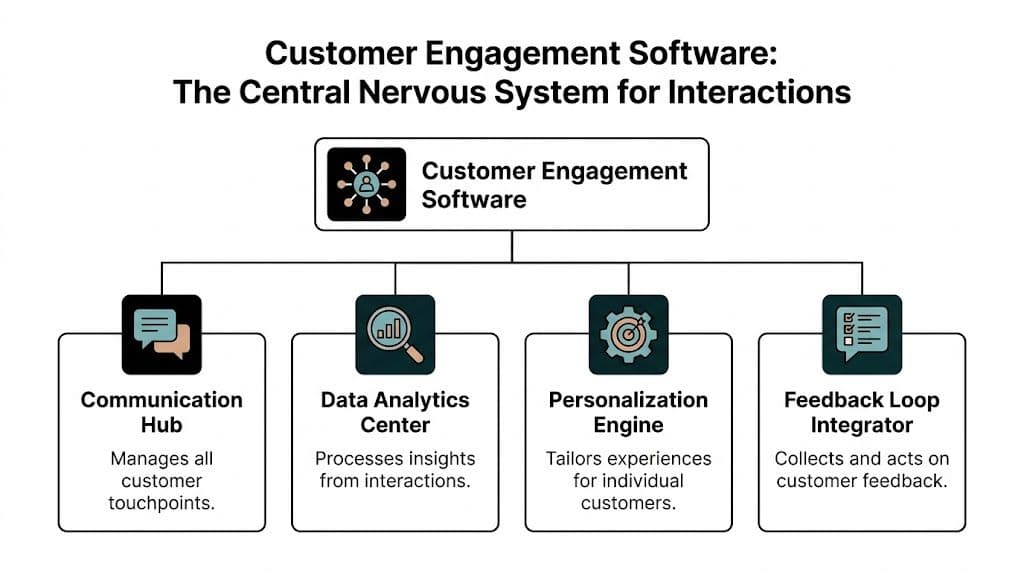
The simplest useful definition is this: customer engagement software is the central nervous system for customer interactions.
It doesn't just send messages. It collects signals, organizes identity, updates customer state, and helps teams act on that state across channels. For a paid acquisition team, that matters because ad platforms only become precise when the underlying customer data is coherent.
Think of it as one profile, not many fragments
Without this layer, every tool builds its own version of the customer.
Your email platform knows opens and clicks. The store knows orders. The support tool knows complaints. The ad platform knows viewed content and conversions it can observe. Each system is useful. None is complete.
Customer engagement platforms usually solve that by building a unified profile. As Blueshift's overview of customer engagement platform capabilities explains, these platforms utilize unified Customer Data Platforms or CDPs that ingest and consolidate customer data from multiple sources to build real-time, cross-device profiles, enabling behavioral segmentation and timely audience activation.
That sentence sounds technical, but the practical consequence is straightforward. You can finally define audiences based on customer reality instead of single-channel clues.
What the architecture actually does
A solid setup usually handles four jobs at once:
- Ingest data from the website, checkout, CRM, support tool, app, email system, and ad platforms.
- Resolve identity so one person isn't treated like separate records across devices and channels.
- Update profiles in real time as behavior changes.
- Trigger action through email, chat, in-app messaging, sales outreach, suppression rules, or audience syncs.
For marketers evaluating AI-heavy stacks, this is also the missing foundation beneath most shiny demos. If the data layer is fragmented, the automation on top won't make good decisions. That's the same reason teams looking into an artificial intelligence marketing platform should care about identity and sync quality before they care about generative features.
A customer engagement platform becomes valuable the moment it stops you from treating the same person like a lead, a buyer, and a support case all at once.
Real-time matters more than feature count
Teams often overvalue channel breadth and undervalue profile freshness.
A platform with ten messaging channels but weak syncing can still produce bad outcomes. A leaner platform with cleaner identity resolution and faster audience updates is often better for paid acquisition. If someone buys this morning and your exclusion audience updates tomorrow, you're still wasting spend today.
Short checklist for what “real-time” should mean in practice:
- Audience membership changes quickly: buyers leave prospecting and lower-funnel retargeting when status changes.
- Lifecycle state is visible: trial, active customer, churn risk, support escalated, and dormant users should be identifiable.
- Behavior can trigger action: product usage, cart abandonment, pricing page visits, and ticket activity can influence messaging.
- Profiles work across devices: one person's mobile and desktop activity shouldn't split your segmentation logic.
This is why good customer engagement software feels less like a campaign tool and more like infrastructure. It sits under acquisition, retention, support, and lifecycle marketing. If it's doing its job, every downstream action gets cleaner.
Core Features and Essential Platform Types
Customer engagement software isn't one product category with one shape. Organizations often use a mix of tools. The important question isn't “which platform has the most features.” It's “which combination gives us a reliable customer view and lets us act on it fast enough.”

The main platform types
Some tools specialize in a channel. Others try to unify the entire journey.
Email and lifecycle platforms
These usually become the first engagement layer for e-commerce and SaaS teams. They handle welcome series, cart recovery, onboarding, win-back, and product announcements.
They work well when the segmentation is strong. They work badly when teams blast generic flows to broad lists and call it personalization.
Live chat and conversational tools
These matter more than many paid teams assume because chat captures high-intent moments. If someone clicks an ad, lands on a pricing page, and opens chat, that interaction should affect both follow-up and future targeting.
Live chat is also a major growth area. In the broader market, Live Chat Software is the fastest-growing segment, while Email Engagement Software holds the largest share, according to the market outlook already cited earlier.
CRM and customer record systems
CRMs are where account status, sales activity, and often lead qualification live. For B2B teams, this layer is usually essential because sales stages need to feed audience logic. You don't want sales-qualified opportunities getting beginner-level awareness ads if your funnel can avoid it.
In-app and product messaging tools
SaaS teams rely on these for onboarding, adoption, and expansion messaging. They're especially useful when ad spend drives trials rather than direct purchases. Product behavior then becomes one of the strongest post-click signals available.
Support and service platforms
Support data is underused in paid acquisition. That's a mistake. Ticket volume, refund requests, unresolved issues, and complaint themes should influence suppression, creative tone, and in some cases audience exclusions.
The features that actually matter
Vendor pages usually flatten every feature into a giant list. In practice, only a handful consistently change campaign performance.
- Behavioral segmentation: Build audiences from actions, not static lists. Viewed pricing twice, started checkout, opened onboarding email, contacted support, and never activated are not the same segment.
- Journey orchestration: Visual builders help teams map triggers and next actions. The best ones are clear enough that marketing ops can maintain them without engineering every week.
- A/B testing and decisioning: Testing shouldn't stop at ads. Subject lines, offer timing, nurture branches, chat prompts, and post-click sequences all affect ROAS downstream.
- Analytics and reporting: Analytics and reporting serves as a core buying criterion because it tells you whether customer state changes are translating into business results. In the market, Analytics and Reporting is the dominant functionality segment, while Campaign Management is rapidly expanding, based on the market report referenced earlier.
- Audience syncs and suppression controls: Paid social teams experience the fastest value from audience syncs and suppression controls. Strong exclusions prevent obvious spend waste.
- Automation logic: Tools should react to customer state without manual list work.
What a modern stack often looks like
The most effective stacks are modular, but they still need a control center. A practical setup might look like this:
| Platform type | Primary job | Why paid teams care |
|---|---|---|
| Email or lifecycle tool | Nurture and retention flows | Improves post-click conversion path |
| CDP or unification layer | Identity and profile management | Cleans audiences and exclusions |
| CRM | Lead and account status | Prevents mistargeting by funnel stage |
| Live chat or support platform | Intent and issue capture | Surfaces urgency and friction |
| Analytics layer | KPI tracking | Connects engagement actions to ROAS and CPL |
A related category worth reviewing for teams that use events, demos, or education as part of the funnel is webinar automation software. Webinar attendance and post-event engagement often become valuable signals for both segmentation and retargeting.
What works and what doesn't
What works is a feature set that supports one customer record and fast action.
What doesn't is buying an “all-in-one” suite and assuming the platform will magically unify your stack. Some suites centralize execution but still leave identity messy. Others have strong orchestration but weak analytics. Some look great in demos and become brittle once you add edge cases like refunds, duplicate contacts, or account-based routing.
Operator note: If a vendor spends more time showing message templates than showing identity resolution, suppression logic, and event governance, they are selling surface area, not control.
The teams that get real performance gains are usually the ones that pair feature selection with operational discipline. They define events clearly, map lifecycle stages tightly, and tie software choices back to outcomes. That's also the lens to use when reviewing platforms with built-in optimization layers, including tools focused on AI optimization for campaigns.
Why Engagement Software Is a Superpower for Growth Teams
Paid acquisition gets more expensive when every click has to do all the work.
Growth teams perform better when they treat the ad click as the start of a managed relationship, not the full conversion engine. That's where customer engagement software changes the economics of paid social. It gives the team more chances to recover intent, qualify traffic, suppress waste, and improve post-click conversion paths.

Better audience hygiene improves ad efficiency
The first gain is usually the least glamorous. Cleaner exclusions.
If your engagement platform knows who just purchased, who asked for a refund, who is already in an onboarding sequence, and who has gone cold, your paid account can stop spending against blended pools that muddy intent. That alone can stabilize ROAS and reduce noisy CPL swings because your retargeting layer starts acting like a funnel instead of a catch-all bucket.
This is one reason strong engagement strategy correlates so strongly with business outcomes. Businesses adopting strong customer engagement strategies achieve 34% higher profitability, 63% lower customer attrition, and a 33% greater likelihood to be the first choice for future business, according to Salesgenie's roundup of key customer engagement statistics.
Better follow-up makes your ad traffic worth more
The click isn't the scarce asset. Qualified attention is.
When someone clicks an ad and doesn't convert immediately, most accounts either retarget them with the same message or lose them. Engagement software creates a middle path. You can route them into the right email flow, fire in-app guidance, trigger a sales task, open a chat prompt, or suppress them from ads until they requalify.
That changes how paid traffic monetizes over time.
- E-commerce brands can recover carts with state-aware messaging instead of blanket discounting.
- B2B SaaS teams can move trial users based on activation behavior, not just form submissions.
- Agencies can separate acquisition from retention logic so they don't report blended performance as media efficiency.
For teams that want more practical lifecycle ideas beyond ad-side tactics, this guide on how to enhance customer engagement is a useful complement.
Engagement data sharpens targeting upstream
Engagement software is often considered a downstream system. That's too narrow.
Good engagement data improves upstream targeting too. Once the platform can identify high-quality customer states, those states can inform lookalike seeds, exclusions, creative variants, and offer sequencing. You stop optimizing only for conversion events and start optimizing for customer quality signals.
The strongest paid social accounts don't just ask, “Who converts?” They ask, “Who converts well, stays, and should look like our next prospect?”
That shift matters because ad platforms are very good at finding more of what you feed them. If your seed audiences include low-quality leads, heavy support burdens, or one-time discount buyers, the model will chase more of that. Customer engagement software helps filter the seed before you scale it.
A lot of this overlaps with broader marketing automation campaigns, but the key difference for growth teams is closed-loop feedback into audience decisions.
It supports the metrics leadership actually cares about
Paid teams often defend budget using platform results alone. Leadership cares about broader business efficiency.
Customer engagement software helps connect paid performance to metrics that survive finance review:
- ROAS: better audience control and stronger post-click nurture improve the value captured from ad traffic.
- CPL and CPA: cleaner suppression and better qualification reduce spend on poor-fit users.
- Retention and LTV quality: ad-acquired users are easier to evaluate once downstream engagement data is visible.
- Pipeline quality: for B2B, lead state becomes measurable after the click, not just at the form fill.
A short explainer on the broader category is useful here:
The software itself won't save a weak offer or poor creative. It won't fix bad economics. But it does give good teams leverage. It reduces avoidable waste and makes every paid click easier to route, evaluate, and improve.
How to Choose the Right Engagement Platform
Most buying mistakes happen because teams evaluate customer engagement software like a feature catalog. The better approach is to treat it like infrastructure that has to survive real operating conditions.
A platform can look strong in a demo and still fail once you connect it to Meta, your CRM, your support tool, and a messy customer database. The right question isn't “Can it do omnichannel?” The right question is “Will our team trust this system enough to run audience decisions through it?”
Start with your operating model
Before vendor comparisons, define the job the platform must do.
For an e-commerce brand, that may mean cleaning exclusions, coordinating lifecycle messaging, and syncing customer states fast enough to support paid social. For B2B SaaS, the core need may be lead routing, lifecycle segmentation, and sales-stage-aware suppression. For agencies, it may be governance across multiple accounts and reliable audience logic that clients can understand.
If you skip that step, you'll overbuy channels and underbuy control.
Buying rule: Choose for the bottleneck you have now and the complexity you'll have next, not the nicest workflow in the product tour.
Customer engagement software evaluation checklist
| Criteria | Key Question to Ask | Importance |
|---|---|---|
| Data unification | How do you merge records across devices, channels, and duplicate identifiers? | High |
| Real-time syncing | How quickly do profile updates affect segments, automations, and audience exports? | High |
| Paid media integration | Can we push suppression and high-intent audiences into ad platforms without fragile workarounds? | High |
| CRM compatibility | How well does it sync lifecycle stage, owner, and account status from our CRM? | High |
| Reporting | Can we tie engagement actions back to revenue, pipeline quality, ROAS, or CPL? | High |
| Workflow usability | Can marketers and ops teams maintain journeys without constant engineering help? | Med |
| Support data access | Can ticket and service events influence audience logic and messaging? | Med |
| Governance | Can we control naming, permissions, event definitions, and QA across teams? | High |
| Pricing model | Does cost scale predictably as contacts, events, or seats increase? | High |
| Vendor onboarding | What does implementation actually require from our internal team? | Med |
Ask vendors the uncomfortable questions
Teams typically ask about channels, AI, and templates. Ask about failure points instead.
Use questions like these in live demos and security reviews:
- When identity resolution fails, what does the platform do?
- How do you handle conflicting customer records across systems?
- What breaks if one source sync is delayed?
- How are exclusions audited before audiences push live?
- Which workflows usually need engineering support after launch?
- How do you report on holdout groups or incremental impact?
These questions reveal whether the vendor understands operating risk or only knows polished demos.
Watch for hidden complexity
Integration issues are where the total cost shows up.
A lot of platforms advertise “effortless” connectivity, but growth teams usually inherit edge cases: old CRM data, multiple purchase sources, inconsistent event naming, account hierarchies, and support tools that don't map cleanly to customer IDs. The friction isn't just technical. It's operational. Someone has to own the definitions, naming standards, QA process, and downstream audience governance.
That matters even more if your team is also evaluating AI-led providers or service partners. If that's on your roadmap, this overview of what to look for in an artificial intelligence marketing company is a useful parallel lens.
Pick for adaptability, not only depth
Deep functionality matters, but flexibility matters more once your funnel changes.
Choose platforms that let you revise lifecycle stages, swap data sources, and change routing logic without rebuilding the system from scratch. Growth teams rarely keep one funnel motion forever. Product-led motions evolve. Sales-assisted paths emerge. New channels enter the mix. Your engagement layer has to absorb that change.
Good customer engagement software should make your stack more coherent as you scale. If it adds another dependency maze, it's the wrong fit.
Implementation Best Practices and AdStellar Integration
Buying customer engagement software is easy compared with making it reliable.
Implementation usually fails in one of two ways. Teams either attempt a giant rollout with every use case at once, or they launch a minimal version with weak governance and spend months cleaning bad data. Neither works well.
Start with one high-value loop
The first rollout should serve one revenue-critical use case.
For e-commerce, that might be cart abandonment plus purchaser suppression for paid retargeting. For B2B SaaS, it might be trial-user segmentation with lifecycle-based exclusions from top-of-funnel campaigns. For agencies, it may be standardizing audience hygiene and post-lead follow-up for one flagship client before cloning the model elsewhere.
A focused launch lets you validate four things quickly:
- Data quality: are records usable and deduplicated?
- Event logic: are actions arriving in the right format?
- Audience trust: do segments reflect reality?
- Business usefulness: does the system influence decisions your team already makes?
Build governance before scale
Customer engagement software gets messy when every team names events differently and defines customer state in its own language.
Create a simple operating layer early:
- Define lifecycle stages clearly. Prospect, lead, customer, active, churn risk, refunded, and reactivated should have agreed logic.
- Standardize event names. Keep page views, purchases, qualified leads, support actions, and activation events consistent.
- Assign ownership. Someone needs final say on schemas, segment naming, exclusions, and QA.
- Set sync expectations. Know which systems update immediately and which have lag.
- Document audience rules. If spend depends on a segment, the rule should be written down, not assumed.
The platform doesn't create alignment. The team does. The platform only exposes whether alignment exists.
Make the ad stack part of the implementation, not a later add-on
A common mistake is treating paid media as a downstream integration that can wait until “phase two.” That delays one of the fastest sources of value.
Your ad account should be included early because engagement data changes who should be targeted, excluded, and sequenced. At the same time, ad performance data should enrich customer understanding. If a user consistently responds to one message angle or creative theme, that signal can inform follow-up journeys and audience refinement.
This is also where workflow automation becomes practical. As noted in Cincom's discussion of customer engagement software features, workflow automation within engagement platforms uses AI-powered decisioning engines to create context-aware, trigger-based customer journeys. That same logic applies to ad operations when campaign performance data flows back into the engagement layer.
A closed-loop model works better than one-way syncing
The healthiest architecture sends information both directions.
From engagement platform to paid media
- Suppression audiences based on purchases, customer stage, or support risk
- High-intent segments based on behavior
- Re-engagement pools based on inactivity or drop-off signals
From paid media to engagement platform
- Creative and message-level response patterns
- Audience source metadata
- First-touch and assisted-touch context that can shape nurture logic
That loop matters because campaign learning shouldn't live only inside the ad platform. If paid social discovers a winning angle, the rest of the customer journey should benefit from it.
Train teams on decisions, not just buttons
Enablement often focuses on how to build a flow. It should focus on when to trust the flow.
Marketing needs to know when audience syncs are safe for launch. Lifecycle teams need to know which states trigger exclusions. RevOps needs to know where lead status is authoritative. Support needs to understand how ticket events affect messaging.
The strongest implementations usually share three habits:
- They QA segments before spending against them
- They launch with fallback logic when data is missing
- They review exceptions weekly until the system stabilizes
If you do that, the engagement layer stops being another app and starts acting like a dependable decision system.
Real-World Use Cases and Measuring True ROI
Most customer engagement software content stops at capabilities. That's where operators usually get frustrated. Features don't justify spend. Financial impact does.
Research also points to this exact gap. Vendors talk heavily about orchestration, personalization, and dashboards, while many businesses still struggle to quantify payback and connect platform investment to concrete revenue outcomes, as noted in Creatio's customer engagement platform glossary.
Use case one for DTC e-commerce
A DTC brand running Meta ads usually has one recurring problem. The retargeting pool contains too many customer states at once.
A better setup separates recent buyers, repeat buyers, cart abandoners, heavy browsers, and support-affected users. The engagement platform controls those states and syncs the right subsets for paid retargeting. At the same time, it runs email or SMS recovery flows based on what the person did after the click.
The gain doesn't come from one tactic. It comes from channel coordination. Paid social stops chasing people who are already moving through owned channels or who shouldn't be pushed right now.
Use case two for B2B SaaS
A SaaS team often pays to drive demo requests or trials, then loses efficiency because follow-up is generic.
Customer engagement software helps route leads by actual behavior. Someone who visited pricing, opened onboarding emails, invited teammates, and used a core product action shouldn't get the same nurture as someone who bounced after signup. Those distinctions can also determine who stays in paid retargeting and who moves into sales-assisted or product-led sequences.
In this context, ad spend starts working more like a feeder system into a governed lifecycle, instead of a separate machine trying to force conversion on its own.
A practical ROI framework
Use a simple model your finance team can inspect.
Start with three buckets:
| ROI area | What to measure | Why it matters |
|---|---|---|
| Ad efficiency | Changes in ROAS, CPL, CPA, and wasted spend from poor exclusions | Shows whether audience quality improved |
| Conversion path | Lead-to-opportunity movement, cart recovery, activation, or trial progression | Shows whether post-click engagement improved |
| Customer value | Retention, churn trends, repeat purchase behavior, and pipeline quality | Shows whether acquired users are more valuable |
Then compare those gains against the full cost of ownership:
- Software cost
- Implementation labor
- Ongoing ops and QA
- Any engineering or consultant dependency
What not to do when proving value
Don't credit the platform for every positive movement after launch.
Use controlled comparisons where possible. Compare segments exposed to the new engagement logic versus segments still running under old rules. Review assisted paths, not only last-click outcomes. Separate acquisition gains from retention gains so leadership can see where value appeared.
If you can't explain which audience changed, which workflow changed, and which KPI changed with it, you don't have ROI. You have correlation.
A good customer engagement software investment should eventually show up in cleaner suppression, better nurture performance, stronger customer quality, and more stable paid efficiency. If it only gives you prettier dashboards, it hasn't earned its place in the stack.
If you're trying to turn paid social performance into a repeatable system, AdStellar AI helps growth teams launch, test, and scale Meta campaigns faster while learning from the combinations that drive ROAS, CPL, and CPA. It's built for marketers who want less manual setup, clearer performance insight, and a tighter feedback loop between creative testing and campaign scale.