The term artificial intelligence marketing company has gone from a niche buzzword to a must-have partner for any brand serious about growth. These companies build platforms that cut through the noise, automating incredibly complex marketing tasks and turning mountains of data into clear, actionable moves for advertisers.
The New Reality of Digital Advertising
Think about what it takes to run a truly successful ad campaign today. You're constantly juggling creative assets, audience segments, and budget shifts, trying to make sense of a firehose of performance data. It feels like you're drowning in spreadsheets while being starved for the actual insights you need to make the right call.
This is the exact problem an artificial intelligence marketing company is built to solve, especially on crowded, fast-moving platforms like Meta. They tackle the overwhelming complexity and sheer manual effort required to not just compete, but win.
Imagine trying to manually test a thousand different ad combinations—different images, headlines, and audiences—to find that one perfect mix. It’s humanly impossible. AI platforms act as execution partners, automating these high-volume tasks at a scale and speed no team could ever match. They find the winning combinations that drive real business results, freeing you up to focus on strategy.
The Market Demand for AI Marketing
The explosive growth of these companies isn't just a trend; it's a direct response to a massive market need. The AI in marketing market has surged from $19.3 billion in 2024 to a projected $24.03 billion in 2025. It’s on a trajectory to hit an incredible $215.03 billion by 2035, growing at a blistering compound annual growth rate (CAGR) of 24.5%.
This growth isn’t just on paper. It's fueled by real-world demand from marketers, e-commerce brands, and agencies who are desperate for better efficiency and performance.
This shift completely changes the game for advertisers. It moves campaign management from a manual, gut-feel process to a data-backed, automated workflow. The table below really brings this transformation to life. If you're interested in digging deeper, you might like our guide on the role of AI in digital advertising.
Manual Marketing vs AI-Powered Marketing
| Task | Manual Approach (The Old Way) | AI-Powered Approach (The New Way) |
|---|---|---|
| Ad Creation | Building ads one-by-one, a slow and tedious process limited by time. | Generating hundreds of ad variations (image, copy, audience) in minutes. |
| Audience Targeting | Relying on broad demographic assumptions and past experience. | Analyzing historical data to identify and build new, high-potential segments. |
| Budget Allocation | Manually checking performance and shifting budgets based on periodic reviews. | Automatically reallocating spend to top-performing ads in real-time. |
| Performance Analysis | Sifting through complex dashboards to spot trends and identify winners. | Receiving clear, ranked insights on the best creatives, copy, and audiences. |
This comparison makes it clear how AI isn't just a minor upgrade—it's a fundamental change in how marketing gets done.
The goal isn't to replace the marketer but to supercharge them. An AI partner handles the repetitive, high-volume work, freeing up human talent to focus on what matters most: strategy, creative direction, and interpreting the valuable insights the AI uncovers.
This new reality allows marketing teams to move faster, test more ideas, and make decisions with a level of confidence that was simply out of reach before. It's about turning creative chaos into campaign clarity and unlocking scalable growth without scaling your team's workload. The result isn't just saved time; it's a direct, measurable impact on the bottom line.
Understanding Core AI Marketing Capabilities
So, what does an AI marketing company actually do? Beyond the buzzwords, these platforms are built to solve real, high-stakes problems for marketers. They aren't magic black boxes; they're powerful tools with tangible features that change how we create, target, and optimize campaigns.
Their value is built on three core pillars.
The shift to AI isn't just a niche trend anymore. A recent study found that a staggering 91% of marketers now use AI in their daily work—a massive jump from just 63% the year before. The results for performance-focused teams are compelling: 50% get their work to market faster, and 45% have lowered operating costs, all while 75% of AI users report higher job satisfaction. You can dig into more of the data in the 2026 State of AI Marketing report.
This visual really brings home the difference between a traditional, manual workflow and a modern, AI-powered one.
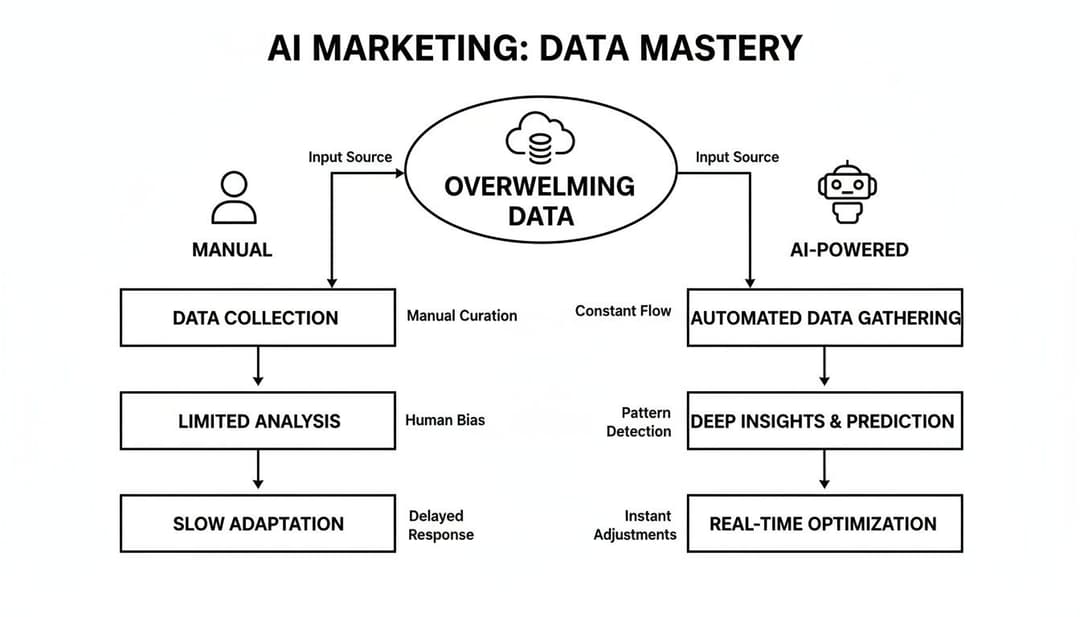
You can see how AI takes a flood of data and turns it into structured, actionable outputs. The old manual way? It’s a recipe for bottlenecks and missed opportunities.
Creative and Copy Automation
The first pillar is all about automation at scale. Think about your team needing to test five product images, ten headlines, and four different ad copy variations. Doing that by hand means building, launching, and tracking 200 individual ads. That’s days of mind-numbing, tedious work.
An AI marketing platform slashes that process down to minutes. You feed it the raw assets—your images, videos, headlines, and descriptions—and it programmatically builds them into hundreds of distinct ad variations. With a single click, you can launch a massive test covering every possible combination. This one capability completely changes the speed and scope of your creative testing.
Intelligent Audience Targeting
The second core capability goes way beyond basic demographic targeting. A true AI marketing company plugs directly into your ad accounts to chew on historical performance data. The AI sifts through months, or even years, of campaign results to find patterns a human could never spot.
It looks for hidden connections between specific ad elements and audience segments that drove conversions. Based on what it finds, the platform can:
- Pinpoint hidden pockets of high-performing users you might have missed.
- Build new lookalike audiences from your most valuable customer profiles.
- Suggest new interest and behavioral targets that have a high probability of success.
This data-first approach takes the guesswork out of audience building. It makes sure your ad spend goes directly to the people most likely to convert.
An AI platform doesn't guess who your best customers are—it uses your own data to prove it. By analyzing thousands of past interactions, it constructs a data-backed portrait of your ideal buyer and then finds more people just like them.
Autonomous Campaign Optimization
Finally, the third pillar is autonomous optimization. Launching hundreds of ads is one thing, but managing them is another beast entirely. An AI marketing platform acts as a tireless campaign manager that monitors performance 24/7.
As data from your new campaigns rolls in, the AI models learn in real time. They track key metrics like Return on Ad Spend (ROAS) or Cost Per Acquisition (CPA) for every single ad. The system then automatically reallocates your budget, pulling spend from the underperformers and doubling down on the winners.
This auto-scaling function ensures your budget is always working as hard as possible, maximizing your returns without you needing to make constant manual tweaks. It’s a crucial function that has a direct impact on your bottom line. To see how this technology all comes together, check out our guide on what to expect from an AI-powered marketing platform.
Building the Financial Case for an AI Partner
Sooner or later, every budget-holder will ask the same question about any new platform: "What's the ROI?" When it comes to an AI marketing partner, the answer isn’t just about saving a few hours. It’s about a fundamental shift in how your team operates and getting more performance out of every dollar you spend.
The financial case is simple. Instead of your sharpest media buyers getting bogged down in repetitive, manual tasks, they can focus on high-level strategy. The AI handles the endless execution, freeing up your team's brainpower for the kind of work that actually moves the needle.
From Wasted Spend to Efficient Investment
Let's be honest—one of the biggest drains on any marketing budget is wasted ad spend. You launch a campaign, cross your fingers, and slowly try to piece together what’s working. AI-driven testing completely flips that script. It rapidly flags underperforming creative and audience pairings, often within hours or days.
That speed is everything. It means you stop burning money on ads that were never going to work in the first place. The platform automatically shifts your budget to the proven winners, making sure every dollar is pulling its weight. Your ad budget stops being a speculative bet and becomes a highly efficient, performance-driving investment.
This isn't a niche strategy anymore; it's being adopted by the biggest players in the game. By 2026, AI marketing budgets are set to surge, with enterprise teams planning to boost AI allocations from 18% to 24% in 2025 alone. The most advanced organizations are already committing over 40% of their budgets to AI-powered tools. With the AI in marketing market projected to jump from $20.44 billion in 2024 to $82.23 billion by 2030, the trend is undeniable. This shift allows teams to replace manual grunt work with AI execution that delivers 2-3x ROI for 60% of teams who make the switch. You can dive deeper into the booming AI in marketing market on sianamarketing.com.
Quantifying the Return on Ad Spend
Working with an AI marketing partner centers the entire conversation around achieving real, measurable returns. The goal is to get clear, actionable insights into your most important metrics so you can scale what’s provably working.
You'll see the impact directly on your bottom line:
- Improved ROAS (Return on Ad Spend): By constantly optimizing for the best-performing ad variations, AI can give your overall ROAS a significant lift.
- Lower CPA (Cost Per Acquisition): Efficient targeting and creative testing find the most affordable paths to winning new customers.
- Reduced CPL (Cost Per Lead): AI pinpoints the most cost-effective audience and messaging combinations to generate high-quality leads.
The real value isn't just seeing the numbers go up. It's the clarity you get. You're no longer guessing which ad or audience is driving results; the platform shows you with hard data, letting you make smarter decisions, faster.
This level of detail is exactly what you need to build a sustainable growth engine. To see how this is possible, it helps to understand the mechanics behind AI-Driven Personalization.
Ultimately, the financial case is straightforward: you invest in a system that makes your advertising more effective, cuts down on waste, and gives you the data-backed confidence you need to scale your business profitably.
Your Checklist for Picking the Right AI Marketing Partner
Choosing the right AI partner is a make-or-break decision. It seems like every platform now claims to be an artificial intelligence marketing company, but a quick look under the hood reveals they’re not all created equal. To get past the buzzwords and find a tool that will actually move the needle for your team, you need a solid game plan.
Think of this as your vetting checklist. These are the sharp questions every performance marketer should be asking to figure out if a potential partner is just a shiny object or a true strategic advantage.
Specialist vs. Generalist: Which One Are They?
First up, you need to pin down the platform's real focus. A lot of AI tools are jack-of-all-trades, trying to cover everything from email and SEO to social media. While that sounds great on a feature list, it often means they’re a master of none.
For performance marketers pouring serious budget into one channel, specialization is everything. If you live and die by Meta ads, you need a partner built from the ground up for that specific world. A specialized platform gets the nuances of Meta's auction, its ad formats, and its API quirks in a way a generalist tool never could.
Get straight to the point and ask:
- Was your platform built exclusively for Meta advertising, or is it just one channel you support?
- How does your AI specifically handle the unique dynamics of Meta's ad auction and delivery?
- Can you show me features that were designed only for a Meta ads workflow?
A generalist tool just can't give you the same depth or performance. A specialized artificial intelligence marketing company will speak your language because they’ve faced the same challenges you do every day.
Is the AI a Black Box or a True Teacher?
Here’s a common problem with AI tools: they feel like a "black box." You feed in your campaign goals, and it spits out results with zero explanation. Even if the numbers look good, you're left wondering why certain creatives or audiences won.
A great partner does the opposite. It provides AI transparency. It doesn't just hand you the winning ad; it breaks down the specific attributes that are making it work. This is gold because it educates your whole team on what actually connects with your audience.
An AI partner shouldn’t just give you answers—it should make you a smarter marketer. It should surface insights you can use for your next campaign, your next creative brief, and your entire marketing strategy.
You need a platform that can answer questions like:
- Why is this headline crushing the others?
- What themes or visual patterns in our top ads are driving the best ROAS?
- Can I see a clear, data-backed ranking of all my creative assets against my main KPIs?
This is how you move from just using AI to truly partnering with it. It’s how you build a real, long-term edge. As you look at different companies, keep an eye out for those pushing the envelope with innovative AI applications, like the ones offered by WearView AI.
Was This Platform Built for a Real Marketer's Workflow?
Power means nothing without usability. An amazing tool is useless if it’s clunky, confusing, or just doesn’t fit how your team operates. The platform should feel like it was designed by people who’ve actually been in the trenches managing large-scale ad campaigns.
The interface should feel intuitive. It should make complex jobs like bulk ad creation, audience testing, and performance analysis feel simple. The whole point is to reduce manual clicks and kill repetitive tasks, not add more steps to your day.
Before you sign anything, demand a live demo that mirrors your actual day-to-day work. Make them walk you through setting up a complex test campaign from start to finish. There’s no better way to see if a platform will be a lifesaver or just another headache. For a deeper dive, check out our guide on what to look for in an artificial intelligence marketing company.
How Does It Handle Your Data Security?
Last but certainly not least, never gloss over data security. You’re about to connect your company’s ad account—one of your most valuable assets—to a third-party tool. You have to know exactly how that connection works and how your data is being protected.
Any legitimate artificial intelligence marketing company will use secure OAuth protocols. This is the non-negotiable industry standard for granting access without ever sharing your password. The platform connects via a secure, revocable token, which means you are always in complete control of who has access to your account.
If a company asks you for your ad account login and password directly, run. That is a massive red flag. Always prioritize partners who are upfront about their security practices and treat your data with the respect it deserves.
AI Marketing Partner Evaluation Scorecard
To help you keep track of your findings, we’ve put together a simple scorecard. Use this to rate each vendor you evaluate. It forces you to compare them apples-to-apples and makes the final decision with your team much clearer.
| Evaluation Criteria | Vendor A Score (1-5) | Vendor B Score (1-5) | Notes for Your Team |
|---|---|---|---|
| Channel Specialization (for Meta) | |||
| AI Transparency & Insights | |||
| Workflow & Usability | |||
| Data Security (OAuth) | |||
| Creative Automation | |||
| Audience Optimization | |||
| Auto-Scaling Capabilities | |||
| Customer Support & Onboarding | |||
| Pricing & Value | |||
| Overall Score |
After you've done your demos and asked the tough questions, sit down with this scorecard. The scores will give you a quantitative look, but the "Notes" column is where the real decision gets made. It’s where you’ll capture the gut feelings and team-specific needs that numbers alone can’t.
How to Implement AI into Your Workflow
Bringing a new AI platform into your workflow can sound like a massive undertaking. But a great artificial intelligence marketing company won't throw you into the deep end. The entire onboarding process should be simple, focused on getting you results, and designed to show its value right away.
The goal is to move from creative chaos to campaign clarity, one logical step at a time.
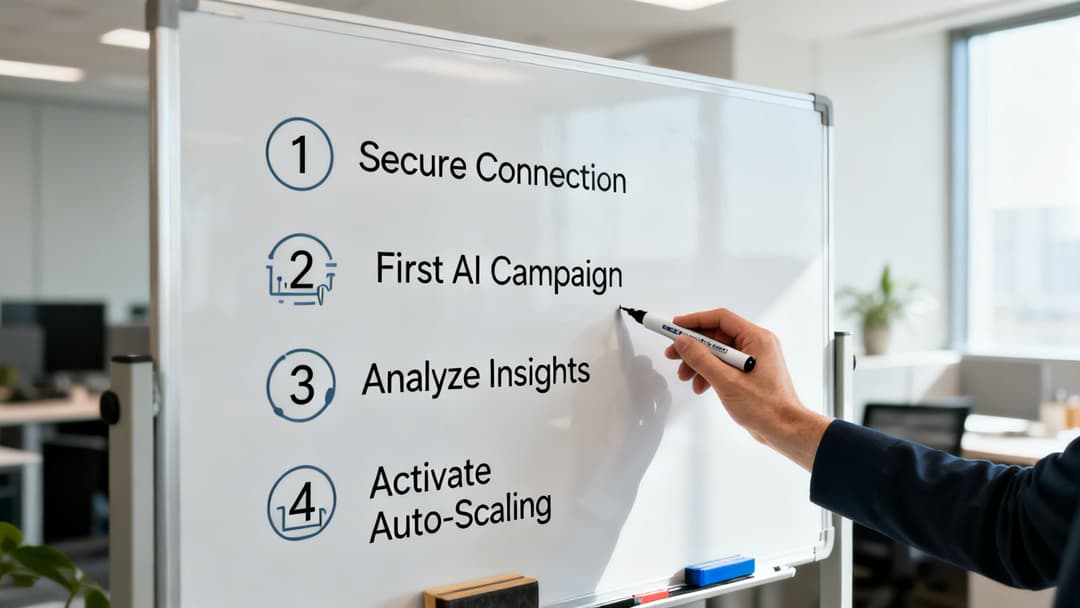
This journey completely changes how you run campaigns, trading manual guesswork for an automated, insight-driven system. Here’s what that looks like in practice.
Phase 1: Securely Connect Your Ad Account
The first step is also the most straightforward: linking your Meta Ads Manager to the AI platform. Any reputable artificial intelligence marketing company will use secure OAuth protocols to make this connection happen. In simple terms, this lets you grant access without ever handing over your password, keeping your account totally secure.
As soon as you're connected, the AI immediately gets to work. It starts digging into your historical campaign data—analyzing past ads, audiences, and performance. This initial deep dive is what gives the system the context it needs to make smart recommendations from day one.
Phase 2: Launch Your First AI-Powered Campaign
With the foundation of your past performance data in place, it’s time to put the AI to the test. This phase is all about using the platform’s bulk creation tools to launch a wide-ranging test campaign that you couldn't possibly build by hand. All you need to do is provide the raw materials: your best images, videos, headlines, and ad copy.
The platform then programmatically assembles all those assets into dozens or even hundreds of unique ad variations. For instance, AdStellar can take just a handful of your creative assets and spin up a massive test campaign in a matter of minutes. This is where you get that first "wow" moment, watching a task that would take a human team days get done with just a few clicks.
Phase 3: Analyze the AI-Driven Insights
Once your test campaign has been running for a little while, you move into the analysis phase. This is what separates a true artificial intelligence marketing company from a basic automation tool. Instead of leaving you to drown in spreadsheets, the platform should serve up clear, actionable insights on a silver platter.
An AI platform's job isn't just to run tests; it's to tell you what those tests mean. It should provide a clear, ranked list of your top-performing creatives and audiences, taking the guesswork out of performance analysis.
Platforms like AdStellar, for example, will rank all your creative elements against your main KPI, whether that's ROAS, CPA, or CPL. You can instantly see which images, headlines, and audience segments are actually driving results, giving you a clear road map for what to do next.
Phase 4: Activate Autonomous Scaling
The final phase is where you let the AI take the wheel and manage your budget for peak efficiency. Once the system has identified the winning ad combinations from your test campaign, you can switch on its auto-scaling features.
This empowers the AI to manage your campaign budget in real time. It will automatically:
- Shift spend away from underperforming ads.
- Increase budget for the top-performing ad combinations.
- Ensure your ad dollars are consistently flowing to the ads most likely to hit your goals.
This four-phase process makes adopting an AI marketing platform feel less like a chore and more like a strategic advantage. It’s a logical path from secure setup to automated success, proving its worth at every step.
Measuring the KPIs That Actually Matter
When you bring an AI marketing company into the fold, it all comes down to one thing: results. Real, tangible business results. It’s easy to get lost in a sea of vanity metrics like clicks and impressions, but to know if your investment is actually paying off, you need to zero in on the numbers that hit your bottom line.
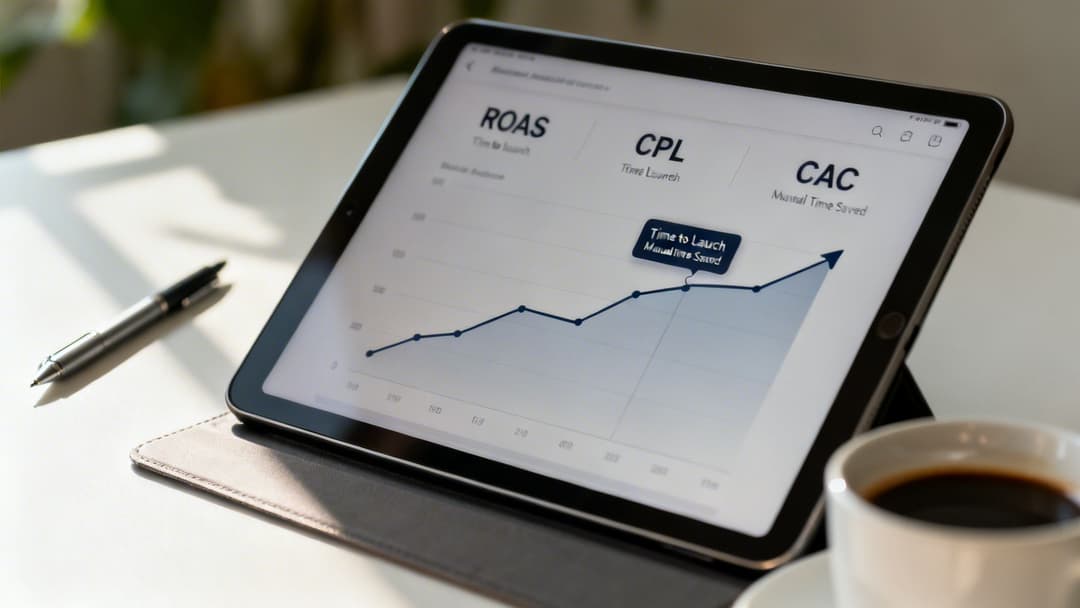
This is where a solid AI platform changes the game. It peels back the layers of your campaigns, giving you a crystal-clear picture of what’s truly working. By connecting performance to every single ad, headline, and audience segment, it takes the guesswork out of your analysis.
Primary Business-Impact KPIs
Your main dashboard should be dominated by the numbers that directly link to revenue and growth. These are the KPIs that prove the financial worth of your campaigns and justify your partnership with an AI platform.
Return on Ad Spend (ROAS): This is the king of all metrics. For every dollar you pump into advertising, how many are you getting back? A smart AI will automatically funnel your budget toward the ad combinations that deliver the highest return.
Customer Acquisition Cost (CAC): How much are you really spending to get a new paying customer? An effective AI platform will find the most efficient routes to conversion, pushing your CAC down and making sure you’re not just buying revenue at a loss.
Cost Per Lead (CPL): If your business runs on leads, CPL is everything. The right AI partner will sniff out the creative and audience pairings that bring in quality leads without breaking the bank.
These three KPIs are the bedrock of your performance measurement. They give you a straight, data-backed answer to the most important question of all: "Is my marketing budget making me money?"
Secondary Efficiency-Focused KPIs
Beyond the big financial numbers, a top-tier artificial intelligence marketing company also delivers huge wins in operational efficiency. These secondary KPIs show you how AI is buying back your team's most valuable asset: time.
The real power of an AI partner is a one-two punch: it boosts your financial results while making your team faster and more strategic. This dual benefit creates a compounding advantage that’s hard to beat.
Key efficiency metrics to keep an eye on include:
- Time to Launch New Tests: How quickly can your team take a new idea and get a complex, multi-variant campaign live? AI can shrink this timeline from days down to a matter of minutes.
- Reduction in Manual Setup Time: Track the hours your team gets back by no longer having to build, monitor, and tweak campaigns by hand. This time can be poured back into big-picture strategy.
When you track both primary and secondary KPIs, you get a complete view of the platform’s value. You can take a closer look at this process by reading our post on AI-driven marketing insights.
A Real-World Case Study
Picture a direct-to-consumer e-commerce brand that was hitting a wall, struggling to scale its Meta ads profitably. After bringing in an AI platform, they managed to launch a massive test with over 200 ad variations in their very first week.
The AI quickly found a handful of winning creative-audience combos that were crushing everything else. By automatically shifting the budget to these top performers, the brand saw a 40% increase in ROAS in just 90 days. This led to a major lift in revenue, proving the clear, undeniable impact of an AI-powered strategy.
Common Questions About AI Marketing Partners
Even as more brands start using AI, it’s completely normal for marketers to have some valid questions before bringing on an artificial intelligence marketing company. Getting these concerns out in the open is the best way to build the confidence you need to move forward.
Let's tackle some of the most frequent questions we hear.
Will AI Replace My Media Buyer
Not a chance. Think of an AI partner as a powerful assistant for your team, not a replacement. A platform like AdStellar is designed to handle the repetitive, high-volume work that’s simply impossible for a person to manage, like creating and tracking hundreds of ad variations at once.
This actually frees up your media buyer from the daily grind and elevates their role. Instead of getting bogged down in manual tasks, they become the strategic mind guiding an intelligent system. They can finally focus on the high-value work: digging into AI-driven insights, shaping creative strategy, and planning your next big campaign.
Is It Secure to Connect My Ad Accounts
Security is everything, and any reputable artificial intelligence marketing company will never ask for your password. The connection is made using industry-standard protocols like OAuth, which is built for this exact purpose.
Here’s how it works: OAuth generates a secure, temporary token that gives a platform like ours the specific permissions it needs to analyze data and manage your campaigns. You never share your actual login details, and you can revoke access at any time. It's the same secure technology that major tech companies use, so you always stay in complete control.
How Much Historical Data Is Required
While having more data is always a plus, a modern AI platform can start delivering value even with a limited campaign history. It gets to work immediately, analyzing whatever past performance data is available to find the first signs of winning patterns.
The system's real power grows over time. As you launch new campaigns, the AI learns from fresh, real-time results. It gets progressively smarter and more accurate with every single test it runs. For a deeper dive on this, you can learn why an automated marketing agency can be such a powerful partner.
Ready to transform your Meta advertising? AdStellar automates the tedious work of launching, testing, and scaling campaigns so you can focus on strategy. Discover how AdStellar can help you grow faster.