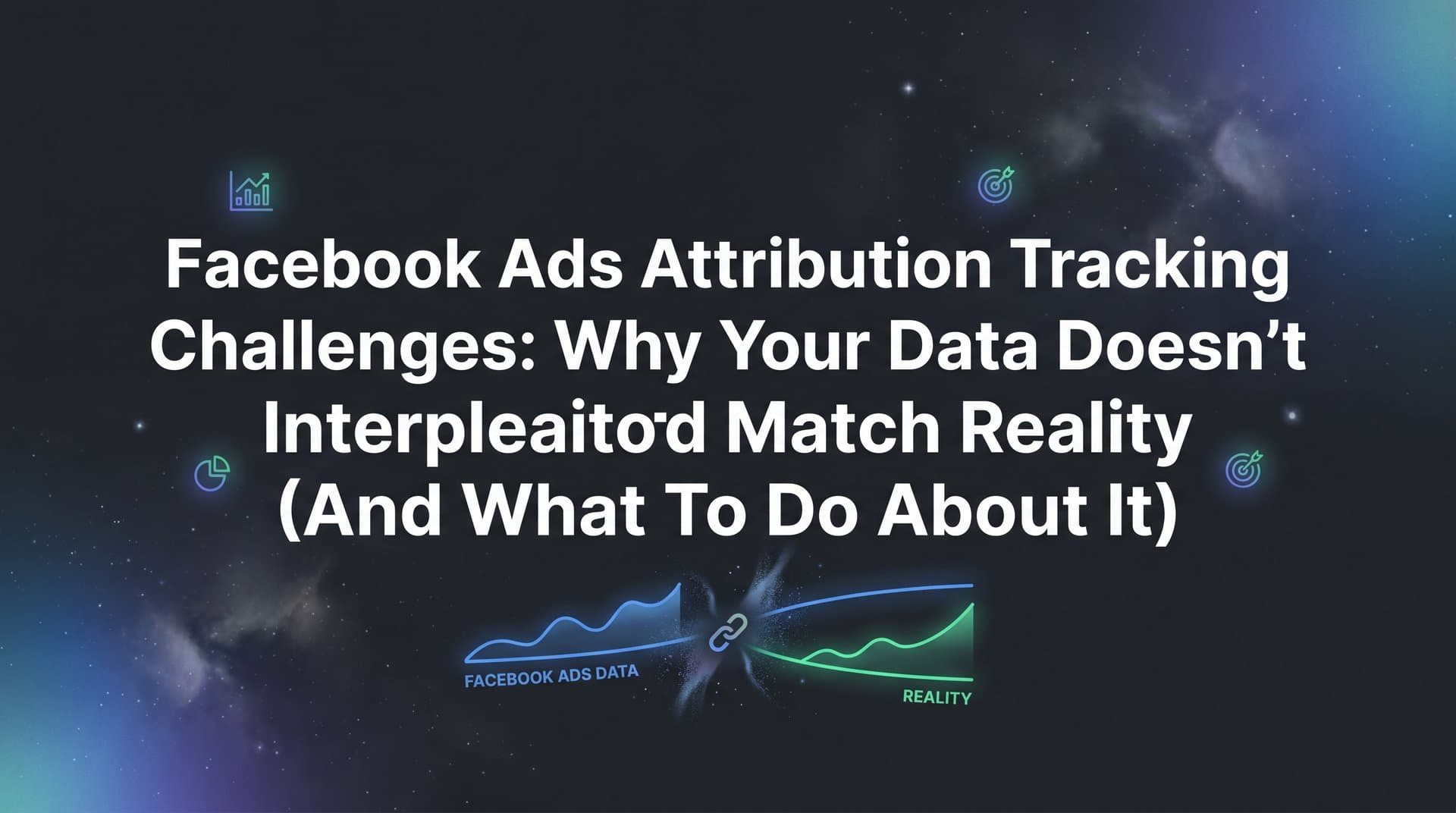
The numbers on your screen don't add up. Meta Ads Manager proudly displays 50 conversions from yesterday's campaign. You feel a brief moment of satisfaction before switching tabs to check Shopify. The dashboard loads: 30 orders. Your stomach drops.
Where did the other 20 conversions go? Did Meta lie to you? Is your tracking broken? Are you being overcharged for phantom results?
Welcome to the attribution gap, the single most frustrating reality facing Facebook advertisers in 2026. This isn't a bug you can fix or a setting you misconfigured. The iOS 14.5 privacy update, ongoing cookie deprecation, and the messy reality of cross-device customer behavior have fundamentally broken the way we measure ad performance. Meta sees one version of reality. Your backend sees another. Both are technically correct, yet neither tells the complete story.
This guide breaks down exactly why attribution tracking is broken, what's actually happening behind the scenes, and most importantly, the practical strategies you need to navigate this new reality and make smart decisions despite incomplete data.
The Attribution Gap: Why Meta's Numbers Never Match Your Backend
The disconnect between Meta-reported conversions and your actual sales data isn't random. It's the inevitable result of how attribution models work and the fundamental differences between what platforms can see versus what actually happens in your business.
Meta's attribution system operates on two primary mechanisms: click-through attribution and view-through attribution. When someone clicks your ad and converts within the attribution window (default is 7 days), Meta claims that conversion. But here's where it gets messy: Meta also claims conversions when someone simply views your ad without clicking, then converts within 1 day. That person scrolling past your ad in their feed at breakfast might make a purchase that evening after seeing your brand mentioned elsewhere, and Meta counts it as a view-through conversion.
Your Shopify dashboard doesn't care about attribution windows or view-throughs. It counts actual completed transactions. Period.
The gap widens when you consider that multiple platforms can claim credit for the same conversion simultaneously. Someone might see your Facebook ad, click a Google search ad later, and then convert after receiving your email. Facebook claims the conversion (view-through). Google claims it (last-click). Your email platform claims it (last-touch before purchase). Your backend shows one sale. Your marketing dashboards show three conversions.
Meta's conversion modeling adds another layer of complexity. When the pixel can't track a conversion directly due to privacy restrictions, Meta uses statistical modeling to estimate whether a conversion likely occurred. These modeled conversions appear in your dashboard alongside actual tracked conversions, inflating your numbers compared to verifiable backend sales. Understanding these attribution tracking problems is essential for accurate campaign analysis.
The attribution window itself creates discrepancies. If you run a campaign on Monday and someone clicks but doesn't convert until the following Tuesday (8 days later), your backend shows a sale but Meta doesn't count it because it fell outside the 7-day click attribution window. Conversely, someone who clicked your ad 6 days ago and converts today gets attributed to an old campaign that you might have already paused.
Understanding this gap isn't about finding the "true" number. It's about recognizing that attribution is fundamentally a modeling exercise, not an exact science. Both Meta's numbers and your backend data are pieces of a larger puzzle.
How iOS 14.5 and Privacy Changes Shattered Facebook Tracking
April 2021 marked a before-and-after moment for Facebook advertising. Apple's iOS 14.5 update introduced App Tracking Transparency (ATT), requiring apps to ask users for permission before tracking their activity across other apps and websites. The result? Most users said no.
When users opt out of tracking, the Facebook pixel loses its ability to follow them across the web. That beautiful retargeting campaign you built? It can't see most iOS users anymore. The conversion tracking that powered your optimization? Suddenly blind to a massive portion of your audience.
Meta's response was Aggregated Event Measurement (AEM), a system that fundamentally changed how conversion tracking works. Instead of tracking unlimited conversion events in real-time, advertisers now prioritize up to 8 conversion events per domain. These events are reported in aggregate rather than at the individual user level, and the data arrives with delays of up to 72 hours.
Think about what this means practically. You launch a campaign on Monday morning. Tuesday arrives and you want to check early results. The data you're seeing is incomplete, delayed, and aggregated in ways that prevent you from understanding individual user behavior. The immediate feedback loop that allowed you to kill underperforming ads quickly? Gone. These data analysis challenges have fundamentally changed how advertisers operate.
The 8-event limitation forces painful decisions. Do you track Add to Cart or Initiate Checkout? Both are valuable, but you might only have room for one after prioritizing Purchase, Lead, and other critical events. Every event you can't track is a blind spot in your funnel.
Meta's conversion modeling attempts to fill these gaps by using statistical techniques to estimate conversions that can't be directly tracked. When the pixel loses visibility into a conversion, Meta looks at patterns from similar users who can be tracked and makes an educated guess about whether a conversion likely occurred.
These modeled conversions appear in your reporting alongside actual tracked conversions, but they're estimates based on probability, not confirmed events. Your backend shows 30 actual sales. Meta might show 50 conversions: 25 tracked directly, 25 modeled based on statistical likelihood.
The modeling isn't malicious, but it creates a fundamental trust problem. How do you optimize campaigns when you can't distinguish between actual tracked conversions and statistically estimated ones? How do you know if your ROAS is real or modeled?
Cross-Device and Cross-Platform Blind Spots
Your customer's journey rarely follows a straight line. The reality looks more like this: they see your Instagram ad on their iPhone during their morning commute, click it during lunch break on their work computer, abandon the cart, then complete the purchase that evening on their iPad while watching TV.
One person. One conversion. Three different devices. And your tracking system sees three completely separate anonymous users.
Cookie restrictions prevent connecting these touchpoints. The cookie dropped on their iPhone can't communicate with the session on their work computer. The work computer can't connect to the iPad session. Each device exists in its own silo, and privacy regulations intentionally prevent cross-device tracking without explicit user consent.
Meta's ability to connect these dots depends on whether the user is logged into Facebook across all devices. If they are, Meta can sometimes piece together the journey. If they're not logged in, or if they use different accounts on different devices, the connection breaks. Running campaigns across Facebook and Instagram simultaneously compounds these tracking complexities.
The mobile-to-desktop conversion path is particularly problematic. Many users browse and research on mobile but complete purchases on desktop where they feel more comfortable entering payment information. Your mobile ads might be driving significant desktop conversions, but the attribution system can't see the connection.
Offline conversions create even bigger blind spots. Someone sees your Facebook ad, visits your physical store the next day, and makes a purchase. Your backend knows about the sale. Your Facebook pixel has no idea it happened. Phone orders present the same challenge: a customer calls after seeing your ad, places an order over the phone, and the conversion lives entirely outside your digital tracking ecosystem.
The customer journey is also rarely single-platform. Someone might see your Facebook ad, search for your brand on Google, read reviews on a third-party site, click a retargeting ad on Instagram, and then convert after receiving your email. Every platform in that chain wants to claim the conversion, but the reality is that all of them contributed in some way.
Cross-device and cross-platform behavior doesn't just create attribution gaps. It fundamentally challenges the assumption that digital tracking can capture the complete customer journey. The best tracking system in the world still can't see what happens when someone puts down their phone and picks up their laptop.
Server-Side Tracking and the Conversions API Solution
When browser-based tracking started breaking down, Meta introduced the Conversions API (CAPI) as a server-side alternative. Instead of relying on a pixel that runs in the user's browser (where it can be blocked by privacy settings, ad blockers, and cookie restrictions), CAPI sends event data directly from your server to Meta's servers.
The fundamental advantage is that server-side tracking bypasses browser limitations entirely. When a conversion happens on your website, your server sends the event data to Meta regardless of whether the user has blocked cookies, disabled tracking, or opted out of App Tracking Transparency. The pixel can't see the conversion, but your server can report it directly.
Implementation requires technical setup but the core concept is straightforward. When someone completes a purchase on your site, your backend system (Shopify, WooCommerce, custom platform) sends a server event to Meta with details about the conversion: purchase amount, products bought, and crucially, matching parameters that help Meta connect the server event to the person who saw your ad. For a complete walkthrough, consult our attribution tracking setup guide.
Event matching is where CAPI shows its power and limitations. Your server sends identifying information (hashed email, phone number, IP address, user agent) along with the conversion event. Meta attempts to match this information to a Facebook user who was shown your ad. When the match succeeds, the conversion gets attributed. When it fails, the conversion data is lost.
The quality of your event matching directly impacts attribution accuracy. If you're only sending IP address and user agent, match rates might be low. Adding hashed email and phone number (when available) dramatically improves matching. The challenge is collecting this information without creating friction in your conversion funnel.
CAPI works best when combined with the pixel, not as a replacement. This dual approach (called "redundant events") sends the same conversion through both the browser pixel and server-side API. Meta deduplicates these events using an event ID parameter, so you don't double-count conversions. When the pixel is blocked but CAPI succeeds, you still capture the conversion. When CAPI matching fails but the pixel works, you still get attribution.
The benefits are significant: better conversion tracking, improved attribution accuracy, and more stable campaign optimization. But CAPI isn't a magic bullet. It still relies on matching server events to Facebook users, and that matching is probabilistic rather than deterministic. Someone who's never logged into Facebook on their device is nearly impossible to match. Privacy-conscious users who provide fake information during checkout can't be matched accurately.
Server-side tracking also doesn't solve the fundamental attribution challenges around multi-touch journeys, cross-device behavior, or platform competition for conversion credit. It improves data quality and capture rates, but the underlying complexity of modern customer journeys remains.
Building a Multi-Touch Attribution Strategy That Works
Single-touch attribution models oversimplify reality. Last-click attribution gives all credit to the final touchpoint before conversion, ignoring the Facebook ad that introduced the customer to your brand. First-touch attribution credits only the initial interaction, dismissing the retargeting campaign that actually closed the sale.
Linear attribution attempts to solve this by distributing credit equally across all touchpoints in the customer journey. If someone saw your Facebook ad, clicked a Google search ad, and then converted through an email, each touchpoint gets 33% credit. This feels fairer but assumes every interaction contributed equally, which rarely reflects reality.
Time-decay attribution gives more credit to touchpoints closer to conversion, operating on the theory that recent interactions matter more than early awareness. A customer who saw your Facebook ad three weeks ago but clicked your retargeting ad yesterday sees most credit go to the retargeting campaign. Understanding these different attribution tracking methods helps you choose the right approach for your business.
Data-driven attribution models use machine learning to analyze patterns across thousands of conversions and assign credit based on which touchpoints statistically correlate with higher conversion rates. These models require significant data volume to work effectively and remain opaque in their decision-making process.
The reality is that no single attribution model tells the complete truth. Each model is a lens that highlights different aspects of your marketing performance. The key is using multiple models simultaneously to build a more complete picture.
UTM parameters become essential in a multi-touch world. Tagging every campaign link with source, medium, campaign, and content parameters allows you to track the customer journey across platforms. When someone clicks your Facebook ad (utm_source=facebook&utm_campaign=spring_sale), then later converts through a Google ad (utm_source=google&utm_campaign=brand_search), your analytics platform can see both touchpoints even if the attribution systems can't connect them.
Third-party attribution platforms like Cometly, Triple Whale, and Northbeam exist specifically to solve the multi-platform attribution challenge. These tools collect data from all your marketing channels, attempt to deduplicate conversions, and provide a unified view of customer journeys. They use various techniques: first-party cookies, server-side tracking, probabilistic matching, and statistical modeling to connect touchpoints across platforms. Choosing the right attribution software can significantly improve your measurement accuracy.
The gold standard for measuring true ad impact is incrementality testing. Instead of trying to attribute individual conversions, incrementality tests measure the lift your ads actually create. The methodology is straightforward: create a holdout group that doesn't see your ads, compare their conversion rate to a group that does see your ads, and measure the difference. That difference is your true incremental impact.
Incrementality testing requires discipline and patience. You need to run tests for sufficient duration (usually several weeks) to account for delayed conversions. You need adequate sample size to reach statistical significance. And you need to resist the urge to optimize mid-test. But the results give you something attribution models can't: proof of actual causation rather than correlation.
Optimizing Campaigns When Your Data Is Incomplete
Perfect attribution is dead. The question becomes: how do you make smart decisions when your data is fundamentally incomplete and contradictory?
Start by establishing a hierarchy of truth. Your backend sales data is the ultimate source of truth for revenue. Platform-reported conversions are directional signals, not absolute facts. When Meta shows 50 conversions but your backend shows 30 sales, don't dismiss Meta's data entirely. Instead, understand that Meta is seeing signals your backend can't capture (view-throughs, assisted conversions, cross-device journeys) while also including modeled estimates.
Focus on relative performance rather than absolute numbers. If Campaign A shows 100 conversions in Meta and Campaign B shows 50, Campaign A is likely performing better even if the absolute numbers are inflated. The directional signal matters more than the precise count. This approach works for creative testing, audience comparison, and budget allocation decisions. A robust performance tracking dashboard helps you monitor these relative metrics effectively.
Creative performance signals become more reliable than conversion attribution. You can measure click-through rates, engagement rates, and cost-per-click with reasonable accuracy. These top-of-funnel metrics aren't subject to the same attribution challenges as conversions. A creative with 3% CTR is objectively outperforming one with 1% CTR, regardless of attribution gaps.
AI-powered insights can identify winning patterns even when individual conversion attribution is uncertain. By analyzing thousands of ad variations and their performance signals, AI can surface which creative elements, messaging angles, and audience segments correlate with better results. The platform doesn't need perfect attribution to recognize that ads featuring customer testimonials consistently drive lower cost-per-click than product-only ads. Leveraging AI marketing tools for Facebook ads helps you extract actionable insights from imperfect data.
Build feedback loops that improve accuracy over time through continuous testing. Launch multiple ad variations simultaneously. Track which combinations of creative, audience, and copy drive the best top-of-funnel metrics. Monitor your backend data to see which campaigns correlate with revenue spikes. Over time, patterns emerge that help you make better decisions despite imperfect attribution.
Use blended metrics that combine platform data with backend reality. Calculate a "truth ratio" by dividing your backend conversions by platform-reported conversions. If Meta consistently reports 1.5× your actual sales, use that ratio to adjust your expectations. When Meta shows 75 conversions, you can estimate approximately 50 actual sales. This isn't perfect, but it's more actionable than treating platform numbers as gospel.
Incrementality becomes your north star for major decisions. Before scaling a campaign from $1,000/day to $10,000/day, run an incrementality test to confirm it's actually driving lift. Before cutting a channel entirely based on poor attribution, test what happens to overall revenue when you pause it. These tests are slower and more expensive than checking a dashboard, but they prevent catastrophic decisions based on misleading attribution data.
Moving Forward in the Attribution Era
Attribution tracking isn't going to get better. Privacy regulations will continue tightening. Cookie deprecation will continue spreading. The gap between platform-reported conversions and backend reality is a permanent feature of modern advertising, not a temporary bug waiting to be fixed.
The advertisers who thrive in this environment stop chasing perfect attribution and start building systems that work despite imperfect data. They implement server-side tracking to capture what they can. They use multiple attribution models to see different angles of the truth. They run incrementality tests to measure actual impact. They focus on creative performance signals that can be measured reliably.
Most importantly, they recognize that attribution challenges make creative excellence more valuable, not less. When you can't rely on perfect conversion tracking to guide optimization, the quality of your creative becomes the primary differentiator. Ads that genuinely resonate with your audience will drive better top-of-funnel metrics, stronger brand recall, and ultimately more conversions, regardless of whether the attribution system can perfectly track them.
The future of Facebook advertising belongs to platforms that can surface winning ads even when attribution is imperfect. AI-powered systems that analyze creative performance across multiple signals, identify winning patterns from incomplete data, and continuously test variations to find what actually drives results.
Ready to transform your advertising strategy? Start Free Trial With AdStellar and be among the first to launch and scale your ad campaigns 10× faster with our intelligent platform that automatically builds and tests winning ads based on real performance data. Our AI analyzes your historical campaigns, ranks every creative and audience by actual performance, and surfaces your winners even when attribution data is incomplete. Focus on what you can control: creating scroll-stopping ads and letting AI handle the complexity of finding what works.