Marketing automation isn't just about scheduling a few emails anymore. If that’s what comes to mind, your playbook is probably a decade out of date. Today, building a real marketing automation campaign means creating a smart, interconnected system that practically runs itself, especially on hyper-competitive platforms like Meta.
Why Modern Marketing Automation Is an Engine for Growth
Forget the textbook definitions. Let's get real. We're not just talking about software that sends messages on a timer. We're talking about building a sophisticated, data-driven ecosystem that can manage huge chunks of the customer journey without you lifting a finger.
This is why the sharpest brands are going all-in on automation. It’s no longer a "nice-to-have" tool; it’s a massive competitive edge. This is a fundamental move away from manual guesswork and toward predictable, data-backed decisions that actually grow the bottom line. It’s about building a true engine for growth.
From Manual Tasks to Predictable Revenue
The real magic of automation is how it turns mind-numbing manual work into a scalable system that generates revenue. Just think about all the hours your team sinks into segmenting lists, launching ad variations one-by-one, or chasing down leads with follow-ups. Automation takes over, freeing up your team to think about strategy.
Platforms like AdStellar AI are the perfect example of this shift in action. Instead of painstakingly creating a handful of ad variations for a Meta campaign, you can generate hundreds of creative, copy, and audience combos in minutes. The system doesn't just stop there—it tests them, learns from the live performance data, and automatically shifts your budget to the winners. Suddenly, your paid social spend becomes a predictable revenue driver, not a gamble.
By automating the repetitive work, marketers get a promotion. You stop being a campaign operator and become a strategic growth architect. The job changes from "doing the work" to "designing the system that does the work."
The Uneniable Financial Impact of Automation
If you’re still not convinced, just look at the money trail. The global marketing automation market was valued at $6.65 billion in 2024, but it's expected to explode to $15.58 billion by 2030. That kind of growth only happens when the results are real.
For a clearer picture, let's break down what a well-oiled automation machine can do.
Before you can reap these rewards, you need to build a strategy that actually works. We've created a quick-reference table to show you the core pillars of any successful automation plan.
Core Components of a Successful Automation Strategy
| Component | Description | Example Metric |
|---|---|---|
| Data & Segmentation | Using clean, integrated data to create highly specific audience segments based on behavior, demographics, and engagement. | Segment Size Growth |
| Triggers & Workflows | Defining the specific actions (triggers) that initiate an automated sequence of events (workflow) for a user. | Workflow Completion Rate |
| Personalized Content | Dynamically inserting relevant content, offers, or messaging into communications based on user data and journey stage. | Content Engagement Rate |
| Channel Integration | Ensuring your automation flows seamlessly across multiple channels, like email, social ads, SMS, and your website. | Cross-Channel Conversion Rate |
| Testing & Optimization | Continuously running A/B tests on different parts of your workflow—from subject lines to ad creative—to improve performance. | Lead-to-Conversion Lift |
| Reporting & Analytics | Tracking the right KPIs to measure the direct impact of your automation efforts on revenue and business goals. | Automation-Influenced Revenue |
Building on these components is your ticket to seeing real financial impact. It’s not just about theory; it’s about execution.
The stats paint a pretty clear picture. Businesses see an average return of $5.44 for every $1 invested in automation over three years. Companies using it well report a 45% increase in qualified leads, and we've seen high-performers boost that figure up to an incredible 451%.
Our own guide on https://www.adstellar.ai/blog/ai-marketing-automation dives deep into how these tools deliver such a powerful ROI. The data consistently shows that 63% of companies that blow past their competitors are using automation to slash marketing overhead by 12-30% while simultaneously boosting sales productivity by 14.5%.
To truly get these results, you need to ground your strategy in proven methods. Incorporating these marketing automation best practices will help you steer clear of common mistakes. The goal isn't just to save time—it's to build a system that actively and predictably drives your business forward.
Mapping Your First Automated Campaign Workflow
When people hear “marketing automation,” they often picture a tangled web of complex, intimidating workflows. But here’s the secret: the most effective automated campaigns aren’t about complexity. They're about clarity. A winning workflow always starts with a single, clear goal—like boosting your Return on Ad Spend (ROAS) or driving down your Cost Per Lead (CPL)—and then works backward from there.
It’s tempting to lean on broad demographic targeting, but that’s old-school thinking. The real power of automation today comes from triggers based on actual user behavior. Segmenting your audience based on what they do—the pages they visit, the content they download, the products they look at—creates a far more personal and effective experience.
From Trigger to Action Sequence
Every great automated workflow hinges on a trigger. This is simply the specific action that kicks the whole sequence into motion. A trigger could be anything: someone visiting your pricing page, downloading a whitepaper, or—the classic example—abandoning a shopping cart.
Once that trigger fires, it sets off a series of pre-planned actions.
Picture this: a user clicks your Meta ad, lands on your site, browses a bit, but then leaves without converting. That "site visit, no conversion" action can trigger an entire journey:
- Immediate Action: The user is instantly added to a Meta retargeting audience and shown a new ad creative that addresses a potential objection.
- Day 2: Still no conversion? An automated email goes out with a compelling case study relevant to the product they viewed.
- Day 4: For B2B, if they clicked a link in that email, your CRM could create a task for a sales rep to connect with them on LinkedIn.
The point isn't to build a rigid, one-size-fits-all funnel. It's to create an intelligent, responsive journey that adapts to how the user behaves at each step, gently guiding them toward your end goal.
This is what we mean when we talk about a growth engine. It’s a simple but incredibly powerful feedback loop.
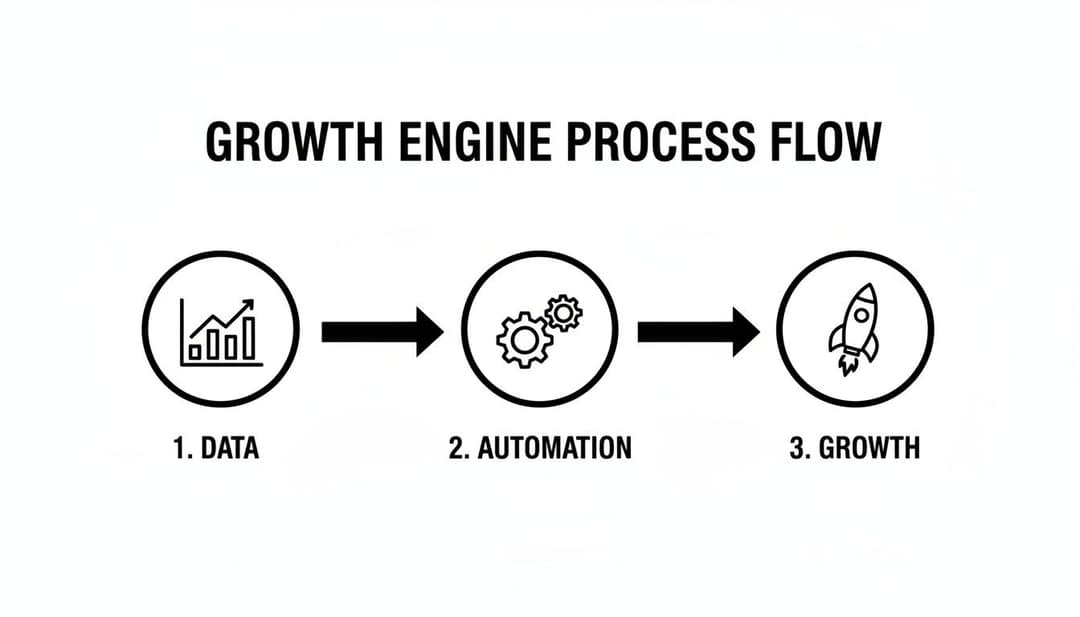
You gather behavioral data, use automation to act on it in real-time, and measure the resulting growth to make your data and triggers even smarter next time.
Real-World Workflow Examples
Let's move away from the abstract and look at two common scenarios where marketing automation campaigns shine.
E-commerce Abandoned Cart Flow:
- The Trigger: A customer adds products to their cart but doesn't complete the checkout within one hour.
- Action 1 (1 Hour Later): A friendly email lands in their inbox reminding them about the items they left behind. Just automating a welcome email can produce an 82% open rate, so a timely reminder is just as potent.
- Action 2 (24 Hours Later): A retargeting ad pops up in their Meta feed, showcasing the exact products they were considering.
- Action 3 (48 Hours Later): If they still haven't bitten, a second email arrives. This time, it offers a small, time-sensitive discount—like 10% off for the next 24 hours—to create a little urgency.
B2B SaaS Lead Nurturing:
- The Trigger: A user downloads your new e-book on "Advanced Facebook Ad Strategies." (A resource like our guide to the Facebook campaign creation workflow is a perfect magnet for this).
- Action 1 (Immediate): The user gets their e-book via email, and in the background, your system tags them as a "High-Intent Lead."
- Action 2 (3 Days Later): An automated email follows up, sharing a related blog post or inviting them to an upcoming webinar on the same topic. You're providing more value, not just selling.
- Action 3 (7 Days Later): If they register for or attend the webinar, an alert is automatically sent to the sales team, signaling it's the right time for a personal outreach.
These aren't just theoretical. These are the kinds of automated sequences that deliver real results. In fact, 67% of marketers rely on drip and nurture campaigns to stay relevant at scale. It’s no surprise when you see that some automated emails can generate up to 30 times more revenue than one-off email blasts.
Using AI for Smarter Campaign Creation and Testing
This is where the theory of automation meets the raw power of AI, especially on paid social platforms like Meta. The old way of manually cranking out a handful of ad variations just doesn't cut it anymore. Today, it’s all about moving faster and, more importantly, smarter.
AI platforms like AdStellar can generate hundreds of creative, copy, and audience variations in minutes—a job that would bury a human team for days. This isn’t just about being quick; it’s about exploring creative possibilities you’d never have the time to test on your own. This kind of scale allows for massive A/B tests that run almost effortlessly in the background.
The real magic of AI in marketing automation campaigns is its knack for finding the non-obvious wins. It might uncover that a specific headline, paired with an unusual image, connects powerfully with a tiny segment of your audience—an insight you’d almost certainly miss with manual testing.

This completely flips your role from a campaign operator to a strategic analyst. Instead of getting bogged down in the tedious setup of individual ads, you can focus on interpreting the data AI brings to the surface, making the high-level decisions that actually steer the ship.
How AI Uncovers Winning Combinations
At its heart, AI’s strength here is its analytical muscle. By chewing through historical performance data from your ad account, these systems spot the patterns that correlate with your most important goals, whether that's ROAS, CPL, or CPA. It's not just guessing; it's data-driven prediction.
Think about it. If you've run hundreds of ads over the past year, an AI can analyze every single one to figure out:
- Top-Performing Creatives: Which images or videos consistently drove the most conversions, no matter what the copy said?
- Most Effective Copy: What specific phrases, calls-to-action, or value props resulted in the lowest cost-per-click?
- Highest-Value Audiences: Which of your custom or lookalike audiences responded best to your offers?
Armed with these insights, the AI can then recommend or even automatically build new ad combinations that mix and match these proven elements. To really get the most out of artificial intelligence for your creative, digging into tools like an ultimate AI ad maker can give you a serious edge.
From Iterative Tweaks to Rapid Optimization
This AI-driven method fundamentally changes how you optimize. The traditional approach is painfully slow: launch a campaign, wait weeks for enough data, make one small tweak, and repeat. It’s a linear, plodding process.
AI, on the other hand, enables a much more dynamic and rapid optimization cycle. It’s a continuous feedback loop that looks something like this:
- Launch: Deploy dozens or even hundreds of ad variations all at once.
- Learn: The AI starts monitoring real-time performance data from the second the campaign goes live.
- Optimize: Underperforming ads are automatically paused, and the budget is shifted to the top performers—often within hours, not weeks.
- Evolve: Insights from the winning ads are then fed back into the system to inspire the next wave of creative generation.
This approach lets you test hypotheses at a scale that was previously unimaginable. For marketers who want to work smarter, not harder, this is a total game-changer. As you get comfortable with these new capabilities, our guide on using AI for ads offers practical steps for weaving these powerful tools into your daily workflow. The payoff is a more agile, data-informed, and ultimately more profitable approach to your marketing automation campaigns.
How to Measure and Optimize Your Automated Campaigns
Getting your automated campaigns live is one thing. Actually making them profitable is another game entirely. The real wins happen after the launch, when you start using live data to make your campaigns smarter and more efficient. This is where you build a feedback loop that constantly refines your strategy.
But you can’t get lost in a sea of vanity metrics. The trick is to focus on the Key Performance Indicators (KPIs) that actually tie back to your business goals. For a B2B SaaS company, that means being obsessed with your Lead Conversion Rate and Cost Per SQL. If you're running an e-commerce brand, you live and die by your Return on Ad Spend (ROAS).
Your first step? Building a dashboard that gives you a real-time pulse on what’s working and what’s not. This isn’t just a report—it’s your mission control.
Building Your Optimization Dashboard
A good dashboard shouldn't be cluttered. It needs to give you at-a-glance answers to the most important questions so you can take action quickly.
For example, a dashboard in a platform like AdStellar AI can instantly show you a ranked view of your best-performing ad creatives and audiences, all stacked up against your main goal.
This screenshot shows exactly how an AI-powered platform can take mountains of campaign data and boil it down to a simple, actionable view. You can immediately see which creative-and-audience combos are crushing your ROAS or CPL targets.
That kind of clarity is a game-changer. It allows you to spot the underperformers draining your budget and, more importantly, find the winners that deserve more of your ad spend. This is the foundation of a self-optimizing system. Our guide on how to measure advertising effectiveness digs much deeper into setting up these exact frameworks.
Turning Insights into Action
Once you have a clear view of performance, you can start making smart, data-backed calls. Optimization isn't a one-and-done fix; it's a constant cycle of testing, learning, and refining.
Here are a few proven tactics you can put into play right away:
- Refine Audience Segments: Is one of your lookalike audiences blowing the others out of the water? Double down on it. Use its characteristics to build new, even more specific variations.
- Tweak Email and Ad Copy: If your email open rates are solid but your click-through rate is lagging, it’s time to A/B test your call-to-action and body copy. Find out what language actually gets people to click.
- Reallocate Budget Swiftly: With an AI platform, you can stop manually shifting budgets. The system can automatically pull spend from losing ad variations and push it toward the winners in real time, making every dollar work harder.
This kind of integrated approach is quickly becoming the new normal. In fact, 79% of marketers are now automating parts of the entire customer journey, from onboarding right through to post-purchase follow-ups. The most popular channels for this are email (63%), social media (50%), and paid advertising (40%).
And with 70% of business leaders planning to increase their automation spending in 2026, getting a handle on this optimization loop is no longer just a nice-to-have. You can check out more stats on this growing trend on cazoomi.com.
The goal is to move from reacting to data to anticipating it. An effective optimization process doesn’t just report on what happened; it uses that information to intelligently predict what will work next.
Scaling From One Campaign to a Full Automation Ecosystem
So, you’ve run a few successful marketing automation campaigns. That’s a fantastic start. But let's be honest, the real win isn't just a handful of isolated victories; it's scaling that success across your entire marketing function without descending into chaos. This is where you shift from one-off wins to building an interconnected system that works for you long-term.
Making that leap requires a fundamental change in how you think. You need to start seeing your marketing efforts in terms of reusable assets. Every killer creative, every perfectly tuned audience segment, and every workflow that just plain works should become a building block in your library, ready to be deployed at a moment's notice.

Build a Library of Proven Assets
The bedrock of any scalable system is a central library of your best-performing components. Think of it less as simple storage and more as your brand’s tactical playbook—a collection of what’s been proven to deliver.
- Winning Creatives: Pinpoint the specific images, videos, and ad copy that consistently generate high ROAS or a low CPL. Tag them by product, theme, and audience so you can grab them instantly.
- Refined Audiences: Your top-performing custom and lookalike audiences are pure gold. Keep a curated list of these segments, adding notes about why they’re so effective.
- Workflow Templates: Remember that abandoned cart sequence that crushes it every single time? Save it as a template. Now you can spin up that same successful journey for a new product launch in minutes, not days.
Once you have this library locked and loaded, you’ll find you’re spending way less time on manual setup and more time on strategy.
Let AI Assemble Your Campaigns
With a solid library of winning assets, you can bring in AI to act as your master campaign architect. This is exactly what platforms like AdStellar’s AI Launch feature are built for. It takes your proven assets, analyzes them, and intelligently assembles new campaigns based on your specific goals.
The result? Launch times shrink from days to minutes. The AI does the heavy lifting, mixing and matching your best creative with your top audiences to ensure every campaign starts from a position of strength. For a deeper look at this strategy, check out our guide on scalable marketing automation.
By connecting disparate workflows—like linking a Meta lead generation ad directly to a CRM nurture sequence—you create a seamless customer journey that drives significant revenue with minimal hands-on effort.
And this isn’t just a game for massive corporations. The impact is especially powerful for smaller teams. In fact, it’s not uncommon for small businesses to see an immediate 25% increase in ROI after implementing automation. It just goes to show that this is an accessible growth lever for businesses of all sizes. You can discover more stats on small business ROI on cazoomi.com.
Ultimately, scaling your marketing automation is all about building a smart, self-improving ecosystem. You're creating a system where past performance directly fuels future growth, allowing you to operate with more speed, intelligence, and impact than ever before.
Frequently Asked Questions About Marketing Automation
Whenever I talk to marketers about automation, the same few questions always pop up. It's a powerful concept, but it's easy to get tangled up in the details before you even start.
Let's clear the air on some of the biggest hurdles so you can move forward with a solid plan.
How Do I Choose the Right Marketing Automation Platform?
With a dizzying number of tools out there, it’s easy to get overwhelmed. The key is to ignore the noise and focus on your biggest pain point right now.
If you’re drowning in email follow-ups and need better nurturing sequences, then a platform with a killer workflow builder and segmentation is your best bet. But if you’re a performance marketer burning cash on paid social, your problems are totally different. You need a tool like AdStellar AI that’s built from the ground up to automate ad creation and testing on platforms like Meta.
Before you sign any contracts, ask yourself these questions:
- Does it play well with others? Your marketing automation tool can't live on an island. It has to connect smoothly with your CRM, e-commerce platform, and the rest of your tech stack.
- Will I outgrow it? Think about where you want to be in six or twelve months. Will this platform scale with you, or will you be shopping for a new one just as you’re hitting your stride?
- Is it a specialist? Don't fall for a "jack-of-all-trades, master-of-none." Find the tool that excels at solving the one thing that’s holding you back the most, whether that's ad fatigue, lead response time, or messy reporting.
What Is a Common Mistake to Avoid?
The single biggest mistake I see is the "set it and forget it" trap. It's so tempting to spend weeks building the "perfect" workflow, hit launch, and then just walk away, assuming the machine will do all the work forever.
That approach is a one-way ticket to failure. An automated campaign is not a crockpot dinner; it's a living system that needs attention.
The real win with automation isn’t just getting tasks off your plate. It's about freeing up your brainpower to focus on high-level strategy and optimization.
A workflow that crushed it last quarter might completely bomb this quarter. Audience tastes change, ad platforms update their algorithms, and new competitors pop up. You have to be constantly looking at the data, testing new creative, and refining your offers.
Can Marketing Automation Feel Too Robotic?
Absolutely. But only when it’s done poorly. When you get a generic, soulless email, that’s not a failure of automation itself—it’s a failure of the marketer’s strategy.
Great automation doesn’t replace the human touch; it scales it. It uses data to make every interaction more relevant and personal, not less.
Think about it. Using personalization tokens to greet a customer by name, sending a follow-up about an item they actually looked at, or triggering a helpful tip based on how they’re using your product—that’s not robotic. That’s just good, timely service.
The goal is to be helpful. An abandoned cart reminder that takes someone straight back to their items is useful. A random, generic promo email blasted to your entire list every day is just spam. Focus on adding real value with every automated touchpoint.
Ready to build, test, and scale your Meta campaigns 10x faster? AdStellar AI replaces tedious manual setup with a powerful, repeatable, and data-backed system. Learn more at https://www.adstellar.ai.