Think of an artificial intelligence marketing platform as an expert co-pilot for your campaigns. It uses AI to analyze mountains of data, predict which ads will work, and suggest winning strategies—all in real time. It's the new command center for growth marketers, going far beyond simple automation to actively learn and improve everything you do.
What Is an AI Marketing Platform and Why It Matters Now
Imagine having your best marketing strategist, your sharpest data analyst, and your fastest creative designer all rolled into one, working for you 24/7. That's the core idea behind an artificial intelligence marketing platform. It’s a sophisticated system built to take the guesswork out of digital advertising by using machine learning to make smarter, faster decisions.
At its heart, an AI marketing platform is like an advanced Marketing Automation Platform that got a major upgrade. While traditional automation follows rigid, pre-set rules (like sending a follow-up email three days after a cart is abandoned), an AI platform actually learns and adapts. It sifts through thousands of data points, from ad performance to audience behavior, to spot patterns a human team could never see.
The Shift From Manual Work To Intelligent Optimization
For years, marketers have been buried in repetitive tasks. Building campaigns, especially on complex networks like Meta, means hours of manually duplicating ad sets, swapping out images, and tweaking audience settings. An AI marketing platform automates this whole process, but it does a lot more than just save you time.
It fundamentally changes your workflow from being reactive and manual to proactive and strategic. Instead of spending 80% of your time on setup and 20% on strategy, you can finally flip that ratio.
This isn't just about convenience; it's quickly becoming a necessity. The digital advertising space is more crowded and competitive than ever. The ability to launch, test, and scale campaigns at a speed and scale that's physically impossible for humans is what gives you an edge. This is precisely why more teams are digging into how AI for ads can completely change their operations. To dive deeper, you can explore our article on how AI transforms advertising campaigns.
Let's break down the fundamental difference in how work gets done. The old way of doing things just can't keep up with the speed and complexity of modern advertising.
Manual Campaign Management vs AI-Powered Marketing
| Aspect | Traditional Manual Approach | AI Platform Approach |
|---|---|---|
| Strategy | Based on historical reports and human intuition. Often reactive. | Proactive and predictive, based on real-time data analysis and outcome forecasting. |
| Campaign Setup | Manual, time-consuming, and prone to error. Involves duplicating ad sets one by one. | Automated and rapid. Launches hundreds of variations in minutes based on a single brief. |
| Audience Targeting | Broad segments based on demographic data and assumptions. | Hyper-segmented audiences identified by AI based on thousands of behavioral data points. |
| Creative Testing | Limited A/B testing due to manual effort. Often tests only a few variables at a time. | Massively multivariate testing. Simultaneously tests hundreds of creative and copy combos. |
| Optimization | Periodic, manual adjustments based on weekly or daily reports. | Continuous, real-time optimization. AI adjusts bids and budgets 24/7 to maximize results. |
| Learning & Insights | Slow learning cycles. Insights are discovered after the campaign, often too late to act on. | Fast, automated learning loops. Insights are generated and applied within the campaign. |
This table highlights the transition from a hands-on, often overwhelming process to a strategic, AI-assisted workflow that drives better, faster results.
The Market Push Towards AI Adoption
The industry's rapid move toward these tools is no accident; it's backed by some serious money. The artificial intelligence marketing sector is seeing explosive growth. In 2024, the global AI in marketing market was valued at $19.3 billion, and it's projected to hit $24.03 billion in 2025 and an incredible $215.03 billion by 2035.
This trend is powered by a compound annual growth rate (CAGR) of 24.5%, which shows just how crucial AI has become for creating personalized, data-driven marketing that actually works. You can find the complete research on the AI in marketing market growth to see the full picture.
This isn't just about chasing the next shiny object. For performance marketers managing high-volume Meta ad campaigns, adopting an AI marketing platform is about survival and growth. It’s about turning the chaotic, high-stakes game of paid social into a predictable field of opportunity, unlocking new revenue, and leaving the competition behind.
The Core Capabilities Behind Top AI Marketing Platforms
Behind all the buzz, a real artificial intelligence marketing platform isn't magic. It's a set of smart, connected tools built to tackle the biggest headaches in digital advertising. Once you understand these core functions, you'll see exactly how the AI turns raw data into a higher return on ad spend (ROAS) and gives you back hours of your day.
Think of it like this: if running a campaign manually is like building a car by hand, piece by piece, then an AI platform is like a fully automated assembly line. It’s not just about speed. It's about building a better, more reliable car every single time by learning from every unit that rolls off the line.
Let's pull back the curtain on the four pillars that make this assembly line hum.
This infographic breaks down how these capabilities translate directly into business outcomes you actually care about.
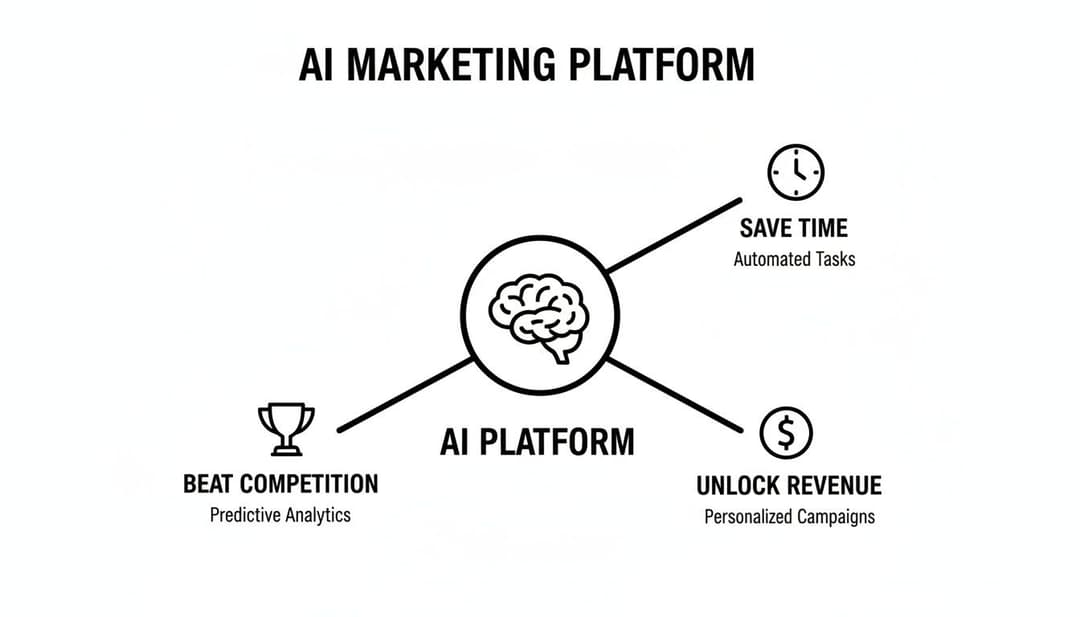
As you can see, the AI engine is the driving force behind saving time, outsmarting the competition, and ultimately, unlocking more revenue.
Creative Automation At Scale
The first, and most obvious, win is automating creative production. We’ve all been there. You need to test five images against five headlines and five different blocks of ad copy. That's 125 unique ads you have to build one-by-one in Meta Ads Manager. That’s not marketing; it’s a full day of painful, repetitive clicking.
This is where creative automation tools step in. You just upload your assets—your images, videos, headlines, and descriptions—and the system instantly combines them into every possible variation. A task that used to burn an entire day is now done in minutes.
A platform like AdStellar AI, for instance, can take just a handful of your best assets and spin up hundreds of unique ad variations, all perfectly structured for testing. This alone changes a campaign launch from a soul-crushing marathon into a quick sprint.
Advanced Audience Optimization
Building audiences by hand often means you’re working off assumptions and broad demographic buckets. An AI marketing platform throws that guesswork out the window. It uses a surgical approach, digging through mountains of data to find hidden, high-performing audience segments you'd never think of on your own.
By plugging into your historical ad account data, the AI spots patterns among your past converters. It analyzes thousands of signals—far beyond just age and location—to build hyper-targeted audiences based on interests, behaviors, and brand affinities.
It’s a fundamental shift from targeting "who we think our customers are" to "who the data proves our best customers are." This simple change dramatically cuts down on wasted ad spend.
This powerful capability is getting better every day, thanks to massive investment in the AI platform market. Projections show the market rocketing from $18.22 billion in 2025 to $94.31 billion by 2030—a staggering 38.9% CAGR. This boom is fueling huge leaps in predictive analytics, which you can read about in this in-depth AI platform research.
Automated Testing and Experimentation
Okay, so you've created hundreds of ads and dozens of audiences in minutes. Now what? The next challenge is testing it all without setting your budget on fire. This is where AI-powered testing and experimentation shines. The platform can run huge multivariate tests that would be flat-out impossible for a person to manage.
Here’s a quick look at how it works:
- Smart Budget Allocation: The AI sprinkles a small part of your budget across all your ad variations to get a baseline reading.
- Real-Time Monitoring: It keeps a constant eye on key metrics like click-through rate (CTR), cost per acquisition (CPA), and ROAS.
- Fast, Decisive Action: The system quickly spots the losers and shuts them down automatically, ensuring you don't waste another dime on what isn't working.
This automated cycle makes sure your budget is always flowing to the winning ad combinations, squeezing maximum performance out of every dollar right from the start. To see how this compares across tools, check out our guide on the top features of AI ad platforms.
Continuous Learning Loops
This last piece is the most important of all: the learning loop. An artificial intelligence marketing platform isn’t a one-and-done tool. It’s a living system that gets smarter with every single campaign you run. Every click, conversion, and impression is a new data point that gets fed right back into the AI.
This constant feedback loop makes every other function better over time:
- Smarter Creative: The AI learns which images, colors, and messages actually resonate with your audience, giving your creative team a huge head start.
- Sharper Audiences: As more conversion data flows in, the AI refines your existing audiences and uncovers new, even more precise segments.
- Better Predictions: The platform gets shockingly good at predicting which new ad combinations will be winners before you even spend a penny.
This self-improving cycle creates an incredible competitive advantage. While your competitors are stuck trying to learn from slow, manual tests, your AI is constantly optimizing, ensuring your marketing gets more effective and profitable with every campaign.
Unlocking Growth with Real-World Use Cases
It’s one thing to talk about the features of an artificial intelligence marketing platform. It’s another thing entirely to see how they actually make a business money. For any performance marketer, growth team, or agency, the only question that really matters is, "So what?"
This is where we answer that question. We’ll show you how these platforms produce real-world results—slashing time spent on busywork, taking the guesswork out of creative, and driving higher, more predictable ROAS.
The shift is already well underway. A recent report found that 88% of performance marketers were using these tools daily back in 2024, completely changing how e-commerce and SaaS brands approach growth. Budgets are following suit, with enterprise AI spending projected to jump from 18% to 24% by next year as leaders see the payoff from precise ad targeting and audience building. You can dig into more of that data in this AI in marketing market size report.
But let's leave the stats behind and look at a real-world scenario. Meet "GlowRight," a fictional direct-to-consumer (DTC) skincare brand. They have a fantastic product, but they're completely stuck, unable to scale their Meta ad spend beyond a few thousand dollars a month without their profits evaporating. Their small marketing team is drowning in the day-to-day grind of campaign management, with zero time left for actual strategy.
From Manual Chaos to Automated Clarity
Before bringing in an AI platform, a typical product launch for GlowRight was a week-long nightmare. The team would spend days in Meta Ads Manager manually stitching together a few ad variations, mostly just guessing which audiences might respond. Once launched, they were glued to their screens, checking data every few hours and trying to figure out what was working before the budget was gone.
This old-school process created a ton of problems:
- Creative Burnout: The team was so buried in building ads that they had no energy left to think about what makes good creative in the first place.
- Wasted Spend: Money was constantly torched on underperforming ads that ran for far too long before someone had a chance to shut them off.
- Limited Scale: They could only test a handful of ideas at once, which meant they were almost certainly leaving better-performing combinations undiscovered.
Now, let's see what happens when they integrate an artificial intelligence marketing platform like AdStellar AI into their workflow. Their next big launch looks completely different. (We cover this process from top to bottom in our guide to AI marketing automation.)
The team just uploads their new product photos, video clips, headlines, and descriptions. In about ten minutes, the AI generates over 200 unique ad combinations. It also digs into their historical Meta data to identify and build a dozen high-potential audience segments—far more nuanced than the basic demographic targets the team was using before.
Launching, Learning, and Scaling with AI
With a single click, GlowRight launches the entire test. From this point on, the AI platform takes over, doing the work of a whole team of media buyers around the clock.
The platform doesn't just run the ads; it actively manages them. It intelligently allocates a small portion of the budget across all 200+ variations to gather initial performance data, quickly identifying early winners and losers.
Within the first 48 hours, the AI has already turned off more than 150 underperforming ads that weren't hitting the target cost-per-purchase. At the same time, it starts shifting the budget toward the top-performing 20% of ads. The team can see a simple, ranked dashboard showing exactly which image, headline, and audience is driving the best returns.
By the end of the first week, the platform has pinpointed three "superstar" ads that are consistently delivering a 4.5x ROAS. Armed with undeniable data, GlowRight confidently scales the budget on just those proven winners. They’ve finally turned a chaotic guessing game into a predictable, data-backed engine for growth—and they scaled their ad spend profitably without having to hire more people.
Picking the right artificial intelligence marketing platform feels a lot like navigating a maze. New tools pop up constantly, all promising the world. To find what actually works, you need a smart way to evaluate them. You're not just looking for a tool to automate a few tasks; you're looking for a partner that will help you grow your business faster and smarter.
This isn't a decision to rush. The right platform will become the brain of your entire paid media operation. The wrong one is just another monthly bill and a new source of headaches.
Nail Down the Integrations First
The first thing to check is how a platform connects to your ad accounts, especially on networks like Meta. You absolutely need a platform that uses secure OAuth 2.0 connections. This is the non-negotiable industry standard. It lets the platform access your account without you ever sharing your password, and you can cut off access instantly.
If any vendor asks for your username and password, run. That’s a huge red flag. A proper integration through official APIs isn't just about security—it’s about ensuring a steady, reliable flow of data. This deep connection is what allows the AI to pull in your historical performance data and figure out what’s already working for you.
Scrutinize the AI-Powered Insights
Almost every platform claims to have "AI insights," but the quality varies wildly. You have to learn to spot the difference between a simple data report and truly useful intelligence. When you're in a demo, don't let flashy dashboards distract you. Ask tough questions:
- How does the platform decide which creatives and audiences are "winners"? Is it based on flimsy metrics or the numbers that actually drive your business, like ROAS or CPA?
- Does the AI explain why a certain ad is performing well? Can it show you the reasons behind its recommendations?
- How easy is it to act on these insights? Can you scale a winning ad or launch a new campaign from top performers with just one click?
The difference between a good and a great artificial intelligence marketing platform is its ability to turn a mountain of complex data into a short, clear to-do list. You need a tool that tells you what to do next, not just what happened last week.
This is where the real value is. You want a system that connects the dots between insight and action, making it dead simple to put more money behind what’s actually working.
Demand a Centralized, Efficient Workflow
The entire reason to get an AI platform is to make your life easier, not more complicated. A great solution should bring your whole campaign workflow into one clean, intuitive space. You shouldn't have to constantly switch between spreadsheets, ad manager tabs, and asset folders.
To help you compare different AI platforms and find the best fit for your team, use this checklist during your evaluation process.
AI Marketing Platform Vendor Evaluation Checklist
| Feature and Criteria | What to Look For | Why It Matters for Your Team |
|---|---|---|
| Ad Network Integration | Secure OAuth 2.0 connections (no password sharing). Deep API access for data pulls. | Ensures account security and allows the AI to learn from your historical performance data. |
| Quality of Insights | Actionable recommendations, not just data dumps. Clear reasoning behind suggestions. | The AI should be a strategic guide, telling you why something works and what to do next. |
| Workflow Centralization | A single interface for campaigns, creatives, audiences, and reporting. | Eliminates the chaos of juggling multiple tools and tabs, saving time and reducing errors. |
| Creative Management | A built-in media library with tagging, filtering, and easy access to assets. | Stops you from wasting time digging through folders and helps you quickly find your best-performing images and videos. |
| Audience Management | A centralized hub to build, save, and reuse your top-performing audience segments. | Allows you to quickly apply proven audience strategies to new campaigns without starting from scratch. |
| Learning & Automation | Automated A/B testing, budget optimization, and clear performance reports. | The platform should do the heavy lifting, freeing your team to focus on strategy and creative thinking. |
| Support & Onboarding | Dedicated support, clear documentation, and a structured onboarding process. | A strong support system ensures you get the most value out of the platform from day one. |
By methodically checking these boxes, you can cut through the marketing fluff and focus on the features that will genuinely impact your team's performance and efficiency.
A top-tier platform should have dedicated spaces for:
- Campaigns: A command center to launch, watch, and manage all your tests and scaling efforts.
- Creatives: A media library where you can organize, tag, and grab your images and videos in seconds.
- Audiences: A home for building, managing, and reusing your most successful audience segments.
- Performance: Dashboards that are actually easy to read and break down results by creative, audience, and placement.
The end goal is a single workspace that puts an end to the chaotic mess of spreadsheets and different ad managers. If you're also thinking about working with a specialized agency, our guide on choosing an artificial intelligence marketing company provides more things to consider.
Ultimately, choosing the right platform is about finding a solution that doesn't just check technical boxes but truly fits your team's goals. You want a partner that will empower you to graduate from manual, tedious tasks to strategic, AI-powered growth.
Integrating an AI Platform into Your Workflow

Buying a powerful artificial intelligence marketing platform is the easy part. The real work—and the real payoff—comes from weaving it into the fabric of your team's day-to-day work. This isn't about flipping a switch and hoping for magic. It’s a strategic process of turning incredible technology into an instinctual part of your marketing DNA.
The goal is to move from the frantic pace of manual campaign management to smart, AI-driven growth without causing chaos. A smooth rollout is all about showing value quickly, building your team's confidence, and creating a new rhythm where the platform does the heavy lifting so your people can focus on big-picture strategy.
Securely Connecting Your Data Sources
First things first: you need to establish a rock-solid, secure connection to your data. This is the bedrock for every insight the AI will generate. A trustworthy platform will never ask for your passwords. Instead, it should use industry-standard protocols like OAuth 2.0 for every integration, especially for something as critical as your Meta Ads Manager.
This token-based system gives the platform secure access without ever exposing your login details, and you can cut off access at any time. Once connected, the AI can start pulling in your historical campaign data, which is essential for it to begin learning what has—and hasn't—worked for your brand. If your team is navigating complex data setups, our guide on the Meta Conversions API is a great resource for keeping your data clean and accurate.
Setting Clear KPIs and Running a Pilot Campaign
Before you let the platform loose on your entire budget, you need to define what a "win" actually looks like. "Better results" isn't a target; it's a wish. You need to set specific, measurable Key Performance Indicators (KPIs) that tie directly to your business goals.
A few fundamental KPIs to track are:
- Return on Ad Spend (ROAS): The clearest measure of profitability.
- Cost Per Acquisition (CPA): Exactly what it costs you to land a new customer.
- Campaign Launch Time: The hours or days you get back in your week.
- Creative Test Volume: How many more ad variations you can test each month.
The best way to get your team on board and prove the platform's worth is to start small. Run a single pilot campaign with a tight focus, like boosting ROAS for one of your core product lines.
A successful pilot is the most powerful internal case study you can create. When your team sees the platform identify a new winning ad that doubles their ROAS, any skepticism evaporates. It builds real excitement for what’s possible when you scale up.
Fostering a Culture of Testing and Learning
An artificial intelligence marketing platform is an engine that runs on data and experimentation. To truly get your money's worth, your team has to fully embrace a culture of non-stop testing. The platform makes it simple to test hundreds of variables, but it’s the strategic curiosity of your marketers that provides the fuel.
Start encouraging your team to ask more profound questions. Instead of just, "Did this ad work?" they should be asking, "Which audience segment is responding best to this angle?" or "What specific visual element is driving our click-through rate?"
This shift in thinking turns campaign managers into strategic analysts. They start to see the AI not just as an automation tool, but as a powerful partner for digging up deep customer insights. Over time, this human-AI collaboration makes your marketing smarter, more efficient, and more profitable with every dollar spent.
So, where does this leave us?
This guide has walked you through the nuts and bolts of artificial intelligence marketing platforms, and the main takeaway is pretty clear: this isn't some far-off, futuristic concept anymore. It’s a core part of a modern growth team's toolkit.
By handing over the repetitive, soul-crushing campaign tasks to a machine, these platforms give marketers their time back. More importantly, they give them the space to think, create, and strategize at a higher level.
The bottom line is simple. Adopting this kind of tech helps you swap the daily chaos of campaign management for clean, operational clarity. You get to stop guessing and start making calls based on what the data is actually telling you, which is how you directly grow revenue.
A platform like AdStellar AI can be the key to unlocking serious, sustainable growth from your marketing. The tech brings the speed and scale, and you bring the strategy and the big ideas.
Think about it. Instead of drowning in the manual grind of setting up campaigns, you can get back to what you do best: understanding your customers, crafting creative that hits home, and building a brand that people care about. Your job becomes more strategic, more fulfilling, and a lot more impactful.
Your Next Step
It's time to seriously look at how this technology can work for your team. Picking the right artificial intelligence marketing platform gives you the tools to not just keep up, but to pull ahead in a market that gets more crowded by the day.
- Radical Efficiency: Get back countless hours by automating campaign creation, launching, and testing.
- Data-Backed Confidence: Stop the creative guesswork. Finally know what visuals and messages truly connect with your audience.
- Profitable Scaling: Pour more money into your ads without tanking your ROAS. Every dollar you spend is put to its best possible use.
This isn't just about saving a bit of time. It's about changing the entire way you think about growth. It’s about turning data into decisions and decisions into dollars—faster and smarter than ever before.
Frequently Asked Questions
When marketers start exploring artificial intelligence marketing platforms, some big questions always pop up. It’s completely normal to think about job security, how much data you really need, and whether your customer information will be safe.
Let’s tackle some of the most common questions we hear from marketing teams just like yours.
Will an AI Marketing Platform Replace My Job?
No, but it will absolutely change it—for the better. The goal isn't replacement; it's collaboration. Think of it as the ultimate assistant, taking over the soul-crushing, repetitive tasks like bulk ad creation and manual bid changes.
A popular insight from a Harvard study puts it perfectly: you won’t be replaced by AI, but by someone who knows how to use AI.
This shift frees you up to do the high-impact work that actually moves the needle:
- Strategic Planning: Focusing on the big picture, from long-term campaign goals to market positioning.
- Creative Direction: Owning the brand's voice, vision, and the human touch in your messaging.
- Complex Analysis: Digging into the why behind the numbers and interpreting the nuanced results AI surfaces.
The platform provides the scale; you provide the strategy. Marketers who embrace these tools just become more effective, capable of managing bigger budgets and more complex campaigns than ever before.
How Much Data Does an AI Platform Need?
This is a common concern, but a well-designed artificial intelligence marketing platform starts delivering value almost immediately. Platforms like AdStellar AI, which connect directly to your Meta Ads Manager, can pull in all of your historical campaign data right away.
This gives the AI a rich, instant understanding of your past performance.
The AI doesn’t start from a blank slate. It begins with a full history of your past wins and losses—which creatives, audiences, and messages have already worked for you.
While more data always helps the models get smarter, you can see actionable insights within your first few campaigns. The real magic happens with the "learning loop." The platform gets smarter with every new ad, click, and conversion, meaning its value just keeps compounding over time.
Is My Advertising and Customer Data Secure?
Security isn't just a feature; it should be a top priority for any platform you consider. Reputable vendors build their products on a foundation of data security.
Always look for platforms that connect to ad accounts using the industry-standard OAuth 2.0 protocol. This gives the platform token-based access without you ever having to share your password. It's secure, and you can revoke access with a single click at any time.
Before you commit to a vendor, make sure you review their:
- Security policies and protocols.
- Data privacy and handling procedures.
- Compliance certifications, like SOC 2 or GDPR adherence.
A trustworthy artificial intelligence marketing platform will be completely transparent about how it protects your valuable first-party data. If a provider ever asks for your direct login credentials, walk away. That's a massive security red flag. The right partner will protect your data as fiercely as you do.
Ready to see how an AI-powered platform can transform your Meta ad campaigns? AdStellar AI helps you launch, test, and scale 10x faster, turning creative chaos into campaign clarity. Unlock more revenue with less spend today.