You've probably seen this movie before. A DTC account scales cleanly, then six months later the CPA is twice what it was. The team keeps editing interests, rebuilding Saved Audiences, narrowing age ranges, and adding exclusions. The Ads Manager dashboard looks busy, but performance keeps sliding.
The problem usually isn't a missing targeting option. Audience segmentation on Facebook is a feedback system connecting first-party data, Ads Manager structure, creative performance, and measurement. If one part weakens, more audience layers rarely repair the account. They often make delivery less stable and the diagnosis harder.
Why Most Audience Segmentation on Facebook Stalls After the First Build
The familiar failure pattern starts with a reasonable setup. A brand builds a Saved Audience around location, demographics, interests, and behaviors, launches several ads, and lets the campaign run. When frequency rises or CPA drifts, someone adds another interest stack. When delivery slows, the team creates a narrower segment. Each change feels like optimization because the account contains more targeting decisions, yet the underlying customer signal may be getting older and less useful.
Facebook advertising has always moved toward more platform-assisted optimization. Ads launched on the platform in November 2007, and audience segmentation evolved from simple page-fan promotion into targeting based on demographics, interests, behaviors, and custom lists. By the mid-2010s, advertisers could combine lookalike audiences, exclusions, and retargeting windows. After 2018, algorithmic optimization and broader targeting changed how much manual control advertisers needed, while preserving the importance of defining useful seed audiences and customer lists (the history of Facebook ad strategy).
That history matters because it exposes three systems that buyers often treat as one:
- First-party data quality: Your CRM, purchase events, qualified leads, and engagement pools determine whether Meta receives a useful description of customer intent.
- Ads Manager structure: Audience naming, exclusions, overlap, budget allocation, and campaign architecture determine how the platform can deliver against that signal.
- The feedback loop: Creative results reveal which problems, motivations, and product angles resonate with each audience. Those insights should influence the next segment build.
A lookalike isn't interchangeable with an interest stack. A purchaser seed carries a different commercial signal from a broad collection of people who selected related interests. Pixel events alone aren't automatically enough either. If the event is shallow, duplicated, delayed, or poorly matched to the business outcome, the algorithm learns from activity that may not predict revenue.
Practical rule: Rebuild segments when the data changes or the creative cycle changes, not simply because a calendar reminder says it's time to edit targeting.
The account should therefore be treated as a recurring operating process. Refresh customer states, inspect delivery mechanics, compare audience-level outcomes, and rotate creative before fatigue turns into a targeting problem. The rest of this playbook assumes that foundation.
The Data Sources Your Segments Actually Run On
Start with the source that carries the strongest connection to business value, then move toward weaker proxies. A segment built from recent, well-matched customer records can support a very different decision from one built from casual page engagement.
Start with CRM and offline conversion data
Customer lists, qualified leads, repeat buyers, and offline sales usually provide the clearest commercial context. Use them to separate recent purchasers, high-value customers, active opportunities, and leads that sales has qualified. Uploading a list is not enough. You need permission to use the data, consistent identifiers, a clear event date, and a reliable process for removing people after their status changes.
CRM activation also exposes operational weaknesses. Manual exports can leave buyers in prospecting pools after purchase, while disconnected sales data can make a valuable segment look smaller than it really is. A practical overview of turning customer records into advertising inputs is available in this guide to first-party data activation. For teams that need to connect Facebook activity with another workflow, the PostPulse Facebook connector is another possible integration reference.
Use pixel and Conversions API events selectively
Prioritize events that sit close to the outcome you're buying. Purchases, qualified leads, and meaningful add-to-cart actions generally tell you more than page views. ViewContent can help with retargeting or product-interest analysis, but it's a weak foundation for a revenue-focused segment when the funnel requires several steps before conversion.
Check event quality before creating a Custom Audience. Deduplication matters when browser and server events both report the same action. Timing matters because a delayed purchase can leave a person in the wrong lifecycle segment. Event names and parameters should also describe the actual business action, not a convenient proxy.
Treat on-platform engagement as a set of different signals
A video viewer, an Instagram profile visitor, a page engager, and a shop visitor have interacted with different parts of the buying journey. Keep those pools separate when the message or follow-up action differs. Engagement intensity is especially important. A 2018 Facebook market-segmentation study identified frequency of use and engagement level as the most important segmentation variables, with marital status, blogging habits, mobile Facebook use, and interest in competing networks also acting as discriminators (the Facebook user segmentation study).
The practical implication is simple. Segment by behavior first, then add device or demographic context only when it changes the buying hypothesis.
Use third-party enrichment only after first-party signal is exhausted
Data brokers may add context, but they rarely compensate for weak purchase or lead data. Treat enrichment as a hypothesis source, not proof of intent. Validate any segment against downstream conversion quality before assigning it meaningful budget.
| Data source | Minimum match rate | Recency window | Minimum seed size | Use case |
|---|---|---|---|---|
| CRM and offline conversions | Verified high match quality | Recent enough to reflect the current offer | Sufficient to represent the customer state | Purchaser exclusions, qualified leads, value-based prospecting |
| Pixel and Conversions API | Clean, deduplicated events | Aligned with the buying cycle | Sufficient conversion volume for stable learning | Retargeting and outcome-based seeds |
| On-platform engagement | Consistent engagement definition | Matched to content decay | Sufficient active users for delivery | Warm retargeting and creative follow-up |
| Third-party enrichment | Validated against first-party outcomes | Current and legally usable | Large enough to test without over-narrowing | Supplemental discovery |
The table intentionally avoids invented universal thresholds. Meta account quality varies by market, event volume, consent framework, and buying cycle. If a source can't demonstrate usable match quality, current behavior, and enough people to support delivery, don't build a strategy on top of it.
Choosing Between Core, Custom, Lookalike, and Saved Audiences
These audience types solve different problems. Treating them as interchangeable is how accounts accumulate complexity without gaining signal.
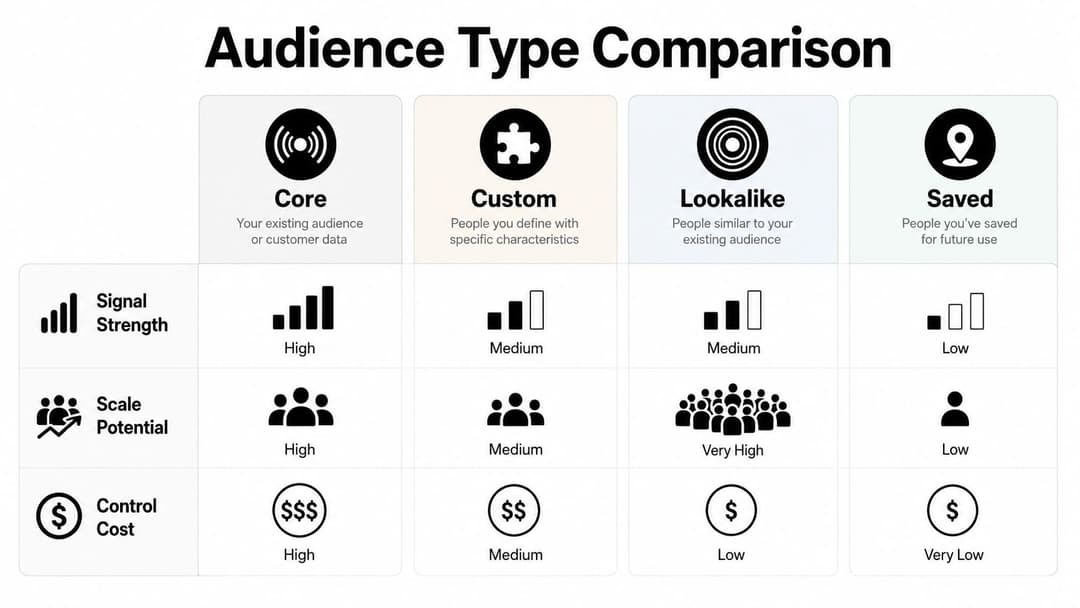
| Audience type | Signal strength | Scale potential | Control cost | Best use |
|---|---|---|---|---|
| Core | Broad and often noisy | High | Lower manual control, but more validation required | Discovery when first-party data is thin |
| Custom | Strongest direct intent | Limited by source size | Higher maintenance and freshness requirements | Retargeting, exclusions, customer lifecycle |
| Lookalike | Depends entirely on seed quality | High | Moderate, because expansion trades precision for reach | Prospecting from valuable customer patterns |
| Saved | No independent signal | Depends on the rules inside it | Low setup cost, high risk of strategic misuse | Reusable targeting container |
Core Audiences can help when the account lacks enough first-party information to seed prospecting. Interest and behavior filters offer a starting hypothesis, but inferred interests can be noisy. A North Carolina State University study found that Facebook's inferred interests didn't reliably capture the situational meaning of user activity, so interest targeting should be judged by conversion quality rather than assumed intent (the study on Facebook interest profiling).
Custom Audiences carry the strongest direct relationship with your brand, but they can saturate quickly. Use them for retargeting, purchase exclusions, customer progression, and seed construction.
Lookalikes extend a source audience. A lookalike built from repeat purchasers is not equivalent to one built from free-trial users. The seed defines the commercial behavior Meta is trying to reproduce. Review how Meta lookalike audiences work before expanding a seed because the estimated reach looks attractive.
Saved Audiences are containers, not strategy. Save a well-defined hypothesis so the team can reuse it, but don't mistake naming and storage for segmentation quality.
A useful decision rule is to expand from a Custom Audience into a Lookalike once the Custom Audience is absorbing roughly $5,000 per week in campaign spend. That threshold is a practical operating guideline, not a universal law. If scale and precision are both unresolved, test Broad with strong creative before adding another interest layer. More targeting rarely beats better signal.
Building Segments in Ads Manager Without Creating a Mess
Ads Manager rewards discipline because every audience becomes an object other people may reuse. A naming system and an overlap check prevent the account from turning into a library of ambiguous lists.
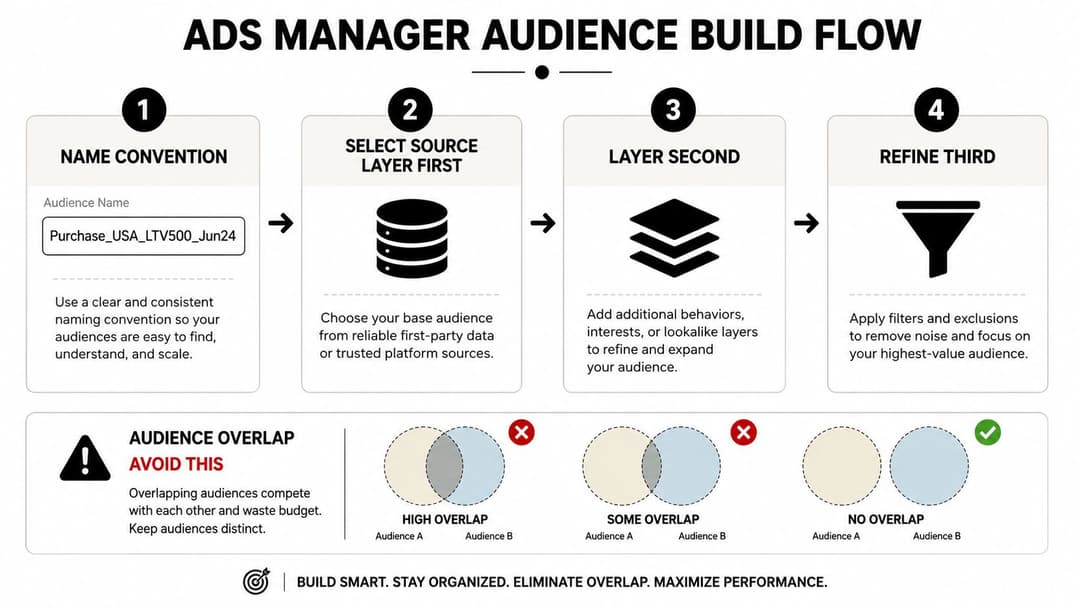
Build in a fixed sequence
Name the audience before saving it. Use a structure such as
objective_country_seedLTV_date. A name likePurchase_USA_LTV500_Jun24tells the next buyer what the segment is intended to do, where it applies, what value logic shaped it, and when it was created. More detail on this operating habit appears in Facebook Ads naming conventions.Select the source layer first. Start with the data source, such as purchasers, qualified leads, product viewers, or Instagram engagers. Don't begin by stacking interests around an undefined customer state.
Layer second. Add a meaningful behavioral or value condition only when it supports a clear hypothesis. Examples include recent purchasers, repeat customers, or people who engaged with a specific product category.
Refine third. Apply geography, exclusions, placement logic, or other constraints after the source and behavior are clear. Refinement should improve relevance, not compensate for a weak seed.
The most commonly skipped step happens before you click save. Preview estimated reach for related audiences side by side and perform a pairwise overlap check. Compare purchaser versus repeat purchaser, recent engagers versus site visitors, and each prospecting lookalike against its source. If two ad sets are competing for nearly the same people, the budget split becomes difficult to interpret and delivery can cannibalize itself.
Make exclusions local and deliberate
Exclude past purchasers at the ad set level when the objective is acquisition. That keeps the rule attached to the audience logic and makes it visible to anyone editing the ad set. For prospecting, exclude the source customer list from its lookalike structure where appropriate, and prevent purchaser lookalikes from competing with other purchaser-based expansion pools.
Use a master naming sheet with the source, inclusion logic, exclusion logic, owner, and last refresh date. Keep active audience stacks limited to three per campaign as an operating guardrail. Retire audiences that no longer support the account's conversion history, including audiences below 100 conversions, rather than allowing obsolete objects to remain available indefinitely.
The objective isn't to create every possible segment. It's to make each live segment explainable, distinct, and measurable.
A Framework for Testing Segments Without Lying to Yourself
Most audience tests fail before launch because the team changes too many variables at once. One ad set gets a new seed, another gets different creative, a third receives more budget, and the winner is declared from a small difference in reported CPA. That isn't a segmentation test. It's an uncontrolled comparison.
Isolate the variable
Use one variable per test cell. If you're testing audience logic, keep the creative, landing page, optimization event, placements, and schedule consistent. Turn off Advantage Campaign Budget for the test so one cell doesn't receive an unplanned budget advantage. Hold out a control where the account structure allows it, especially when you're evaluating whether a new audience adds incremental value rather than just capturing conversions that would have happened anyway.
| Element | Requirement | Common mistake |
|---|---|---|
| Test variable | Change audience or seed, not both | Rebuilding the audience and creative together |
| Creative | Identical across cells | Giving one audience the newest winner |
| Budget | Controlled split | Letting campaign-level automation skew spend |
| Control | Defined comparison group | Comparing against a different historical period |
| Measurement | Agreed KPI and attribution view | Switching reporting views after launch |
| Decision rule | Set before delivery | Promoting the first apparent winner |
Set a meaningful difference before launch. A test plan may use a 20% relative CPA lift, 80% power, a 7-day window, and 50 conversions per cell as its minimum detectable effect framework. Those are planning requirements from the test design, not verified performance results. If the cells can't reach the required evidence, don't call a winner.
Read the account in layers
Use Campaign Reports breakdowns to inspect audience-level delivery, spend, reach, frequency, clicks, and conversions. Use a formal A/B test when you need a cleaner comparison and the account can support the required sample. Meta's reported CPA can move by 15% to 25% during delivery fluctuation, so a small early difference should remain a monitoring signal, not a promotion decision.
A practical example is a purchaser lookalike that appears to beat broad targeting after a brief launch. If the difference is below the pre-agreed threshold, the correct action is to continue the test or repeat it with a fresh cycle. Promote a segment only after two consecutive test cycles support the same decision, and document what changed between cycles.
For a deeper treatment of holdouts and causal measurement, use this guide to incrementality testing. The point is not statistical theater. It's protecting budget from confident decisions based on unstable platform reporting.
KPIs, Attribution, and a Weekly Optimization Rhythm
Audience decisions are only as good as the KPI attached to them. A segment can produce cheap clicks and poor customers, or expensive leads that sales values highly. Start with the business objective, then select the reporting view that reflects how that objective happens.
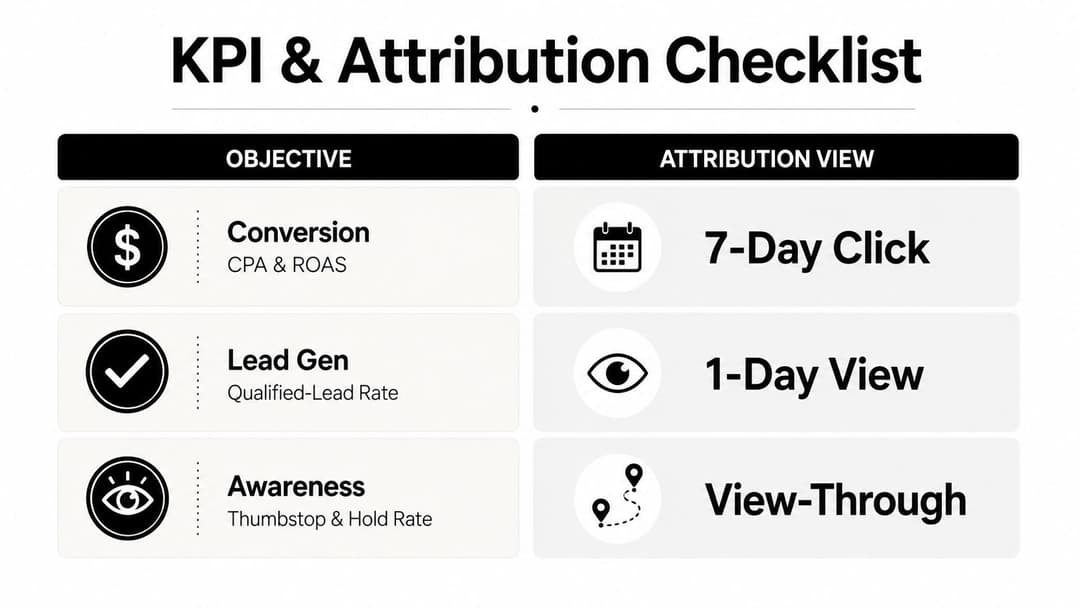
| Objective | Primary KPI | Useful attribution view |
|---|---|---|
| Conversion | Purchase CPA and ROAS | 7-day click for direct response |
| Lead generation | Qualified-lead rate | A shorter click view when lead quality is the priority |
| Awareness | Thumbstop and hold rate | 1-day click or view-through context for upper funnel |
Use the 7-day click view for direct-response decisions when the buying cycle supports delayed conversion. A 1-day click view can be more appropriate for upper-funnel analysis, while view-through context may help explain awareness influence. Override the default when your sales cycle, CRM feedback, or offline close data shows that the platform's standard view doesn't match the customer path. Resources such as how Exerta attributes chat-driven revenue are useful when conversations, calls, or assisted interactions sit between the ad click and the final sale.
Run a weekly operating cadence
- Monday, KPI review: Compare each audience against the agreed target, then check whether changes came from conversion rate, average order value, lead quality, or delivery.
- Wednesday, audience cut: Break out CPA and conversion quality by audience, seed, creative angle, placement, and lifecycle state. Look for outliers before editing the whole campaign.
- Friday, creative decision: Review frequency, declining engagement, and audience size together. If the audience is small and the creative is tired, refresh the message before narrowing targeting again.
Segmentation becomes a feedback loop. Creative performance tells you which audience motivations deserve a new test. Downstream sales or purchase data tells you whether the platform's optimization event represents value. A useful overview of marketing attribution models can help teams keep those views consistent across channels.
AdStellar AI is one workflow option for teams that want to generate and compare large combinations of Meta creative, copy, and audience inputs, then rank performance against CPA, CPL, or ROAS inside a central system. It can connect with Meta Ads Manager, use historical performance, and organize campaign, creative, audience, and breakdown workflows.
Troubleshooting Segmentation Problems Before They Become Spend Drains
A weak campaign doesn't automatically need a new audience. Rebuilding from scratch is often the most expensive response because it discards useful structure before anyone identifies the actual failure mode.
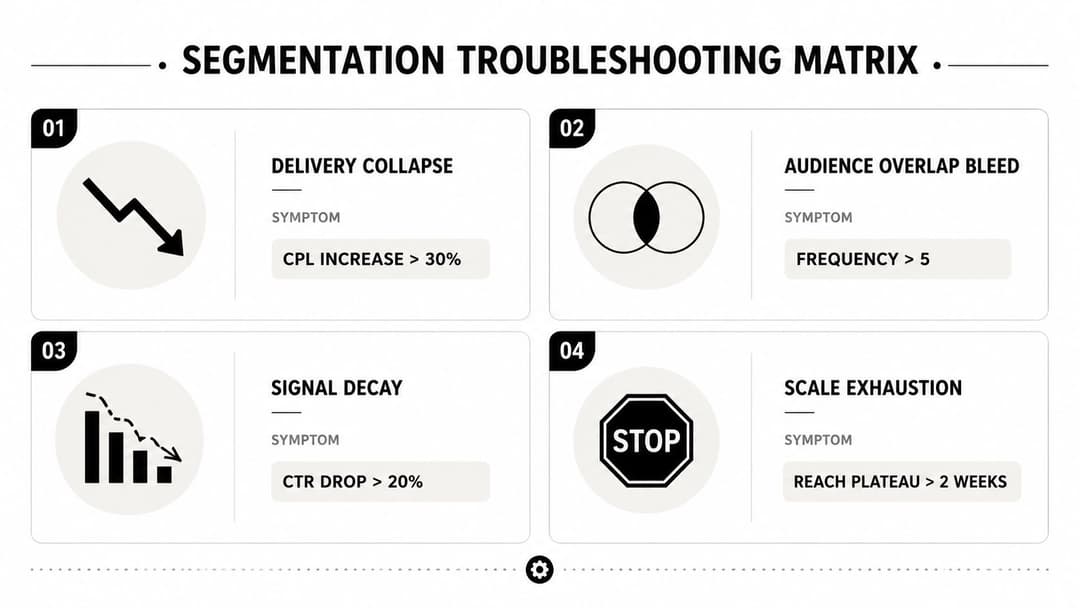
Diagnose the symptom first
Delivery collapse usually points to excessive restriction, a small eligible pool, or conflicting exclusions. First inspect reach and delivery at the ad-set level. If one exclusion removes the people another rule needs, edit that local condition before changing the entire campaign.
Audience overlap bleed appears when multiple ad sets can reach the same people. Compare the audience definitions and exclusions, then consolidate or make one segment mutually exclusive. Don't add another interest stack to solve a structural collision.
Signal decay occurs when a seed is stale, engagement has cooled, or the audience has seen too much of the same message. A 1% Lookalike seeded by fewer than 100 purchasers is a warning sign, not proof that lookalikes have failed. Refresh the seed, verify the event source, and inspect whether the audience still represents current customer value.
Attribution mismatch happens when Ads Manager reports conversions that sales, CRM, or finance can't validate. Check event timing, duplicate browser and server events, offline upload logic, and the selected attribution view. Changing targeting won't repair measurement.
Apply the smallest structural fix
Use this decision tree:
- Delivery is restricted: Edit the narrowest audience rule or exclusion first.
- Ad sets overlap: Adjust exclusions or consolidate competing stacks.
- The seed is stale: Refresh the CRM, event, or engagement source before rebuilding the campaign.
- The signal is valid but response is weakening: Escalate to creative testing and message rotation.
- Platform and business reporting disagree: Repair event mapping and attribution before touching targeting.
The first fix should always be the most local one. That protects the account from unnecessary rebuilds and leaves a clearer record of what changed.
Run a short triage before making edits. Confirm the audience source, last refresh, conversion event, exclusions, overlap with active ad sets, creative frequency, and the business-side conversion record. If those checks point to creative fatigue, don't punish a healthy audience for a tired ad. If they point to stale data, don't manufacture a new interest theory.
AdStellar AI helps media buyers turn audience segmentation into a repeatable Meta workflow by organizing audience, creative, campaign, and performance data in one place. Use it to generate and test audience combinations, identify which segments are contributing to CPA, CPL, or ROAS, and reduce the manual work behind each rebuild. Visit AdStellar AI to see how the platform can support your next segmentation test.