Your CRM is full. Your CDP dashboard is green. Thousands of customer profiles sit neatly inside systems your team paid to implement, yet Meta still receives a thin, delayed version of what those customers did. Campaigns target incomplete audiences, recent purchasers keep seeing acquisition ads, and the team spends more time exporting CSVs than learning from outcomes.
That's the uncomfortable reality of first-party data activation. The hard part isn't collecting another identifier or adding another tracking tag. It's turning consented customer activity into a matched identity, a correctly shipped event, and a signal that reaches a bidding system while the decision still matters. The practical playbook below treats activation as the product, not as the final checkbox after data collection.
Why Most First Party Data Programs Fail Silently
A team can own years of customer records and still have little usable signal in its campaigns. CRM counts, event volume, tag coverage, and dashboard totals measure inventory. They do not show whether a consented event reaches a bidding system in time to influence a decision.
An independent 2026 audit found a median activation rate of 34%, leaving roughly two-thirds of collected first-party data unused for personalization, segmentation, or model training. The same audit found 67% activation among top performers and 11% among the bottom quartile (independent 2026 activation audit). That spread points to the activation layer as the critical product. Identity stitching, consent handling, workflow latency, destination compatibility, and delivery reliability determine whether collection produces value.
Practical rule: Count the records that arrive at the decision point, not the records sitting in storage.
A well-funded brand may hold clean purchase history yet fail to deliver a usable customer segment to Meta. A smaller team with one dependable Conversions API connection, a clear suppression audience, and consistent event naming can provide more actionable signal. The limiting factor is often activation infrastructure, rather than the amount of data acquired.
The activation gap
The table uses the audit's median finding to make the operating problem visible. “Collected” means the available record base. “Activated” means the portion used in a campaign, personalization workflow, or model during the relevant activation window.
| Data Source | Collected (Median) | Activated (Median) | Gap |
|---|---|---|---|
| First-party customer records | 100% of collected records | 34% | Roughly two-thirds not activated |
A clear explanation of first-party data helps teams separate owned, consented signals from indirectly sourced data. The definition does not put a profile into production. Every step in this playbook should improve one of three outcomes: matched identity, shipped event, or attributable revenue.
The 2021 Boston Consulting Group benchmark remains a useful directional reference. Its summary associates advanced first-party data activation with 2.9× higher revenue uplift and about 1.5× cost savings compared with less advanced approaches, as reported in FirstPartyData.com's BCG reference. Those figures are not a forecast for every brand. They support a more practical conclusion: a stored profile creates potential, while a reliable signal creates an opportunity to optimize.
Auditing Your Data and Getting Ingestion Right
Start with an operational audit, not a catalog of every table your business owns. The question isn't “How much data do we have?” It's “Can the activation layer receive the right event, with the right identity, consent state, and value, inside the decision window?”
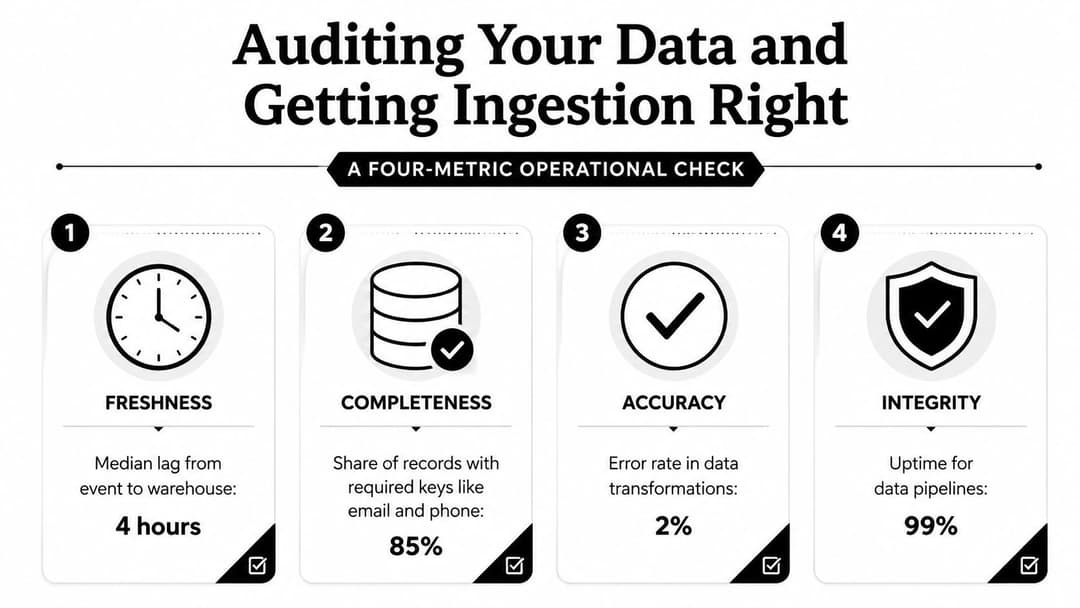
Four checks expose most ingestion failures:
- Freshness measures the median lag between an event and its arrival in the warehouse or activation layer. A checkout event arriving 36 hours late is too old for timely value-based bidding, even if the payload is otherwise perfect.
- Completeness measures whether records contain the keys required for matching and optimization, such as email, phone, external ID, order ID, currency, and event time.
- Schema stability tracks breaking changes in event names, fields, types, and enumerations. A renamed
purchase_valuefield can turn revenue optimization into event counting. - Consent integrity confirms that a consent state, timestamp, and policy version travel with the record from collection through activation.
Turn the audit into an SLO
Put these checks in the warehouse and review them on a recurring operating cadence. A dashboard should flag late events, missing keys, invalid values, duplicate event IDs, and consent states that don't map to an approved use. The team responsible for ingestion should own the alerts, not discover failures after a campaign underperforms.
The practical benchmark for activation uses coverage rate, match rate, freshness, and activation rate in sequence. Enterprise programs commonly target 60% to 75% coverage, 80% to 90% deterministic match rate, attribute freshness of under 7 days for active customers, and an activation rate above 40% for data used within the last 90 days, as summarized in the first-party data activation benchmark. These are operating targets, not universal guarantees. Your thresholds should reflect event value, sales-cycle length, consent requirements, and destination behavior.
Enforce quality at the boundary
Fixing a malformed event after it reaches Meta is expensive. Enforce required keys before records enter the activation layer, deduplicate at ingestion, normalize currencies and timestamps, and attach consent before downstream exports. For website behavior, combine the warehouse audit with a practical website visitor tracking workflow so anonymous activity and known customer events follow compatible naming and identity rules.
A usable foundation stays usable week after week. If freshness deteriorates, completeness falls, or consent becomes detached from the payload, stop adding audiences and repair ingestion first.
Identity Resolution and Stitching Customers Together
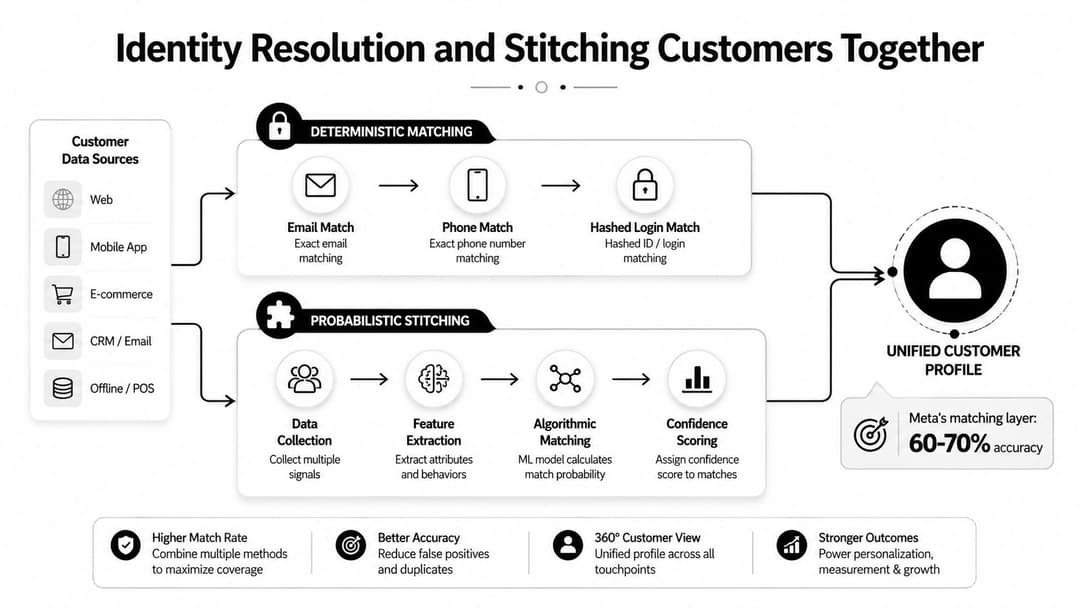
A customer can appear as a CRM contact, email subscriber, logged-in browser, mobile device, and offline purchaser. If those records remain separate, Meta receives fragments rather than a usable behavioral history. Identity resolution turns those fragments into an activation layer that can support suppression, conversion feedback, and audience decisions.
Deterministic matching uses explicit keys such as normalized email, phone number, or a hashed login identifier. These matches are explainable and easier to audit. Probabilistic stitching estimates that records belong to the same person from signals such as device, timing, geography, or behavior. It can extend usable reach, but uncertainty requires tighter confidence thresholds, consent controls, and review procedures.
The practical Meta target in the plan is a deterministic match rate of 60% to 70%. Claims of 90% may reflect weak keys or favorable counting rules. A separate enterprise benchmark describes 80% to 90% as a common deterministic match target, as noted earlier. The figures can coexist when the denominator and destination differ. Define whether the rate covers all ingested records, eligible records, or records sent to Meta before evaluating performance.
Make three identity decisions explicit
First, select a canonical customer ID. It should remain stable when an email changes, a browser resets, or a customer purchases offline. Second, define how anonymous activity becomes known activity. A login, email click, or completed form can establish the link, but the rule must specify which historical events may join and which consent state permits that join.
Third, define how offline conversions re-enter the online graph. A store purchase, sales-qualified lead, or subscription payment should carry the same stable identifier used online, where lawful and technically possible. The offline conversion tracking guide explains the handoff mechanics.
Consider a repeat purchaser who opens an email on a laptop, returns on a phone, and completes a purchase after a sales-assisted interaction. Separate records can cause acquisition retargeting after conversion and leave revenue out of optimization. Approved identifiers stitched into one profile let the system suppress that customer from acquisition, classify the conversion correctly, and send a stronger value signal back to bidding.
Store identity rules in version control. Document normalization, key precedence, match confidence, consent conditions, merge behavior, and rollback procedures. A spreadsheet owned by one analyst is not governance. It is a single point of failure. Review the rules when identifiers, destinations, or consent requirements change.
Turning Resolved Profiles into Segments and Models
A resolved profile has no marketing value until it changes who Meta reaches, excludes, or learns from. Build audiences around decisions, not around every field available in the customer record.
Start with a high-intent retargeting pool. Cart abandoners, repeat product-page viewers, and recent email engagers can support different messages because their behavioral context differs. Keep the audience definitions narrow enough that creative and offer decisions remain meaningful.
Next, create a value-led prospecting seed. Rank customers using purchase value, repeat behavior, margin, or retention quality, then use the highest-value group as the source for a modeled audience. A simple RFM score can work when the business lacks a mature model. A logistic propensity model can estimate churn or upsell likelihood when the team has enough labeled outcomes and a disciplined validation process. The important point is to map each score band to an action that Meta can consume.
The third tier is suppression. Recent converters, active subscribers, existing account holders, or customers in a service recovery process may need exclusion rather than additional acquisition pressure. Suppression protects spend and keeps customer experience aligned with lifecycle status.
Match the audience to the decision
| Tier | Source Signal | Meta Format | Refresh Cadence |
|---|---|---|---|
| High intent | Cart, product, or email engagement | Custom audience | Frequent, based on event recency |
| High value | Purchase value, margin, or repeat behavior | Customer seed and modeled audience | On a defined data refresh cycle |
| Suppression | Recent conversion or active customer status | Exclusion custom audience | Tied to status changes |
Use stable inclusion and exclusion logic. A retargeting audience should expire when intent becomes stale, while a suppression audience should update as soon as a purchase or account event changes eligibility.
For teams exploring predictive methods, predictive modeling for marketing decisions provides useful context. The model doesn't need to be elaborate to be useful. It needs reliable labels, explainable inputs, a clear destination, and a refresh process that prevents yesterday's score from controlling today's spend.
AI-driven platforms such as AdStellar AI can compress the manual work by clustering resolved profiles, suggesting seed audiences, generating creative and audience combinations, and supporting campaign deployment through Meta workflows. Automation only helps when the underlying identity, consent, and event data are reliable. Otherwise, it moves bad segments faster.
Connecting Audiences to Meta Without Losing Events
Browser-only measurement creates a blind spot before an audience can inform optimization. The verified technical benchmark reports that pixel-only Meta setups can lose roughly 30% to 40% of events, while adding the Conversions API can reduce loss to about 5%, as described in the server-side tracking and Conversion API playbook. The causes include browser restrictions, ad blockers, and platform privacy controls. A campaign can't optimize toward a conversion it never receives.

Build a dependable CAPI path
Send conversion events from the backend through server-side GTM or an equivalent server-side collection layer. Include approved, normalized first-party identifiers such as hashed email or external ID, alongside event name, event time, value, currency, and the appropriate action source.
The browser pixel and server event must share a deduplication key. In practice, that means generating one event_id for the conversion and passing it through both paths. Without that shared key, Meta can count one purchase twice. With inconsistent event names or timestamps, it may reject, delay, or misclassify the signal.
A practical implementation sequence looks like this:
- Define the event contract: Document required fields, allowed values, consent conditions, and ownership for each event.
- Route server-side: Send backend-confirmed events through server-side GTM into the Conversions API.
- Map identity carefully: Pass only permitted identifiers, normalize them consistently, and use an external ID that connects to your governed customer graph.
- Validate deduplication: Compare browser and server event volumes, shared IDs, and duplicate outcomes before increasing spend.
- Monitor destination quality: Track match rate, suppression delivery, activation delivery, event delay, and downstream campaign behavior.
Watch for event hygiene problems. Duplicate firing can make a funnel appear healthier than it is. Missing currency can undermine value optimization. Stale attributes can inflate audience size without improving relevance. More data isn't automatically better data.
A technical connection to Meta's Facebook Conversion API workflow should include testing in Events Manager before scaling campaigns. The activation layer needs observability, with alerts when match scores decline, deduplication fails, or a parameter changes unexpectedly.
The following video provides another practical reference point for teams reviewing server-side event delivery.
Independent benchmarks reported in the same 2026 playbook indicate that improving activation from median to top-quartile performance can correspond with a 2.1× rise in marketing ROI. The operational implication is clear. Improve quality and delivery reliability before collecting more identifiers.
Privacy, Consent, and Measurement as One Feedback Loop
Consent isn't a legal appendix to activation. It determines which identifiers can survive into a destination, which events can be used for targeting, and which outcomes can be measured. If consent is missing, stale, or disconnected from the payload, the system may either activate data it shouldn't use or exclude more people than necessary.
Centralize consent in a consent management platform that records the decision, timestamp, policy version, and permitted purposes. Pass that state into the CDP and server-side event layer. Exclude opted-out users before audience export, not after a campaign has already consumed the audience.
Treat measurement as a control system
Meta's Aggregated Event Measurement can support platform reporting, but it shouldn't be the only way you judge an audience. Pair platform outcomes with first-party holdouts, incrementality tests, and business-level revenue validation. A modeled audience that reports conversions may still fail to create incremental demand if it mostly captures people who would have purchased anyway.
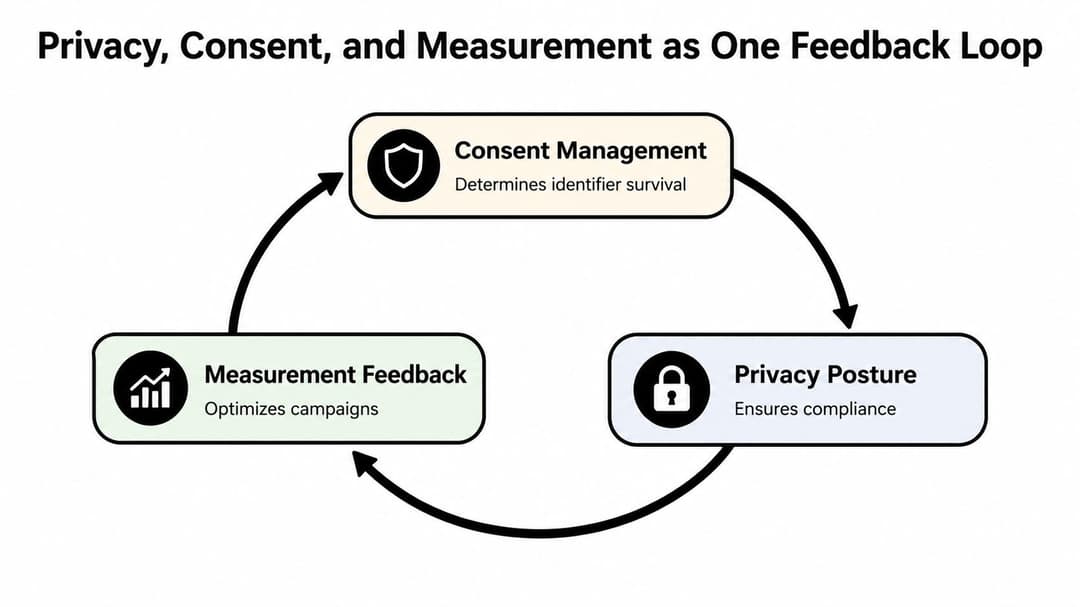
The loop should work like this:
- Consent management determines whether an identifier and event may be used.
- Privacy controls enforce that decision across storage, transformation, and destination.
- Measurement compares exposed outcomes with appropriate holdouts.
- Learning updates audience definitions, bidding rules, and creative priorities.
- Governance records the change so the next test remains interpretable.
That loop also gives privacy teams better evidence. When an opt-out changes reachable audience size or match quality, the effect becomes visible rather than hidden inside a platform metric. When attribution shifts, the team can investigate whether consent, event delivery, identity rules, or campaign structure caused the change.
People should also be able to understand and manage your data rights, especially when brands connect behavioral events with advertising destinations. Clear explanations and accessible controls build trust while giving activation teams a more defensible data foundation.
Compliance doesn't have to block performance. A consent record attached at ingestion, enforced during export, and reflected in measurement creates cleaner signal boundaries. That makes the data easier to use responsibly and easier to interpret.
Operationalizing Continuous Learning and Automation
A first-party data program without a testing cadence is dormant inventory with a dashboard attached. The campaign may launch with carefully built audiences, but performance will plateau if the team never tests whether a segment, message, bid, or suppression rule creates incremental value.
Start every test with a written hypothesis. For example, a recent high-intent audience may respond better to product reassurance than to a broad discount, while a high-value customer seed may need a different creative angle from a general purchaser seed. Define the audience, exposure logic, creative variants, primary outcome, guardrails, and holdout method before launch.
Make the learning cycle visible
A useful operating rhythm connects four signals:
- Audience performance: Which segments produce qualified outcomes, not just cheap clicks?
- Creative response: Which hooks, formats, offers, and product combinations earn attention from each segment?
- Conversion quality: Do platform-reported conversions align with backend orders, qualified leads, or retained customers?
- Bid and budget behavior: Should the system scale, restrict, suppress, or reallocate spend based on the validated result?
Keep the experiment record with the campaign. Record the hypothesis, audience definition, consent rule, event version, creative version, and decision made afterward. This prevents each quarter from becoming a fresh debate about what happened previously.
Automation can shorten the distance between signal and action. Audience refreshes can run from status changes, creative rotations can respond to segment fatigue, and bid adjustments can use validated conversion data rather than delayed manual exports. An AI-driven platform can handle repetitive combinations and surface patterns, but the growth team still needs to decide which tests matter and which business outcomes define success.
The strongest workflow is closed loop:
- Resolve profiles and classify lifecycle or value.
- Push audiences and suppression rules to Meta.
- Capture browser and server events with deduplication.
- Compare platform reporting with first-party outcomes and holdouts.
- Refresh segments, creative, and bids.
- Document the result and launch the next hypothesis.
That's how teams turn activation from a one-time upload into an operating system for growth. The objective isn't to create more campaigns. It's to make every useful event arrive reliably, influence a decision, and produce a learning signal that improves the next one.
AdStellar AI helps growth teams connect first-party signals with Meta campaign execution by organizing audiences, creative combinations, launches, and performance feedback in one workflow. Visit AdStellar AI to see how you can reduce manual setup, refresh activation workflows, and turn validated customer data into faster campaign experiments.