You're watching campaigns stall for the stupidest reasons. Creative is approved, but the upload queue is full. The budget is ready, but someone still needs to check policy, fix tracking, and reconcile the numbers before launch. Meanwhile, the competitor with a cleaner workflow is already learning from live data.
That's where the self service ad platform changed the game. Instead of waiting on a sales rep or a managed-service queue, advertisers can build, launch, and optimize directly in the interface, which is why platforms like Google Ads, Meta Ads Manager, LinkedIn Campaign Manager, and Amazon Advertising became the default for so much of digital buying, and why they accounted for roughly 65% of global digital ad spend in 2024 (Advergize glossary on self-service advertising platforms). The model pushed ad buying from manual ordering into always-on software workflows, with budgets, targeting, and creative controlled in the platform itself.
For a practical breakdown of how campaign automation changes execution, the guide on self-service ads with Tagada is a useful companion read. For teams also thinking about paid social automation, the approach overlaps with what's covered in performance marketing AI.
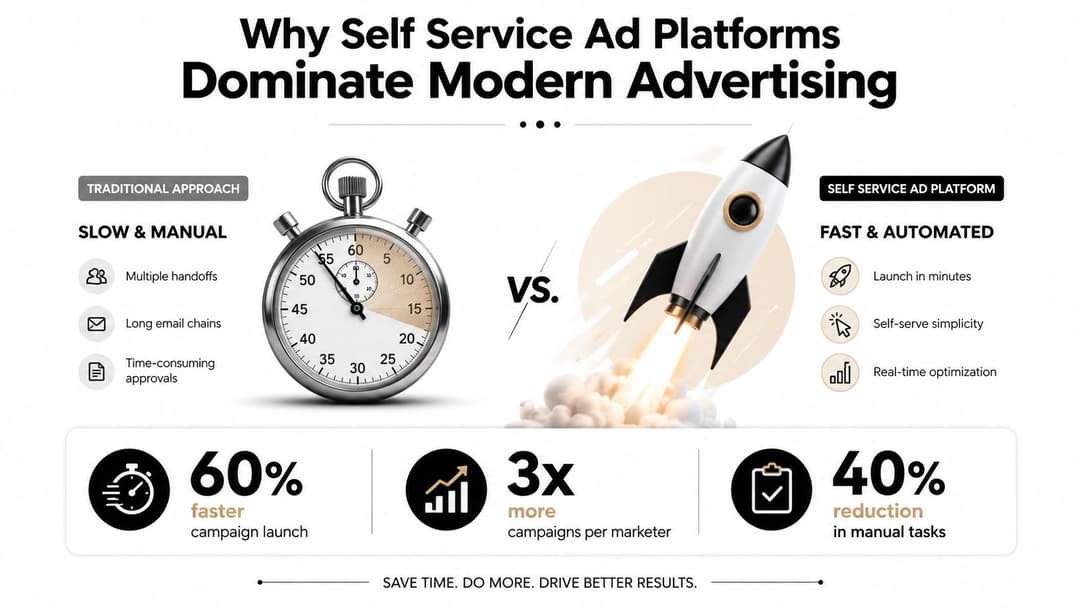
Why Self Service Ad Platforms Dominate Modern Advertising
A performance marketer can lose half a day to the same grind, adjusting bids, re-uploading creative, waiting for approval, and checking whether the audience is even eligible. The frustrating part is not only the delay, it is the way every manual step slows the learning loop. While one team is still stitching together the campaign, another has already launched, tested, and moved on to the next variation.
The shift from ordering to operating
The change with a self service ad platform is operational. Buying ads stopped looking like a one-time purchase and started looking like software operations, where the advertiser owns the controls and can change them without waiting for human mediation. That shift matters most when speed compounds into advantage, because the account that learns faster usually finds the winners faster.
That is also why self-service is no longer just for giant brands. Startups, agencies, e-commerce teams, and B2B marketers use the same model at very different spend levels because entry is no longer gated by a sales process. According to the platform economics summarized in the verified data, Meta and Amazon allow daily budgets as low as $1, LinkedIn requires at least $10 per day, and Google Ads has no formal minimum (Advergize glossary on self-service advertising platforms). The point is not that every budget is enough to win, it is that access itself is no longer restricted to enterprise buyers.
Practical rule: if a platform lets you launch, optimize, and measure without waiting on a person to push the next step, you are already working in self-service.
The market has rewarded that model because it fits how teams buy media now. Major platforms dominate because they combine software, inventory, reporting, and optimization in one place, and the workflow is familiar enough that operators can move quickly without re-learning the basics every time. That speed has a cost, though, and teams often miss it until the bills show up in policy reviews, creative revisions, tracking fixes, and internal reconciliation.
For a deeper look at how automation changes paid media operations, the discussion at AdStellar AI's ad-tech platform guide is a helpful reference point. The same practical tension shows up in self-service ads with Tagada, where the appeal of direct control has to be weighed against the work required to keep campaigns clean and moving.
Why the model keeps spreading
The reason self-service keeps winning is simple, it removes friction from the path between intent and action. When the advertiser controls the budget, targeting, and creative directly, there is less coordination overhead and fewer bottlenecks. That does not make the work easy, but it does make it faster to iterate.
The bigger reason teams keep adopting it is economic. Self-service can reduce vendor dependency, but it does not remove operating cost. Someone still has to review policy issues, fix broken URLs, check event tracking, reconcile invoices, and make creative updates when performance starts to slip. For smaller teams, those chores can erase part of the savings they expected from skipping managed service. For larger teams, the break-even point often depends on whether internal labor is cheaper than external support, and whether the team can keep enough pace to justify the extra workload.
The platform becomes the operating layer, not just the buying channel. That is what sets up the rest of the decision, because once control moves into software, the question becomes whether your team can absorb the operational responsibility that comes with it.
Core Features That Define a Self Service Ad Platform
A competent self service ad platform feels less like ordering from a vendor and more like working in a fully equipped kitchen. You get the tools, the ingredients, and the controls, but you also own the cleanup, the timing, and the quality of the final dish. That trade-off is what separates convenience from capability.
Campaign creation, targeting, and budget control
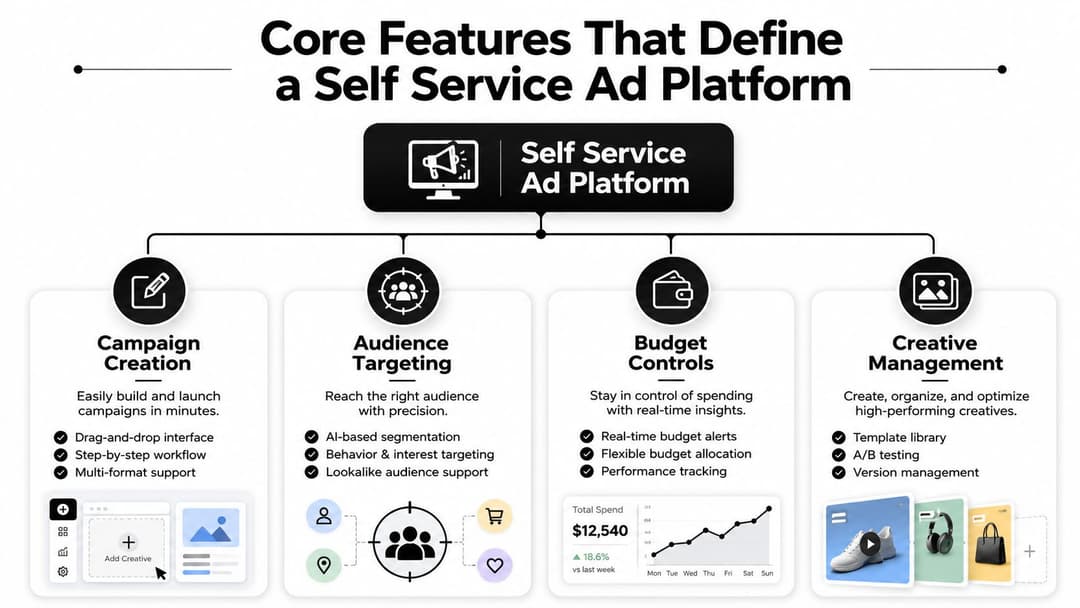
At the center of any good platform is a campaign builder that lets you set objective, audience, placement, schedule, and spend without waiting on an ops queue. The interface should make it easy to duplicate campaigns, adjust parameters, and preserve the structure of what already works. If the build process is clunky, teams end up treating the platform like a ticketing system instead of a live operating environment.
Audience tools matter just as much. Strong platforms don't just offer broad demographic filters, they help marketers segment by behavior, intent, account list, or platform-specific signal. That's where the practical value shows up, because targeting is what turns a generic media buy into a controlled test.
Budgeting is the other critical part. Good platforms expose pacing, daily limits, and spend visibility clearly enough that a marketer can catch problems before they become expensive. If the system hides where the money is going, the self-service label doesn't mean much.
Creative management and live reporting
Creative management is where a lot of teams underestimate the workload. A strong platform should support asset upload, versioning, testing, and reusable templates, so the team isn't rebuilding the same ad from scratch every time. The more variations you can handle cleanly, the less the workflow depends on manual copy-paste labor.
Real-time reporting is the part that turns the platform from a purchase tool into a performance tool. The dashboard should surface impressions, clicks, conversions, and rate metrics in a way that helps the operator make the next decision quickly. The verified research on self-service workflows found that better control can translate into stronger engagement and conversion efficiency when teams can test and iterate faster (homegrown self-service ad stack study).
Operational takeaway: if the dashboard can't tell you what changed, when it changed, and which audience or creative drove it, the workflow isn't really self-service.
For teams evaluating interface quality and automation depth, AdStellar AI's campaign builder guide is relevant because it shows how campaign assembly can be reduced to a single working surface rather than a sequence of disconnected steps.
What modern platforms add on top
Modern systems increasingly layer in AI-assisted insights, bulk creative generation, and automated optimization. That doesn't replace judgment, but it removes repetitive work that used to slow down testing. In practice, the best setups make it easier to move from one winner to the next without rebuilding the entire machine each time.
Self Service vs Managed Services vs DSPs
Teams often treat self-service as the default choice, but the better model depends on how much operating work your team can absorb. Media cost is only part of the equation. Once policy checks, creative revisions, tracking cleanup, and reporting reconciliation land on your team, the cheaper-looking setup can become the more expensive one.
A self service ad platform gives you direct control and faster iteration. Managed or agency services add a human layer that can absorb complexity, strategy, and troubleshooting. A DSP usually fits when the goal is programmatic buying at scale, especially if your team already knows how to operate in that environment and has the discipline to keep setup and reporting clean.
The mistake is assuming self-service automatically wins on cost. It can, but only when the team has the internal capacity to keep the account healthy without turning every rejection, pixel issue, or naming mismatch into a long back-and-forth. If the platform is easy to launch but hard to maintain, the labor bill shows up inside marketing, operations, and finance instead of on the platform invoice.
| Criteria | Self-Service Platform | Managed/Agency Service | DSP |
|---|---|---|---|
| Cost structure | Lower platform fees, higher internal labor | Higher service cost, lower internal execution burden | Platform and media costs vary, often more complex |
| Speed to launch | Fast once the workflow is set up | Slower, because work passes through people | Fast for programmatic buyers with the right setup |
| Control and customization | High | Medium to high, depending on the partner | High within programmatic rules |
| Expertise required | Medium to high | Lower on the buyer side | High |
| Reporting transparency | High when the platform is built well | Depends on the agency process | Strong on delivery, but can be technical |
| Scalability | Strong for teams that can operate it | Strong with the right partner bandwidth | Strong for scale-focused media teams |
The question is whether you want to own the operating system or pay someone else to run it. If your team is lean and the account is mission-critical, managed support is often the safer call. If your team can move quickly, handle policy review, and keep tracking tight, self-service usually makes more sense.
For a broader view of how buying models sit inside the stack, AdStellar AI's ad-tech platform article is useful because it shows how the technology layer shapes execution speed and reporting clarity. For teams comparing automated support with human-led campaign help, Algomizer's advertising agent guide gives a practical reference point.
Where each model wins
Self-service wins when the team needs direct control, rapid iteration, and clean visibility into what changed. Managed services win when strategy, troubleshooting, or creative production would otherwise take too much of the team's time. DSPs win when buying needs are tied to programmatic scale and the operators already know how to work inside that environment.
The break-even point is where many teams get surprised. A self-service buy can look efficient on paper and still lose to a managed model once policy review, creative edits, tracking fixes, and internal reconciliation are counted. That is the hidden operational cost most comparisons skip, and it is usually the line that decides whether self-serve saves money for your team.
The Real Trade-Offs and Hidden Costs
The biggest myth around self-service is that it automatically saves money. In reality, it just moves work from a vendor to your team, and that work doesn't disappear because the interface looks cleaner. Policy checks, creative revisions, tracking fixes, attribution cleanup, and internal reconciliation still have to be done by someone.
Where the hidden cost shows up
A platform can be self-service and still be operationally expensive. If your team spends time checking policy compliance, updating ad copy after rejections, and rebuilding tracking when pixels break, the labor cost can eat away at the budget advantage. The same is true when finance and marketing can't agree on revenue numbers because campaign metadata wasn't preserved end to end.
That break-even question matters more than most buyers admit. The right lens is not “what does the platform cost,” but “what does launch plus support plus cleanup cost over the life of the campaign.” Recent guidance on self-serve economics pushes exactly that view, especially when support requests are frequent and attribution is fragile (Tagada on self-service ad platform break-even thinking).
The verified architecture data also helps explain why the systems need to be so disciplined. A self-serve ad platform that supports real-time launch and optimization typically uses an event-driven architecture with a sub-millisecond ad-delivery path, because every request has to evaluate targeting, bid eligibility, budget availability, and frequency caps before serving an impression (Inexture on self-serve advertising platform architecture). That's great for speed, but it also means any weakness in data flow, counters, or state management can cause problems downstream.
If the platform can't preserve campaign metadata, conversion records, and payment outcomes together, you'll spend more time arguing about truth than improving performance.
What to model before you commit
The simplest break-even model asks three questions. How often will the team need help after launch. How much internal time will policy, creative, tracking, and reconciliation consume. And does the platform keep enough durable conversion and revenue data to support clean optimization decisions.
If those answers are weak, self-service becomes a setup shortcut, not a cost-saving system. If they're strong, the workflow pays off because operators can move from issue to action without waiting on another department.
For teams comparing a managed workflow against a self-directed one, AdStellar AI's comparison of automated platforms and Ads Manager workflows is worth reviewing because it highlights the exact kind of operational friction that changes the true cost of ownership.
How to Evaluate and Implement a Self Service Ad Platform
A practical evaluation starts with the questions that usually get skipped in demos. Can the platform connect cleanly to your CRM, analytics stack, and conversion tracking. Can it handle bulk work without forcing your team back into spreadsheets. Can the reporting show enough detail that media, creative, and finance can all work from the same numbers.
A platform that looks easy in a sales call can become expensive once it hits real operations. The hidden cost is usually not media spend, it is the time spent fixing tracking, reviewing policy issues, editing creative, and reconciling numbers across teams.
What to test before you buy
Start with integration depth. If the platform cannot work with the tools you already rely on, the team will end up exporting data manually and recreating the workflow somewhere else. That usually means the self-service layer is adding process instead of removing it.
Then test automation with real campaigns, not a sandbox. Look at whether the system helps with campaign assembly, creative variant creation, bidding, and adjustment logic. A platform like AdStellar AI is one option in this category because it focuses on bulk ad creation, AI-powered insights, and automated campaign assembly for Meta workflows, but it still needs to fit your stack, your approval flow, and your reporting requirements.
The integration side matters just as much as the ad builder. AdStellar AI's integration guide is a practical place to review how connection choices affect setup time, data flow, and day-to-day maintenance.
A clean implementation path
- Set up account access carefully. Make sure the right people can launch, edit, and approve without creating unnecessary risk.
- Configure pixel and conversion tracking first. If tracking is shaky, every later decision gets worse.
- Build audiences before you launch. Use the signals you already trust, then expand from there.
- Upload creative in a repeatable workflow. The goal is version control, not one-off uploads.
- Launch one pilot campaign. Prove the workflow before you scale spend or complexity.
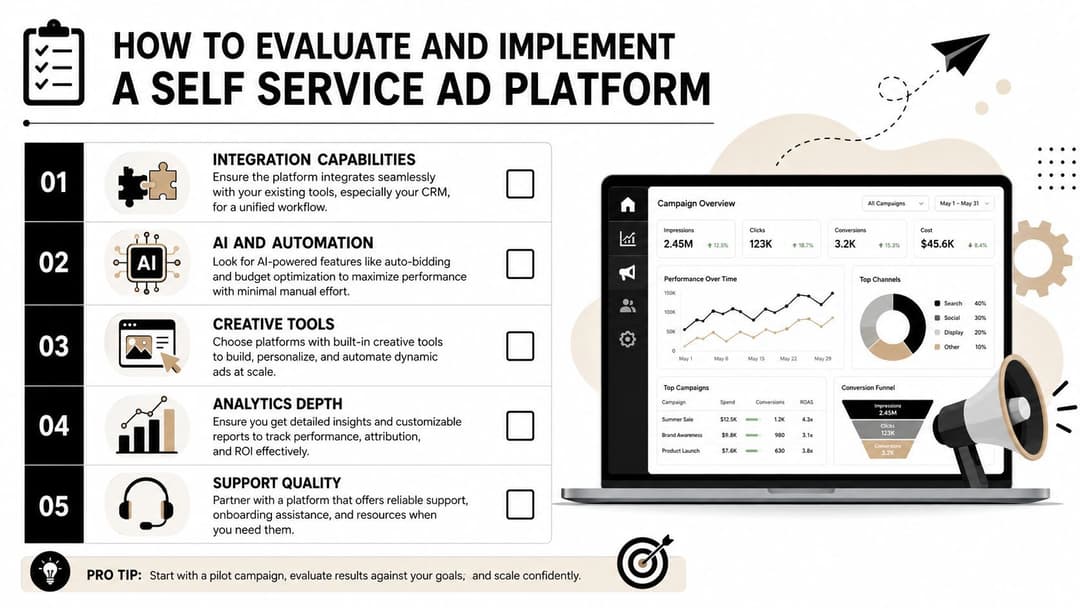
A small pilot tells you more than a product demo ever will. You'll see whether creative approvals are smooth, whether the dashboard is usable, and whether the platform helps the team move faster without creating new errors. The right rollout should reduce friction in week one, not after a quarter of cleanup.
Before you commit, model the break-even point with your own operating reality. Include policy checks, creative edits, tracking fixes, and internal reconciliation time, because those tasks are what often decide whether self-service saves money or just shifts work inside the company.
Quick-start checklist: integration confirmed, tracking validated, audiences built, creative templates ready, pilot budget defined, and reporting reviewed by both marketing and finance.
Real-World Use Cases Across Industries
An e-commerce team lives and dies by creative volume. It needs enough structure to test product angles, hooks, and formats across Meta and Google without rebuilding campaigns by hand every week. In that environment, self-service works when the platform makes bulk creative testing and rapid iteration feel routine instead of exceptional.
Digital agencies use the same model differently. They need a centralized workflow that can separate clients cleanly, keep approvals organized, and move quickly without confusing one account's settings with another's. The operational win is not just speed, it's consistency across many campaigns and many stakeholders.
B2B SaaS teams usually care more about precision than volume. A LinkedIn campaign for lead generation lives or dies on audience quality, offer alignment, and tracking discipline. Self-service helps when it lets the team control targeting and messaging directly, but it can backfire if the account owner doesn't have the patience to maintain clean attribution and review the funnel regularly.
What growth teams usually need
Startups and lean growth teams tend to adopt self-service because they don't have spare headcount. They need enough automation to avoid drowning in setup, but enough control to keep testing their core acquisition channels. That's where AI-assisted creation and automatic assembly become useful, because they reduce the manual drag that usually slows small teams down.
The smartest teams don't try to use every feature on day one. They use the platform to make one workflow repeatable, then expand into the next. That usually means one clear audience, one conversion path, and one reporting standard the whole team trusts.
The most common failure isn't lack of access, it's trying to scale too many moving parts before the team has a stable launch process.
Across industries, the pattern is consistent. Self-service works best when the team has a clear test plan, a reliable tracking stack, and a reason to move faster than a managed workflow would allow. It works less well when the account is so messy that the platform becomes a place to store problems instead of solve them.
Making the Right Decision for Your Team
Choose a self service ad platform if your team values speed, direct control, and tight feedback loops more than hand-holding. Choose managed services if your internal bandwidth is thin and you need strategic support, creative help, or troubleshooting baked into the relationship. Choose a hybrid approach if you want control over launch and optimization, but still need outside support for design, policy, or account operations.
The practical test is simple. If your team can keep tracking clean, creative fresh, and reconciliation disciplined, self-service usually becomes an advantage. If those three areas already create friction, the platform won't fix the operating model by itself.
Start small, measure everything, and treat the first launch as a workflow test, not a proof of scale. Invest in tracking infrastructure early, use AI where it removes repetitive work, and only expand when the process is stable enough to repeat. When that happens, the platform stops being another tool to manage and starts becoming a genuine competitive edge.
If you want a single place to launch Meta campaigns faster, organize creative and audiences, and keep performance visibility in one workflow, AdStellar AI is built around that operating model. It's designed for teams that want to reduce manual campaign assembly and make self-service execution more repeatable. Visit it if you're ready to turn campaign setup into a faster, cleaner process.