You increase the budget, watch results hold for a day, then performance slips. The team blames the audience, duplicates the campaign, changes the bid strategy, and starts another round of testing. A week later, the account has more campaigns, more spend, and less clarity about which creative or signal is doing the work.
That pattern is common because Meta ads at scale aren't a budgeting exercise. Scaling requires a production system for creative, reliable conversion signals, controlled use of automation, and measurement that detects fatigue before CPA becomes the headline problem. Meta's advertising business illustrates the platform's operating environment. In 2025, advertising revenue reached about $196.18 billion out of total revenue of about $200.97 billion, with advertising representing roughly 97.6% of the business. Ad impressions across Meta's Family of Apps rose 12% year over year. Meta advertising statistics and revenue figures
The practical lesson is straightforward: the auction can absorb enormous demand, but your account still needs enough fresh inputs and trustworthy feedback to help the system find the next profitable opportunity.
Why Most Meta Campaigns Stall Before True Scale
A campaign often stalls after its first promising phase. The initial audience is responsive, the original angle earns efficient conversions, and the buyer raises spend. Then delivery expands into less obvious pockets of demand. The same concepts appear repeatedly, conversion signals become noisier, and the media buyer reacts by making several changes at once.
That reaction creates a diagnosis problem. If you change budget, creative, audience, placement, and optimization event together, you can't tell which decision helped or damaged performance. The account may recover, but the team hasn't built a repeatable explanation for the recovery.
Scale is a system, not a spend setting
The auction rewards ads that produce useful predicted outcomes for the platform and the advertiser. In practice, that means Meta needs creative variety, enough conversion feedback, and a campaign structure that doesn't fragment learning unnecessarily. A small account can survive on one strong ad because its limited spend doesn't expose every weakness immediately. A larger account quickly finds those weaknesses.
At scale, four operational failures appear repeatedly:
- Creative starvation: The team launches a few ads, waits for certainty, then keeps spending behind the same concepts after the audience has seen them repeatedly.
- Signal fragmentation: Similar campaigns compete for overlapping users while each campaign receives too little clean conversion information.
- Automation without guardrails: Advantage+ receives broad permission, but the team hasn't defined acceptable CPA, spend limits, exclusions, or creative replacement rules.
- Delayed diagnosis: The dashboard focuses on blended CPA and CPM, so declining hook rate and CTR go unnoticed until conversion efficiency has already deteriorated.
The platform's ranking system is only one part of the result. Your workflow determines whether it has enough quality inputs to make good delivery decisions. A useful primer on how ads are evaluated and ranked is AdStellar's guide to ads ranking, but the operational implication matters more than the terminology. You need to give the system a broad set of credible options, then preserve the signal that tells you which options deserve more budget.
What true scale looks like
True scale means the account can spend more while maintaining a controlled process for finding, validating, deploying, and replacing winners. It doesn't mean every ad performs well or that CPA remains perfectly flat. A scaled account expects variance and manages it.
The strongest teams separate exploration from exploitation. They use structured tests to discover new messages, visuals, offers, and formats. They then move durable winners into campaigns designed for sustained delivery, while keeping a replacement pipeline active. Budget increases become one input in that system, not the system itself.
Practical rule: If the team can't explain where the next batch of creative will come from, how it will be tested, and what signal will trigger replacement, the account isn't ready for aggressive scaling.
Building the Foundation for Scalable Meta Advertising
Before increasing spend, audit the account as if another buyer had to operate it tomorrow. A campaign can look healthy while the underlying event setup, naming, exclusions, and ownership rules make expansion risky. Scaling amplifies those weaknesses because more delivery depends on the same measurement and workflow.
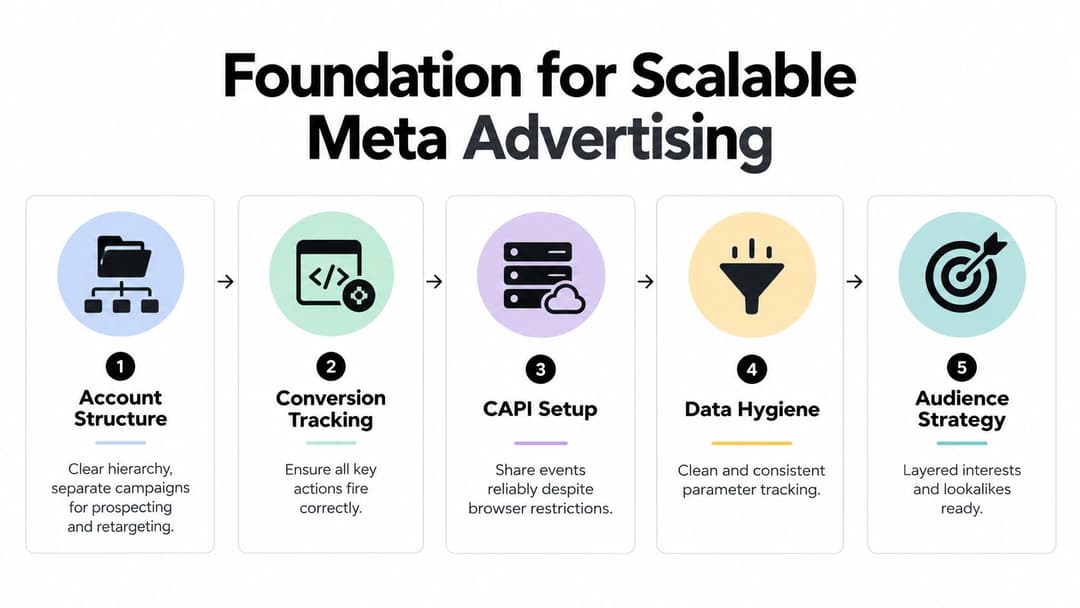
Start with account and conversion hygiene
Keep the account structure legible. Separate prospecting from retargeting where the business logic requires different messaging or exclusions, and use naming conventions that identify the offer, market, funnel role, creative batch, and launch date. Avoid creating a new campaign for every small hypothesis. Excessive fragmentation makes reporting harder and can split useful delivery information across too many containers.
Then verify the conversion path from impression to business outcome:
- Check event firing: Confirm that the pixel records the intended actions, including the optimization event and the downstream value event that finance trusts.
- Validate parameters: Keep campaign, ad set, ad, product, and creative identifiers consistent across Meta, analytics, CRM, and revenue reporting.
- Resolve duplication: Compare browser and server events so one customer action doesn't appear as multiple conversions.
- Review latency: Understand how long conversions take to arrive. Don't judge a campaign on same-day data if the sales process routinely reports later.
- Document exclusions: Record customer, purchaser, employee, lead-quality, and geographic exclusions in a place the whole team can access.
Treat CAPI and first-party data as operating infrastructure
Conversions API can help send server-side events when browser-based signals are incomplete, but implementation quality matters more than turning it on. Match events consistently, pass useful parameters, and monitor whether Meta receives the events you expect. Your first-party data should also connect ad exposure to CRM stages, qualified leads, purchases, refunds, and repeat value where relevant.
For teams building demand beyond direct-response ecommerce, the broader principles in these pipeline generation ad strategies provide useful context for connecting paid media with pipeline outcomes. The key is to define the business event before you scale toward it. Optimizing for a cheap intermediate action can produce impressive platform metrics and disappointing revenue.
Establish guardrails before automation expands delivery
Write down the boundaries that automation must respect:
- Budget boundaries: Set campaign and account limits that protect cash flow during testing and learning.
- Quality boundaries: Track qualified leads, approved orders, contribution margin, or another business measure alongside platform conversions.
- Change boundaries: Require review for major edits to optimization events, attribution settings, offers, and landing pages.
- Rollback boundaries: Keep a known-good configuration and a documented process for restoring it.
- Ownership boundaries: Assign one person to approve launches, one to review diagnostics, and one to reconcile platform results with business results when the account warrants it.
A solid first-party data activation workflow can support this process, but no tool compensates for undefined events or inconsistent data ownership. The go or no-go decision is simple: if tracking, exclusions, naming, and financial reconciliation aren't reliable, fix them before adding material spend.
How to Build a High Volume Creative Testing Engine
Creative is the main scaling constraint in many Meta accounts. A single concept can work across several audiences, but it rarely supplies enough variation for sustained delivery. The answer isn't random production. It's a high-volume testing engine that turns customer insight into controlled batches, measures one meaningful change at a time, and promotes winners without starving the next round.
Across a benchmark dataset of 578,750 Meta ads, only about 5% to 8% became true winners, and roughly half were turned off before 28 days of spend. In the top spend tier, weekly creative output reached 12 to 19 or more ads, compared with a median of 6 to 7 creatives per week for mid-tier advertisers. Meta creative testing benchmark
Those figures shouldn't become a rigid quota for every account. They do show why low shipment rates create a predictable problem. If you don't produce enough credible alternatives, the algorithm has fewer chances to find the next winner.
Build batches around a hypothesis
Start with a message map rather than a list of formats. Pull objections, desired outcomes, product mechanisms, customer language, proof points, and buying triggers from sales calls, reviews, support tickets, search queries, and post-purchase surveys. Each batch should answer a question such as, “Does showing the time-saving mechanism outperform a general benefit message?”
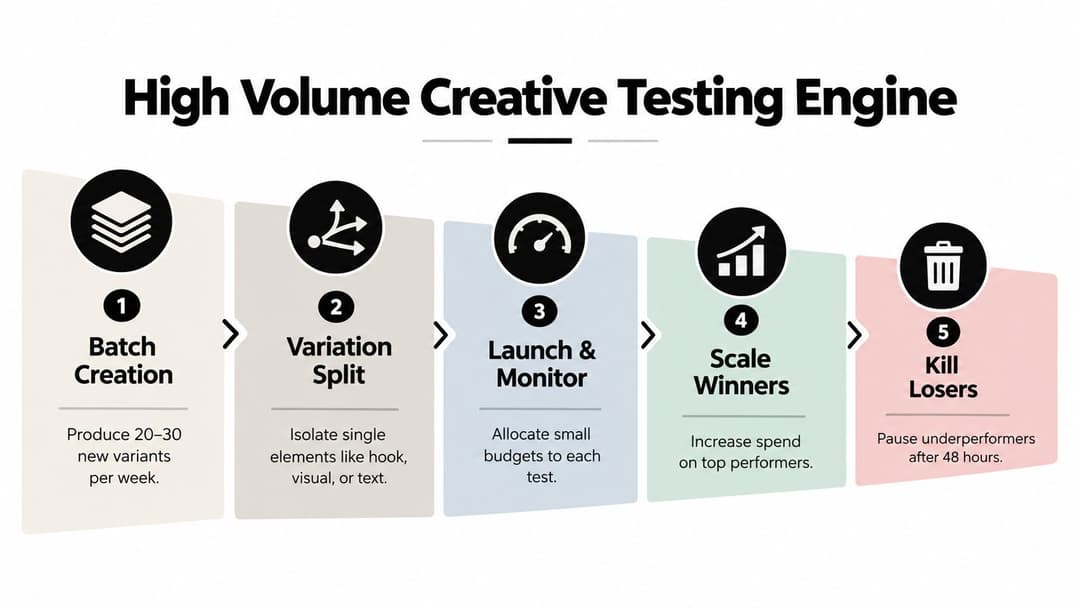
Create variants that preserve the hypothesis while changing one primary element:
- Hook variants: Keep the body and offer stable while changing the first visual or opening line.
- Proof variants: Keep the claim stable while testing a demonstration, testimonial-style presentation, product view, or comparison.
- Format variants: Adapt the same message for video, static, carousel, or collection placements without changing the central promise.
- Offer variants: Test the commercial incentive separately from the creative idea whenever the account has enough signal to support that distinction.
The ad creative testing framework from Wojo Media is a useful reference for organizing this discipline. Your internal naming should make the test legible without opening the ad: ANGLE_PROOF_FORMAT_HOOK_BATCH.
Isolate variables and wait for signal
A meaningful creative test should isolate one variable, include at least 2 variants, preferably 3 to 4, and gather enough evidence before you call a winner. The recommended signal threshold is roughly 1,000 or more link clicks per variant or 100 or more conversions per variant, with a runtime of 7 to 14 days, not a conclusion drawn from the first day or two. Meta creative testing methodology
Those thresholds aren't practical for every low-volume account, so use the principle even when you can't reach the ideal sample. Record the confidence limitation, avoid declaring a definitive winner from early volatility, and compare the same business outcome across the test. Don't test the creative, copy, audience, landing page, and optimization event in one launch. That produces an interesting result but a weak lesson.
A workable weekly cycle looks like this:
- Create a batch from a small set of prioritized hypotheses.
- Launch variants in a controlled test environment.
- Monitor delivery, spend distribution, early engagement, conversion quality, and technical errors.
- Hold decisions until the account has enough stable signal, unless an ad creates a clear compliance, customer, or financial risk.
- Promote durable winners into scaling campaigns.
- Archive losers with a reason, then recycle the lesson into the next batch.
The video below can help teams visualize the mechanics of a repeatable testing workflow.
The scalable creative advantage comes from shipment rate, not from pretending every launch will win. Most variants should teach you something, and a small share should earn more budget.
Use a central media library with approved claims, aspect ratios, usage rights, product references, and status labels. A system such as AdStellar AI can create and launch large combinations of creative, copy, and audiences in bulk, then rank performance against ROAS, CPL, or CPA. The buyer still owns the hypotheses and approval rules. Automation should reduce repetitive setup, not replace judgment about positioning or customer quality. A practical ad creative strategy framework can help keep production tied to those decisions.
Scaling Budgets and Audiences Without Breaking Performance
Budget scaling fails when the buyer treats every performance change as a reason to rebuild the account. There are two different expansion problems: vertical scaling, which increases spend inside an existing structure, and horizontal scaling, which adds new creative, markets, placements, offers, or audience opportunities. Both can work, but they create different risks.
Vertical scaling concentrates delivery in a known environment. It may preserve operational simplicity, yet it can accelerate fatigue or force the system into increasingly expensive inventory. Horizontal scaling creates more opportunities, but it also introduces new variables that complicate diagnosis.

Use the platform's reach, but define the boundaries
By Q2 2026, Meta reported $59.363 billion in quarterly advertising revenue, up from $46.563 billion a year earlier. During the same comparison, ad impressions increased 14% and average price per ad increased 12%. Meta advertising performance figures for Q2 2026
The mechanics matter for buyers. Meta can find more inventory, charge more effectively in the auction, and continue expanding delivery. That doesn't mean your account should surrender every decision. Give Advantage+ room to find users and placements when the conversion event is trustworthy, the creative batch is broad, and the business can tolerate audience discovery. Retain control when exclusions are commercially important, geography has strict constraints, the offer requires distinct messaging, or you need a clean comparison between strategic segments.
A useful decision test is:
| Situation | More automation | More control |
|---|---|---|
| Reliable conversion feedback | Yes | Only for a deliberate comparison |
| Broad prospecting objective | Yes | Keep exclusions defined |
| Strict market or product eligibility | Carefully | Yes |
| New offer with uncertain positioning | Limited | Yes |
| Mature creative library | Yes | Monitor concept concentration |
| Sensitive lead-quality requirements | With CRM feedback | Yes, until quality stabilizes |
Increase spend through controlled changes
Make one material budget change at a time, then observe the account through its normal conversion delay. If performance changes, record the change, the expected effect, and the actual business result. Avoid editing several active campaigns because the blended account view looks uncomfortable for a few hours.
Horizontal expansion should follow the creative engine. Add a new angle or format before adding another audience layer if audience fragmentation is already making reporting difficult. If prospecting has sufficient coverage, expand geography or product lines only when logistics, landing pages, and conversion quality can support the new demand.
For agencies and growth teams, bulk launch workflows reduce manual errors. Centralize campaign templates, audience rules, creative approvals, and budget permissions so a buyer can deploy a tested structure without rebuilding it for every account. The Meta campaign scaling guide offers a useful operational reference, but the governing principle remains ownership. Let automation handle repetitive execution. Keep humans responsible for financial limits, business exclusions, and interpreting conflicting signals.
Measuring What Matters and Catching Fatigue Early
Most buyers notice fatigue too late because they wait for CPM to rise or CPA to break. At scale, the first warning often appears earlier in the creative response: the hook attracts fewer people, CTR declines, and only later does conversion efficiency deteriorate.
One independent benchmark reported a median creative lifespan of 3 days, with 75% of ads killed within 8 days and only the top 5% lasting beyond 38 days. The same source described fatigue appearing first through lower hook rate and CTR, followed by CPA deterioration, rather than an immediate CPM increase. Meta fatigue and scaling benchmark
A separate study cited in that coverage reported a 5.5% CTR decline by 250,000 impressions and a 19.6% CPA increase by 500,000 to 1 million impressions, while CPM didn't necessarily rise early. Treat those figures as diagnostic reference points, not universal shutdown rules. The same creative fatigue analysis

Build a fatigue dashboard around sequences
Review creative by concept, not only by ad ID. Several ads may use different footage while repeating the same promise, opening structure, visual pattern, and offer. The audience can fatigue against the concept even when the file names look different.
Track the sequence in a diagnostic order:
- Hook rate: Is the opening earning attention from the people receiving the impression?
- CTR: Does that attention turn into a meaningful click?
- Landing-page behavior: Does the visitor continue after the ad promise?
- Conversion rate: Does the traffic produce the intended action?
- CPA or ROAS: Is the business outcome still acceptable?
- Frequency and impression concentration: Is one concept absorbing delivery across the same audience?
Replace creative when the early engagement signals weaken across a meaningful delivery window and the downstream trend confirms the problem. Don't kill a valuable ad because of a single bad day, but don't wait for CPA collapse when hook and CTR decay has persisted. Sequence replacements before the incumbent fails. New creative should enter while the existing winner still has enough delivery to fund the next learning cycle.
Adjust measurement for an automated environment
Meta's 2026 trend coverage describes expanded Advantage+ capabilities, Andromeda and GEM-era automation, and attribution changes that move some interactions away from older click-through assumptions. Meta ads trends and automation coverage That shift makes platform reporting useful but incomplete.
Use three views together:
- Platform delivery: Spend, reach, impressions, frequency, placement, CPM, CTR, and conversion reporting.
- Creative diagnosis: Hook rate, concept, format, first-frame behavior, comments, landing-page continuation, and replacement status.
- Business truth: Qualified leads, accepted orders, gross margin, refunds, sales-cycle progression, and customer value.
Format mix also deserves attention. The cited survey reported single-image usage down by over 8%, static carousel down 7%, and Collection Ads up nearly 15% year over year, while average cost per conversion fell over 17% across its clients. Format and conversion benchmark coverage Those figures don't prove one format will win for your account. They do support a broader testing portfolio rather than assuming static images should carry every scaling plan.
A structured campaign performance analysis process helps separate delivery problems from creative fatigue, tracking gaps, offer weakness, and post-click friction.
Your Scaled Meta Ads Operating System in Action
A durable operating system turns scaling into a weekly sequence rather than a series of urgent interventions. The team checks data quality, ships creative, expands controlled winners, and investigates fatigue before making major structural changes.
The weekly cadence
Start with signal quality. Confirm that events, CRM outcomes, revenue data, exclusions, and attribution notes are behaving as expected. If tracking changed, annotate the dashboard before comparing results with an earlier period.
Ship the next creative batch. Use customer language and recent performance to choose hypotheses. Preserve the variable you aren't testing, label every asset by concept and format, and keep approval standards consistent across markets.
Review delivery by concept. Look for concentration, rising frequency, declining hook rate, CTR decay, placement changes, and unusual spend shifts. A winner is only useful if its performance remains tied to a business outcome, not just a cheap click.
Scale with a written decision. Record whether you're increasing spend, expanding reach, promoting a creative, pausing an asset, or leaving the structure unchanged. Include the reason and the signal that would reverse the decision.
Assign ownership instead of relying on heroics
The media buyer owns campaign design, budget decisions, and test integrity. The creative lead owns production throughput, claim compliance, and the replacement queue. The analytics owner reconciles platform data with CRM and finance. A growth lead decides which business outcomes matter when platform metrics and revenue quality disagree.
Automation belongs in repetitive, bounded work. It can assemble variations, apply naming rules, surface winners, prepare launches, and flag waste. Humans should approve positioning, offers, exclusions, financial exposure, and interpretations that could change the strategy.
Use a simple operating scorecard:
- Foundation: Events and business outcomes reconcile.
- Creative: New concepts are entering before old concepts fail.
- Delivery: Budget changes are deliberate and documented.
- Diagnosis: Hook, CTR, conversion quality, and fatigue signals are visible together.
- Learning: Every test produces a reusable decision, not just a winner or loser label.
That is what scaling looks like in practice. You aren't trying to force one campaign to spend forever. You're building a system that keeps producing credible options, protects signal quality, gives automation useful freedom, and tells the team when performance is weakening.
AdStellar AI helps teams create and launch large combinations of Meta creatives, copy, and audiences in bulk, then analyze performance against goals such as ROAS, CPL, or CPA. Visit AdStellar AI to centralize campaign, creative, audience, media-library, and performance workflows so your next scaling decision is based on a repeatable operating system rather than manual guesswork.