You've found the winner. The campaign is producing efficient conversions, the dashboard is showing attractive ROAS, and the obvious move seems to be increasing spend. Then the budget changes, delivery shifts, CPA climbs, and the result deteriorates before you've had enough time to understand what happened.
That pattern is common because scaling successful ad campaigns changes the conditions that created the success. Meta may enter a different part of the auction, the campaign may lose delivery stability, and the creative may reach people who respond less strongly to the original message. The right question isn't “How fast can I increase spend?” It's “What evidence shows this campaign can absorb more spend without destroying contribution margin?”
Why Most Ad Campaigns Break When You Scale
A winning campaign often looks more durable than it is. You see efficient acquisition at its current budget, assume the audience has additional room, and make a large increase. Within a short period, the campaign begins buying different impressions, the mix of placements changes, and the algorithm has less certainty about which users are most likely to complete the optimization event.
The problem isn't that Meta spends more. The auction environment changes as delivery expands. At a smaller budget, the system may find a concentrated group of high-propensity users. A higher budget asks it to search more broadly, often before the campaign has enough fresh signal to distinguish profitable expansion from cheap-looking but low-quality delivery.
Learning disruption adds another layer. A substantial edit can alter delivery behavior and make recent performance less comparable with the previous baseline. If you judge the change immediately, you may mistake temporary volatility for a permanent decline, or continue scaling a campaign that has already lost its economic edge.

The three signals that move together
I separate scaling risk into three connected variables:
- Signal density: Does the campaign generate enough optimization events for Meta to make reliable delivery decisions?
- Creative freshness: Can the account keep producing new reasons for the audience to stop, understand, and act?
- Audience availability: Is there enough reachable demand beyond the users already responding to the current ads?
A budget increase exposes weaknesses in any one of these areas. Strong creative cannot compensate for poor conversion tracking. Broad reach cannot compensate for a weak offer. More optimization events cannot rescue an audience that has stopped responding to the message.
That's why generic advice about changing budgets every few days is incomplete. The correct pacing depends on signal quality, stability, and what happens to costs as delivery expands. Meta's campaign scaling limitations are easier to manage when you treat scale as a controlled experiment rather than a reward for finding a temporary winner.
For practitioners who want additional perspectives on testing, auction behavior, and creative iteration, the best tweets on paid advertising offer a useful stream of practitioner commentary. Use that material for ideas, not as a substitute for account-level evidence.
Identifying When a Campaign Is Ready to Scale
A campaign can show a profitable day and still fail as soon as spend expands. Before increasing budget, confirm that the account has enough signal density for Meta to make reliable delivery decisions and that the result reflects repeatable demand rather than auction noise, delayed conversions, or one unusually strong audience pocket. The methodology in Ad Library's Meta campaign scaling guidance uses at least 50 optimization events in the last 7 days as a practical minimum.
One strong day is not a scaling signal. Use 2–3 consecutive 7-day windows instead. In each window, the primary KPI should meet or beat goal, week-over-week variance should remain within ±10–15%, and the CPA coefficient of variation should stay below 0.25, following the Meta Ads scaling readiness framework. KPI performance tests the economics, variance tests consistency, and the coefficient of variation shows whether CPA remains stable relative to its average.
A practical readiness checklist
Review these conditions before changing the budget:
- Optimization events: The campaign has at least 50 events during the most recent 7-day period, and the event represents a meaningful business outcome rather than a weak proxy. Ad Library
- Performance history: Results meet or exceed the KPI goal across 2–3 consecutive 7-day windows. Tailored Edge Marketing
- Signal stability: Week-over-week variance stays within ±10–15%, while CPA's coefficient of variation remains under 0.25. Tailored Edge Marketing
- Recent volume: A core campaign has generated 100–200 optimization events in the prior 14 days, giving the decision a wider evidence base. Tailored Edge Marketing
- Business quality: Validate reported ROAS against incrementality where possible, lead quality, refunds, repeat purchasing, and healthy 90-day cohort behavior, as discussed in guidance on scaling without sacrificing ROI. AdCampin
The commercial check decides whether platform efficiency is real. Meta may report an efficient conversion while low-quality leads, weak retention, or poor downstream conversion leave the business unprofitable. Scale only when platform and business outcomes support the same conclusion.
Know when to stop calling it volatility
Set a pullback rule before adding spend. The readiness framework identifies CPA at 50% above target, CPA rising 20% for two days, or ROAS below break-even for 48–72 hours as warning signals. Tailored Edge Marketing
These signals do not prove that scaling caused the decline. They require pausing the next increase, checking creative and delivery, and comparing the post-change period with the pre-scale baseline. Use campaign performance analysis to make that comparison across reporting views rather than judging a single day.
Budget Pacing and Bidding Strategies That Protect Performance
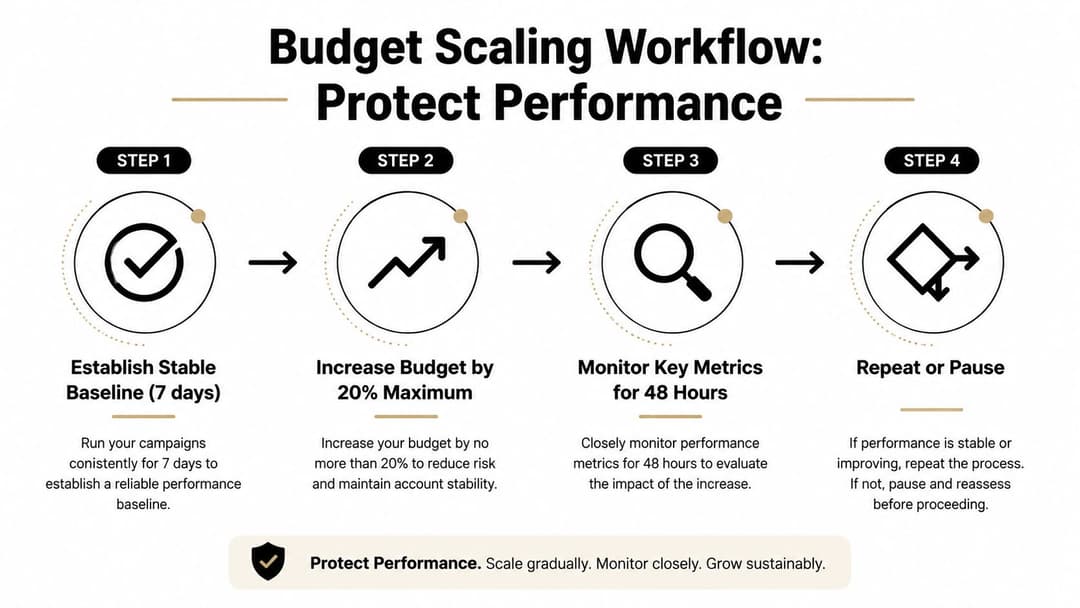
A campaign can look ready at its original spend and weaken as soon as delivery expands. Protect comparability by changing one variable at a time, holding the new budget long enough to judge conversion quality, and using predefined guardrails rather than reacting to hourly noise. A practical pacing method is to raise budget by 15–20%, then wait 48–72 hours before evaluating the result, as outlined in Meta campaign scaling guidance. Repeat only when performance returns to, or exceeds, the previous baseline.
The waiting period serves two purposes. It prevents a premature pullback during ordinary delivery turbulence, and it stops another increase while efficiency is already deteriorating. The new budget needs enough delivery and conversion data to support a decision.
Use a controlled pacing loop
Run every increase through the same sequence:
- Record the baseline. Capture CPA, ROAS, CPM, frequency, CTR, spend, optimization events, and available business-quality indicators.
- Make one material change. Increase the budget without rebuilding the audience, replacing every ad, or changing the bid strategy at the same time. Isolating the change makes the result easier to interpret.
- Hold for 48–72 hours. Do not grade the adjustment after only a few hours. Review delivery patterns, conversion quality, and the guardrails established before scaling.
- Continue, hold, or reverse. Continue when performance returns to baseline or better. Hold when the signal remains unclear. Reverse or investigate when costs breach the preset limits.
CPM needs a careful read. A CPM increase without a matching frequency increase can indicate algorithmic instability rather than audience exhaustion. That distinction changes the response. Fatigue points toward creative or reach expansion, while unstable delivery calls for patience, a smaller adjustment, or a return to the last stable budget, as described above.
Match the bid strategy to the job
Lowest-cost bidding gives Meta the widest opportunity to find conversions, which can help when expansion reaches unfamiliar auction inventory. The trade-off is weaker control over the cost of each result, so set a clear economic floor and monitor quality closely.
Cost caps can protect efficiency once a campaign has enough signal to support them. Set the cap too tightly, however, and delivery may stall during expansion. Bid caps impose still more control and can restrict volume further. Use either approach for a specific auction or cost-control reason, not as an automatic response to uncomfortable results.
Budget structure determines how much flexibility the account has. The practical guidance on Facebook ad budgets can help when deciding how to separate proven delivery from controlled tests. Keep the scaling campaign identifiable, fund experiments without draining the core, and make it possible to stop a weak test without disrupting stable delivery.
Use the walkthrough below alongside account data. It cannot replace guardrails, baseline comparisons, or a decision to pause when the economics no longer work.
Creative and Audience Expansion Tactics
Budget increases eventually force the campaign beyond its most responsive users. At that point, scaling becomes a creative supply problem as much as a media-buying problem. The winning ad may still deserve more spend, but it can't carry every additional impression indefinitely.
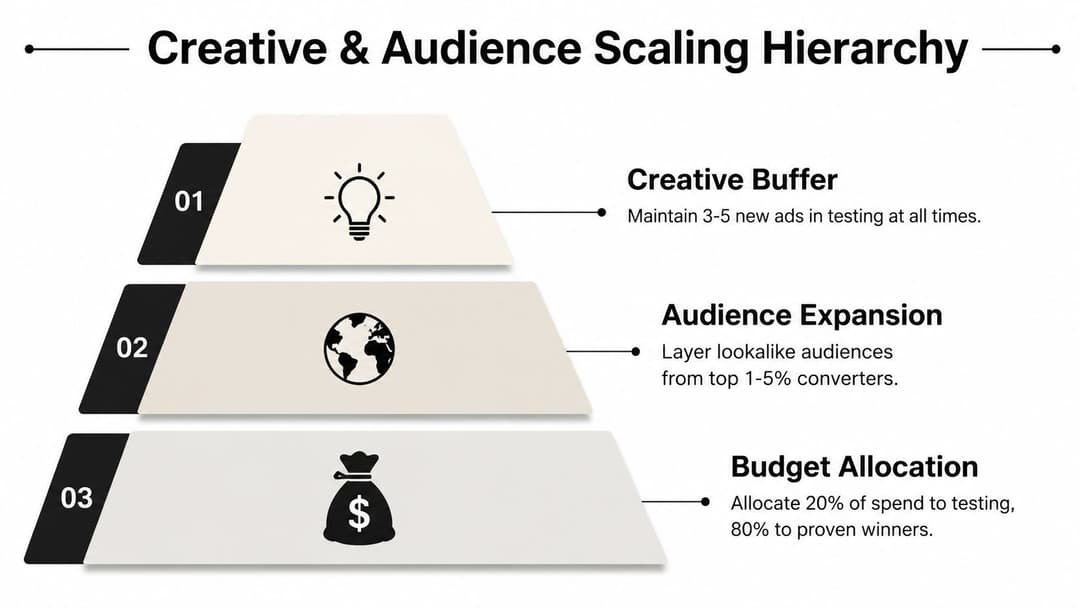
Build a creative buffer before you increase delivery. The scaling guidance reviewed for this topic recommends maintaining 4–6 creative variants per ad set to reduce dependence on one message and give Meta room to find new pockets of response. AdCampin The variants shouldn't be cosmetic duplicates. Change the hook, opening visual, proof structure, offer framing, creator voice, or objection being answered.
Turn the winner into a testing system
Start with a creative deconstruction. Identify the part that appears to be doing the work, then create controlled variations around it:
- If the hook wins, preserve the promise and change the first visual.
- If the demonstration wins, preserve the product proof and test a different problem.
- If the offer wins, keep the commercial structure while testing a new audience context.
- If social proof wins, vary the customer objection rather than repeating the same testimonial.
Keep proven ads live while testing new variants. Consolidating too early removes the benchmark you need for judging the next batch. A separate testing area also makes it easier to identify whether a new concept has potential without allowing one weak experiment to destabilize the primary campaign.
Expand audiences without destroying the signal
Audience expansion should increase reachable demand while preserving the reason the original campaign worked. Layer lookalike audiences based on high-quality converters, test broader targeting when the account has enough conversion signal, and avoid narrowing the audience because a smaller segment produced an attractive early CPA.
The important variable is not the label inside Ads Manager. It's whether the expanded audience produces the same business outcome. A broader audience with slightly less efficient reported CPA may still be valuable if it generates more qualified customers and healthier downstream revenue. Conversely, a narrow segment can look excellent until frequency rises and the same users see the same message too often.
Test one expansion variable at a time. Launch a new audience with the established creative, or launch new creative into the established audience. Changing both at once creates ambiguity, especially when the campaign moves through a different part of the auction. For a more advanced discussion of using signals to guide audience selection, see predictive audience targeting.
Automation and Monitoring Best Practices
Scaling across multiple campaigns turns monitoring into an operational design problem. A media buyer can inspect a small portfolio manually, but repeated budget changes, creative launches, and audience tests create too many opportunities for a problem to sit unnoticed.
Start with a single source of truth. Your dashboard should show spend, primary KPI, CPA or ROAS, CPM, frequency, CTR, optimization events, and a business-quality measure. Break the view down by campaign, ad set, creative, placement, and meaningful time window. A blended account number can hide the fact that one ad is consuming delivery while another is producing the actual result.
Automate the repetitive decisions
Rules should protect the account from obvious damage, not attempt to replace judgment. Useful triggers include:
- Budget protection: Pause or flag an increase when CPA breaches the account's pre-defined warning threshold.
- Stability control: Block another budget change until the current increase has completed its 48–72-hour observation window, following the methodology in Ad Library's scaling framework.
- Creative review: Alert the buyer when frequency climbs alongside declining CTR, rather than waiting for CPA to collapse.
- Delivery review: Flag unusual CPM movement, especially when it isn't explained by a corresponding shift in frequency.
- Quality review: Compare platform conversions with qualified leads, completed purchases, refunds, or later cohort behavior.
The automation should create a queue of decisions. It shouldn't make every decision automatically. A human still needs to assess offer changes, tracking breaks, landing-page issues, stock constraints, and external demand shifts.
Use AI for analysis, not blind execution
AI tools can help rank creative themes, surface spend anomalies, group ads by message, and identify combinations that deserve testing. They're most useful when they reduce analysis time while leaving the final economic judgment with the media buyer.
AdStellar AI is one option for this workflow. Its platform can ingest historical Meta performance, identify high-performing creative, copy, and audience components, generate combinations for testing, and support campaign launches through a centralized workflow. That makes it relevant when a team needs to produce and evaluate many variations without losing the original control group.
The operating principle is simple: automate data collection, alerts, and repetitive setup. Keep humans responsible for interpreting incrementality, customer quality, creative strategy, and whether additional spend creates profitable growth. The Meta Ads automation guide provides further context for structuring that division of labor.
Common Scaling Mistakes and How to Avoid Them
The most expensive mistake is treating a winning CPA as proof of unlimited capacity. It only proves that the campaign worked under its current conditions. Increase spend aggressively, and you may force delivery into weaker inventory before the creative and audience systems are ready.
A second mistake is making several changes at once. Buyers often increase the budget, broaden targeting, add a new optimization event, and replace the ads in the same session. When performance moves, nobody knows which change caused it. Keep a clean control wherever possible and change one major variable at a time.
What popular advice gets wrong
“Just narrow the audience” sounds sensible when costs rise. It can backfire by reducing auction flexibility, concentrating frequency, and preventing the algorithm from finding adjacent users. Narrowing may help when the audience is clearly unqualified, but rising CPA alone doesn't prove that narrower targeting is the answer.
“Keep only the top ad” creates a similar problem. Consolidating spend behind one winner can improve short-term reporting, but it removes creative redundancy and increases dependence on a single message. When that message fatigues, the account has no prepared replacement.
“Scale because ROAS looks strong today” ignores conversion lag and business quality. Review the longer-term customer outcome before calling a spike durable. The practical PPC tactics for SMBs are useful for grounding scaling decisions in operational constraints rather than dashboard excitement.
Diagnose the failure before changing direction
When performance weakens, classify the symptom:
- CPA rises while frequency and CTR remain broadly stable: Inspect auction conditions, tracking, landing-page conversion, and offer economics.
- Frequency rises while CTR falls: Treat creative fatigue as the leading hypothesis and introduce fresh concepts.
- CPM rises without a matching frequency increase: Investigate algorithmic instability before declaring audience saturation. Ad Library
- ROAS falls while platform conversions remain steady: Check order value, lead quality, refunds, and cohort behavior.
- Performance worsens immediately after multiple edits: Restore the last stable configuration where possible, then retest changes separately.
A pullback isn't failure. It's a way to preserve the last known profitable state while you identify what broke.
Your Scaling Decision Framework and Checklist
A scaling decision should produce an operating plan, not another readiness scorecard. Once the campaign meets the previously defined event volume, consistency, and CPA stability requirements, approve only the next controlled change. Keep the strongest ad set or campaign as the control, prepare replacement creative, and record the exact budget, bid, audience, and attribution settings before launch. The Meta Ads scaling readiness guidance provides useful context for making that initial call.
After the change, hold the configuration long enough to establish a comparable baseline. Avoid stacking a budget increase with a new audience, fresh creative, or bid adjustment. If results remain within the account's accepted range, continue the plan. If CPA rises materially, ROAS falls below break-even, lead quality weakens, or conversion lag changes the picture, stop the next increase and diagnose the cause before editing again.
Use this decision sequence:
- Criteria met, business quality confirmed: approve one controlled expansion, retain a control, and define the observation window.
- Criteria met, business quality unclear: hold spend at the current level and validate contribution margin, refunds, sales acceptance, repeat behavior, or cohort quality.
- Criteria partly met: keep the budget stable, gather more comparable evidence, and fix the weakest signal rather than forcing scale.
- Performance deteriorates after the change: pause further increases, compare the new baseline with the control, and restore the last stable configuration when appropriate.
- Creative fatigue appears: refresh the message or format while protecting the audience and budget variables that still work.
- Tracking or conversion quality is uncertain: resolve measurement before interpreting platform performance or approving additional spend.
Document the decision, owner, change made, expected signal, and reversal condition. This makes the next review faster and prevents a short-term spike from becoming the justification for uncontrolled expansion.
The framework must match the business model. B2B teams should include lead quality and sales acceptance in the approval, while ecommerce teams should review contribution margin, refunds, and repeat behavior. For cross-channel planning considerations, the fractional CMO Google Ads guide offers a useful parallel framework, although its channel mechanics differ from Meta.
AdStellar AI helps teams turn proven Meta campaign elements into new creative, copy, audience combinations, and launch-ready tests while keeping performance data in one workflow. Visit AdStellar AI to review a more repeatable process for testing winners, monitoring performance, and scaling spend.