You know the routine. A campaign goes live, the first ads for ecommerce spend starts flowing, and within an hour the dashboard is already telling a story you don't trust. Maybe the click-through looks fine but carts stall. Maybe one creative gets all the credit while the rest disappear. Maybe the algorithm found buyers, or maybe it just found people who were going to buy anyway.
That's the job now. Not just launching ads, but building a system that can ship creative fast, read results accurately, and scale only when the numbers mean something. Ecommerce advertising has become a concentrated performance channel, with $271 billion in projected spend, 71% of ad spend concentrated on Meta, Google, TikTok, and Amazon, and 62% of budgets going to performance marketing, according to a 2025 industry roundup on ecommerce advertising marketingltb.com. If you're managing ads in 2026, the edge isn't more noise. It's tighter production, cleaner measurement, and fewer false wins.
Why Most Ecommerce Ads Miss the Mark
A campaign goes live, the first clicks start rolling in, and the dashboard seems to tell a story before the account has earned one. One creative gets early credit, carts stall, and the team starts reacting to a result that may only reflect captured demand already in motion. That is how paid social gets mistaken for proof.
The deeper issue is process. Creative gets produced, uploaded, and judged on its own. Audience settings get adjusted. Budgets shift around. The account never behaves like a product system, where each release informs the next one and each test is designed to answer a single question cleanly.
The primary bottleneck is iteration, not ideas
Teams often have more ideas than their testing infrastructure can handle. What they lack is a clean path from hypothesis to launch to readout without contaminating the result. When creative, audience, and budget all change together, the winner is usually unclear.
Practical rule: if you cannot explain why an ad won, you are probably not ready to scale it.
That is the part most ecommerce ad guides skip. They show hooks, angles, and formats, but they rarely separate signal from luck. They also leave out incrementality, which is the only way to tell whether paid social created demand or just took credit for it. A campaign launch checklist from AdStellar AI can help teams keep that launch discipline tight without turning the account into a mess of one-off exceptions.
The market makes sloppy testing more expensive. Ecommerce spend keeps concentrating into a few major platforms, which means most brands are working inside algorithmic systems that optimize for the easiest visible conversion, not always the highest-quality one. In that kind of setup, weak test design burns budget fast marketingltb.com.
Why the old launch mentality breaks
A lot of accounts still follow the same sequence. Make a batch of ads. Launch them. Check ROAS. Pick a winner. That can look fine until volume rises, the creative pool starts to dry up, or attribution gets noisy. Then the same workflow starts producing false confidence.
Mobile makes the problem sharper. Shopping now happens in a mobile-first environment, and broader ecommerce growth has pushed advertising deeper into social, search, and retail media seoprofy.com. The message has to land fast, on a small screen, in a crowded feed. If the first test is not structured well, the account spends time guessing instead of learning.
Launching Your First Profitable Campaign
Start with one question, not five. Decide what success means before you choose audiences or write copy. If the account is new, I'd rather see one clean success metric and a disciplined launch than a half-dozen goals competing with each other.

For a DTC brand, the cleanest setup usually breaks into three jobs. Prospecting finds new buyers. Retargeting recaptures people who already showed intent. Retention speaks to past customers with a different message and a different offer logic. Don't force those jobs into one campaign just because the dashboard is easier to read.
Build the campaign structure first
In Meta Ads Manager, keep the hierarchy simple enough that a stranger could audit it in five minutes. Name campaigns by objective and audience logic, not by whatever your team happened to upload that morning. If the naming convention doesn't help you spot what changed, it isn't doing its job.
Use broad, ASC, or manual structures based on the account's starting point, but don't pretend they're interchangeable. Broad gives the algorithm room to learn. Manual control is useful when you need a narrower test or a very specific exclusion logic. ASC can work when the asset pool is strong and the product-market fit is already clear.
The practical mistake is overbuilding the account before the first result comes in. Every extra split makes the data harder to interpret. That matters because ecommerce ad budgets are increasingly measured against performance outcomes, and platform concentration means the learning phase has to do more work than it used to marketingltb.com.
Upload assets with future testing in mind
Creative uploads should be organized for iteration, not just launch. Keep assets grouped by concept, not by file name chaos. If a designer sends six versions of the same hook, keep them together so you can compare the message, not just the polish.
Your setup choices matter later too. Frequency caps, exclusions, placement choices, and attribution settings all shape what you'll think happened. If you're testing multiple campaigns, keep the window and conversion event consistent or you'll end up comparing apples to a fruit basket.
Practical rule: launch fewer variables, then change one thing at a time until the account starts telling the truth.
For a real example, a DTC apparel brand can launch one prospecting campaign for cold traffic, one retargeting campaign for cart and site visitors, and one retention campaign for recent buyers. Prospecting gets the broadest targeting and the freshest creative. Retargeting gets tighter exclusions and sharper proof. Retention should talk like a customer-led brand, not like a discount machine.
A useful operational checklist is already laid out in the campaign launch checklist, and it's the kind of reference that saves accounts from avoidable setup drift.
Building Creative That Earns the Scroll
Creative is not decoration. It's the first and often only thing the algorithm and the customer both have to react to. Meta-oriented testing data points to creative as the dominant performance lever, with creative explaining 70% of campaign performance variance and batch video testing producing only a 12 to 18% winning-ad rate, which means most variants never deserve scale webtonic.io.
That's why creative production has to look more like a product pipeline than a brainstorm. You're not hunting for the one magical ad. You're building a system that can surface the few winners out of a lot of near misses.
Use the hook, angle, format split
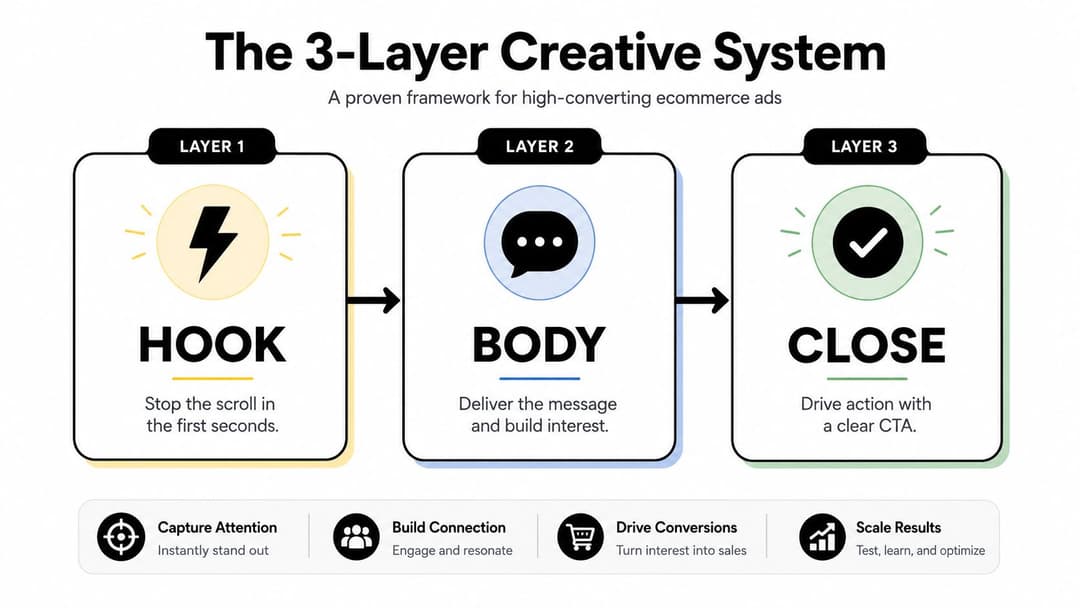
The easiest way to keep creative organized is to separate it into hook, angle, and format. The hook earns attention in the first seconds. The angle gives the reason to care. The format decides how the message feels, whether that's UGC, founder POV, comparison, demo, or before-and-after.
Hooks should be brutally clear. Lead with the pain, the payoff, or the pattern interrupt. If the opening line needs context, it's already too slow for a feed environment. Mobile traffic dominates retail behavior, so the opening frame has to do more work in less space seoprofy.com.
Match format to funnel stage instead of forcing one template everywhere. UGC and founder POV tend to work well when trust is the issue. Comparisons and demos are stronger when the shopper is already evaluating alternatives. Before-and-after can help when the product's effect is visual and believable without too much explanation.
Turn one insight into many variants
A skincare brand with three strong customer reviews doesn't need three ads. It can turn those reviews into a whole test set by changing the hook, swapping the proof order, and rewriting the close. One review becomes a testimonial-led ad. Another becomes a problem-solution angle. A third becomes a comparison against the old routine.
That's where AI can help without flattening the work. Use it to generate draft variations, alternate openings, and format combinations. Don't use it to erase judgment. If ten ads sound different but all say the same thing to the same person, you've only built production volume, not differentiation.
For a deeper breakdown of visual execution, the FB ads design guide is worth keeping close when the creative team starts scaling output.
The goal isn't to make one ad that works forever. It's to make a machine that keeps producing the next usable winner.
Targeting Audiences Without Overfitting
Audience strategy gets messy when teams confuse control with precision. They keep building narrow interest stacks long after the account has enough signal to let the platform learn. Or they swing all the way to broad and then blame the algorithm when the structure itself is too loose to read.
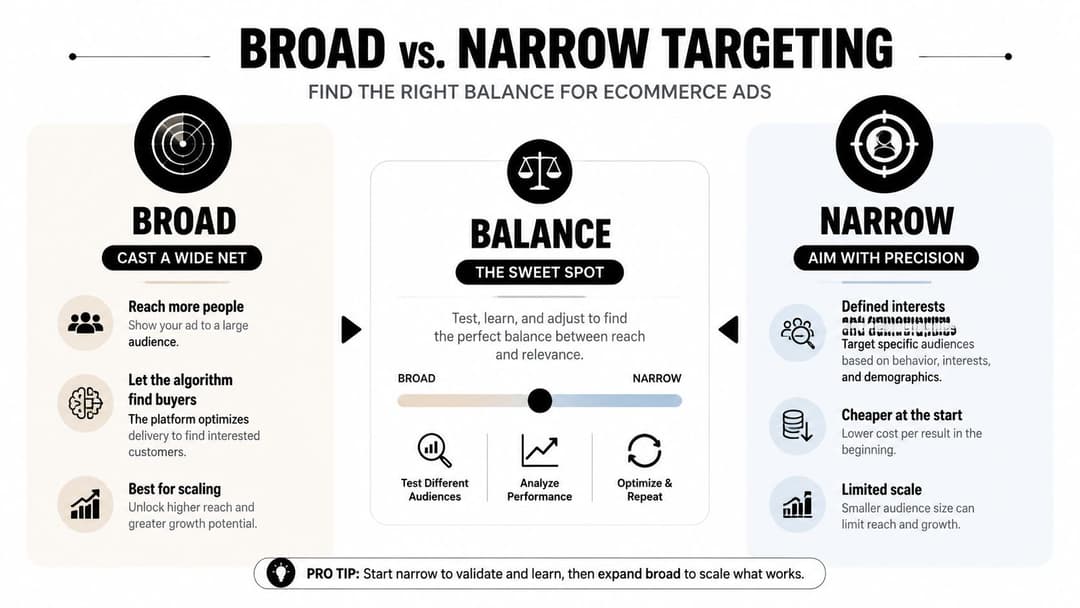
The cleaner path is usually broader than people expect. Start with enough room for the system to find buyers, then tighten only where the data justifies it. Ecommerce growth is now tied to mobile behavior, social feeds, and retail media ecosystems, so the audience layer works best when it doesn't fight the delivery system seoprofy.com.
Start broad, then earn the right to narrow
Broad targeting is useful when the pixel already has enough signal and the offer is proven. It gives the machine more room to explore adjacent buyers you would've missed by hand. Narrow targeting still has a place, but mostly when you're diagnosing a specific problem or testing a highly defined product angle.
Lookalikes are where people often get sloppy. A small, overfitted seed can look clean on paper and perform badly in practice. If the account has real purchase volume, use broader lookalikes as one input, not the whole plan. If signal is weak, stop pretending percentages are magic.
Retargeting needs discipline too. Small pools get exhausted quickly, and when they're too thin, the auction stops teaching you much. Exclusions matter more than many teams admit, because without them you end up paying to show the same message to people who've already moved on.
Segment by value, not just by demographics
A home goods brand can often do better by splitting audiences around customer value tiers than by guessing at age or household labels. The reason is simple. Buyers who order a high-value bundle behave differently from one-time low-ticket shoppers, and the ads should reflect that difference.
That's where first-party data starts pulling its weight. If you've got repeat buyers, AOV bands, product affinity, or subscription behavior, use those signals to shape what you exclude and what you message. The first-party data overview is a solid reference for teams that are ready to stop guessing and start segmenting from their own customer base.
A practical rule for scale is to consolidate when the account fragments without improving signal, and split only when the performance difference is explainable. If two ad sets are reading the same people in different wrappers, merge them. If one segment clearly buys for repeat value and another only converts on entry offers, keep them separate.
Measuring What Really Matters
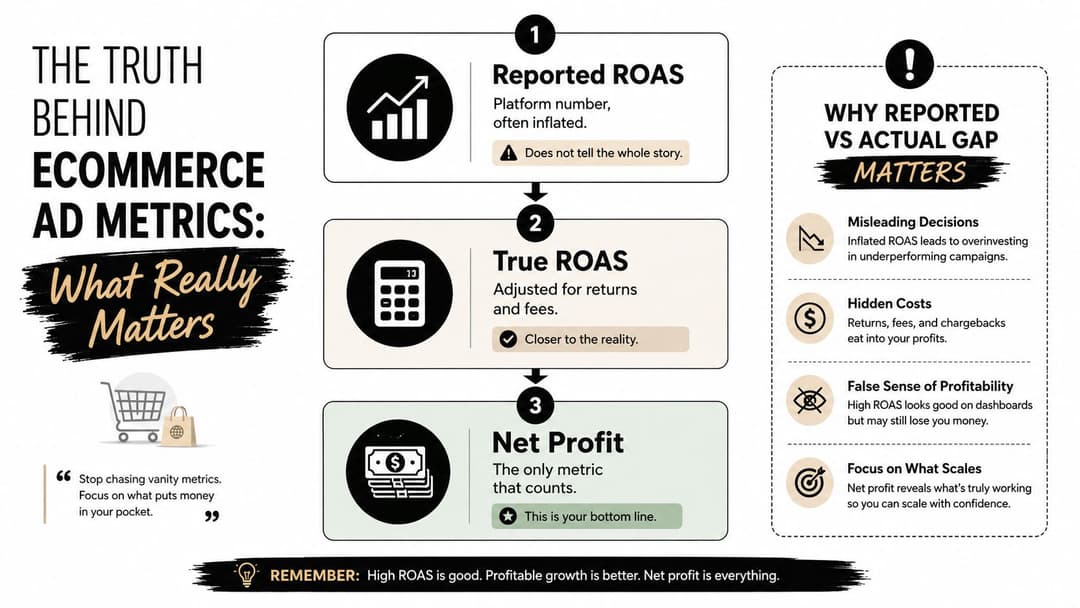
Platform ROAS is a useful dashboard number, but it's not the same thing as actual incremental revenue. That gap matters more now because ecommerce advertisers are under pressure to defend spend efficiency while privacy changes keep platform-reported performance less reliable. Meta may optimize for a conversion, but that doesn't automatically mean the conversion was caused by the ad.
That's why measurement has to answer a harder question than “did it convert?” It has to answer, “would this sale have happened anyway?” When the question shifts that way, lift testing, geo holdouts, and incrementality methods stop sounding theoretical and start becoming the only honest budgeting tools.
Use platform data for speed, not truth
The cleanest way to think about measurement is to separate optimization truth from budget truth. Platform data is usually good enough for day-to-day bidding decisions. It's fast, directional, and useful when the goal is to keep learning. But it can overstate impact when the platform is capturing demand already in motion.
That's where a practical metrics stack helps. If you need a baseline definition of return, the digital advertising ROI metric is a useful reference point for aligning internal language before you compare numbers across systems. Then add your own business layer, including returns, fees, and margin reality, so reported results don't pretend to be profit.
Reported ROAS can help you steer the car. It can't tell you whether the road was actually yours.
Test incrementality when the decision is bigger than optimization
When you're deciding whether to raise budget, protect a campaign, or challenge a winning creative, use methods that measure lift instead of relying on attributed conversions alone. Geo tests and holdouts are especially useful when the business question is larger than one ad set. Conversion lift studies matter when the account is mature enough that platform attribution starts blending new demand with existing demand.
A good measurement stack usually has three layers. Pixel data for short-term bid control. Lift data for budget decisions. Finance or cohort data for understanding what survived beyond the platform window. The campaign performance metrics guide is a useful companion when the reporting conversation gets stuck on vanity numbers.
The hard part is not running the test. It's accepting the result when it contradicts the dashboard. That's where a lot of teams lose money, because they keep funding what looks good instead of what adds revenue.
Budgeting, Scaling, and AI-Assisted Iteration
A campaign can look healthy right up until you feed it more budget. Then the cracks show. Spend rises faster than learning, the audience gets tired, or the creative that carried the first wins stops doing the work. Good scaling is controlled and repetitive, with each step tied to evidence instead of optimism.
The working rhythm is straightforward. Build creative. Launch a controlled test. Measure the result against the right baseline. Learn one thing. Put the winner back into the next round. AI helps most when it speeds up draft volume and pattern spotting. Humans still decide what deserves more money, and what only looks good in the dashboard.
Pick the budget motion before you need it
Daily budgets and lifetime budgets solve different problems. Daily budgets give tighter control and faster reads. Lifetime budgets can work when pacing matters more than hands-on adjustment, but they can also blur the learning curve if the account is already messy.
Campaign structure choices matter too. CBO gives the platform room to allocate across ad sets. ABO gives you more control when you need to isolate a test or protect a specific segment. There is no universal winner. The right setup depends on account maturity and the proof you need.
Scaling Tactics for Ads for Ecommerce
| Tactic | Best For | Risk Level |
|---|---|---|
| Gradual budget increases | Stable winners with clear signal | Low |
| New ad set duplication | Testing a new audience or angle | Medium |
| Campaign consolidation | Accounts with fragmented signal | Low to medium |
| Fresh campaign launch | New offer, new creative direction, or new objective | Medium |
| Aggressive spend expansion | Short windows with strong proof | High |
The easy mistake is to shove more money into the winner immediately. That is usually where consistency breaks. A steadier approach is to expand in measured steps, watch for creative decay, and open a new campaign only when the current one cannot absorb more spend cleanly.
Practical rule: if the winning creative is the only thing holding the account up, don't scale faster than your next test batch can replace it.
Use AI where it removes grunt work, not judgment
AI is useful for bulk creative variants, audience pattern detection, and spotting fatigue before a manual review would catch it. It is less useful when it is asked to invent strategy from scratch or pretend the account does not need human taste. In saturated ecommerce accounts, overproducing similar ads can make the feed look busy while making differentiation worse.
That is why the strongest teams use AI as a production layer, not as the whole process. One useful option here is AdStellar AI, which can connect to Meta Ads Manager, ingest historical performance, and generate campaign, creative, and audience combinations faster than a manual workflow. For more on how AI models identify high performers, see our guide on performance marketing AI. It fits best when the team already knows what it wants to test and needs a faster way to launch and learn.
Your First 30 Days With a Sharper Ad System
A better ecommerce ad system doesn't start with a grand redesign. It starts with a tighter week one, where launch decisions are simple and the account doesn't have room to hide bad structure. Then week two turns into a creative audit, not a panic refresh. By week four, the job is to scale the winner that proved something real, not the one that merely looked good in the platform.
That's the rhythm worth keeping in 2026. Creative production is getting faster. The feed is getting noisier. Measurement scrutiny is only getting harsher. The brands that stay ahead won't be the ones making the most ads. They'll be the ones building a repeatable system that turns speed into learning.
A practical month-one checklist
- Week one: Launch with one clear success metric, one clean account structure, and enough creative volume to avoid guessing.
- Week two: Cut the weak variants, keep the strongest message patterns, and check whether your audience logic is helping or masking the result.
- Week four: Test lift or holdout logic on the campaigns that matter most, then scale only the combinations that survive both platform readout and business reality.
The next stage of maturity is already visible. Teams need structured experimentation, stronger first-party data use, and more internal creative capacity so they aren't waiting on an agency for every refresh. Multi-platform diversification matters too, but only after the core system is disciplined enough to transfer cleanly.
If the account is still held together by instinct and late-night dashboard checks, fix the process before you chase more spend. Build the creative engine, measure like the budget depends on it, and let the data kill the ego work.
If you want a faster way to launch, test, and scale Meta campaigns without losing measurement discipline, see how AdStellar AI turns creative generation, audience testing, and performance reads into one workflow. It's built for teams that need to move faster without giving up control, which is exactly what ecommerce advertising demands now.