You can boost a Facebook post for as little as $1 to $5 per day, but most practical test budgets start around $10 to $20 per day and run for 3 to 7 days. The catch is that the cost of boosting a post on Facebook isn't a flat fee. It's set by an ad auction, so your audience, objective, creative, and timing decide what that spend buys.
That's usually the moment marketers hesitate. A post is doing well organically, the blue Boost Post button is sitting there, and the budget feels small enough to try without much debate. The underlying question isn't whether you can afford the boost. It's whether the boost will buy useful attention or just cheap activity that looks good in a report and goes nowhere.
That distinction matters more than the headline budget. A boosted post can be a smart move when you want to extend the life of content that already proved it can earn attention. It becomes a weaker move when you need tighter audience control, better measurement, or optimization toward leads and sales.
What Is the Real Cost of Boosting a Post on Facebook
You have a post that is already getting comments, a few shares, and more clicks than your usual content. The Boost Post button offers a fast way to add spend and keep that momentum going. The price looks small. The bigger question is whether that spend is buying useful business traction or just inexpensive engagement.
That is the cost issue that matters here.
A boost can be cheap at the checkout level and expensive at the efficiency level. You might spend a modest amount and still give up better targeting, cleaner testing, stronger optimization, and clearer reporting that you would get from a campaign built in Ads Manager. If you only need extra reach on content that has already shown promise, that trade-off can be acceptable. If you need leads, purchases, or tighter control over who sees the ad, the low sticker price often hides a weaker buying decision.

Why the sticker price is misleading
The budget field inside Boost Post creates a simple expectation. Enter an amount, get distribution. In practice, you are also choosing a lighter version of Meta's ad setup, and that choice has a cost.
The trade-off is control.
Boosting uses the same ad system underneath, but it gives you fewer ways to shape performance. That means the cost of boosting a post on Facebook is not just what leaves the account. It is also the value you may lose by using a simpler tool for a job that needs more precision. For broader context on how pricing behaves across Meta placements and objectives, see these Facebook ads cost benchmarks.
Practical rule: Judge a boost by cost per useful outcome, not by how cheap the daily budget looks.
What boosting is good at, and where it starts to break
Boosting works best when the job is straightforward. Extend the life of a post that already earned attention. Put more spend behind social proof. Get more local visibility for a timely announcement. In those cases, speed matters more than advanced setup, and the convenience of the button can be worth it.
It gets less attractive when you are trying to force a business result from a post that was never built for paid distribution in the first place. A weak offer, vague message, or low-intent audience usually stays weak after you add budget. You may still get clicks or reactions, but those signals can flatter performance without improving pipeline or revenue.
That is why experienced advertisers do not ask only, “How much does a boost cost?” They ask, “What would this same budget do inside a properly structured campaign?” Sometimes the answer is “not much different.” Sometimes the answer is “a lot more.” That gap is the part many marketers miss when they look only at the daily spend.
How Facebook Boost Post Pricing Actually Works
Clicking Boost Post feels simple because Facebook hides most of the machinery. Under the hood, you're entering a live auction for attention.
It's comparable to buying a concert ticket where prices shift with demand. You're not purchasing a fixed package called “boost.” You're telling Meta how much you're willing to spend to reach a defined audience for a defined outcome, and the platform competes for impressions on your behalf.
What your settings actually do
Your budget, audience, and duration are instructions. They are not guarantees.
If you choose a narrow audience that many advertisers want, Meta has to win more expensive impressions. If you choose a broad audience with lower competition, your budget may stretch further. If your post gets weak engagement signals once the boost starts, delivery can become less efficient because the platform sees less evidence that users want the ad.
For marketers who want the mechanics in plain English, this walkthrough of what a boost post on Facebook actually is helps separate the simplified interface from the underlying ad system.
Why results vary so much
Two advertisers can spend the same amount and get very different outcomes. That isn't random. The auction weighs more than money alone.
Here's what usually changes the result:
- Audience demand: Some audiences are more expensive because more advertisers want them.
- Objective pressure: Reach and engagement are one thing. Traffic, leads, and sales ask the platform to find people more likely to take a harder action.
- Creative response: A post that earns clicks and interaction sends stronger relevance signals than one people scroll past.
- Timing: Costs often climb when more brands are spending aggressively.
You're not paying for the button. You're paying to compete for a user's attention in a market that changes minute by minute.
Why the platform makes boosting feel cheaper than it is
The interface emphasizes convenience. That's useful for speed, but it can distort decision-making. A marketer sees a small daily budget and thinks “low risk.” The more accurate framing is “limited control.” You can get value from that trade-off, especially when you just want to extend a proven post. But convenience always comes with fewer levers.
That's why experienced teams judge a boost by efficiency, not by whether the budget looks modest on screen.
Key Factors That Influence Your Boost Cost
The auction sets the price, but marketers still control several inputs that shape that price. Some are obvious, like budget and audience. Others are easier to miss, like timing and creative format.
Historical benchmark data summarized by AdRoll's Facebook ad cost breakdown reported average Facebook ad costs of about $0.44 per click and $14.40 CPM in one 2026 benchmark, while another reported an average CPC of 51 cents and CPM of $8.77. The same source notes that boosted-post spend can range from $1 to $100 per day, and that costs can rise during peak periods such as Q4 and major sales events.
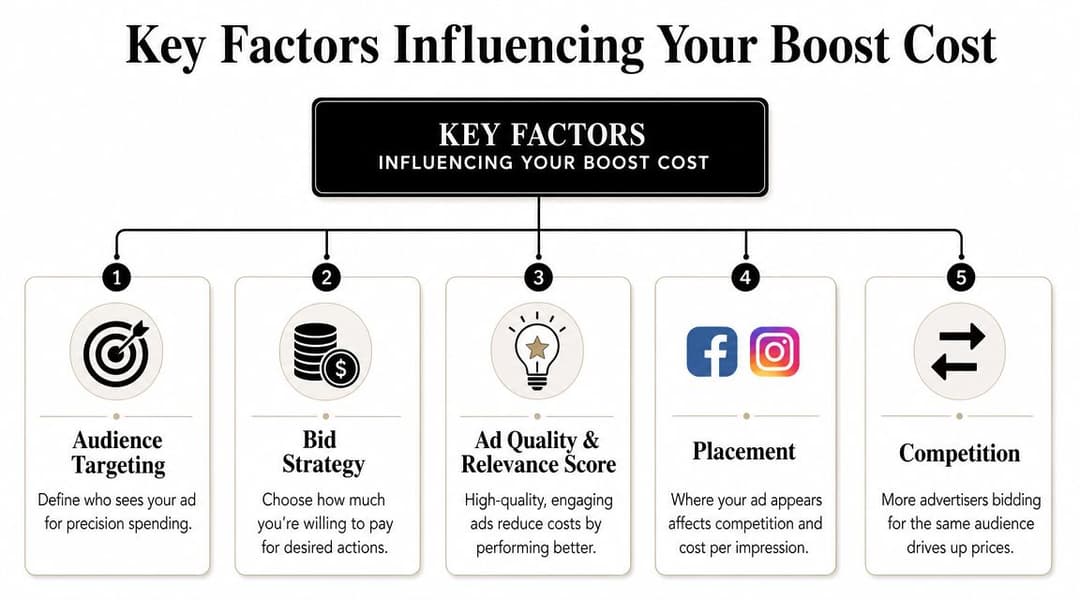
Audience targeting
A broad local audience often costs less to reach than a tightly defined high-value segment. That doesn't mean broad is always better. It means precision has a price.
Teams often get this wrong in one of two ways. They either target too loosely and waste spend on low-intent users, or they target too narrowly and make the auction unnecessarily expensive. A more advanced option, once you move beyond basic boosts, is working with modeled segments such as Meta lookalike audiences.
Campaign objective
The objective changes what Meta tries to buy for you.
If you boost for engagement, the platform can serve impressions to users who are relatively likely to react or comment. If you ask for a harder outcome, the system has to compete for scarcer behavior. That's why a boost built for visibility can feel efficient while a boost aimed at stronger business intent can feel expensive very quickly.
Creative quality and relevance
Good creative lowers friction in the auction. Bad creative wastes money fast.
A static image with a clear message can outperform a more expensive video if the video doesn't earn attention. The reverse is also true. Format alone doesn't win. Response does. What matters is whether the ad gives Meta evidence that users find it relevant.
Timing and seasonality
This is one factor many smaller teams ignore until costs spike.
When more advertisers are trying to reach the same people, prices go up. Promotional periods, crowded retail moments, and event-driven demand make boosts less forgiving. During quieter periods, the same post can go further.
Placements and delivery context
The boost tool simplifies placement choices compared with Ads Manager, which is convenient but limiting. Placement still affects cost because different environments carry different competition and engagement patterns. If you can't control placements at the level your campaign needs, your boost may spend in ways that are acceptable for awareness but less useful for performance.
Estimating Your Budget with Cost Benchmarks
If you're trying to set a realistic starter budget, don't begin with “What's the minimum?” Start with “What action am I buying?”
For boosted posts, the most useful benchmark is often cost per engagement, not just daily spend. According to WT Marketing Pros on whether boosting is worth it, boosted-post budgets can be as low as $1 per day, a common range is $5 to $50 per boosted post, and a typical cost per engagement is about $0.50 to $2.00.
A simple way to estimate
Use three inputs:
- Your goal: awareness, engagement, or traffic support.
- Your post quality: strong organic response or mediocre response.
- Your acceptable cost per result: what counts as efficient for this campaign.
If the post already beats your normal organic baseline, a small test budget is easier to justify. If the post is average, even a cheap boost may not be efficient.
Cheap spend and efficient spend aren't the same thing. A low budget can still produce expensive outcomes if the post doesn't earn meaningful actions.
Three practical budget scenarios
| Scenario | Likely use of boost | Budget logic |
|---|---|---|
| Local business post | Extend reach on an event, announcement, or timely update | Start small and judge whether engagement comes from the right local audience |
| E-commerce product post | Amplify a product post that already earned strong interest organically | Use the boost as a validation layer before moving into a structured campaign |
| B2B thought leadership post | Put a high-signal post in front of a defined professional audience | Be stricter about downstream quality because engagement alone can be misleading |
For a local business, the boost is often defensible when the goal is visibility and response inside a tight geography. For an e-commerce brand, the boost can act as a quick content test. If the post draws useful engagement, that may justify moving the concept into a full campaign. For B2B, I'd be more skeptical. Seniority-based or niche audience targeting tends to make “cheap engagement” a poor success metric if there's no path to pipeline.
Use engagement benchmarks, but think in acquisition terms
Many teams stop at likes, comments, and reach because boosts make those metrics easy to see. That's fine for awareness, but weak for performance management. If your real objective is leads or purchases, it helps to understand how to improve marketing ROI with CPA so you can compare boosted-post economics against actual acquisition outcomes.
If you want a rough planning tool before launch, a Facebook ad cost calculator can help frame the budget conversation. Just remember that calculators estimate spend conditions. They don't solve for creative quality or audience fit.
Boost Post vs Ads Manager Which Is Right for You
Marketers don't need a lecture on the difference. They need a decision rule.
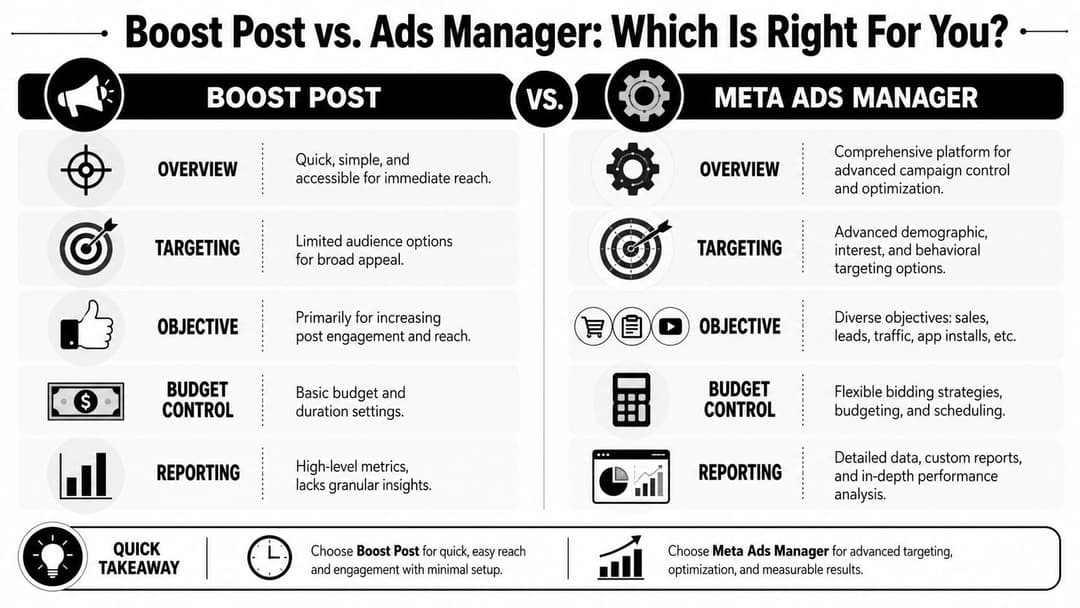
If the job is “give this proven post more reach quickly,” Boost Post can do that. If the job is “generate measurable business outcomes with tighter control,” Ads Manager is usually the better tool.
The core trade-off
The deeper issue isn't minimum spend. It's efficiency against a real business outcome. Hootsuite's explanation of how Facebook boosts work highlights that the major question is the true cost per meaningful business outcome compared with a regular Meta ads campaign, and that the same boost can produce very different CPC or CPA results depending on audience size, creative quality, and objective selection.
Boosting wins on speed. Ads Manager wins on control.
That difference matters because the moment you care about traffic quality, lead quality, or sales efficiency, the shortcut starts to look expensive. If your team is debating ownership, complexity, or outside help, this guide on when to engage a social media agency is a useful decision aid.
Boost Post vs Ads Manager at a Glance
| Feature | Boost Post | Ads Manager |
|---|---|---|
| Setup speed | Fast | Slower, more deliberate |
| Best use case | Amplifying existing content | Building campaigns around business outcomes |
| Targeting control | Limited | Much deeper control |
| Optimization options | Basic | More advanced |
| Reporting depth | High-level | Granular |
| Testing capability | Minimal | Stronger for structured testing |
| Fit for scale | Limited | Better suited for growth programs |
A lot of brands outgrow Boost Post. They don't stop using it because it's bad. They stop using it as the default because the limits become expensive.
This explainer is worth watching if you want a visual comparison before deciding which route to use.
When to graduate
Move into Ads Manager when any of these are true:
- You need conversion intent: engagement is no longer enough.
- You want cleaner testing: audiences, creatives, and messages need structured comparison.
- You manage multiple campaigns: manual boosts become messy fast.
- You need better reporting: top-line reach metrics no longer answer the business question.
For teams scaling beyond simple boosts, tools such as Ads Manager automation workflows can help reduce the manual load. One example is AdStellar AI, which is built to generate and launch many creative and audience combinations directly through Meta Ads Manager rather than relying on single-post boosts.
Practical Tips to Lower Your Boost Costs
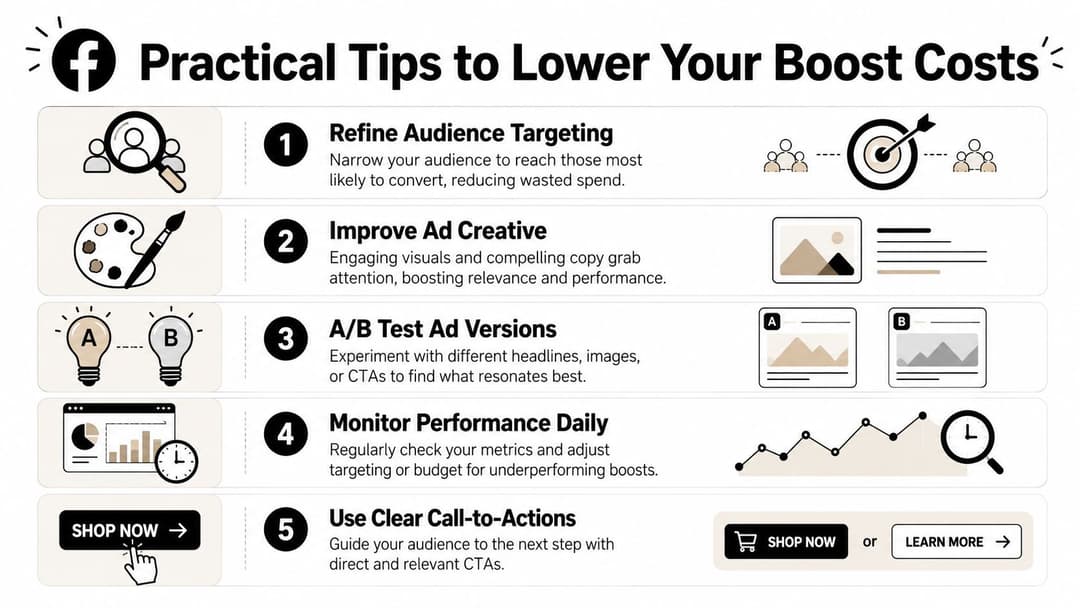
Most cost reduction comes from better decisions before launch, not from tweaking after the fact.
The cheapest way to waste money is to boost a weak post because the budget looks harmless. The more disciplined move is to use boosts selectively, with a clear reason for each one.
Five moves that usually improve efficiency
- Boost winners, not stragglers: Put spend behind posts that already show strong organic traction.
- Match the objective to the job: If you want awareness, buy awareness. Don't expect an engagement-first boost to behave like a sales campaign.
- Keep test windows tight: Short tests make it easier to judge whether the post deserves more budget.
- Watch the audience quality: Cheap engagement from the wrong people is still wasted spend.
- Graduate when complexity rises: Once you need advanced targeting, testing, or optimization, move out of the boost interface.
A boost works best as an amplifier. It works worst as a substitute for campaign strategy.
If you've reached the point where you need more structure, this overview of how agencies manage Facebook ad campaigns is useful for understanding the operational side of scaling beyond one-off boosts.
The bottom line is simple. The cost of boosting a post on Facebook is low enough to test, but not low enough to ignore efficiency. Spend is the easy part. What that spend produces is the actual decision.
If you're ready to move from one-off boosted posts to structured Meta campaigns, AdStellar AI gives growth teams a faster way to build, test, and scale ads inside Ads Manager. It's designed for marketers who want more control over creative, audiences, and performance without doing every setup task by hand.