So, you’re trying to figure out how much to budget for Facebook ads. The short answer? It’s complicated.
There’s no menu with set prices. Your Facebook ads cost is decided in a massive, real-time auction where you're bidding against thousands of other advertisers for the same eyeballs. Think of it less like buying a product and more like bidding for prime real estate in a city that’s constantly under construction.
What Do Facebook Ads Really Cost?
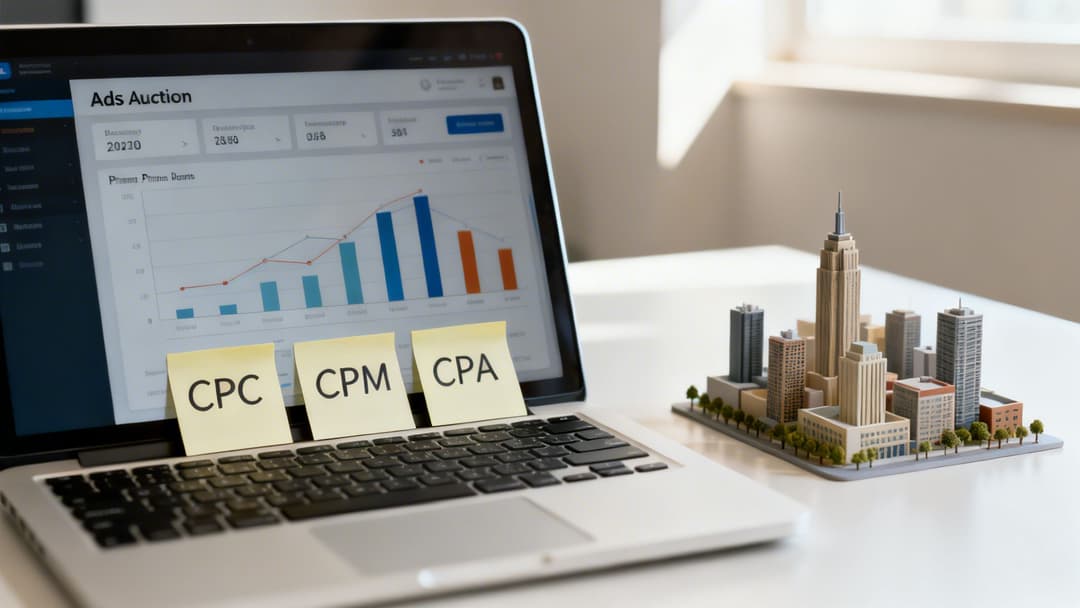
The final price tag depends entirely on the neighborhood (your target audience), how many other buyers are interested (your competition), and the quality of your pitch (your ad creative and copy).
To a newcomer, this auction can feel like a total black box. But once you get the hang of it, you’ll see it’s a system you can actually influence. Your final ad spend isn't random—it's a direct result of a few key variables you can learn to manage.
The Key Cost Variables
Three main things drive what you’ll end up paying: your industry, the audience you’re chasing, and what you’re trying to achieve with your campaign.
For example, trying to sell financial services is always going to be more expensive than advertising a local dog walking business. The competition is just fiercer.
Likewise, targeting a very specific, high-value audience—think CEOs in San Francisco—will cost a lot more than targeting a broad group of "people who like hiking." It’s a constant battle, and it's critical to start understanding rising ad costs on platforms like Facebook to get a real grip on your budget.
Key Takeaway: Your ad costs aren't random. They're the result of a competitive auction where Meta's algorithm weighs your bid against your ad's quality and relevance. A great, engaging ad can often beat a higher-bidding, mediocre one.
Our goal here is to pull back the curtain on this whole process. We’ll break down the core metrics that advertisers live and breathe by, giving you the foundation to predict, manage, and ultimately lower your ad spend.
These are the big three you need to know:
- CPC (Cost Per Click): What you pay every time someone clicks your ad.
- CPM (Cost Per Mille): What you pay for 1,000 people to see your ad (impressions).
- CPA (Cost Per Action): What you pay when someone takes a specific action, like making a purchase or signing up for a newsletter.
Getting these concepts down is the first real step toward building a predictable and profitable ad strategy. If you want to play with some numbers, check out our guide on using a Facebook ad cost calculator to start projecting your potential spend.
The Core Metrics That Define Your Ad Spend
 To really get a grip on your Facebook ad costs, you have to speak the language of the ad auction. This isn’t about reciting dictionary definitions. It’s about understanding the "why" behind the three metrics that truly matter: Cost Per Click (CPC), Cost Per Mille (CPM), and Cost Per Action (CPA).
Think of these as different lenses for viewing your campaign's performance. Each one tells a unique story about how your budget is working for you. The one you choose to focus on depends entirely on what you're trying to accomplish.
Understanding Cost Per Click (CPC)
Cost Per Click is exactly what it sounds like: the price you pay every time someone clicks your ad. This metric is your most direct gauge of how much it costs to get someone from Facebook over to your website or landing page.
Let’s say you’re running a campaign to drive traffic to a new blog post. Your goal isn't an immediate sale; it’s just getting eyeballs on your content. Here, CPC is your north star. A low CPC means you’re efficiently pulling people to your site and stretching your budget further.
But be warned, CPC can be a rollercoaster. The market saw an average CPC drop of 20.95% between 2021 and 2022, only to climb back up toward $1.14 by 2025. These swings, detailed in this in-depth analysis of Facebook advertising costs, prove that simply chasing a low CPC isn’t a winning strategy. You need to be adaptable.
Decoding Cost Per Mille (CPM)
Cost Per Mille, or CPM, is what you pay for one thousand impressions—basically, for one thousand people to see your ad. It has nothing to do with clicks or conversions. It’s all about exposure.
Think of CPM as the price of a billboard on a busy digital highway. You’re paying for brand awareness, betting that repeated exposure will build familiarity and keep your brand top-of-mind.
A new beverage brand launching a line of sparkling water, for example, would be obsessed with CPM. They just want their colorful cans seen by as many people in their target audience as possible. For them, a low CPM is a massive victory, as it means they're blanketing their market without breaking the bank.
Mastering Cost Per Action (CPA)
For most businesses aiming for real growth, this is the metric that pays the bills. Cost Per Action is the price you pay when someone takes a specific, valuable action—like making a purchase, submitting a lead form, or starting a free trial.
CPA is the undisputed champion for conversion-focused campaigns because it ties every dollar you spend directly to a business result. It answers the most important question of all: "How much did it cost me to get a new customer?"
A B2B software company, for instance, lives and dies by its CPA. They don't care much about clicks if those clicks don't convert. Their success is measured by how much it costs to get a qualified demo request. If their CPA for a demo is a profitable $50, they can scale. If it’s not, nothing else matters.
In the end, while CPC and CPM are useful for diagnosing campaign health, CPA is what really dictates profitability. A successful campaign is simply one where your CPA is comfortably lower than the value of the customer you just acquired. This is the first step in truly understanding what Return on Ad Spend really means for your business.
Key Factors That Influence Your Ad Costs
Ever asked yourself why one advertiser is paying a measly $0.50 per click while you’re stuck with costs ten times higher? It’s not about luck or some secret Facebook algorithm. It all comes down to a handful of factors you can actually control.
Think of your ad campaign less like a slot machine and more like a sound engineer’s mixing board. Each factor is a slider. Push one up, and your costs might rise; pull another down, and you could see your spend get a lot more efficient. Mastering these levers is how you go from guessing at your budget to strategically owning it.
Your Audience and Targeting Choices
If there's one lever that can send your costs soaring or bring them back to earth, it’s who you decide to target. This is, without a doubt, the biggest driver of your ad costs.
Imagine you're selling high-end running shoes. Targeting a massive, general audience like "people interested in fitness" is like casting a huge net in the ocean. You'll catch a lot of things, but most of them aren't what you're looking for. This approach often feels cheaper upfront, but the results are rarely effective.
Now, let's get specific. What if you target "vegan marathon runners living in urban areas"? That’s a much smaller, hyper-relevant group. Because other savvy brands also want to reach this high-intent audience, the competition is fierce, and that bidding war drives up the price you pay.
The core idea is simple: the more valuable and sought-after an audience is, the more you will pay to reach them. Your job is to find that sweet spot between audience size and relevance to keep your Facebook ads cost from spiraling out of control.
The Quality and Relevance of Your Ad
Meta's number one priority is keeping people on its apps. How do they do that? By showing them content they actually want to see. This is where your Ad Quality becomes your secret weapon.
Meta’s algorithm actively rewards advertisers who create ads that people genuinely engage with. If your ad is racking up likes, comments, shares, and clicks, Meta sees it as a good user experience. In return, it will show your ad to more people for less money.
On the flip side, if your ad gets ignored—or worse, hidden by users—the algorithm will penalize you with higher costs and slash your reach. A huge part of this is making sure your tracking is set up correctly from the start. We walk you through this in our guide on how to install the Shopify Facebook Pixel to ensure you're getting credit for every conversion.
Your Bidding Strategy
Your bidding strategy is basically you telling Meta how you want it to spend your money in the ad auction. The two most common starting points are "Lowest Cost" (often called "Highest Volume") and "Cost Cap."
- Lowest Cost (Highest Volume): This tells Meta to get you the most results possible within your budget. It’s like telling a personal shopper to find the best deals they can—it prioritizes volume, but costs can fluctuate.
- Cost Cap: This lets you set a maximum average cost you're willing to pay per result (like a Cost Per Acquisition, or CPA). It gives you more control and predictability, but if you set your cap too low, you might limit how often your ad is shown.
Choosing the right one depends entirely on your goals. If you need predictable costs to maintain your margins, a Cost Cap is your friend. If you’re focused on maximizing volume and are okay with some cost variation, Lowest Cost is a great way to get started.
Seasonality and Competition
The ad auction is a live marketplace, and just like any market, its prices are all about supply and demand. During the most competitive times of the year—think Black Friday, Cyber Monday, and the entire holiday season—demand for ad space goes through the roof.
When thousands of advertisers are all bidding to reach the same people, costs inevitably go up for everyone. It's not at all uncommon to see your average CPC or CPM double during these peak periods. Smart advertisers anticipate this by either increasing their budgets or shifting their focus to less crowded times of the year. It's also worth noting that algorithm changes, like recent Facebook News Feed updates, can shake things up and alter ad costs without warning.
Where Your Ads Appear
Finally, not all ad placements are created equal, and where you choose to show your ads has a direct impact on your wallet. Meta gives you a whole menu of options, from the News Feed to Stories to Reels, and each has its own price tag.
A great way to see this in action is by looking at Cost-per-mille (CPM), which is the cost for a thousand impressions. Recent data shows that Feed placements often have the highest CPMs, sometimes hitting around $16. In contrast, Stories and Reels can be much cheaper, hovering in the $10-$12 range. For highly competitive industries like finance, it's not unusual to see CPMs climb past $20.
This means a poorly placed ad could easily cost you 60% more than the exact same ad running in a different spot.
To make this easier to digest, here's a quick summary of the main cost drivers.
Facebook Ad Cost Drivers At a Glance
The table below breaks down the primary factors that influence what you'll pay and highlights what you have the power to change.
| Factor | Impact on Cost | What You Can Control |
|---|---|---|
| Audience Targeting | High-demand audiences cost more. | The specificity of your targeting; testing different lookalike and interest-based audiences. |
| Ad Quality & Relevance | High engagement lowers costs. | Your ad creative, copy, and landing page experience. |
| Bidding Strategy | Determines how Meta spends your budget. | Choosing between Highest Volume, Cost Cap, or other bid strategies based on your goals. |
| Seasonality | Costs rise during peak shopping seasons. | Your campaign timing and budget allocation during competitive periods. |
| Ad Placement | Some placements (e.g., Feed) cost more than others (e.g., Stories). | Selecting which placements to run your ads on (or letting Meta optimize for you). |
By understanding each of these levers, you can start making strategic decisions that directly impact your bottom line, turning unpredictable costs into a manageable part of your growth strategy.
How to Budget and Estimate Your Ad Spend
Figuring out your Facebook ad budget can feel like throwing darts in the dark. If you just pick a random number and hope for the best, you’re setting yourself up for wasted spend and a lot of frustration.A much smarter way to approach this is to turn the whole process on its head. Start with your business goals, get a realistic sense of what things actually cost, and then work backward to build a budget that’s grounded in data, not guesswork. This method gives you a clear plan and sets you up for scalable success from day one.
Starting with Industry Benchmarks
Before you spend a single dollar, you need a realistic grasp of costs. Every industry is different, of course, but looking at benchmarks gives you a solid starting point. It’s what keeps you from aiming for a $5 Cost Per Acquisition (CPA) when the industry average is closer to $50.
Having a ballpark figure helps you manage expectations with your team or clients right out of the gate.
Here are a few general industry benchmarks to get you started:
- E-commerce: You can expect your CPA to land somewhere between $20 to $60. If you’re selling lower-priced items, you might see a CPA closer to $20, but for higher-ticket products, a CPA of $100 or more can still be very profitable.
- B2B/SaaS: Acquiring a lead (CPL) is a different ballgame. Costs here are often higher, typically falling in the $50 to $150 range. The longer sales cycles and higher lifetime value of each customer absolutely justify that higher upfront investment.
- Finance & Insurance: Welcome to one of the most competitive—and expensive—arenas. With fierce competition and high customer value, CPAs can easily blow past $75 and often climb well into the triple digits.
Just remember, these are starting points. The real cost will come down to a few key factors like your audience, ad quality, and timing, which all play off each other.
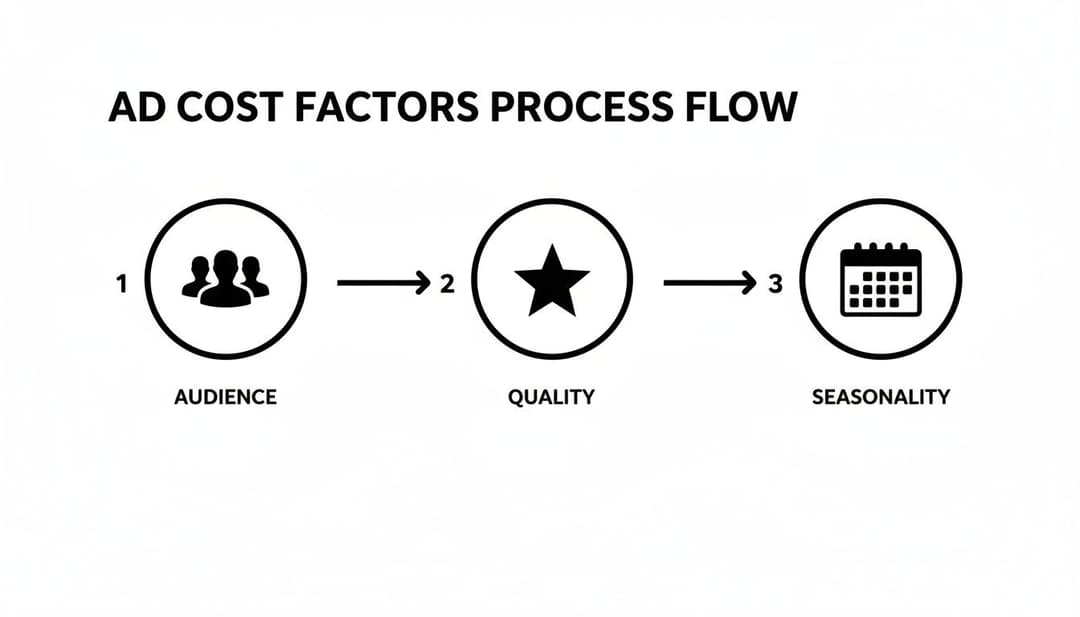
As you can see, each of these elements builds on the last, ultimately deciding how efficient your ad spend will be.
How to Estimate Your First Ad Budget
Once you have a rough idea of your target CPA, you can build your first test budget with a simple, goal-based formula. This approach is perfect for new businesses or anyone launching a major campaign because it ties your spending directly to a real, tangible outcome.
Let's walk through an example. Say you run an e-commerce shop selling custom pet portraits, and your goal is to generate 50 sales a month. Based on some research and your product’s price point, you figure a realistic CPA is $40.
The Calculation: Target Number of Conversions × Estimated Cost Per Conversion = Initial Test Budget
Plugging in the numbers, it looks like this:
50 Sales × $40 CPA = $2,000 Monthly Budget
This $2,000 isn't just a budget for sales; think of it as a critical investment in data. It gives you enough runway to test different audiences and ad creatives, see if your sales funnel holds up, and confirm whether that estimated $40 CPA is actually achievable.
If you can't hit your target, it’s not a failure. It’s a signal that something in your strategy—the audience, the offer, or the ad itself—needs another look. Our guide on marketing budget allocation can help you think through this process for all your marketing channels.
Choosing the Right Budgeting Model
While a goal-based approach is great for getting started, more established brands might use a different model. A popular one is the percentage-of-revenue model, where you dedicate a fixed portion of your total revenue (like 5-10%) to advertising. This model is great because it scales up naturally as your business grows.
But spending patterns are all over the map. Research on Facebook ad spend shows just how diverse the landscape is. A huge chunk of marketers (28.65%) spend between $101-$500 a month, making it a common testing ground. At the same time, over 19% invest more than $500 monthly, with a dedicated 6.74% committing to budgets over $3,000.
These numbers, highlighted in a detailed report on Facebook ad spend, prove there’s no single "right" amount. It all comes back to your scale, your goals, and your industry.
Your first budget is really a tool for learning. Start with a data-backed estimate, give your campaigns enough fuel to gather meaningful data, and get ready to adjust your strategy based on what the performance tells you.
Actionable Strategies to Lower Your Ad Costs
 Alright, so you understand the metrics that make up your Facebook ads cost. Now for the million-dollar question: how do you actually lower it? This is where theory meets action, and where you can make every dollar you spend work harder for you.
Forget about searching for a single secret hack. The real win comes from systematically improving each part of your campaign. The good news? You're in the driver's seat. By focusing on a few key areas—your ad creative, audience targeting, and testing—you can create a powerful feedback loop that consistently finds more efficient ways to get results. Let's break down the strategies you can start using today.
Master Your Creative and Copy
Your ad creative is your single best tool for getting the ad auction to work in your favor. It's simple: Meta rewards ads that people find engaging. When your ads get clicks, comments, and shares, the platform gives you a lower Cost Per Mille (CPM) and more reach as a thank you.
A lot of advertisers make the mistake of creating generic ads that just list product features. That’s a fast track to being ignored. Your ad copy needs to stop the scroll by telling a story, hitting on a specific pain point, or presenting a narrative that grabs attention. One of the best ways to do this is by finding real-world stories that connect with your audience’s problems and goals.
For instance, instead of an ad that just says, “Get help with your back pain,” try something with emotional punch: “She was forced to use the money she’d saved for her son’s Disney trip just to get by while on disability.” That kind of specific, human storytelling is what makes an ad memorable and earns the engagement that drives down your costs.
Refine Your Audience Targeting
Broad, generic targeting is one of the quickest ways to burn through your ad budget. It might feel like you’re doing something right by reaching as many people as possible, but you’re really just paying to show your ads to millions of users who couldn't care less about what you're selling. Precision is the key to cost-effective advertising.
Start by moving away from those huge, expensive interest-based audiences. Instead, focus on these two powerful alternatives:
- Lookalike Audiences: This is a game-changer. You can create Lookalike Audiences from your best customers, your most engaged email subscribers, or people who have already made a purchase on your website. You're essentially telling Meta, "Go find me more people exactly like these," which gives you a much higher-quality audience from the get-go.
- Retargeting Campaigns: It is almost always cheaper to convert a warm lead than a cold one. Set up retargeting campaigns for people who have visited your website, added an item to their cart, or engaged with your Facebook page. These users are already familiar with your brand, making them far more likely to convert at a significantly lower Cost Per Action (CPA).
A well-structured retargeting campaign is often the most profitable part of any ad account. Showing a specific offer to someone who abandoned their cart is a simple, high-return strategy that drastically lowers your overall acquisition cost.
Automate and Systematize Your Testing
The final piece of the puzzle is to stop guessing and start testing. The only way to truly know which ad creative, copy, or audience works best is to pit them against each other and let the data decide. A systematic split testing process is non-negotiable for long-term success.
But let's be honest, manually setting up dozens of A/B tests is slow, tedious, and a total drag on your time. This is where AI-powered automation shines. Platforms like AdStellar can generate hundreds of ad variations—mixing and matching different images, headlines, and audiences—and get them live in minutes. This lets you test at a scale that's just not possible by hand.
This kind of rapid, high-volume testing quickly shows you the winning combinations, allowing you to cut budget from the losers and double down on what’s working. This continuous cycle of testing and optimizing ensures your Facebook ads cost is always trending downward while your results climb. For a deeper look, our article on advanced Facebook ad optimization has even more tactics to sharpen your campaigns.
Your Top Facebook Ad Cost Questions, Answered
If you’ve ever run Facebook ads, you've probably asked yourself: "Am I paying too much for this?" It’s a fair question. Ad costs feel like they’re constantly in flux, shifting with your industry, your audience, and even the time of year.
Let's clear up the confusion. Here are some straightforward answers to the most common questions marketers have about what they should really be spending on Facebook ads.
What Is a Good Cost Per Click for Facebook Ads in 2026?
This is easily the most common question, and the honest answer is: it depends. A "good" Cost Per Click (CPC) is completely relative to your industry, your profit margins, and who you're trying to reach.
But you need a number to start with, right? Across all industries, the average CPC in 2026 is hovering around $1.14.
Think of that number as a general landmark, not a hard rule. If you're in a super competitive space like finance or legal services, a $3.00 CPC that brings in a high-value client is a huge win. On the other hand, an apparel brand might need their CPC to be well under $0.70 to stay profitable.
The only benchmark that truly matters is your own. A "good" CPC is one that lets you acquire customers profitably. Stop obsessing over CPC and start focusing on your Cost Per Acquisition (CPA) and Return on Ad Spend (ROAS). A $5.00 CPC is fantastic if every click turns into a $200 sale.
How Much Should a Small Business Spend on Facebook Ads?
When you're just getting your feet wet, a monthly budget between $500 to $1,000 is the sweet spot. It’s enough money to gather real data without breaking the bank right out of the gate.
A daily spend of just $15-$20 (which lands you at $450-$600 a month) is enough to start seeing what works. You can test one or two key audiences and a few different ads, giving the algorithm enough information to start optimizing.
If you can push that closer to $1,000 per month, you can learn much faster. This lets you run a few campaigns at once, pit different audiences against each other, and A/B test a wider range of ad copy and images to find your winners.
The most important thing is to treat your starting budget as an investment in data. Spend what you’re comfortable learning with. Once you find a campaign that's making you money, you can scale up your ad spend with confidence.
Why Are My Facebook Ad Costs Suddenly So High?
It’s one of the most frustrating things for an advertiser: a campaign is humming along nicely, and then, out of nowhere, your costs skyrocket. This almost never happens by chance; it’s usually a symptom of a few common problems.
First, look at your audience targeting. If you've targeted a group that's too broad or has suddenly become popular with other advertisers, you're now in a bidding war that will drive your costs up.
Second, take a hard look at your ad creative. Meta's algorithm wants to show people ads they actually like. If your ad is getting ignored or, worse, people are sick of seeing it (ad fatigue), Meta will charge you a premium to keep showing it.
Here are the usual suspects to investigate:
- Ad Fatigue: Is your frequency score climbing? If the same people have seen your ad too many times, it’s time for a refresh.
- Seasonality: Competition heats up and costs spike during big shopping moments like Q4 (Black Friday, Cyber Monday, Christmas). It's just the nature of the beast.
- Audience Saturation: You may have simply run out of new people in your current audience. The algorithm is now struggling to find fresh eyes for your ad.
- Bidding Strategy: A misconfigured bid strategy might be telling Meta to spend your money inefficiently.
Start by testing a few new ad creatives to see if you can fight off ad fatigue. At the same time, try building a new, more niche audience to see if you can find a less competitive pocket of users.
How Can AI Ad Platforms Help Reduce Facebook Ads Cost?
AI-powered advertising platforms are built to cut costs by doing the heavy lifting of campaign management and optimization for you. Their real power comes from their ability to test on a scale and at a speed no human ever could.
Imagine launching hundreds of ad variations in minutes, testing every combination of creative, copy, and audience you can think of. That’s what these platforms do. This massive, rapid-fire testing quickly shows you what’s working, so you can stop wasting money on the losers and put your entire budget behind the winners.
By crunching performance data in real-time, these tools give you smart recommendations to lower your CPA and boost your ROAS. They take the guesswork out of the equation, ensuring your budget is always flowing to the most profitable strategies and cutting out the manual work that leads to wasted spend.
Ready to stop guessing and start scaling? AdStellar AI helps you launch, test, and optimize hundreds of ad variations in minutes, not days. Our AI-powered platform uncovers your top-performing creatives and audiences, so you can cut wasted spend and double down on what works. See how much faster you can grow by visiting https://www.adstellar.ai today.