Let’s be honest, true Facebook ad optimization is so much more than just tweaking a few bids and hoping for the best. It's a full-blown system that expertly balances your creative, audience strategy, and hard data. When you get it right, your ad spend stops being a cost and starts becoming a predictable engine for revenue.
Establishing Your Foundation for Winning Facebook Ads
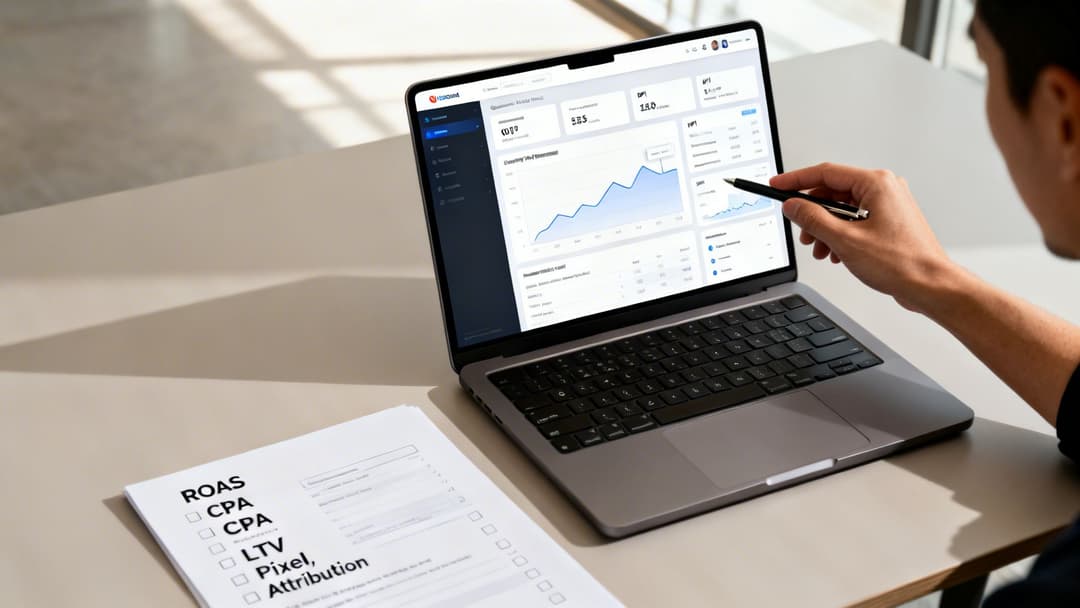
Here's a secret the best advertisers know: effective ad optimization for Facebook doesn't start when you launch a campaign. It starts long before, with an honest, deep-dive audit of your ad account. This is your chance to find quick wins and, more importantly, fix the leaky pipes that are secretly capping your performance.
Think of it like a mechanic giving a race car a once-over before a big event. You wouldn't just top up the fuel and cross your fingers. You’d get under the hood to check the engine, tires, and alignment. That’s exactly what auditing your Meta ad account is—a full inspection of your technical setup and past performance.
Conducting Your Baseline Account Audit
The whole point of an audit is to get a crystal-clear picture of where you stand right now. This means digging into both the technical health of your account and your strategic history. Without this baseline, you’re just guessing, and you'll never know if your changes are actually making a difference.
Your audit needs to zero in on a few critical areas:
- Meta Pixel and Conversions API Health: Is your tracking actually working? A wonky Pixel feeds the algorithm bad data, leading to garbage targeting and wasted money. Make sure your events are firing correctly and you’re using server-side tracking via the Conversions API for the most accurate data possible.
- Attribution Window Settings: Are you using a 7-day click or 1-day view? This one setting directly changes how Meta reports conversions and optimizes your ad delivery. You need to align it with how long it really takes your customers to decide to buy.
- Historical Performance Review: This is where the gold is. Dive into your past campaigns and find your greatest hits—the ads, audiences, and creative angles that knocked it out of the park. Look for patterns. This is your roadmap for what to test next.
Before you even think about launching your first Facebook ad, you have to make sure your website is built to convert. A solid Conversion Rate Optimization Checklist will help you plug the holes in your funnel before you start pouring paid traffic into it.
Setting Business-Centric Goals and KPIs
Okay, so you know your starting point. Now, where are you trying to go? Fuzzy goals like "get more leads" are completely useless. For real ad optimization on Facebook, you need specific, business-focused Key Performance Indicators (KPIs).
Stop obsessing over vanity metrics like likes or impressions. Instead, build your entire strategy around the numbers that actually move the needle for your business.
To make this crystal clear, let's break down the core components of a winning optimization strategy.
Key Pillars of Facebook Ad Optimization
| Pillar | Objective | Key Metric(s) |
|---|---|---|
| Goal Setting | Define what success looks like in business terms, not just ad metrics. | ROAS, CPA, LTV |
| Audience Strategy | Identify and reach the most profitable customer segments. | Audience Overlap, Frequency, CPM |
| Creative Testing | Systematically find winning ad visuals, copy, and angles. | CTR, Conversion Rate, Cost per Result |
| Bidding & Budget | Maximize results within your budget constraints. | ROAS, CPA, Spend Pacing |
| Measurement | Accurately attribute results to your advertising efforts. | Conversion Lift, Attribution Window Data |
These pillars aren't just a checklist; they're the interconnected parts of your growth machine. When they work together, your results compound.
Here are the big-picture metrics you should be laser-focused on:
- Return on Ad Spend (ROAS): The ultimate measure of profitability. For every $1 you put in, how many dollars do you get back out?
- Cost Per Acquisition (CPA) / Cost Per Result: What does it cost you to get a new customer or a key action, like a purchase or lead?
- Customer Lifetime Value (LTV): How much is a customer worth to you over their entire relationship with your business? This tells you exactly how much you can afford to spend to acquire them in the first place.
When you define these KPIs from the get-go, you create a clear scoreboard. Every test, every creative, and every audience gets judged against these bottom-line numbers. If you're still new to the platform, get familiar with the tools at your disposal by exploring our guide on what Facebook Ads Manager is and how it all comes together. This foundational work isn’t just busywork—it’s the most important step you can take to build a machine that turns ad spend into predictable growth.
Focus on the Metrics That Actually Move the Needle
If you've ever felt lost in the sea of data inside Facebook Ads Manager, you're not alone. It's easy to get sidetracked by vanity metrics like likes, shares, or even raw click volume. But successful ad optimization isn't about making noise; it’s about ruthlessly focusing on the numbers that directly impact your bottom line.
Getting past the fluff is the first real step toward building a profitable ad account. The real game is won by mastering the metrics that dictate whether you're making money or just burning through your budget. These are your north stars, guiding every decision from creative tweaks to budget allocation.
The Profit-Driving Trinity: ROAS, CPR, and LTV
While you could track dozens of metrics, only a handful truly matter for sustainable growth. Let's break down the essential trio that should be on your dashboard every single day.
- Return on Ad Spend (ROAS): This is the ultimate litmus test. It answers one simple question: "For every dollar I put in, how much am I getting back?" If your ROAS is below 1.0x, you're losing money on that campaign. Simple as that.
- Cost Per Result (CPR) / Cost Per Acquisition (CPA): This tells you exactly what you’re paying for a specific outcome, whether that's a purchase, a lead, or an app install. Knowing your target CPA is absolutely critical for setting realistic budgets and bid strategies that work.
- Customer Lifetime Value (LTV): This is where you play the long game. LTV reveals the total revenue you can expect from a single customer over their entire journey with your brand. Once you know your LTV, you can spend more confidently to acquire a customer, knowing you'll earn it back (and then some) over time.
When you start zeroing in on these three KPIs, your entire perspective shifts. You stop asking, "How can I get cheaper clicks?" and start asking the right question: "How can I acquire higher-value customers more profitably?"
Benchmarking Your Performance in 2026
Knowing your numbers is one thing, but understanding how they compare to the rest of the market is another. Benchmarks can vary wildly by industry, but here’s a general snapshot of what to aim for in 2026 to see if your performance is in the right ballpark.
| Metric | 2026 Industry Average | What It Tells You |
|---|---|---|
| CPM (Cost Per 1,000 Impressions) | $12 - $20 | The cost to get in front of your audience. A high CPM can signal intense audience competition or poor ad relevance. |
| CPC (Cost Per Click) | $0.90 - $2.50 | The efficiency of your creative and targeting at sparking that initial interest. |
| CTR (Click-Through Rate) | 1.0% - 2.5% | How compelling your ad is. A low CTR is often a red flag for a mismatch between your creative and your audience. |
A critical—and often overlooked—part of ad optimization for Facebook is managing ad frequency. Ad fatigue is very real, and it will kill your campaign performance. Once your frequency starts creeping above 3.5, you're likely wasting money and just plain annoying your audience.
The Unskippable Duo: Pixel and Conversions API
In today's privacy-first world, running ads without a solid data foundation is like flying blind. The Meta Pixel, by itself, is no longer enough. To give your campaigns the high-quality fuel they need, you have to pair it with the Conversions API (CAPI).
Think of it this way: the Pixel is a browser-side tool, meaning it can be easily blocked by ad blockers or disrupted by privacy updates like iOS 14. The Conversions API, on the other hand, is a server-side tool. It sends data directly from your server to Meta's, painting a much more reliable and complete picture of what your customers are actually doing. If you need a refresher, our guide on how to set up the Facebook Pixel is the perfect place to start.
The metrics that truly drive profit have moved far away from vanity stats and are now centered on real business outcomes, with ROAS as the ultimate goal. For top performance marketers, frequency management has become a key optimization lever; they typically see the best results between 1.8-3.2 impressions before returns start to diminish. Plus, marketers who properly implement the Conversions API often report significant performance lifts within just 2-4 weeks as the algorithm learns from the richer data. You can explore more insights about Facebook metrics that matter for ad optimization in 2026 on leadenforce.com.
When you combine these two tools, you give Meta's algorithm the most accurate data possible. This directly translates to better targeting, more stable campaign performance, and ultimately, a much higher return on your investment.
Building A High-Velocity Creative Testing Engine
Let's be blunt: in the world of Meta ads, your creative does all the heavy lifting. You can have the most dialed-in audience imaginable, but if you serve them a mediocre ad, you're just burning cash. A killer ad, on the other hand, can make even a broad audience convert.
This is exactly why a systematic, high-speed creative testing engine isn’t just some "nice-to-have" add-on. It's the absolute core of successful Facebook ad optimization. The mission is to stop guessing and start building a structured process to find what works, what doesn't, and—most importantly—why. This is how you transform your ad account from a creative lottery into a data-driven factory that churns out winners.
The "Test and Learn" Matrix
The whole game of rapid testing comes down to one simple principle: isolating variables. If you throw a completely new ad into the mix with a new image, headline, and copy, and it flops, what did you learn? Nothing. Was it the visual? The hook? The offer? You’re left completely in the dark.
Instead, a "test and learn" matrix brings much-needed structure to your experiments. Think of it this way: you start with your current best-performing ad as the control—your champion. Then, you change just one thing. Keep the image and offer the same, but pit 3-5 new headlines against it.
Once you find a headline that beats your control, it becomes the new champion. Now, you use that winning headline and start testing the next variable, like the creative visual. This methodical approach lets you see exactly what’s driving performance. You aren't just finding one winning ad; you're building a library of winning components you can combine in future campaigns. For a much deeper look at this process, our Meta ads creative testing guide breaks down even more frameworks.
Fueling Your Creative Engine with Diverse Content
A testing engine is only as good as the fuel you give it. If all you’re feeding it is polished, studio-shot content, your campaigns will feel sterile and look like... well, ads. Some of the most potent creative comes from incorporating user-generated content (UGC) and assets from influencers.
This type of content feels native to the feed, blending in with what users are already seeing from friends and family, which often builds trust far more effectively than a branded graphic. To see how this works in practice, look at how restaurants use influencer content as paid ad creative. The strategies are gold, and they apply to almost any industry searching for that authentic touch.
Ultimately, these creative tests have to tie back to what really matters: your bottom line.
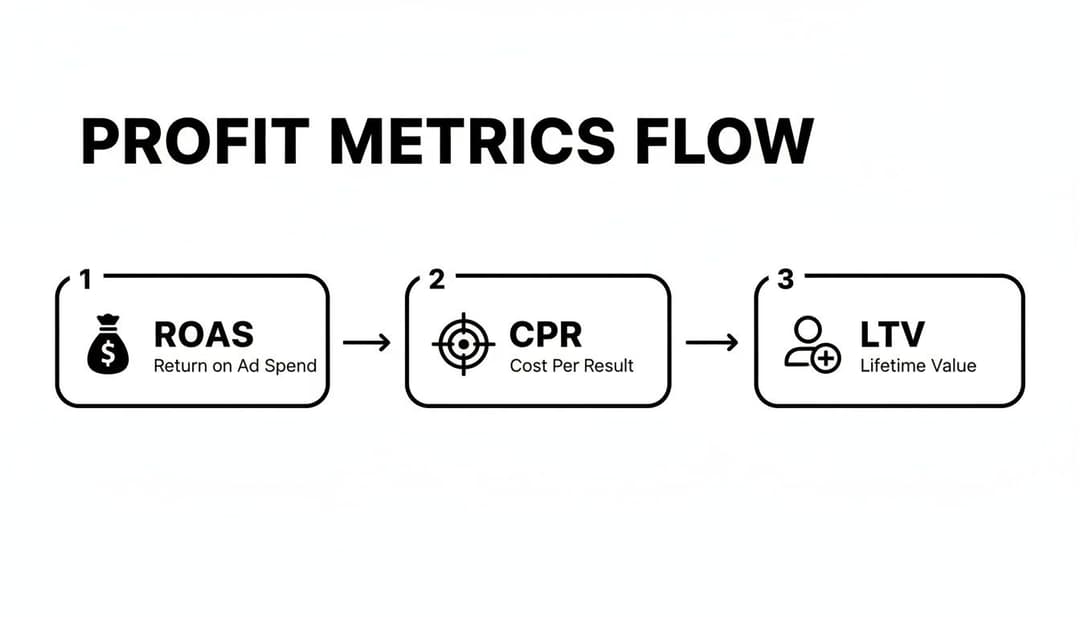
As you can see, strong creative testing directly impacts your ROAS and CPR. Getting those numbers right is how you acquire customers who actually contribute to long-term LTV, not just short-term vanity metrics.
Leveraging Dynamic Creative for Efficient Testing
Let’s be real, manually building dozens of ad variations is a massive time sink. This is where Facebook's Dynamic Creative Optimization (DCO) becomes your best friend. Instead of you creating every single ad combination, you give Meta a pool of assets to work with:
- Multiple images or videos
- Several headlines
- Different primary text options
- Various Calls-to-Action (CTAs)
Meta’s algorithm then does the heavy lifting, mixing and matching all these components in real-time to find the combinations that perform best for different people in your audience. It’s like running hundreds of small A/B tests at once, completely on autopilot.
DCO is a fantastic tool for the middle stage of testing. Once you've identified a few strong creative concepts, use it to quickly pinpoint the perfect combination of copy and visuals. Meta’s own data shows its generative models have delivered a 5% increase in conversions on Instagram and a 3% increase on Facebook Feed by better matching creative to user intent.
This approach saves you countless hours and allows the algorithm to find those small wins that, when added up, make a huge impact on your overall ad optimization for Facebook.
Advanced Audience And Placement Strategies
Getting your ad in front of the right person is only half the job. The real wins come when you reach them in the right place at the right time. If you're still just scratching the surface with basic interest targeting, you're leaving money on the table. The campaigns that truly scale are the ones built on sophisticated audience and placement tactics.
The entire foundation of a killer audience strategy starts with your own first-party data. This means getting surgical with Custom Audiences built from your most valuable customers. Don't just upload a list of every single person who has ever bought from you. Instead, get granular and segment that list by customer Lifetime Value (LTV). An audience of your repeat, high-AOV buyers is infinitely more powerful than a list diluted with one-time discount chasers.
This is where the real leverage comes in. Once you’ve isolated those high-value Custom Audiences, you can spin them into gold with Lookalike Audiences. This is you telling Meta’s algorithm, "Go find me more people exactly like my best customers."
Unlocking High-Value Lookalike Audiences
Building a Lookalike Audience from a seed list of your top 10% of customers based on LTV is one of the single most powerful moves you can make on the platform. This isn't just a nice idea—it’s a battle-tested playbook for finding new, high-intent buyers who are practically pre-qualified to love what you sell.
Get laser-focused on building Lookalikes from these key segments:
- High LTV Customers: Your VIPs. These are the people who have spent the most with you over their entire customer journey.
- Repeat Purchasers: Anyone who has bought from you more than once. They've already proven they trust your brand.
- High Average Order Value (AOV): Users who consistently spend more per transaction.
This isn't just a minor tweak; it’s a fundamental shift that separates the pros from the amateurs. In fact, we’ve seen that Lookalike Audiences built from high-value customer lists can outperform standard interest-based targeting by as much as 5x on conversion rates. You can find more data about how these strategies impact Facebook ad optimization on cometly.com. You're feeding the algorithm the highest quality signals possible, and it rewards you with much more efficient ad spend.
Navigating The Modern Placement Landscape
The days of just running ads in the Facebook Feed and calling it a day are long gone. Today, you have to think like a media planner, understanding the unique role each placement—Feed, Stories, and Reels—plays in your customer's journey.
A strategic placement mix has completely changed how we structure campaigns. The Feed still gets a huge piece of the pie, commanding around 55-65% of impressions, with Stories driving another 30-40%. But Reels are the new frontier, representing a massive opportunity and capturing between 25-45% of total Meta impressions for advertisers who embrace the full placement mix. For a deeper look, check out our guide on the role of placements in advertising.
Here’s a simple framework for how to approach each placement:
- Reels for Awareness: With Cost-Per-Mille (CPM) rates often 10-30% cheaper than the Feed, Reels are your go-to for efficient top-of-funnel campaigns. Use them to grab attention, introduce your brand, and build that initial spark of interest with short, entertaining video.
- Stories for Engagement: Stories are perfect for the middle of the funnel. Their immersive, full-screen format is ideal for driving interaction with polls, quizzes, and behind-the-scenes content that gets people to lean in and connect with your brand.
- Feed for Conversions: The Feed is still the king of direct response. Users are conditioned to click and convert from this placement, making it the prime real estate for your strongest offers and clearest calls-to-action.
A savvy advertiser uses this landscape to their advantage, warming up cold audiences on Reels, nurturing them with engaging Stories, and then closing the deal with a compelling offer in the Feed.
Finally, don’t sleep on device-specific optimization. The user experience on Android can be wildly different from iOS. By creating separate ad sets that target each operating system, you can tailor your creative and landing pages to platform-specific behaviors. It’s a small detail that can lift conversion rates by a few crucial percentage points, ensuring every dollar you spend is working as hard as it possibly can.
Scaling Winners And Automating Your Growth
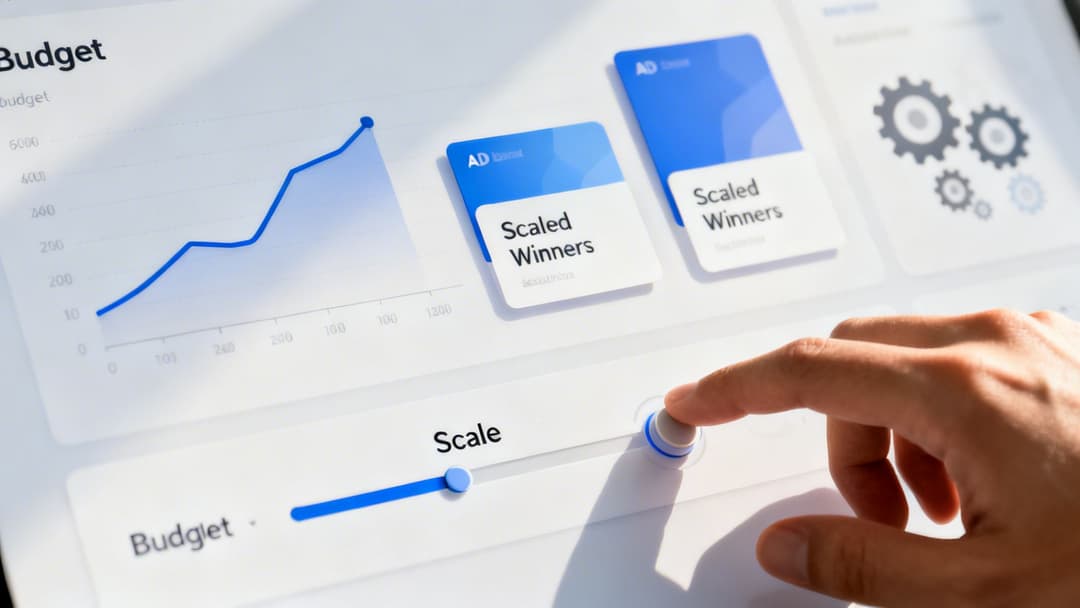
You finally did it. After all the testing, you've got a winning ad creative and audience combo that’s hitting your targets. It’s a huge win, but this is where so many advertisers stumble. The temptation to just crank up the spend is real, but it’s a classic mistake.
Pouring money into a hot campaign too fast can send the algorithm into shock, kicking you right back into the dreaded learning phase and wiping out the very performance you worked so hard to find.
Smart, sustainable scaling isn’t about luck—it’s about having a clear playbook. This means following a disciplined approach to increasing your budget while methodically expanding your reach to new, profitable audiences. Get this right, and you’ll transform your ad account from a cost center into a predictable engine for growth.
Smart Budget Scaling: The 20% Rule
Once you’ve identified a clear winner—an ad set that's consistently crushing your target CPA or ROAS—resist the urge to floor it. A sudden, massive budget increase is the quickest way to make performance volatile and unpredictable.
Instead, you need to scale vertically using the 20% rule. It’s simple: only increase the budget on a winning ad set by a maximum of 20% every 24-48 hours. This slow-and-steady approach gives Meta's algorithm enough time to adjust and find more customers at a similar cost, without triggering a hard reset. It requires patience, but it’s the most reliable way to maintain efficiency as you grow.
Horizontal Scaling: Duplicating Your Success
While vertical scaling is about spending more on a single winner, horizontal scaling is about finding new audiences for that same winning ad. Think about it: if a creative and offer works wonders with one Lookalike Audience, there's a good chance it will work with others.
This strategy involves duplicating your winning ad set but changing just one variable: the audience. You can test it against:
- Another Lookalike percentage (e.g., expanding from a 1% to a 3% Lookalike)
- A different high-value Custom Audience you’ve built
- A fresh interest-based audience that shares similar traits
This method lets you rapidly expand your reach and uncover new pockets of customers, all while using a creative that's already proven to work. For a deeper look at these tactics, check out our full guide on how to scale Facebook ads.
The most effective ad optimization for Facebook leverages both vertical and horizontal scaling in tandem. You increase the budget on your core winners while simultaneously exploring new audiences with those same winning ads.
Embracing Meta's AI for Automated Growth
Let’s be clear: Meta’s AI has gotten incredibly good. Recent updates to its Andromeda algorithm have already shown a 10% jump in efficiency, and their incremental attribution feature delivered a 24% boost in conversions for advertisers. This learning curve is only getting steeper, giving marketers who lean into Meta's AI a serious competitive edge. You can read about Meta’s AI-driven performance insights on about.fb.com to see where things are headed.
This is where Advantage+ campaigns enter the picture. Once you have validated your winning creatives and offers through manual testing, your next move is to consolidate them into an Advantage+ campaign. These campaigns unleash Meta's AI to automate targeting and budget allocation at a massive scale, doing work a human media buyer could never manage.
Tools like AdStellar AI can take this a step further. By connecting directly to your ad account, these platforms can automatically spot your top-performing ads based on core KPIs (like ROAS or CPA) and shift your budget to those winners in real time. This creates a powerful feedback loop where your best ads get more spend, faster. This combination of manual testing, Advantage+ scaling, and third-party automation is the modern playbook for achieving sustainable growth on Meta.
Frequently Asked Questions About Facebook Ad Optimization
No matter how long you've been running Facebook ads, a few nagging questions always seem to pop up. Between algorithm updates, new features, and the constant pressure for fresh creative, even the most seasoned media buyers can get thrown for a loop.
Let's clear the air and tackle some of the most common questions we hear. Think of this as your go-to cheat sheet for the everyday hurdles of Meta advertising.
How Often Should I Test New Ad Creatives?
If you have any decent budget flowing, you should be dropping new ad creative weekly or, at the very least, bi-weekly. Ad fatigue is the silent killer of great campaigns. Once someone has seen your ad 3-4 times, you can pretty much watch its effectiveness fall off a cliff.
Your best defense is a high-velocity testing system. It’s what keeps your campaigns from going stale and, more importantly, it's how you consistently find new winning angles.
The trick is to be systematic. Don’t just chuck random ads into your campaigns and hope for the best. You need to isolate one variable at a time to get clean data you can actually use. For example:
- Test different hooks: Keep the image and offer the same, but try three completely new opening lines in your copy.
- Test new visuals: Use your champion headline and copy, but run it against a brand-new image or video.
- Test the offer: Keep the creative locked, but pit a "20% off" deal against a "Buy One, Get One" offer.
This kind of disciplined testing gives you clear insights to build on, not just a series of random wins and losses.
What Is a Good Starting Budget for Testing Facebook Ads?
Your testing budget should be directly tied to your target Cost Per Acquisition (CPA). A solid rule of thumb is to set a daily budget that gives an ad set a fighting chance to hit at least 50 conversions per week. This is the magic number that helps Meta's algorithm exit the dreaded "learning phase" as fast as possible.
Let's break it down with a real-world example. Say your target CPA for a purchase is $30. To stay on track, you'll need around 7-8 conversions a day. This means a daily budget of at least $210-$240 (7 conversions x $30 CPA) is a good starting point for that one ad set to get you meaningful data, fast.
If your budget is tighter, don't make the mistake of spreading it too thin across a dozen different tests. You’re better off focusing your money on testing just one or two variables at a time. It’s far better to get a statistically significant result on one test than inconclusive data on five.
A smaller budget just means you need to be more patient and methodical. You can still crush it with smart ad optimization for Facebook; it'll just take a bit more time to cycle through your tests and find the winners.
Should I Use Advantage+ Campaigns or Manual Campaigns?
This isn't an "either/or" question. You should be using both. They serve different, but equally critical, roles in any modern ad account. Thinking you have to choose one over the other is a huge mistake.
Manual Campaigns are your lab. They give you the granular control you need for all your early-stage testing. This is where you go to experiment with unproven creative, new audience theories, and different offers to see what actually works. Manual campaigns deliver the clean, isolated data required to identify your winners with real confidence.
Advantage+ Campaigns (ASC) are your scaling engine. Once you've found a clear winner—a specific creative and audience combo that has proven itself with hard data in your manual campaign—you move it over to an ASC. Advantage+ is an incredibly powerful tool for taking those proven assets and letting Meta's AI do the heavy lifting, efficiently finding new customers for you at scale.
Ready to stop the manual grind and automate your growth? AdStellar AI is the platform built to launch, test, and scale your Meta campaigns 10x faster. Generate hundreds of ad variations in minutes, identify your top performers with AI-powered insights, and let our system automatically scale what's working. Transform your creative chaos into predictable revenue. Discover how AdStellar AI can revolutionize your workflow.