When we talk about advertising placements, we’re talking about the specific spots where your ads show up. It could be someone’s Instagram Feed, a video ad before a YouTube clip, or a banner on a news site.
Think of it as digital real estate. The power of your message hinges entirely on where you decide to put it.
What Placements in Advertising Really Mean
Imagine you’re launching a high-end boutique. Would you go for a massive, flashy billboard in Times Square, or would you place a stylish flyer in a few curated local coffee shops? Both are advertising, sure, but they have completely different goals, reach different people, and demand entirely different creative.
That’s the essence of advertising placements. It’s not just about getting your ad seen; it’s about being seen in the right place, at the right time, by the right person.
The "where" is arguably just as critical as the "what." A user's mindset shifts dramatically from one placement to the next. Someone flicking through Instagram Stories is in a fast-paced, entertainment-first mode. Contrast that with someone reading a niche professional blog—they’re in a slower, more focused state of mind, ready to learn.
An ad that feels helpful and native in one spot can feel jarring and intrusive in another. This is exactly why a one-size-fits-all approach to creative is a surefire way to waste ad spend.
The Impact of Context on Your Message
The context a placement provides changes everything about how your message lands. An ad placed inside a trusted industry journal borrows some of that publication's credibility. On the flip side, an ad that appears next to low-quality content can get dragged down by association. This contextual shift influences every decision you make.
Creative Choices: A slick vertical video that crushes it on TikTok will look amateurish and out of place as a horizontal banner on a news website. For more on matching your visuals to the placement, check out our guide on the ideal size for Facebook ads—it’s a great breakdown of how format dictates performance.
Budget Allocation: Premium placements, like a website's homepage banner, cost more for a reason. They offer more visibility and a bigger impact, just like prime real estate in a city center.
Campaign Goals: Placements built for discovery, like the Instagram Explore page, are fantastic for building brand awareness. Meanwhile, nothing beats Google Search ads for capturing high-intent customers who are actively looking to buy something.
Why Every Marketer Needs to Master Placements
At the end of the day, getting placements right is a foundational skill for any performance marketer. It’s the difference between blindly chucking money at an ad platform and strategically investing in inventory that actually delivers results.
When you thoughtfully select where your ads appear, you’re aligning your message with what the user is doing and thinking in that exact moment. That alignment is what drives better engagement, higher conversion rates, and a much healthier return on your ad spend. It’s the bedrock of any truly effective and scalable advertising strategy.
Your Guide to the Digital Ad Placement Landscape
To really get a handle on ad placements, you have to understand the unique personality of each major digital ecosystem. Think of the internet's ad space like different neighborhoods in a sprawling city. Each one has its own vibe, its own rules, and draws a completely different crowd. Deciding where to place your ad is a lot like choosing where to open up a new shop—your location is everything.
We're going to walk through the three dominant territories: Meta's social universe, Google's intent-driven network, and the vast, complex world of Programmatic Display. Each one gives you a different shot at grabbing your audience's attention, depending on what they're doing at that exact moment.
This map gives you a bird's-eye view of how a placement's reach, context, and cost all tie together.
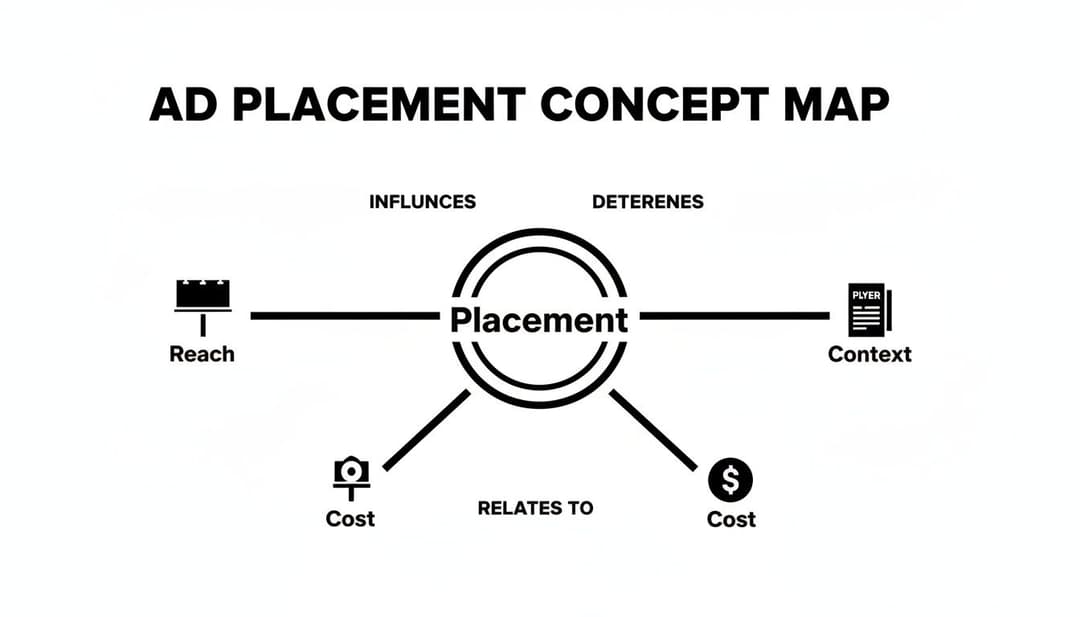
As you can see, these factors aren't isolated. The context of a placement—where it shows up—directly impacts its potential reach, which in turn affects how much it's going to cost you in the ad auction.
A Quick Guide to Key Advertising Placements
To make sense of it all, let's break down the most common placements across the major platforms. This table gives you a snapshot of where your ads can live, what users are doing there, and what kind of creative works best.
| Platform | Placement Examples | Primary Use Case | Best For |
|---|---|---|---|
| Meta | Feeds, Stories, Reels, Explore | Demand Generation: Catching users during discovery and entertainment. | Brand awareness, impulse buys, community building, and retargeting with highly visual creative. |
| Search Results, YouTube (In-Stream, Search), Display Network | Demand Capture: Reaching users who are actively searching for a solution. | Direct response, lead generation, and capturing high-intent customers at the moment of need. | |
| Programmatic | Banner Ads, Native Ads, Video Ads on websites & apps | Scale & Reach: Blanketing the web to build awareness or follow users. | Broad-scale brand awareness, top-of-funnel marketing, and sophisticated retargeting campaigns. |
Think of this as your cheat sheet. While Meta helps you create demand, Google helps you capture it, and Programmatic helps you scale your message far and wide.
The Meta Ecosystem: Facebook and Instagram
Meta's platforms are all about social connection, discovery, and entertainment. People are scrolling to see what's new, get inspired, and kill time. Their mindset is passive and open to discovery, not actively hunting for a specific product. This makes it a goldmine for building brands and sparking those "I need that now" impulse purchases.
News Feed: This is the classic social scroll. Your ad slides right in between posts from friends and pages they follow. To win here, your ad can't feel like an ad. It needs to tell a story, offer real value, or stop the scroll with killer visuals.
Stories & Reels: Welcome to the fast lane. This is a full-screen, sound-on, vertical video world where attention spans are measured in seconds. The ads that crush it here look and feel like organic content—think user-generated style, quick cuts, and a clear message right from the jump.
Explore & Shop: Here, you're catching people with their shopping hats on. They are actively looking for new accounts to follow or products to buy. It's the perfect spot to get your brand in front of a totally new, highly interested audience that's ready to discover you.
If you want to get into the nitty-gritty of managing these options, our guide on what Facebook Ads Manager is breaks down exactly how to navigate the platform.
The Google Ads Network
Google is the kingdom of intent. Simple as that. When someone goes to Google, they have a problem, a question, or a need. They are actively looking for a solution, which makes this network unbelievably powerful for direct-response advertising. You can be the answer they're searching for at the exact moment they need it most.
Key Takeaway: While Meta is fantastic for creating demand out of thin air, Google is where you go to capture the demand that already exists. Getting this distinction right is fundamental to building a smart media plan.
Google Search: This is as direct as advertising gets. You bid on keywords and your text ad shows up when someone searches for them. Forget flashy visuals; success here is all about precise targeting and writing sharp, relevant copy that promises a solution to their problem.
YouTube: Don't forget, YouTube is the world's second-largest search engine. It offers a ton of placement options. Pre-roll and in-stream video ads are brilliant for telling a deeper story and building your brand, while ads in YouTube's search results capture intent just like a classic Google search.
Google Display Network (GDN): This is Google's answer to programmatic, placing your visual banner ads across millions of websites, apps, and videos. It's a go-to for building massive brand awareness and for remarketing to people who've already visited your site.
The Programmatic Display World
Programmatic display is the engine that runs most of the banner ads you see across the internet. It’s the automated buying and selling of ad space on blogs, news sites, and just about anywhere else you can imagine. It offers almost limitless scale, but you need to approach it with a clear strategy.
Open Exchange: This is the wild west—a massive, open marketplace where pretty much any advertiser can bid on ad inventory from a huge pool of publishers. The reach is incredible and the costs can be low, but you have to keep a close eye on things to make sure your ads don't show up in sketchy places.
Private Marketplace (PMP): Think of this as the VIP room. It's an invitation-only auction where premium publishers offer their best ad space to a select group of advertisers. PMPs give you access to high-quality, brand-safe environments and often come with better, more transparent data.
Each of these ecosystems plays a different role. Once you truly understand the user's mindset and the context of each placement, you can start making smarter decisions about your placements in advertising and build a growth strategy that works across multiple channels.
Why Your Creative Strategy Depends on Placement
Ever seen a brilliant ad fall completely flat? Chances are, it was a great message in the wrong place. This simple truth is the bedrock of any successful ad strategy. The magic happens when your creative, the placement, and your bidding all work together in harmony. Treating your creative like a one-size-fits-all asset is a surefire way to burn through your budget with nothing to show for it.
Think about it. Imagine taking a flashy, high-energy vertical video made for TikTok and slapping it into a horizontal banner slot on a serious news website. It would look broken, out of place, and totally unprofessional. The reverse is just as bad—a detailed, text-heavy banner would be scrolled past in a heartbeat in the fast-paced, sound-on world of Instagram Stories.
Why? Because the user’s mindset and what they expect to see are completely different in each location. The power of your placements in advertising is directly tied to how well your creative fits that specific context.
Matching Creative to Context
Adapting your creative is so much more than just resizing an image. It’s about rethinking the entire message for each unique environment. A smart approach means tailoring your visuals, copy, and call-to-action to match the user's experience on that specific placement.
For Stories and Reels: You need to think in quick cuts, use bold text overlays, and design for a sound-on experience that hooks people in the first three seconds. The goal here is to entertain or inform in a snappy, native-feeling format.
For News Feeds: You have a little more breathing room to tell a story. High-quality images, carousels, or slightly longer videos tend to perform well, backed by compelling copy that gets people to engage or click.
For Professional Blogs or Niche Sites: The audience here is often in a research or learning mode. Your creative should be more value-driven, maybe offering up helpful info, a case study, or a clear solution to a problem they're trying to solve.
This visual shows exactly what we're talking about—how different ad formats are built for specific digital environments, from a vertical video on a phone to a display banner on a desktop.
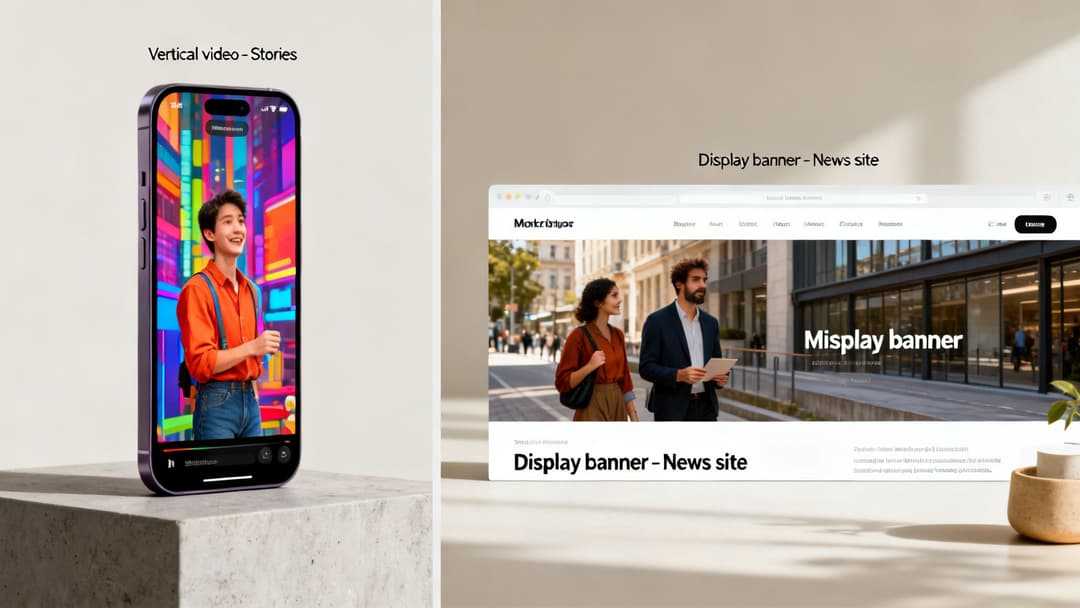
This distinction is everything. It shows how the format dictates its function, making sure the ad feels like it belongs there and connects with the user. Your creative strategy lives and dies by the quality of your content, which makes a solid guide to creating video ads an essential resource.
How Placement Influences Bidding and Cost
The connection between placement and creative has a direct impact on your wallet. Ad platforms like Meta and Google don't treat all placements equally; their bidding systems automatically assign value to them based on expected performance, visibility, and user engagement.
A premium placement—like the very top of a search results page or a homepage banner on a major publisher's site—is prime real estate and will naturally cost more. These spots are valuable because they’re more likely to be seen and clicked. On the flip side, placements with lower engagement potential will be cheaper.
When you feed the algorithm creative assets that are perfectly optimized for high-value placements, you’re sending a strong signal that your ad is relevant. This can boost your "quality score," which can actually lower your costs and improve your ad's delivery.
The scale of this market is staggering. Last year, global marketers spent nearly US$1.1 trillion on advertising, with digital channels gobbling up over US$790 billion of that. Programmatic placements alone made up US$650 billion, showing just how massive automated ad buying has become. For performance marketers trying to compete here, using AI-powered tools to quickly generate and test hundreds of placement-specific ad variations isn't a luxury anymore—it’s a necessity for getting a strong return on your ad spend.
At the end of the day, understanding this connection is the key to spending your ad budget efficiently. You can see how technology automates this in our deep dive on what dynamic creative optimization is. When you stop fighting the system with mismatched creatives and start giving each placement the exact format it needs, you empower the platform's algorithm to work for you, not against you.
A Framework for Testing and Optimizing Your Placements
Knowing all the placements in advertising is one thing, but figuring out which ones actually make you money? That's the real game. It’s time to stop guessing and start building a practical framework for choosing, testing, and validating your ad placements to get real results.
The modern playbook, especially on platforms like Meta, is to start broad. Forget painstakingly picking and choosing every spot your ad might appear. The best practice today is to begin with automated placements, what Meta now calls Advantage+ Placements.
This approach lets the platform's incredibly powerful algorithm do the heavy lifting for you. You're giving it access to the entire inventory—from Feeds and Stories to Reels and the Audience Network—and letting it sniff out the most cost-effective opportunities to hit your goal, whether that’s a rock-bottom CPA or a sky-high ROAS.
This hands-off approach often uncovers hidden gems. You might discover a placement you would’ve completely ignored, like Facebook Marketplace or an in-stream video slot, is actually a goldmine of low-cost conversions for your specific audience.
Reading the Data to Find Your Winners
Once your campaign has been running for a bit and has gathered enough data, it’s time to roll up your sleeves and dig in. This is where you separate the workhorses from the placements just burning a hole in your budget.
Jump into your ad platform’s reporting dashboard and use the "Breakdown" feature to slice your performance data by placement. This report gives you a crystal-clear view of exactly where every dollar is going and what it’s bringing back.
You're looking for a few key patterns:
- High Spend, Low Results: If a placement is eating up a huge chunk of your budget but delivering a painfully high CPA or laughable ROAS, it's a prime candidate for exclusion. Cut it loose.
- Low Spend, High Results: These are your hidden opportunities. A placement might not be getting much love from the algorithm, but if its ROAS is stellar, it's screaming for attention. Try creating custom creative just for it and see if you can scale that success.
- High Impressions, Low Clicks: This is almost always a creative problem. People are seeing your ad, but it’s not clicking (literally). It's a signal that your ad's format or message is out of place in that specific environment.
This isn't a one-and-done task. Think of it as an ongoing conversation with your data, constantly tweaking and refining your strategy based on what’s actually happening in the wild.
Building a Robust Placement Testing System
The single biggest roadblock to testing placements effectively is creative production. To truly know if a placement can work for you, you have to feed it creative that’s actually made for it. You can't just throw a square image into an Instagram Reels slot and call it a fair test.
This is where most advertisers hit a wall. Manually creating dozens of creative variations—different sizes, headlines, and calls-to-action for every single placement group—is a monumental, soul-crushing task. It's an operational nightmare that makes real, comprehensive testing feel like a pipe dream.
Luckily, modern tools are built to solve this exact problem. Platforms like AdStellar AI can automate the generation of hundreds of creative and copy combinations in minutes. You can build out an entire arsenal of assets for every key placement:
- Vertical Video (9:16): For immersive, full-screen experiences like Stories and Reels.
- Square Image/Video (1:1): The workhorse format for most social Feeds.
- Landscape Image (1.91:1): Perfect for in-stream video ads and certain Audience Network spots.
By automating this creative workflow, you completely remove the bottleneck. You unlock the ability to run truly comprehensive placement tests. For a deeper dive into this kind of testing methodology, check out the principles of multivariate testing in our guide.
This transforms testing from something you should do into a streamlined, repeatable part of your workflow. You can push hundreds of tailored ad variants live, let the algorithm find the winning combos, and get undeniable data on which placements in advertising truly move the needle for your business.
How to Scale Your Wins with Automated Workflows
Finding an ad placement that works is a great feeling, but it's just the starting point. The real challenge—and where you find explosive growth—is figuring out how to scale that success. It’s all about building repeatable, data-driven systems that turn the insights from one winning campaign into the blueprint for the next one. This way, you never have to start from scratch again.
The only way to do this at speed is through automation. When you shift from making reactive, manual tweaks to using a proactive, intelligent system, you can continuously lift your campaign performance with way less effort. This frees you up to think about big-picture strategy instead of getting bogged down in repetitive tasks.
Transforming Placement Optimization with AI
Modern advertising tools are built to take the guesswork out of the equation. Platforms like AdStellar AI plug directly into your ad accounts, pull in all your historical performance data, and use artificial intelligence to figure out what’s really working.
This process is so much more than basic A/B testing. An AI-powered system can crunch thousands of data points to rank your best-performing elements against the goals that actually matter to your business.
- Top Creatives: It flags the specific images and videos that stop the scroll and get people to act.
- Top Audiences: It pinpoints the exact user segments delivering the highest return on ad spend (ROAS).
- Top Messaging: It tells you which headlines and ad copy are resonating most powerfully with your customers.
By looking at all these pieces in the context of specific placements in advertising, the system gives you a clear, data-backed recipe for success.
From Manual Chore to Intelligent System
This kind of data-driven approach completely changes how you manage your placements. Instead of digging through placement reports and making educated guesses, you get clear, actionable recommendations based on your own past performance.
Imagine your system tells you that one particular vertical video ad, paired with a specific headline and targeted to a lookalike audience, is absolutely crushing it in Instagram Reels but falling flat everywhere else. An automated workflow takes that insight and immediately puts it to work.
The system can then automatically prioritize that winning combination for future campaigns, ensuring your best assets are always matched with their ideal placements. It's about making your data do the work for you.
This sets up a powerful feedback loop. As new campaign data rolls in, the AI keeps learning and refining its understanding of what drives results. A placement that was a hidden gem last month might be a top performer today, and the system can adjust your strategy in near real-time to jump on that opportunity. For a deeper dive into how this tech is changing the game, check out our post on the benefits of AI marketing automation.
Building Repeatable, Scalable Workflows
Once you have these insights, scaling becomes about execution, not endless experimentation. You can build out workflows that consistently churn out high-performing campaigns.
- Identify Proven Winners: Use the AI-ranked insights to pinpoint your all-star creative, audience, and placement combinations. These are your foundational building blocks.
- Automate Campaign Assembly: Use tools that can take these proven winners and automatically assemble new campaigns. This makes sure every launch is built on what’s already worked, seriously boosting your odds of success from day one.
- Monitor and Scale: As the new campaigns run, the system spots the emerging top performers. You can configure it to automatically shift budget toward them, doubling down on your wins without you having to lift a finger.
To really kick things into high gear, looking into the best social media automation tools can streamline your content delivery and placement management even further. This kind of structured, automated approach is how you turn a single successful placement into a consistent, revenue-driving machine.
What's Next for AI-Driven Advertising Placements?
The game of ad placements is getting a whole lot smarter. We're moving beyond AI just picking the best spots for your ads. The real cutting edge is AI that dynamically creates and matches the perfect ad content to those placements, all in real time.

This is a huge leap from simple optimization. Think about it: an AI could know a user is scrolling Instagram Reels and also understand their current mood based on recent activity. In that split second, it could generate a unique, punchy video ad perfectly tailored for that fleeting moment of discovery.
The Rise of Immersive and Interactive Formats
We're also seeing an explosion of new, more immersive ad environments. These aren't your grandpa's banner ads. They're interactive experiences designed to pull people in. As these new opportunities for placements in advertising pop up, the complexity of managing them skyrockets.
Just look at some of the formats gaining ground:
- AR Filters in Feeds: Ads that let you "try on" a pair of sunglasses or play a quick branded game, right from your social camera.
- Conversational Ads: Think AI-powered chatbots that can chat with a user, answer questions, and guide them to a purchase—all inside the ad unit itself.
- In-Game Placements: Dynamic ads woven seamlessly into mobile and PC games, reaching audiences when they're most engaged.
These new formats demand a totally different creative strategy, making manual management a logistical nightmare at scale. Seriously, who has the time to design a custom AR filter for every single campaign?
The takeaway is simple: as the digital world gives us more places to advertise than ever before, the winners will be those who use intelligent automation to test, learn, and scale faster than everyone else.
This is where having a centralized workflow becomes non-negotiable. Tools like AdStellar AI, which bring campaign management, creative assets, and performance data under one roof, are no longer a "nice-to-have." They are the operational backbone you need to compete, turning the mind-boggling complexity of modern placements in advertising into a powerful competitive edge.
Got Questions? We've Got Answers.
Diving into the world of ad placements always brings up a few questions. Here are some straightforward answers to the ones we hear most often from performance marketers and growth teams.
Should I Use Automatic or Manual Placements?
For almost every campaign, starting with Automatic Placements is the way to go. Think of it like giving the keys to a super-smart chauffeur—you're letting the platform’s algorithm (like Meta's Advantage+) have the freedom to find the most cost-effective spots to hit your goal across its entire network. You’d be surprised how often this uncovers high-performing placements in advertising you might have completely overlooked.
Of course, you'll want to pop the hood and see what's working by checking your performance breakdown report. Manual placements are best saved for very specific situations. For instance, if you have solid historical data showing a few placements are your clear winners, or if your creative is locked into a single format (like a video made only for Reels), then taking the wheel makes sense.
How Do I Keep My Ads Off Unsafe Websites?
Brand safety is a huge deal, especially when you’re running ads on the Google Display Network or through programmatic channels. The last thing you want is your ad showing up next to questionable content. Thankfully, both platforms give you pretty robust controls to protect your brand's reputation.
You can build placement exclusion lists to block specific websites, apps, or channels you want to avoid. You can also get broader by using topic and category exclusions to steer clear of entire content verticals that just don't vibe with your brand. For an extra layer of protection, many advertisers bring in third-party verification services to monitor where their ads are appearing and ensure they’re only in brand-safe environments.
The best defense is a good offense. Make it a habit to regularly review your placement reports and keep your exclusion lists updated. It’s the simplest way to prevent your ads from showing up where they don’t belong.
What Is the Best Way to Test Creatives for Different Placements?
The most effective approach is to create ad variations specifically designed for the context of each major placement group. You wouldn't wear the same outfit to a beach party and a business meeting, right? Same idea here. You should have a slick 9:16 vertical video for Stories, a crisp 1:1 square image for the Feed, and a clean 1.91:1 landscape image for banners.
The real challenge is doing this at scale. Who has time to manually create hundreds of slightly different ad versions? This is where an AI-powered creative platform becomes a game-changer. You can generate hundreds of these tailored variations in minutes. From there, you launch them all in a single campaign using Automatic Placements, let the algorithm find the winning combos, and use that data to make your next creative cycle even smarter.
Ready to stop guessing and start scaling? With AdStellar AI, you can launch, test, and scale your Meta campaigns 10x faster. Generate hundreds of placement-specific creative variations in minutes and let our AI uncover the winning combinations that drive real growth.