Creating ad creatives for Meta campaigns typically involves a frustrating cycle: brief the designer, wait three days, review mockups, request revisions, wait again, and hope the final product actually converts. Meanwhile, your competitors are already testing their next iteration. For performance marketers who need to move fast and test at scale, this traditional workflow is a bottleneck that limits growth.
The solution is learning to generate ad creatives automatically using AI-powered platforms that produce scroll-stopping images, videos, and UGC-style content in minutes instead of days. No more waiting on designers. No more hiring video editors. No more hoping your creative team understands performance marketing.
This guide walks you through the complete process of setting up automated creative generation for your Meta advertising campaigns. You'll learn how to create image ads from a product URL, clone competitor creatives that are already working in your market, and produce UGC avatar videos without hiring actors or influencers.
Whether you're running campaigns for e-commerce, SaaS, or service-based businesses, you'll have a clear path forward by the end of this tutorial. No design skills required. No video editing experience needed. Just a systematic approach to generating the creative volume you need to find winners faster.
Step 1: Gather Your Product Assets and Brand Elements
Before you can generate ad creatives automatically, you need to assemble the raw materials that will fuel your AI-powered creative production. Think of this as stocking your creative kitchen before you start cooking.
Start with your product URL. This is the foundation for automated creative generation because AI can analyze your product page to understand what you're selling, extract key features, and identify visual elements that should appear in your ads. Make sure the URL points to a page with clear product images, detailed descriptions, and your core value propositions.
Next, gather your best product images. You want 3-5 high-quality photos that show your product from different angles or in different contexts. For e-commerce, this might be lifestyle shots alongside product-only images. For SaaS, this could be dashboard screenshots, feature highlights, or illustrations of your software in action. Quality matters here because these images become the visual foundation for your generated creatives. Learn more about creating AI generated product images that convert.
Compile your proven ad copy elements. Pull together your top 5 headlines that have historically driven clicks, your best-performing value propositions, and any calls-to-action that consistently convert. If you're starting fresh without historical data, write out the core benefits your product delivers and the main objections it overcomes. This copy library gives the AI context about your messaging strategy.
Verify your Meta Ad account access and permissions. You'll need admin or advertiser access to your Meta Business Manager account to launch campaigns directly from your creative generation platform. Navigate to Business Settings in Meta Business Manager and confirm you have the necessary permissions for the ad account you plan to use.
Success indicator: You should have a folder containing your product URL, 3-5 high-quality product images, your top 5 headlines, and confirmed Meta Ad account access. If you can check all four boxes, you're ready to move forward.
Step 2: Choose Your Creative Generation Method
AI-powered creative generation offers three distinct approaches, each optimized for different scenarios. Understanding which method matches your goal will save you time and produce better results.
Option A: Generate from Product URL This method analyzes your product page and automatically creates image and video ads based on the content, images, and messaging it finds. It's the fastest path from zero to finished creatives. Use this when you need volume quickly, when you're testing a new product, or when you want the AI to interpret your product positioning without heavy input from you. The system extracts product features, identifies key benefits, and combines them with your product images to generate scroll-stopping ads.
Option B: Clone Competitor Ads from Meta Ad Library This approach lets you replicate the creative style, messaging framework, and visual structure of ads that are already working in your market. You find competitor ads in the Meta Ad Library, input them into your creative generation platform, and the AI produces variations that match the proven concept while adapting it to your product. Use this method when you've identified competitors with strong creative that's been running consistently (a signal that it's probably profitable), or when you want to test proven concepts instead of starting from scratch.
Option C: Build from Scratch Using AI Prompts This gives you complete creative control through conversational AI editing. You describe exactly what you want, the AI generates it, and you refine through chat-based feedback until it matches your vision. Choose this method when you have a specific creative concept in mind, when your product requires unique positioning that competitors aren't using, or when you want to test a hypothesis about what will resonate with your audience. This is the foundation of modern AI ad creation workflows.
Here's how to decide: If speed is your priority and you trust the AI to interpret your product correctly, start with the product URL method. If you've done competitive research and identified winning creative patterns, use the cloning approach. If you have a clear creative vision or need something highly specific, build from scratch with AI prompts.
Most successful marketers use a combination of all three methods. They generate quick variations from product URLs for baseline testing, clone competitor concepts that are clearly working, and create custom variations for unique positioning angles. You're not locked into one approach forever.
Step 3: Generate Your First Batch of Image Ad Creatives
Now it's time to create your first set of image ads. Let's walk through the generation process using the product URL method, which is the most straightforward starting point.
Navigate to the AI Creative Hub in your platform and select the option to generate image ads from a product URL. Paste your product page URL into the input field. The AI will analyze the page, extract product information, and identify the visual elements it plans to use. This typically takes 15-30 seconds.
Once the analysis completes, you'll see your first batch of generated image ads. These are complete, ready-to-launch creatives with product images, text overlays, value propositions, and calls-to-action already designed. Don't expect perfection on the first generation. The power comes from what happens next.
Use chat-based editing to refine each creative. Think of this like talking to a designer, but with instant results. Type instructions like "make the headline text larger and move it to the top third of the image" or "change the background color to match our brand blue" or "remove the product shadow and add a subtle gradient behind it." The AI processes your feedback and regenerates the creative in seconds.
Create 5-10 variations for meaningful testing. This is where many marketers make a critical mistake: they generate one creative, love it, and launch only that single version. This defeats the entire purpose of automated creative generation. You want volume because you don't know which variation will win until you test it with real audience data. Explore how to generate ad variations with AI for maximum testing coverage.
Vary different elements across your batch. Create some versions with benefit-focused headlines and others with problem-focused headlines. Generate variations with different product angles. Test creatives with minimal text overlays against versions with detailed feature callouts. The goal is to give yourself enough diversity that patterns will emerge from your performance data.
If you're using the competitor cloning method instead, the process is similar. Find an ad in Meta Ad Library, input the creative into your platform, and the AI will generate variations that match the structure while adapting the messaging and visuals to your product. You can then refine these clones through the same chat-based editing process.
Success indicator: You should have 5-10 distinct image ad variations saved and ready for the next step. Each should feel different enough that you're genuinely curious which one will perform better.
Step 4: Create Video and UGC Avatar Ads Without Production Crews
Video content typically outperforms static images in Meta feeds, but traditional video production requires budgets, timelines, and expertise that many marketers don't have. AI-powered video generation eliminates these barriers entirely.
Start by generating video ads from your existing product images. Select the static images you gathered in Step 1 and choose the video generation option in your platform. The AI adds motion, transitions, and animation to transform static visuals into engaging video content. You'll see options for animation style: subtle zoom and pan effects for professional products, dynamic motion for consumer goods, or smooth transitions for multi-product showcases.
Customize the pacing and timing through the video editor. Most AI platforms let you adjust how long each scene displays, when text overlays appear, and the timing of your call-to-action. A common effective pattern is: hook in the first 2 seconds, product showcase for 3-4 seconds, benefit callout for 2-3 seconds, and clear CTA in the final 2 seconds. Adjust these timings based on your product complexity and message.
Now here's where it gets interesting: UGC-style avatar content. These are AI-generated videos that look like authentic creator testimonials or product reviews, but you never hired an actor or influencer. The platform creates realistic avatars that speak your script, gesture naturally, and deliver your message in a conversational, authentic style that performs well in social feeds. Discover whether AI can generate UGC content that matches real creator performance.
To create UGC avatar ads, input your script or talking points. Keep it conversational and authentic. Scripts that sound like real people talking about products they genuinely like will outperform corporate marketing speak. The AI generates an avatar that delivers your script with natural facial expressions, hand gestures, and vocal inflection.
You can refine the avatar's appearance, adjust the speaking pace, and modify the background setting through the same chat-based editing interface. Want the avatar in a home office setting instead of a coffee shop? Just ask. Need them to speak slower for complex product explanations? Request it.
Generate multiple video variations just like you did with image ads. Create versions with different hooks, test various avatar styles, and experiment with different script angles. The production cost is the same whether you create one video or ten, so take advantage of the volume.
Why this matters: Video content captures attention in crowded feeds, but traditional production creates a bottleneck that limits testing velocity. When you can generate video variations as quickly as image ads, you unlock a testing capacity that was previously available only to brands with massive production budgets.
Step 5: Set Up Bulk Variations for Maximum Testing Coverage
You've created multiple image ads and video creatives. Now it's time to multiply their testing potential through bulk variation generation. This is where automated creative generation becomes exponentially more powerful than manual workflows.
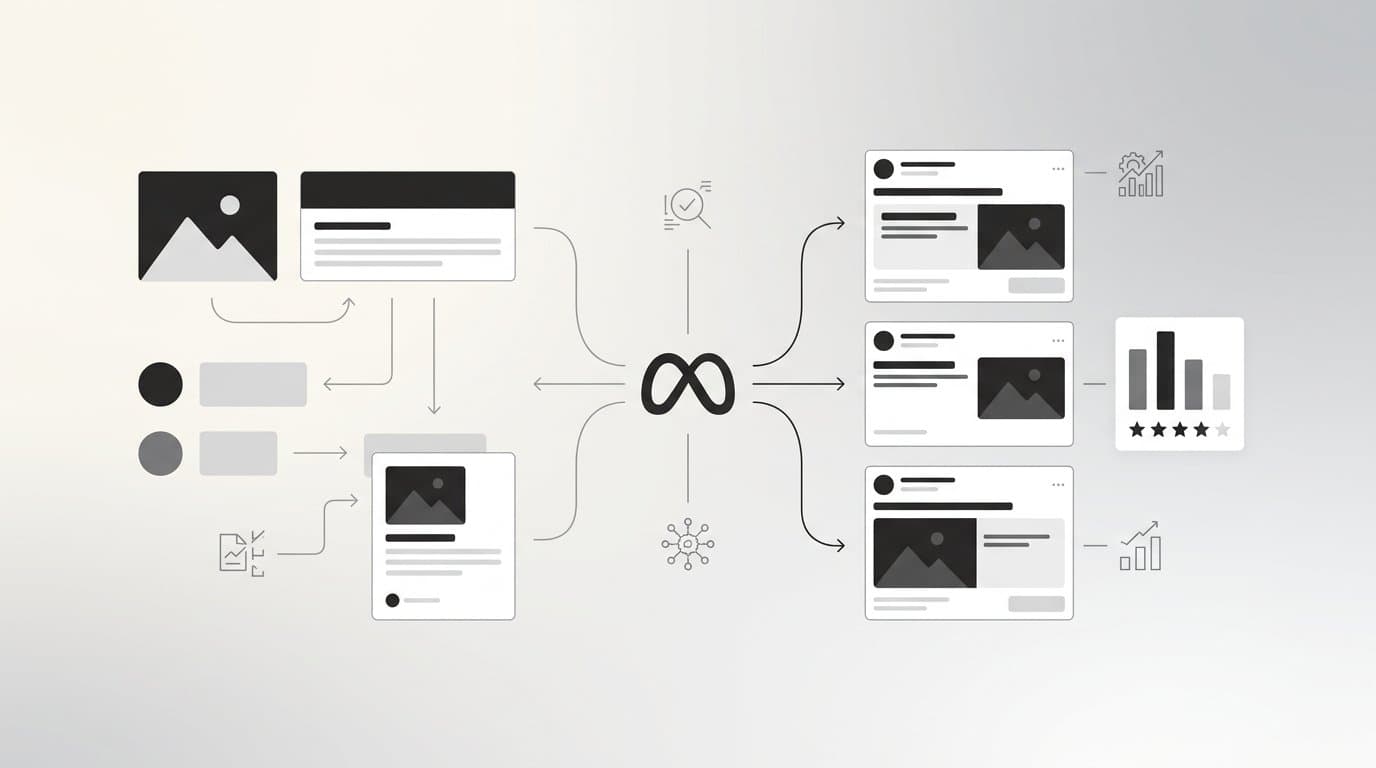
The concept is straightforward: combine multiple creatives with different headlines, ad copy variations, and audience segments at the ad set level. The platform automatically generates every possible combination, creating hundreds of unique ad variations from your base elements.
Here's how it works in practice. Let's say you have 5 image creatives, 3 video ads, 4 headline variations, 3 different ad copy angles, and 2 audience segments you want to test. Traditional campaign building would require you to manually create each combination: Creative 1 + Headline 1 + Copy 1 + Audience 1, then Creative 1 + Headline 1 + Copy 1 + Audience 2, and so on. That's exhausting and error-prone.
Bulk launching handles this automatically. You select your creative assets, choose your headline variations, pick your copy angles, and define your audience segments. The system calculates every possible combination and generates all the individual ads in minutes. In this example, that's 8 creatives × 4 headlines × 3 copy variations × 2 audiences = 192 unique ad variations. This is how you scale ad creatives with AI effectively.
Configure your bulk settings strategically. You can set variations at both the ad set level and the ad level. Ad set level variations test different audiences against the same creative elements. Ad level variations test different creative combinations within the same audience. Most marketers start with ad level variations to identify winning creative combinations, then scale those winners across different audiences at the ad set level.
Don't go overboard initially. While the system can generate thousands of combinations, start with a manageable number that your budget can properly test. If you're spending $50 per day, launching 500 ad variations means each ad gets minimal spend and you won't gather statistically significant data. A better approach: 50-100 variations for initial testing, then scale the winners.
Review the generated combinations before launching. Most platforms show you a preview of the variations that will be created. Scan through to ensure the combinations make sense and there are no obvious mismatches between creative style and messaging angle.
Success indicator: You should have 50+ unique ad combinations ready for launch, with a clear understanding of what variables you're testing (creative type, headlines, copy angles, or audiences). If you can explain your testing hypothesis in one sentence, you've set this up correctly.
Step 6: Launch to Meta and Configure Performance Tracking
Your creatives are generated and your bulk variations are configured. Now it's time to push everything live to Meta and set up the tracking that will identify your winners.
Connect your Meta Ad account through the platform's integration settings. You'll authenticate with Meta Business Manager, select the ad account you want to use, and grant the necessary permissions for campaign creation and performance data access. This connection lets you launch campaigns directly without exporting files or manually uploading creatives to Ads Manager.
Before launching, configure your campaign structure. Choose your campaign objective (typically conversions, traffic, or engagement depending on your goal), set your daily budget, and define your optimization event. If you're tracking purchases, select "Purchase" as your conversion event. For lead generation, choose "Lead" or your custom conversion event. Explore automated Meta campaign deployment for streamlined launches.
Set your target goals so the AI can score performance against your benchmarks. Input your target ROAS (Return on Ad Spend), acceptable CPA (Cost Per Acquisition), and desired CTR (Click-Through Rate). These benchmarks become the measuring stick for identifying winners. An ad that delivers 3.5x ROAS when your target is 3x gets flagged as a winner. An ad that costs $45 per acquisition when your target is $30 gets flagged for pause or revision.
Enable leaderboard tracking to automatically surface winning elements. This feature ranks your creatives, headlines, copy variations, audiences, and landing pages by actual performance metrics. Instead of manually analyzing campaign data in spreadsheets, you get instant visibility into what's working and what's not. Learn more about Facebook ad performance tracking platforms that simplify this process.
Launch your campaigns to Meta. The platform pushes all your ad variations live, creating the campaign structure, ad sets, and individual ads in your Meta Ads Manager account. This process typically takes 2-5 minutes depending on the number of variations you're launching.
Verify everything is live and tracking correctly. Navigate to your Meta Ads Manager and confirm your campaigns are active. Check that your pixel is firing properly by visiting your landing page and using the Meta Pixel Helper browser extension. Ensure conversion events are being recorded in your Events Manager.
Return to your creative generation platform and verify that performance data is flowing into the insights dashboard. You should see impressions, clicks, and conversion data populating within a few hours of launch. If data isn't appearing after 24 hours, check your pixel configuration and Meta account connection.
Success indicator: Your campaigns are live in Meta Ads Manager, your pixel is tracking conversions, and performance data is visible in your platform's insights dashboard. You're now in the testing phase where data will reveal your winners.
Step 7: Analyze Winners and Scale What Works
Data is flowing, ads are running, and now comes the most critical step: identifying your winners and building a system for continuous improvement.
Use the AI insights leaderboard to identify top performers ranked by your chosen metrics. If ROAS is your primary goal, sort by ROAS to see which creatives, headlines, and audiences are delivering the highest return. If you're optimizing for volume at an acceptable CPA, sort by cost per acquisition to find the most efficient combinations.
Look for patterns across your winners. Are all your top-performing creatives using a specific visual style? Do your best headlines follow a particular formula? Are certain audience segments consistently outperforming others? These patterns are more valuable than individual winning ads because they inform your entire creative strategy going forward. Master the art of AI A/B testing ad creatives to accelerate your learning.
Save winning elements to your Winners Hub for instant reuse in future campaigns. When you identify a creative that's crushing your ROAS target, save it with one click. That winning creative becomes available for immediate deployment in your next campaign without regenerating it from scratch. Do the same for high-performing headlines, copy variations, and audience configurations. Discover how to reuse winning ad creatives across multiple campaigns.
Generate new creative variations based on your proven winners. This is where the continuous improvement loop really accelerates. Take your best-performing image ad and use it as the foundation for new variations. Ask the AI to create versions with different color schemes, alternative text overlays, or varied product angles while maintaining the core elements that made the original successful.
For video ads that are performing well, create new versions with different hooks in the first 2 seconds while keeping the winning product showcase and CTA timing. For UGC avatar content that's converting, test new scripts with the same avatar style and setting.
Build your continuous improvement loop: generate creatives, launch bulk variations, let them run for 3-7 days to gather statistically significant data, identify winners through AI insights, save those winners to your hub, generate new variations based on what worked, and repeat the cycle.
Scale your winners strategically. When you identify a creative combination that's consistently beating your targets, increase budget allocation to that specific ad. Create new ad sets targeting different audiences but using the same winning creative elements. Expand to new geographic markets with proven concepts instead of starting from scratch in each region.
Don't abandon testing once you find winners. Markets shift, audiences develop ad fatigue, and competitors copy what works. Keep a portion of your budget dedicated to testing new creative concepts even when your current winners are performing well. A common allocation is 70% of budget to proven winners and 30% to new tests.
Success indicator: You can articulate which creative elements are winning and why, you have a library of proven assets in your Winners Hub, and you have a systematic process for generating new variations based on performance data rather than creative hunches.
Putting It All Together
You now have a complete system for generating ad creatives automatically and scaling what works through data-driven iteration.
Quick checklist before you start: product assets gathered including URL and high-quality images, generation method selected based on your goal (URL, cloning, or custom), first batch of image ads created and refined, video and UGC avatar content produced, bulk variations configured for maximum testing coverage, campaigns launched to Meta with proper tracking, and performance monitoring active through AI insights.
The real power of automated creative generation isn't just saving time on production, though that alone is valuable. The transformative benefit is the ability to test at a scale that would be impossible with traditional workflows. When you can generate hundreds of ad variations in minutes instead of weeks, you find winners faster and scale them before your competitors catch up.
Think about the traditional alternative: briefing a designer for each creative concept, waiting days for mockups, requesting revisions, coordinating with video editors, hiring actors for UGC content, and manually building each ad variation in Ads Manager. That process might produce 5-10 ads per week if you're moving quickly. With automated generation, you can produce 50-100 variations in an afternoon.
This volume advantage compounds over time. More variations tested means more winners identified. More winners identified means better understanding of what resonates with your audience. Better understanding means smarter creative decisions on future campaigns. The loop accelerates with each iteration.
Start with Step 1 today and work through the process systematically. Don't try to implement everything at once. Generate your first batch of image ads, launch them, and learn from the data. Add video content in your second round. Experiment with UGC avatars in your third campaign. Build the muscle memory for each step before adding complexity.
Your first AI-generated campaign could be live within the hour. The creative bottleneck that used to limit your testing velocity is gone. Now the only question is how quickly you can analyze the data and scale your winners.
Ready to transform your advertising strategy? Start Free Trial With AdStellar and be among the first to launch and scale your ad campaigns 10× faster with our intelligent platform that automatically builds and tests winning ads based on real performance data.