You’re probably in one of two situations right now. Either your Meta account is busy but unpredictable, with a few ads carrying the whole program while everything else leaks budget. Or you’ve got decent products, decent margins, decent traffic, and still can’t turn facebook ads for e-commerce into a repeatable sales channel.
That usually happens because brands treat Meta like a checklist. Launch a campaign. Try a few audiences. Swap in new creatives. Raise budget on winners. Panic when ROAS drops. Repeat. The account becomes a pile of disconnected tasks instead of a system.
The brands that scale don’t run Meta that way. They build an engine. Each part feeds the next part. Tracking sharpens optimization. Creative testing improves click quality. Audience strategy shapes who sees what. Campaign structure gives the algorithm enough signal to work with. When one part breaks, you know where to look instead of guessing.
The Blueprint for Your E-commerce Ad Engine
Most e-commerce teams don’t fail because they lack ideas. They fail because they can’t turn ideas into a repeatable operating system. One person is writing copy in a doc, another is uploading ads by hand, someone else is trying to compare placements in Ads Manager, and nobody fully trusts attribution. That’s not a growth engine. That’s manual labor with a dashboard attached.
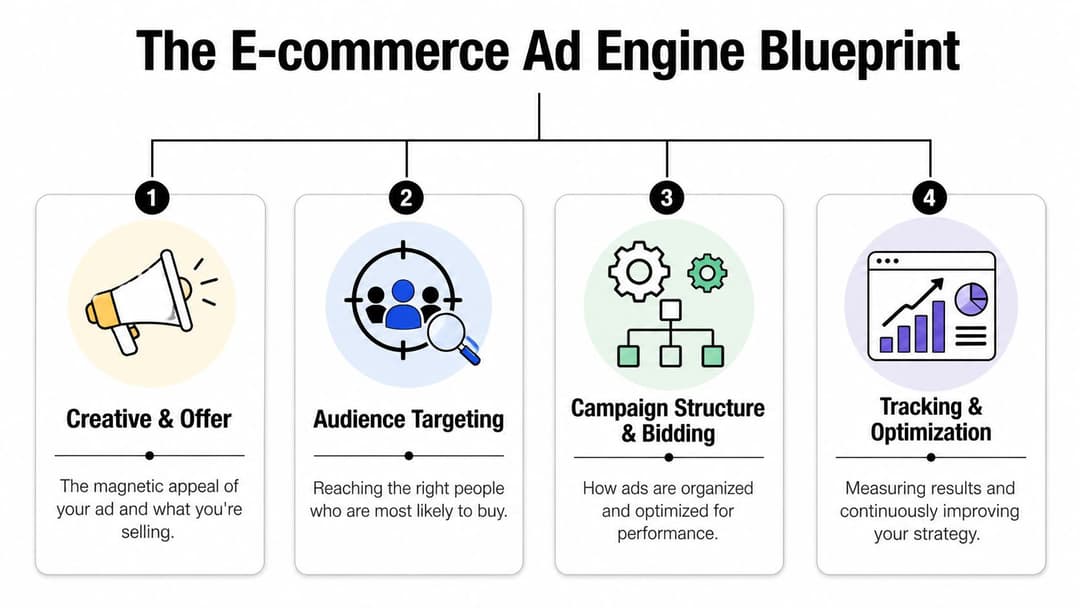
Facebook ads for e-commerce work when you stop thinking in isolated tactics and start thinking in connected parts. A strong account usually stands on four pillars: creative and offer, audience targeting, campaign structure and bidding, and tracking and optimization. If one pillar is weak, the whole system becomes noisy.
The four parts that drive the account
A useful way to diagnose performance is to ask which pillar is failing.
| Pillar | What it controls | What failure looks like |
|---|---|---|
| Creative and offer | Attention, relevance, desire | Low click quality, weak add-to-cart behavior |
| Audience targeting | Who sees the message | Spend goes to the wrong users or wrong intent level |
| Campaign structure and bidding | Delivery and budget flow | Good ads stall, bad ad sets absorb spend |
| Tracking and optimization | Signal quality and decisions | You can’t tell what actually drove purchases |
If your ads get engagement but few purchases, the problem often isn’t “Facebook.” It’s usually a mismatch between the promise in the ad and the reality on the product page. If you have strong products and strong creative but unstable delivery, campaign structure is usually the issue. If nothing seems consistent, tracking is often broken before strategy is.
Practical rule: Diagnose the engine before changing the fuel. Don’t fix weak economics with new audiences, and don’t fix bad tracking with more creative tests.
This is why profitability matters more than vanity metrics. In one efficient vertical, Apparel & Fashion brands on Facebook in 2025 averaged a 4.1% conversion rate and 2.8x ROAS according to Ad Backlog’s 2025 Facebook ads benchmarks. That doesn’t mean every apparel brand wins. It means the platform can work when the account is built around conversion economics instead of random experimentation.
Why modern teams need an operating system
The old approach was manageable when teams ran a few campaigns and refreshed creatives occasionally. That’s not enough now. You need fast testing loops, clean naming, clear hypotheses, and a way to learn from winners instead of rebuilding from zero every week.
If you want a companion read focused on the Facebook and Instagram ecosystem, Sup Growth's Instagram ads guide is useful because it frames placements and creative behavior in the context of how people move between Meta surfaces.
For a broader view on paid acquisition systems inside online retail, this piece on advertising in e-commerce is worth reading alongside your Meta strategy.
Choosing Campaign Objectives and Structuring for Growth
Campaign objectives are tools. The mistake is treating them like they’re interchangeable.
If you want sales, optimize for sales. If you want to build retargeting pools, run traffic or engagement only when you have a clear reason and a clear follow-up path. E-commerce brands lose a lot of time by asking top-of-funnel campaigns to do bottom-of-funnel jobs.
Match the objective to the job
Think of the account in three motions rather than one campaign.
Prospecting
Finding new buyers is a primary goal. For most stores, prospecting should carry the largest testing burden because in prospecting, creative, offer positioning, and broader audience signals get pressure-tested in the market. Advantage+ Shopping Campaigns are often a practical starting point here because they simplify setup and let Meta allocate across combinations using historical conversion data.
Manual prospecting still matters when you need tighter control. That’s especially true for high-ticket, niche, or heavily segmented products where one message should only reach one type of buyer. In those cases, a more hands-on setup can surface insights faster than a blended campaign.
Retargeting
Retargeting is where you recover intent that already exists. The message here should change. Don’t show the same broad awareness angle to a cart abandoner and expect a different result. Warm audiences need reassurance, urgency, product proof, and friction removal.
Common retargeting pools include:
- Site visitors who viewed products but didn’t add to cart
- Cart abandoners who showed stronger buying intent
- Engaged social users who watched, clicked, saved, or messaged
- Past product viewers grouped by category or collection
Retention
A lot of Meta accounts ignore existing customers or dump them into broad exclusions and move on. That leaves money on the table. Existing customers respond to product education, replenishment timing, bundles, new arrivals, and upsells. Retention creative shouldn’t look like acquisition creative because the buyer already knows the brand.
A simple structure that stays readable
You don’t need a maze of campaigns. You need clear separation by intent.
A practical architecture looks like this:
- One prospecting layer for new customer acquisition
- One retargeting layer for high-intent non-buyers
- One retention layer for existing customers and repeat purchase offers
Inside that, keep ad sets organized by a real variable. Audience type. Creative theme. Product category. Not all three at once. If every ad set changes multiple variables, you won’t know what caused the result.
Don’t scale complexity faster than signal. A smaller account with clean logic usually outperforms a crowded one with clever naming and no learning.
Placements and when control beats automation
Automatic placements are often fine until they aren’t. For broad catalog sales, they can work well because Meta has room to allocate inventory. But some products break when you let the system chase cheap impressions in low-intent placements.
For niche and high-ticket products, manually excluding low-quality placements like Audience Network can lift ROAS by 15% to 30% by concentrating spend on higher-intent placements such as Feeds and Stories, based on Creative Monarchy’s placement analysis. That’s not an argument against automation. It’s an argument for knowing when cheap reach is the wrong objective.
Use this decision lens:
| Situation | Better fit |
|---|---|
| Broad catalog, strong data history, many SKUs | Advantage+ and broader placements |
| High-ticket niche product, strict message control needed | Manual campaign structure |
| Weak post-click conversion and suspicious placement quality | Tighter placement control |
| New creative angle with uncertain buyer fit | Isolated manual test |
If you want a deeper breakdown of objective selection itself, this guide on the objective of campaign lays out the strategic trade-offs clearly.
Crafting Ad Creative and Copy That Converts
Creative is the lever most brands underinvest in and overjudge. They’ll spend hours debating audiences and three minutes deciding what the ad says. Then they wonder why click quality is weak.
For facebook ads for e-commerce, the ad has one job before anything else. It needs to attract the right click. Not any click. The right one.

What strong e-commerce creative actually does
High-performing ads usually do four things in sequence:
- Stop the scroll with a clear visual pattern break or specific product use case
- Identify the buyer so the right person feels seen
- Translate features into outcomes instead of listing specs
- Reduce friction with proof, clarity, or context before the click
Weak ads usually do the opposite. They open with brand language nobody cares about, show polished assets that hide the product, and ask for a click before earning one.
A bad version sounds like this: “Premium skincare designed for modern routines.”
A better version sounds like this: “Dry skin by midday? This routine is built for people who need moisture that holds up under makeup.”
The second one does more work. It identifies a problem, hints at a user, and creates a reason to keep watching or reading.
Copy rules that make conversion easier
Use copy that aligns with buying stage.
Cold traffic copy
Cold audiences need context. They don’t know why the product matters yet. Open with the problem, the contrast, or the outcome. Keep the language concrete.
Warm traffic copy
Warm users need fewer explanations and more reasons to finish the purchase. Focus on objections. Shipping, fit, material, ingredients, use case, gifting, ease of setup. Whatever slows the sale.
Customer copy
Existing buyers need relevance. Cross-sell, replenish, or introduce a new category with a clear connection to what they already bought.
The best ad copy doesn’t try to sound smart. It makes buying feel obvious.
One metric tells you whether your ad promise holds up after the click. Landing pages for e-commerce ads see a median add-to-cart rate of 6%, and top performers exceed 10%, according to WordStream’s 2025 Facebook ads benchmarks. If people click but don’t add to cart, the issue usually lives in one of three places: the creative overpromised, the page introduced friction, or the offer wasn’t strong enough.
Visual formats that deserve their place
Not every format should be used all the time. Each one has a job.
| Format | Best use | What usually goes wrong |
|---|---|---|
| Static image | Clear hero product, strong offer, clean message | Looks nice but says nothing |
| Carousel | Product variants, feature progression, bundle story | Too many cards, no narrative |
| Video | Demonstration, transformation, UGC-style explanation | Slow open, product appears too late |
This walkthrough is useful if you want to study how marketers structure visuals and copy hooks in practice:
Build a creative testing factory, not a creative calendar
Many teams still test too little. They launch a handful of ads, wait, then replace the losers one by one. That’s too slow for a platform where creative fatigue and auction shifts are constant.
A better workflow separates variables:
- Angle tests for problem, benefit, persona, and offer framing
- Format tests for static, carousel, and video
- Hook tests for first line, first frame, and headline
- Proof tests for reviews, demonstrations, comparisons, and founder voice
Then batch production. Tools such as Canva, CapCut, Motion, and Figma help with asset generation. For teams that need to launch many combinations directly into Meta, platforms like AdStellar AI can generate large sets of creative, copy, and audience combinations from existing assets and push them live without manual buildout, which is useful when the bottleneck is production speed rather than strategy.
If you want a focused reference for concept development and ad assembly, these Facebook ad creative best practices are a helpful companion.
Building High-Intent Audiences from Scratch
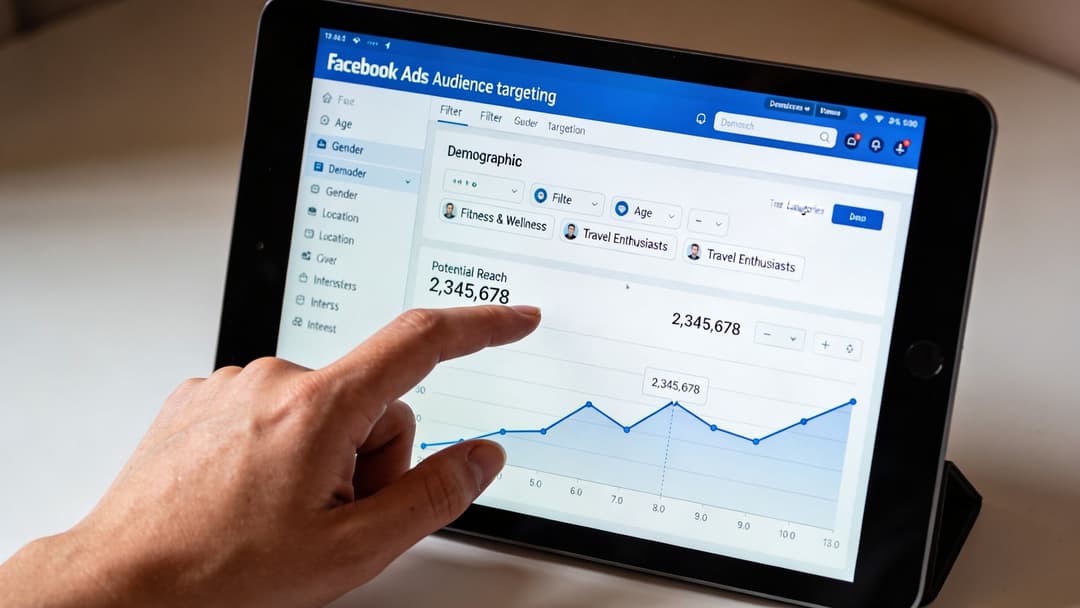
Audience building on Meta is less about finding one magic segment and more about stacking intent correctly. The process is comparable to sifting for gold. Broad targeting moves more dirt. Custom audiences find the heavier material. Lookalikes help you search in places that resemble the ground where you already found value.
Too many accounts jump straight into narrow targeting because it feels safer. That often hurts scale and delays learning. Start with audience types that match how much intent the user has already shown.
Prospecting audiences that don’t box you in
Prospecting is where you introduce the product to people who haven’t bought yet. The biggest mistake here is overdefining the buyer before the market gives you evidence.
A practical prospecting setup can include:
- Broad targeting when your creative and product have clear market fit
- Interest clusters built around adjacent behaviors, use cases, or category affinities
- Lookalikes once you’ve built enough first-party signal from buyers or high-intent visitors
Broad audiences work best when the creative is specific enough to self-qualify the viewer. If your ad is vague, broad targeting becomes expensive noise. If your ad clearly speaks to a problem, buyer type, or use case, broader delivery often becomes more efficient because Meta has room to find patterns.
Custom audiences are where intent gets monetized
Custom audiences are your owned signal translated into media buying. These are the people who’ve already done something meaningful: visited a page, viewed a product, added to cart, purchased, engaged with video, opened a lead form, or appeared in your customer file.
What matters isn’t just building these audiences. It’s segmenting them by behavior and recency so your message fits the actual level of intent.
For example:
| Audience | Better message |
|---|---|
| Product viewers | Product proof, use case, differentiation |
| Cart abandoners | Objection handling, urgency, checkout completion |
| Past purchasers | Replenishment, accessories, bundles, upgrades |
| Instagram engagers | Social proof, creator-style product explanation |
A retargeting audience isn’t a strategy by itself. It only works when the ad acknowledges what the user already did.
That’s why audience exclusions matter too. Don’t keep prospecting to recent buyers with first-purchase messaging. Don’t show checkout recovery ads to casual content engagers. Relevance starts with who gets left out.
Lookalikes work best when the seed is valuable
Lookalikes are only as good as the source audience behind them. A weak seed creates a weak mirror. A strong seed gives Meta a better profile to model from.
Useful seed audiences often include:
- Recent purchasers
- High-value customers
- Repeat buyers
- Cart abandoners with meaningful engagement
- Top on-site engagers based on product depth
When possible, build separate lookalikes from different value groups instead of one blended customer list. Buyer quality matters more than audience convenience. If your best customers buy a specific collection or respond to a specific offer type, let that behavior shape your acquisition strategy.
For a more complete breakdown of segmentation logic beyond Meta alone, this guide on audience segmentation strategies is worth bookmarking.
Your Technical Backbone Pixel and Conversions API
Most e-commerce ad problems that look like performance problems are really signal problems. If your event stream is incomplete, Meta learns from partial truth. That affects attribution, bidding, retargeting quality, and any optimization decision you make afterward.
The easiest way to understand this is to think of the Meta Pixel and Conversions API, often shortened to CAPI, as the account’s nervous system. Pixel captures what happens in the browser. CAPI sends event data from your server. When both are configured well, you give Meta a more durable record of what users did.
Why Pixel alone isn’t enough anymore
Browser-based tracking has limits. Cookie restrictions, browser privacy controls, and post-iOS signal loss all reduce the reliability of client-side events. That creates blind spots exactly where e-commerce teams need clarity most: product views, checkout steps, and purchases.
Relying on Pixel alone can miss 20% to 30% of conversion events, while implementing CAPI can improve attribution accuracy by 15% to 25%, according to Edeska’s guide to Facebook ads for e-commerce. Better attribution improves more than reporting. It gives Meta cleaner optimization signals and makes ROAS calculations less distorted.
If you want a straightforward primer on the Pixel itself before layering in server-side tracking, Rebus on Facebook Pixel does a good job explaining the role it plays.
What a sound event setup looks like
At minimum, your tracking setup should reliably capture the events that define buying intent inside your store. For most e-commerce programs, that means events such as product views, add to cart, initiate checkout, and purchase.
A practical checklist:
- Match events across browser and server so Meta can deduplicate correctly
- Pass product and order context consistently so catalog and value-based optimization stay usable
- Verify event firing inside Events Manager and Test Events before spending hard
- Check quality after changes whenever your store theme, checkout flow, or app stack changes
Poor implementation creates weird account behavior. Purchase campaigns start optimizing toward noisy proxies. Retargeting pools become thinner than they should be. Reporting looks lower than actual store performance, which pushes teams to cut ads that may be working.
Why this changes how the account scales
A stronger signal backbone improves more than diagnostics. It changes how aggressively you can test and scale because your decision-making becomes less fragile.
Here’s the practical difference:
| Weak setup | Strong setup |
|---|---|
| Delayed or missing purchase signal | More complete conversion picture |
| Unclear retargeting pools | Cleaner audience building |
| ROAS swings you can’t explain | More dependable optimization feedback |
| Harder to trust budget decisions | Stronger confidence in scaling calls |
If you’re implementing this from scratch or auditing an older setup, this technical guide to the Meta Conversions API is a useful next read.
Advanced Strategies for Bidding Budgeting and Scaling
Scaling isn’t about pushing budget up and hoping yesterday’s winner survives. It’s about giving the account enough room to learn, then making budget decisions that respect signal quality. Most brands don’t stall because they lack demand. They stall because they underfund tests, mix too many variables, or force scaling before the account has enough purchase data to stabilize.
That’s where bidding and budgeting stop being settings and start becoming strategy.
Budget for learning first, efficiency second
Meta needs conversion volume to optimize properly. If you starve an ad set, you don’t really test it. You just prove that underfunded delivery produces weak data.
A practical benchmark from Engine Scout’s Facebook ads e-commerce guide is that an ad set needs about 50 optimization events per week to move out of Learning Limited, and a usable daily budget formula is Target CPA × 7.14 × number of ad sets. The point isn’t the formula by itself. The point is that budget must match the event goal. If you need purchases and your daily spend can’t realistically generate enough purchase signal, the algorithm never gets traction.
That under-budgeting problem matters because it usually inflates CPA and leads marketers to kill tests early for the wrong reason.
CBO versus ABO is a control question
Campaign Budget Optimization, or CBO, is useful when you trust the ad sets inside the campaign and want Meta to shift spend toward stronger delivery. Ad Set Budget Optimization, or ABO, is better when you’re still validating a test and need cleaner control over where budget goes.
Use ABO when:
- You’re testing new audiences against each other
- You need equal spend to compare creative themes
- One ad set might dominate too early and hide useful losers and near-winners
Use CBO when:
- You already know the ad sets are directionally sound
- You want Meta to allocate budget dynamically
- You’re consolidating proven components rather than discovering them
Pick the bid approach that matches your stage
Bid strategy should follow account maturity.
| Account situation | Better approach |
|---|---|
| New test, uncertain winner, need signal fast | Highest volume |
| Stable conversion behavior, tighter efficiency target | Cost per result goal |
| Broad scaling with many combinations | Let Meta optimize with fewer manual constraints |
If a campaign is still trying to figure out who converts, rigid bid constraints often choke delivery. If the account already has stable patterns and you’re protecting economics, more control can make sense.
Operator mindset: Scale what is repeatable, not what is exciting. A single spike doesn’t deserve a budget increase unless the underlying signal is stable.
How to scale without wrecking the account
Good scaling is less dramatic than one might expect. It usually comes from disciplined iteration, not giant budget jumps.
A sound scaling loop looks like this:
- Find a winner with enough clean conversion signal
- Identify why it won by isolating angle, audience, placement, and offer
- Duplicate the principle, not just the ad
- Expand carefully through adjacent audiences, new creative versions, or broader prospecting
- Cut what weakens efficiency even if it looked promising early
Automation earns its place. The hard part isn’t launching one campaign. It’s processing a growing matrix of creative themes, audience variants, and budget movement fast enough to act before conditions change. AI-assisted workflows help when the team’s real bottleneck is speed of testing, pattern recognition, and execution consistency.
Answering Your Top E-commerce Ad Questions
What should I do when my best ad suddenly stops performing
Don’t replace it instantly. Diagnose first.
Check three things in order:
- Creative fatigue if frequency is rising and response quality is slipping
- Offer or landing page friction if click behavior still looks healthy
- Audience saturation or overlap if spend is stuck in a narrow pool
The next move usually isn’t “launch a totally different campaign.” It’s to produce variations of the winning concept. New hook. New first frame. New proof element. Same core angle.
How do I diagnose a ROAS drop
Start with where the drop happened. Was it before the click, after the click, or at checkout?
Use this shortcut:
- Fewer quality clicks points to creative, audience, or placement issues
- Weak product-page behavior points to message match or page friction
- Checkout drop-off points to offer clarity, shipping surprise, or trust issues
Don’t blame the algorithm before checking the store experience.
How long should I test an ad before killing it
Long enough to gather meaningful signal, short enough that you don’t fund obvious losers forever. The answer depends on your budget, event volume, and optimization goal.
If the ad hasn’t had enough delivery to generate a fair read, leave it alone. If it’s clearly attracting the wrong kind of click, cut it and preserve budget for stronger concepts.
How do I handle creative fatigue without constant reinvention
Refresh the expression, not always the strategy. If an angle worked, make more versions of that angle before inventing a new one.
That means changing:
- The hook
- The visual proof
- The ad format
- The persona speaking
- The objection being resolved
If you’re in a dropshipping or fast-turnover catalog model, this guide on Facebook ads for dropshippers adds some useful context on adapting faster-moving product cycles to Meta.
If you want to turn your Meta account into a faster testing system instead of a manual setup queue, AdStellar AI helps teams generate large batches of creative, copy, and audience combinations, launch them into Meta, and learn from historical performance data inside one workflow.