Great Facebook ad copy is what turns a casual scroll into a determined click. It's every word you write—from the headline that grabs attention to the primary text that builds desire and the call-to-action that seals the deal.
Why Great Facebook Ad Copy Is Your Biggest Advantage

In a feed flooded with content, your visuals might be what stops the scroll, but it's your copy that actually secures the click. Writing compelling Facebook ads isn't just a creative task anymore; it’s a direct lever for your campaign's financial success. The words you choose have a real, measurable impact on your click-through rate (CTR), conversion rate (CVR), and your final Return on Ad Spend (ROAS).
Think of it like this: your ad creative earns a moment of attention, but your copy earns trust and provokes action. It’s the difference between someone thinking, "that's a cool picture," and, "I need to find out more about this right now."
Connecting Words to Wallet
Every piece of your ad copy has a job to do, and getting each one right can lead to huge wins. Generic, one-size-fits-all messages just fade into the background, burning through your ad spend with nothing to show for it. On the other hand, copy that’s tailored to a specific audience’s pain points and desires cuts right through the noise.
Here’s how sharp copy moves the needle on your most important metrics:
- Higher CTR: A killer hook and a benefit-packed headline make people stop and click, which tells Meta’s algorithm your ad is relevant.
- Lower CPC: When your engagement and relevance scores go up, your Cost Per Click often goes down. That means your budget stretches further.
- Improved CVR: Copy that clearly explains your value and gives a direct call-to-action walks users smoothly from being interested to becoming a customer.
This direct line between language and results is why the best campaigns are built on a foundation of rigorous testing and message refinement. It's worth taking a moment to explore the core principles of psychology in advertising to truly understand what makes an ad connect.
The Financial Stakes of Standout Copy
The sheer scale of Facebook's ad platform shows just how crucial effective copy has become. In 2025, Meta brought in a massive $156.8 billion in ad revenue, a 5.8% jump from the year before. That kind of spending means you’re in a fierce battle for every eyeball. While the average CTR hovered around 1.44%, elite campaigns using persuasive, audience-specific copy were hitting rates as high as 2.5%.
Dynamic formats like Reels saw even better numbers, with top-performing ads reaching a 3.0% CTR or more. It’s definitive proof that powerful storytelling in your ad copy can send your performance soaring.
Your Facebook ad copy isn't just text on a screen; it's the salesperson that works for you 24/7. It must be compelling, clear, and relentlessly focused on the customer's "what's in it for me?"
Ultimately, if you want to scale profitably, you have to treat your ad copy as a core strategic asset. It’s about turning raw performance data into winning messages that deliver real business results. In this game, generic just doesn’t cut it anymore.
Building Your Ad Copy With Proven Frameworks
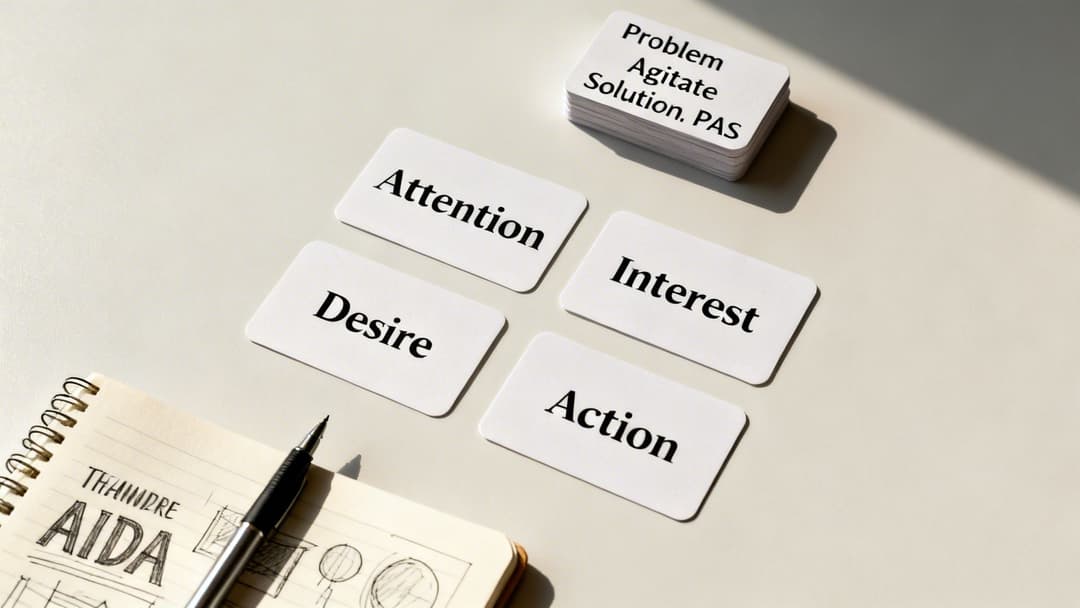
We’ve all been there: staring at a blinking cursor on a blank document, waiting for the perfect ad copy to magically appear. It’s a huge momentum killer. Instead of trying to reinvent the wheel every time, the pros rely on proven copywriting frameworks.
Think of these as blueprints for persuasion. They give you a repeatable structure to build strong Facebook ad copy time and time again. This isn't about making your ads sound robotic. It’s the opposite. A solid framework handles the logical flow, freeing you up to focus your creativity on what really matters: connecting with your audience.
The AIDA Framework: Attention, Interest, Desire, Action
AIDA is a classic for a reason. It’s a simple, four-part structure that perfectly mirrors a customer's journey from awareness to purchase, making it ideal for Facebook's fast-scrolling environment. I find it’s especially effective when introducing new products to a cold audience.
Here’s how it breaks down:
- Attention: Hook them immediately. Your first line or headline needs to stop the scroll. Think bold questions, shocking statistics, or a statement that challenges their assumptions.
- Interest: Now that you have their eyes, you need to hold them. Share intriguing details, benefits, or facts that are directly relevant to their life.
- Desire: This is the pivot from features to feelings. You need to paint a vivid picture of what life looks like with your solution. Focus on the transformation, not just the product itself.
- Action: Tell them exactly what to do next. Your call-to-action (CTA) should be clear and low-friction. "Learn More" or "Shop Now" should feel like the obvious next step.
Let's say you're selling noise-canceling headphones. AIDA in action could look like this: Attention: “Can’t hear yourself think? Your noisy commute is killing your focus.” Interest: “Our new headphones use adaptive AI to filter out 98% of background noise, from rumbling trains to office chatter.” Desire: “Imagine finally enjoying your favorite podcast in peace or locking into deep work, no matter where you are.” Action: “Tap ‘Shop Now’ to reclaim your quiet.”
The PAS Framework: Problem, Agitate, Solution
If your product solves a specific, nagging problem, the PAS framework is your best friend. It’s incredibly direct and works by tapping into a user's existing pain points, making them feel understood, and then positioning your offer as the ultimate fix.
This framework is a powerhouse for SaaS companies, local services, and anything in the health and wellness space. It cuts right through the noise because it leads with a problem the user is already painfully aware of.
The structure is simple but effective:
- Problem: State the customer's pain point clearly and directly.
- Agitate: Don’t just state the problem—twist the knife a little. Describe the frustrations, consequences, and emotional toll of that problem. Make it real.
- Solution: Introduce your product as the clear, simple answer to their suffering.
For a meal prep service targeting busy professionals, PAS is a perfect fit:
- Problem: Tired of wasting your Sundays meal prepping, only to eat the same bland chicken and broccoli all week?
- Agitate: You lose precious weekend hours in the kitchen, your diet gets boring fast, and you usually give up by Wednesday and order expensive takeout anyway.
- Solution: Get chef-crafted, healthy meals delivered to your door. Reclaim your weekends and never eat a boring meal again.
For more inspiration, you can explore a variety of sample ad copy to see how different brands put these powerful principles into practice.
The Before-After-Bridge Framework
This framework is all about transformation. It’s simple, highly visual, and incredibly effective because it helps the user instantly picture a better version of themselves.
You start by showing them their current world (Before) and contrast it with the ideal world your product creates (After). Your product is the "Bridge" that gets them from one to the other.
Imagine an ad for a language-learning app:
- Before: You’re on vacation in Italy, awkwardly pointing at a menu and just hoping for the best.
- After: You’re confidently ordering pasta in fluent Italian, chatting with the waiter, and soaking in the local culture.
- Bridge: With our 15-minute daily lessons, you can bridge the gap from tourist to traveler. Start your first lesson free.
By building your Facebook ad copy on these frameworks, you eliminate the guesswork. You start creating persuasive, structured messages that are engineered to drive real results. Pick the one that best fits your offer, and then start testing different angles within that structure.
Aligning Your Message With Your Audience
Throwing the same ad at everyone on Facebook is like shouting into a void. It’s loud, expensive, and nobody’s really listening. The fastest way to burn your ad budget is to assume a one-size-fits-all message will work. The real magic happens when you map your ad copy directly to specific audience segments.
This goes way beyond basic demographics. Sure, knowing your audience is 25-34 years old is a starting point, but it tells you nothing about why they should care about your offer. You need to get into their heads.
From Demographics to Psychographics
Psychographics are the key. We're talking about their values, their lifestyle, and most importantly, the problems that keep them up at night. Are they stressed-out founders desperate for more time, or are they new parents just trying to get through the day? Each one needs to hear something completely different from you.
To get this right, you have to conduct user research that digs deep into their world. It’s the only way to find the language and angles that actually convert. If you want to go deeper on this, our guide on how to identify your target audience is the perfect next step.
https://www.adstellar.ai/blog/how-to-identify-a-target-audience
And the stakes are high. By January 2025, Facebook's ad reach is projected to hit an incredible 2.28 billion users—that's 93.3 million more people than the year before. With 74.3% of monthly active users seeing ads in their feed, cutting through the noise is everything. Your ability to tailor your message is what will make you stand out. You can see more details in the full Facebook statistics report from DataReportal.
Segmenting by Audience Temperature
One of the most effective ways I've found to structure messaging is by "audience temperature." It’s a simple concept that groups people by how aware they are of your brand and solution.
- Cold Audiences: These folks have no idea who you are. They might not even be fully aware they have a problem you can solve. Your job is to educate them and make the problem feel real.
- Warm Audiences: They’ve interacted with you before—maybe they visited your site or liked a post. They know your name. Now you can get more direct and focus on the benefits.
- Hot Audiences: This group is on the verge of buying. They’ve added something to their cart or checked out your pricing. The goal here is to push them over the finish line with urgency and social proof.
Crafting Copy Angles for Each Temperature
Once you’ve got your segments, you can start writing copy that speaks directly to each one. Let's walk through a real-world example.
Scenario: A SaaS company selling project management software.
Cold Audience Ad Copy (Focus: The Problem)
Headline: Is your team drowning in deadlines? Body: Juggling projects across emails, spreadsheets, and chat threads is a recipe for chaos. Important tasks fall through the cracks and you're always one step behind. See how top teams get organized. CTA: Learn More
Warm Audience Ad Copy (Focus: The Solution's Benefits)
Headline: The #1 Tool for Effortless Project Management Body: You saw how our platform centralizes your tasks. Imagine reclaiming 5+ hours a week with automated workflows and crystal-clear progress tracking. Ready to take control? CTA: Start Free Trial
Hot Audience Ad Copy (Focus: Urgency & Overcoming Objections)
Headline: Don't lose your progress! Body: You were so close to organizing your team's workflow. Join over 10,000+ companies who are already shipping projects faster and with less stress. Your 14-day free trial is waiting. CTA: Complete Your Sign-Up
This tailored approach ensures your Facebook ad copy meets people exactly where they are. By speaking to their specific level of awareness and hitting on their pain points, you create a natural path from a casual scroller to a loyal customer, driving much better relevance and, ultimately, higher conversion rates.
Executing a Bulletproof A/B Testing Plan
If you want to improve your Facebook ad copy, you have to stop guessing what works and start testing. A solid A/B testing plan is what turns your ad account from a money pit into a learning machine, where every dollar you spend buys you valuable, actionable insights. This isn't about throwing random ideas at the wall to see what sticks—it's a systematic way to figure out exactly what language gets your audience to act.
The golden rule of any good test is to isolate one variable at a time. If you change the headline, body copy, and CTA all at once, you’ll have no idea which element actually made the difference. Clean data only comes from clean tests.
Designing Your Tiered Testing Strategy
A really effective way to approach this is with a tiered testing method. This strategy stops you from wasting time and money on tiny tweaks before you've even validated your core message. You start broad and get more specific as you uncover winning concepts.
Here’s how that breaks down:
Tier 1: High-Level Concepts. Your first tests should be about the big picture. Pit two fundamentally different angles against each other to see which one connects on a deeper level. For instance, you could test an ad that hammers on a major pain point versus one that paints a picture of a transformative benefit.
Tier 2: Core Copy Elements. Once you have a winning concept, you can start drilling down into the main copy components. The angle stays the same, but now you test different hooks or headlines. Does a headline that asks a question grab more attention than one making a bold statement?
Tier 3: Granular Optimizations. This is where you get to sweat the small stuff. With your winning concept and headline locked in, you can fine-tune smaller variables like the call-to-action. Will "Shop Now" outperform "Learn More"? Does "Get Your Offer" create a stronger sense of urgency?
This process guarantees you're making data-driven decisions at every turn. You find the right forest (the core message), then the right tree (the key element), and finally the best branch (the specific word choice). For a more in-depth look at the fundamentals, our guide on what A/B testing in marketing is is a great place to start.
When it comes to deciding what to test, some changes have a much bigger impact than others. The table below outlines a logical progression, starting with the big-picture ideas and moving toward smaller, more refined optimizations.
Effective A/B Testing Variables for Ad Copy
| Test Category | Variable to Test | Example A | Example B |
|---|---|---|---|
| Conceptual Angle | Core Message/Hook | "Tired of wasting money on ads that don't work?" (Pain Point) | "Launch high-ROAS campaigns in minutes." (Benefit) |
| Headline | Headline Format | "The Ultimate Guide to Facebook Ads" (Statement) | "Are You Making These Facebook Ad Mistakes?" (Question) |
| Body Copy | Opening Line | A direct statistic: "82% of marketers struggle with..." | A relatable story: "I used to spend hours..." |
| Call to Action (CTA) | CTA Phrasing | "Learn More" | "Get Instant Access" |
| Granular Wording | Adjective/Verb Choice | "Our good software helps you..." | "Our powerful software helps you..." |
Start at the top of this list with conceptual tests and work your way down. Once you find a winning angle, you can move on to testing headlines within that angle, and so on. This keeps your testing focused and efficient.
Setting Up for Statistically Significant Results
A test is completely useless if the results aren't reliable. Reaching statistical significance simply means you can be confident the outcome wasn't just a fluke. For most Facebook campaigns, this means letting your test run long enough to gather enough data—well past the initial learning phase.
Don't fall into the trap of declaring a winner after just 24 hours and a handful of clicks. Small sample sizes are incredibly misleading. You need to set a realistic budget for each ad variation and give it a clear timeframe. As a rule of thumb, try to get at least a few hundred conversions per variation before you make a final call.
A critical mistake is ending a test prematurely because one variation has a slight early lead. Ad performance can fluctuate daily, and what seems like a winner on Monday might fall behind by Friday. Patience is a prerequisite for accurate insights.
The infographic below shows how you can align your testing strategy with different audience temperatures, from brand new prospects to your most engaged leads.
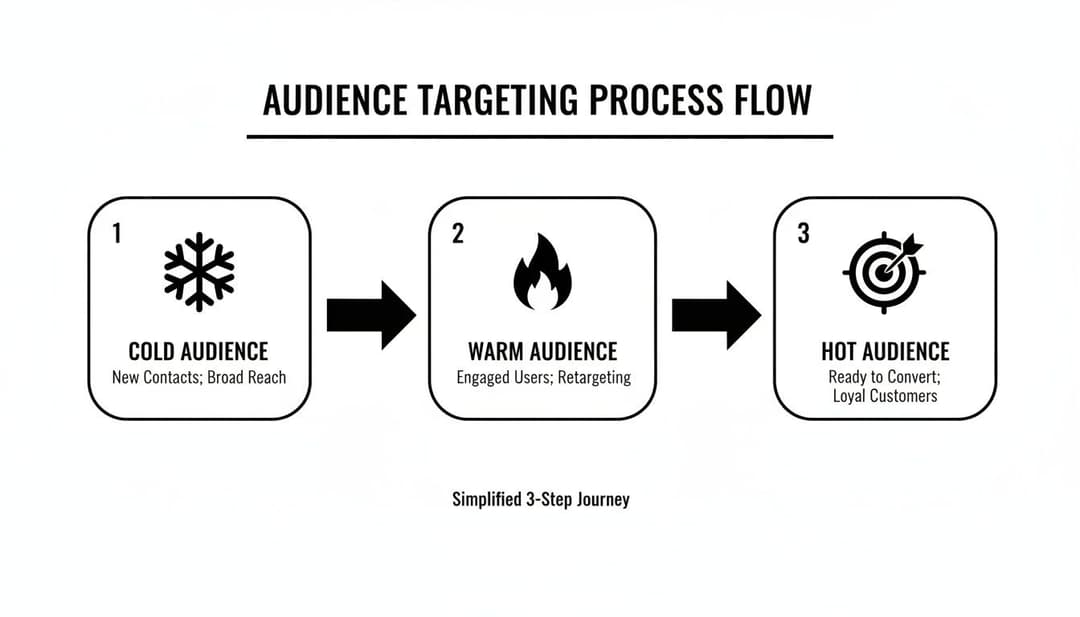
As you can see, broad, educational concepts are perfect for testing on cold audiences who are just getting to know you. For warm and hot audiences who are already familiar with your brand, you can test more direct benefits and urgent offers. By building this continuous feedback loop, your Facebook ad copy will evolve from an art form into a science that consistently drives better results.
Using AI to Scale Your Facebook Ad Copy
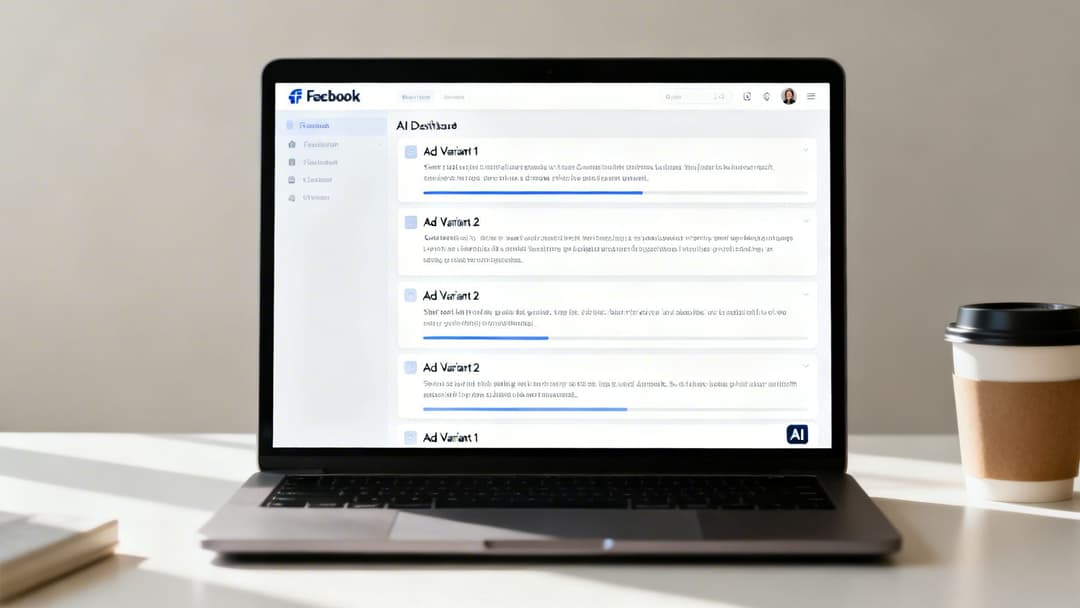
Let's be honest: manually writing, testing, and tracking dozens of ad variations is a soul-crushing grind. It’s slow, tedious, and the biggest bottleneck preventing you from learning what works and scaling your campaigns. This is where artificial intelligence stops being a buzzword and becomes your most powerful advantage.
AI platforms aren't here to take your job. They’re here to give you superpowers.
By plugging into your ad account, these tools can analyze all your historical performance data, instantly spotting the themes, phrases, and hooks that have driven your best results in the past. Instead of spending a whole afternoon brainstorming, you can generate hundreds of high-potential Facebook ad copy variations in just a few minutes.
This unlocks a level of testing that would be completely unrealistic to do by hand. Think about launching a campaign where you test ten different pain points against five unique benefits, each with three distinct calls to action. The manual effort alone would be staggering. With AI, it’s practically a one-click operation.
From Manual Guesswork to Automated Insight
The real magic of AI isn't just about spitting out text—it's about connecting that text directly to performance. Good AI tools look past vanity metrics like clicks and go straight for what actually matters to your bottom line: your cost per acquisition (CPA) and return on ad spend (ROAS).
This means the system learns what works specifically for your business. It might find that ads mentioning "free shipping" deliver a 15% higher ROAS, or that headlines phrased as questions achieve a 20% lower CPA. These are the kinds of insights that pave the way for profitable scaling.
The goal is to offload the grunt work to AI so you can focus on high-level strategy. Let the machine churn through the repetitive task of creating and testing variations while you analyze the results and guide the creative direction.
This whole approach turns the chaos of creative testing into crystal-clear campaign insights. Instead of drowning in spreadsheets trying to pinpoint a winning ad, you get a clean, data-backed report showing your top-performing messages, headlines, and audience combinations.
How to Get Great Ad Copy from AI
Just asking an AI to "write an ad" will get you painfully generic results. To generate copy that actually converts, you have to give it the right strategic ingredients. A great AI platform doesn't guess; it builds on the foundation you provide. For more advanced help in crafting compelling ad copy, an AI writing assistant can be a great partner for learning your style and boosting efficiency.
Here are the key inputs that produce high-quality, AI-generated ad copy:
- Audience Pain Points: Get specific. Instead of a vague "save time," feed the AI a problem like "stop wasting your entire Sunday on meal prep."
- Product Benefits & Features: Clearly list what your product does, but more importantly, what it helps the customer do or feel.
- Winning Angles: Give it examples of your past home-run ads. The AI will reverse-engineer what made them work and create new variations based on those successful themes.
- Brand Voice: Provide clear guidelines on your tone. Are you witty and informal like Chubbies, or are you professional and empowering like Slack?
This process ensures the AI-generated copy isn't just creative but is also perfectly dialed into your brand identity and business goals. You can see a complete breakdown of this entire workflow by exploring how to use AI for Facebook Ads to your advantage.
A Practical Example of AI-Powered Iteration
Let’s say you run an e-commerce brand selling sustainable activewear. You want to test a few different marketing angles to see what connects with a cold audience.
First, you give the AI its initial inputs. You tell it your product is eco-friendly leggings, your audience is environmentally-conscious millennials, and you want to test three core angles: performance, sustainability, and comfort.
The AI immediately gets to work, generating dozens of ad variations for each theme.
- Performance Angle: "Crush your next workout in leggings that move with you."
- Sustainability Angle: "Wear your values. Leggings made from 10 recycled water bottles."
- Comfort Angle: "So comfortable, you'll forget you're wearing them."
Next, you launch these variations in a test campaign. The AI monitors the results, and after gathering enough data, it flags that the sustainability angle has the lowest CPA by 30%.
Now you have a clear winner. You can instruct the AI to double down on the "sustainability" theme, creating a whole new batch of headlines, body copy, and CTAs all built around that core message.
This iterative loop—generate, test, refine, and scale—is how you build a powerful, self-improving ad account. You go from making educated guesses to making data-backed decisions at a speed that’s simply impossible to do manually. And that gives you a serious edge in any market.
Analyzing Performance and Scaling What Works
Getting your ads live is just the beginning. The real work—and where the real money is made—starts the moment you hit "publish." Now it's time to dive into the data, figure out what's actually working, and make smart moves to scale your winners.
It’s easy to get distracted by flashy numbers like a high Click-Through Rate (CTR) or a super low Cost Per Click (CPC). But let's be honest, those are vanity metrics. They don't pay the bills. We need to look deeper at the numbers that tell us if our campaigns are actually profitable.
Identifying a True Winner
A "winning" ad isn't the one with the most likes or clicks. It's the one that drives results for your business without breaking the bank. That means your entire focus should be on Cost Per Result (the cost for each purchase, lead, or sign-up) and Return on Ad Spend (ROAS).
These are the metrics that tell you if your Facebook ad copy is doing its job and turning attention into revenue.
Imagine you're running two different ads:
- Ad A: Grabs a lot of attention with a 3% CTR, but each purchase costs you $50.
- Ad B: Has a lower 1.5% CTR, but it's driving purchases for only $25 each.
On the surface, Ad A looks great. But Ad B is the clear winner here. It’s twice as efficient at converting prospects into customers, making every dollar you spend work harder. An ad that just gets cheap clicks but no sales is nothing more than a budget leak.
Understanding the Cost Landscape
Advertising on Facebook is a dynamic battlefield. Costs are always shifting based on competition and, just as importantly, your ad quality. Over the last decade, we've seen a clear trend: killer copy gives you a massive advantage in Meta's auction system.
By 2025, the average CPC on the platform settled around $0.54. However, top-tier campaigns with truly persuasive copy were consistently driving that cost down into the $0.30–$0.40 range. This shows just how much of a cost advantage you can get with the right messaging. If you're interested, you can explore more about the historical evolution of these costs to see how far strong copy can take you.
A winning ad isn't just about good copy; it's about the right copy reaching the right audience at the right price. When you find an ad with a low Cost Per Result and a healthy ROAS, you've struck gold. The next step is to scale it without breaking what makes it work.
Smart Scaling Strategies
Once you've found a winning ad creative and its matching Facebook ad copy, the first instinct is to just pour more money into it. But how you scale is just as critical as when. There are two main ways to go about it, and the right choice depends on your goals.
Vertical Scaling (Increasing the Budget)
This is the most straightforward approach. You simply take your successful ad set and slowly increase its budget.
- When to use it: This is perfect when you have a proven ad performing consistently and you want to show it to more people within the same audience.
- How to do it: Don't just double the budget overnight. Increase it in small, controlled steps—think 15-20% every 2-3 days. Big jumps can shock the algorithm, kicking you out of the learning phase and wrecking your performance. Keep a close eye on your Cost Per Result; if it starts to climb, you might be hitting audience fatigue.
Horizontal Scaling (Duplication and Expansion)
Horizontal scaling is all about taking your winning formula to new audiences. You duplicate the ad set and test it on fresh eyes.
- When to use it: This is the move when your original audience is getting tired of your ad (you'll see performance dip) or when you're ready to see if your message resonates with other groups.
- How to do it: Duplicate the entire ad set, keeping the winning ad creative and copy exactly the same. The only thing you change is the audience targeting. You could try a new lookalike audience, a different interest group, or even expand into a new country.
By mixing both vertical and horizontal scaling, you build a system that grows and improves over time. You squeeze every last drop out of your proven audiences while constantly hunting for new customers. It’s a balanced approach that helps you grow sustainably, even as the ad space gets more crowded.
Ready to stop guessing and start scaling your Meta ads with data-backed precision? AdStellar AI automates bulk ad creation, tests hundreds of variations in minutes, and uses AI to identify the exact copy, creative, and audiences that drive your highest ROAS. Learn how AdStellar can help you launch and scale campaigns 10x faster.