Most paid social teams start the day the same way. They open Ads Manager, sort by CPA or ROAS, and look for anything that needs to be cut before more budget leaks out.
That habit makes sense. Meta moves fast. Creative burns out. Auctions shift. Costs spike without warning. If you wait too long, a bad campaign can eat a week’s budget in a day.
However, many solid marketers get trapped optimizing for the first purchase. They optimize for the first purchase so aggressively that they stop asking a harder question: Did this campaign acquire a customer who will be worth keeping? A cheap conversion isn’t automatically a good conversion. A strong day-one ROAS number can still hide weak customer quality.
That’s why customer lifetime value, or CLV, matters. If you’ve been asking what is customer lifetime value in marketing, the practical answer is simple: it’s the long-term value a customer brings to the business, not just the revenue from the first click or first order. It changes how you judge traffic, creative, audiences, and budget decisions.
Beyond the First Click The Power of Customer Lifetime Value
A familiar pattern shows up in growth accounts. One campaign delivers a lower CPA than everything else, so the team scales it. Another ad set looks weaker on immediate ROAS, so it gets trimmed. On paper, that sounds disciplined.
Then the downstream numbers come in. The low-CPA campaign brought in bargain hunters who never came back. The “worse” campaign attracted customers who bought again, opened emails, and responded to remarketing. The media buying decision looked right in platform reporting and wrong in the business.

CLV becomes useful in that gap. It gives you a lens for judging campaign quality beyond the first transaction. If you already track return on ad spend, it helps to understand what ROAS in digital marketing does well and where it stops. ROAS tells you how the campaign performed now. CLV tells you what that customer may be worth over the full relationship.
Why retention changes the economics
Retention doesn’t improve the business in a small, linear way. It changes the math. Increasing customer retention by just 5% can boost profits by 25% to 95%, according to Bain & Company as cited by Genesys Growth (source)).
That’s why brands that look disciplined on acquisition can still struggle. They keep buying first orders instead of building customer value over time.
Practical rule: If two campaigns acquire customers at similar cost, the one that produces stronger repeat behavior is the better campaign, even when its day-one dashboard looks less impressive.
What separates strong teams
Strong teams still care about CPA and ROAS. They just don’t stop there.
They ask better follow-up questions:
- Which audience segments buy again
- Which creative angles attract loyal customers instead of one-time shoppers
- Which offers create demand without training customers to wait for discounts
- Which campaigns deserve patience because customer value shows up later
That is the primary use of CLV. It’s not an academic finance metric sitting in a spreadsheet. It’s a filter for deciding what to scale, what to pause, and what kind of customer your paid social program is creating.
The Anatomy of Customer Lifetime Value
The easiest way to understand CLV is to stop thinking about a customer as a single purchase.
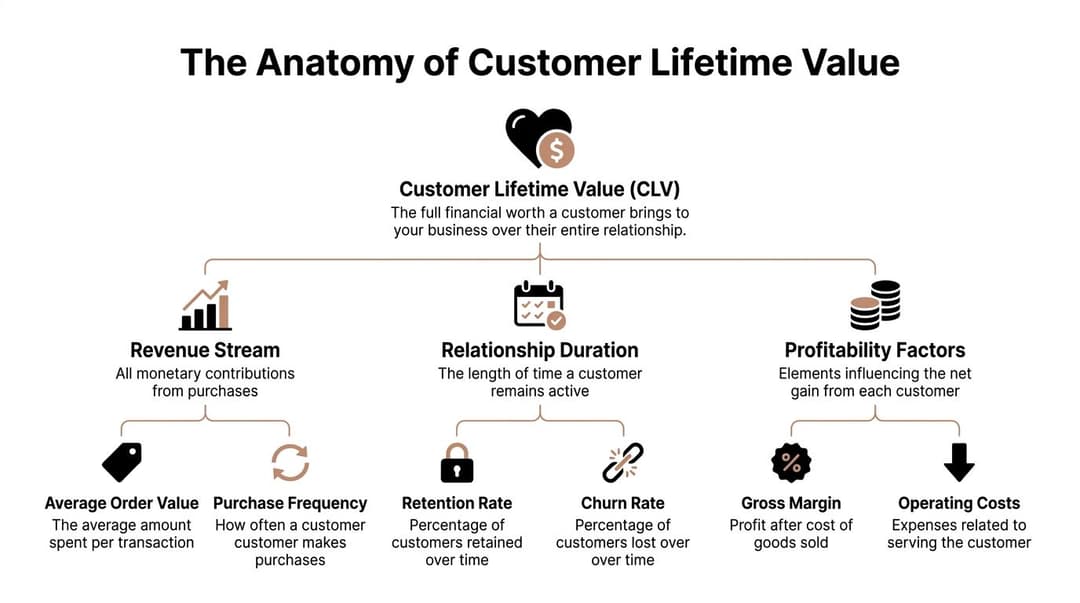
Think of CLV as the full value of a relationship. One order matters, but the relationship matters more. A customer who buys once and disappears has one kind of value. A customer who comes back, spends more, and stays engaged has a different kind.
Three parts drive CLV
At a practical level, CLV rests on three inputs.
Average purchase value
This is the typical amount a customer spends in a transaction.
For an ecommerce brand, that might be the average cart size. For a SaaS company, it might be monthly or annual contract value. This number tells you how much revenue enters the relationship each time the customer buys.
A lot of junior marketers over-focus on this lever because it’s visible. Bigger bundles, stronger merchandising, better upsells. Those all matter. But average purchase value alone doesn’t tell you much about long-term customer quality.
Purchase frequency
This is how often the customer comes back.
Two brands can have the same first-order revenue and still produce very different outcomes. One customer buys once. Another buys every few weeks. Paid social often hides this difference because the platform usually celebrates the first conversion, not the repeat pattern.
Marketers often get burned by dashboards here. If you don’t have a clear picture of who your best-fit customers are, CLV analysis gets noisy fast. A practical starting point is building an ideal customer profile template so your team can connect customer quality with audience strategy instead of treating every conversion as equal.
Customer lifespan
This is the length of the relationship.
Some products create short, bursty buying windows. Others create long retention curves. Neither is automatically better. What matters is that your CLV model reflects how your customers really behave, not how a generic blog says they should behave.
Profit matters, not just revenue
Many teams calculate CLV as if every dollar of revenue is equally valuable. That approach can be imprecise.
A customer who buys often but creates heavy support costs, refund issues, or low margins isn’t as valuable as top-line revenue makes them look. That’s why experienced teams eventually move from a revenue-only view to a profit-aware view.
CLV gets more useful when paired with business realities. Margin, retention, channel mix, and customer type all change what “good” means.
The levers you can pull
Once you see CLV as a combination of value, frequency, and duration, the optimization paths get clearer.
- Raise order value through bundles, merchandising, or stronger product mix
- Increase repeat behavior through retention flows, product experience, and smarter remarketing
- Extend lifespan by reducing friction after the first purchase
- Protect profitability by watching margin and service costs, not just revenue
That’s the core anatomy of CLV. It isn’t one mysterious number. It’s the result of how much customers spend, how often they return, and how long the relationship lasts, adjusted by the fact that some revenue is more profitable than others.
Calculating CLV With Formulas and Practical Examples
A media buyer launches a Meta campaign, sees a strong first-week ROAS, and starts scaling. Three weeks later, refunds rise, repeat purchase rates disappoint, and the "winning" audience stops looking profitable. That is the practical reason CLV matters. It changes how you judge performance before you overinvest in cheap customers.
You do not need a perfect CLV model on day one. You need one that is accurate enough to set bids, compare audiences, and avoid scaling the wrong traffic.

The basic formula
The standard starting point is:
CLV = Average purchase value × Purchase frequency × Customer lifespan
It is simple, fast to build, and good enough for an initial pass. It also breaks quickly if you treat it like a finished model. One source on CLV notes that many explanations stop at the textbook formula without addressing how teams should adjust it for real buying behavior and retention patterns in practice (source).
That limitation shows up fast in paid social. Meta accounts often run on promos, product drops, seasonal spikes, and mixed-intent traffic. In that environment, customer lifespan is usually an estimate, not a clean fact. Use the simple formula as a starting point, then pressure-test it against what your cohorts do.
A more practical version
A better operating model adds margin:
CLV = Revenue per customer over the relationship × Gross margin
That gets you closer to money the business keeps instead of top-line revenue that looks good in a dashboard.
For media decisions, CLV gets much more useful when you pair it with acquisition cost. If you need to tighten up the spend side of the equation, this guide to how to calculate customer acquisition cost accurately is the right companion metric.
A worked SaaS example
A verified SaaS example makes the margin point clearly. For a customer paying $50 per month with 85% gross margin and a 52-month lifespan, LTV equals $2,210 (source)).
Here is the math:
- Monthly revenue is $50
- Customer lifespan is 52 months
- Total revenue over the relationship is $2,600
- Gross margin is 85%
- Lifetime value is $2,210
The example is clean because SaaS often has stable billing and clearer retention curves. Paid social teams should still take the lesson. Revenue alone is not enough. Margin and retention are what make one acquired customer worth more than another.
How I’d calculate CLV for a DTC brand
Ecommerce is messier. Customers buy on different cadences, promotions distort behavior, and a "new customer" acquired during Black Friday may behave nothing like one acquired in February. The workflow still works if you keep it grounded in cohorts instead of storewide averages.
Start with a historical cohort
Pull customers acquired in a fixed date range and track:
- First order revenue
- Repeat order behavior
- Gross revenue over a fixed window
- Refund rate or margin impact, if available
This gives you observed value from a real acquisition period. That is more useful than a blended average that hides timing, offer mix, and traffic quality.
Build a short-window estimate if data is thin
New brands and fresh campaigns rarely have enough retention history to calculate a full lifespan with confidence. In that case, use a directional model and label it clearly as one.
For example, look at:
- First purchase behavior to see who converts
- Early repeat signals to see who comes back fast
- Retention patterns from similar cohorts to estimate likely future value
That approach is how operators make decisions in fast accounts. You are not trying to win an analytics purity test. You are trying to decide whether Audience A deserves more budget than Audience B before the quarter is over.
This is also where newer AI workflows help. Tools like AdStellar can connect campaign inputs with downstream customer quality signals faster than a manual spreadsheet process, which makes CLV more usable inside the actual pace of Meta optimization.
Do not wait for a fully matured retention curve if your team needs to make budget decisions this week. Build a directional model, state the uncertainty, and update it as cohort data fills in.
A useful walkthrough on the mechanics sits below if you want a visual explainer before building your own sheet.
What breaks in paid social
The common failure mode is not the formula itself. It is using a static formula inside a channel that changes every day.
Problems usually show up in four places:
- Lifespan assumptions are too aggressive because the product has seasonal demand or irregular reorder cycles
- Blended averages hide campaign differences so weak traffic gets credited with the value created by stronger cohorts
- CAC shifts by audience, placement, and creative which makes CLV hard to judge in isolation
- Teams build the model once and stop updating it even though the account, offer, and customer mix keep changing
That last point matters more than people think. A CLV model should behave like an operating tool, not a one-time finance exercise.
A practical decision framework
For Meta accounts, I use CLV in layers:
| Use case | Best CLV approach |
|---|---|
| New account with limited retention data | Directional estimate based on early cohorts |
| Established brand with repeat behavior | Historical CLV by campaign, audience, and offer |
| Budget allocation across segments | Margin-aware CLV paired with CAC |
| Creative testing | Compare which concepts attract stronger repeat customers |
In practice, customer lifetime value in marketing is a working model for better decisions. The formula matters. The key advantage comes from applying it at campaign speed, checking it against cohort behavior, and using tools that can feed those insights back into paid social optimization before the data gets stale.
Seeing the Future Predictive vs Historical CLV Models
Historical CLV is like driving with a rearview mirror. You can see what happened clearly. You just can’t use it alone to steer around the next turn.
Predictive CLV is closer to a GPS. It estimates where the customer relationship is likely to go based on available signals. It won’t be perfect, but it helps you make forward-looking decisions before the full revenue story arrives.
Predictive CLV uses statistical models and machine learning to estimate future customer spending based on behavioral patterns, enabling prospective budget allocation decisions, while historic CLV calculates the sum of all gross profit from a customer's completed transactions and serves as a backward-looking validation metric (source)).
If you’re working in Meta, you need both. Historical CLV tells you what kind of customers your campaigns produced. Predictive CLV helps you decide where the next budget should go, especially when campaign velocity is faster than your retention window.
Where historical CLV helps
Historical CLV is strongest when you want proof.
It answers questions like:
- Which campaign themes brought in better customers
- Which audiences generated repeat buyers
- Which offers created weak long-term value
- Which acquisition sources looked efficient but underperformed later
This is the model you use to validate assumptions. It’s grounded in completed behavior, which makes it hard to argue with.
Where predictive CLV helps
Predictive CLV matters when waiting for full customer lifespan data would slow the team down too much.
It helps with decisions such as:
- Budget allocation across current campaigns
- Audience prioritization before long-term revenue fully matures
- Creative testing based on likely customer quality
- Early ranking of customer cohorts for remarketing and upsell
Teams evaluating software for this kind of forecasting usually pair CLV thinking with tools built for predictive ad performance software, because campaign planning gets stronger when creative and audience decisions are tied to projected value instead of only immediate cost metrics.
Historical CLV vs Predictive CLV
| Aspect | Historical CLV | Predictive CLV |
|---|---|---|
| Time orientation | Backward-looking | Forward-looking |
| Core input | Completed transactions and observed profit | Behavioral patterns and modeled expectations |
| Best use | Validation of channel and cohort quality | Budget allocation and prioritization |
| Strength | Grounded in actual customer behavior | Useful before full revenue matures |
| Limitation | Slow for fast campaign decisions | Depends on model quality and signal quality |
| Paid social value | Shows what your campaigns produced | Helps choose what to test and scale next |
Use historical CLV to prove. Use predictive CLV to act.
Don’t treat them as rivals
A lot of teams frame this as an either-or choice. It isn’t.
Historical CLV keeps you honest. Predictive CLV keeps you fast. If you only use the historical model, you’ll react too slowly. If you only use the predictive model, you can talk yourself into bad assumptions.
The stronger setup is a loop. Historical performance validates what worked. Predictive modeling turns those lessons into next-budget decisions. That’s how CLV becomes useful operationally instead of theoretical.
Moving Beyond ROAS Setting Targets with the LTV to CAC Ratio
ROAS can tell you whether ads are paying back quickly. It cannot tell you whether the business model behind those ads is healthy.
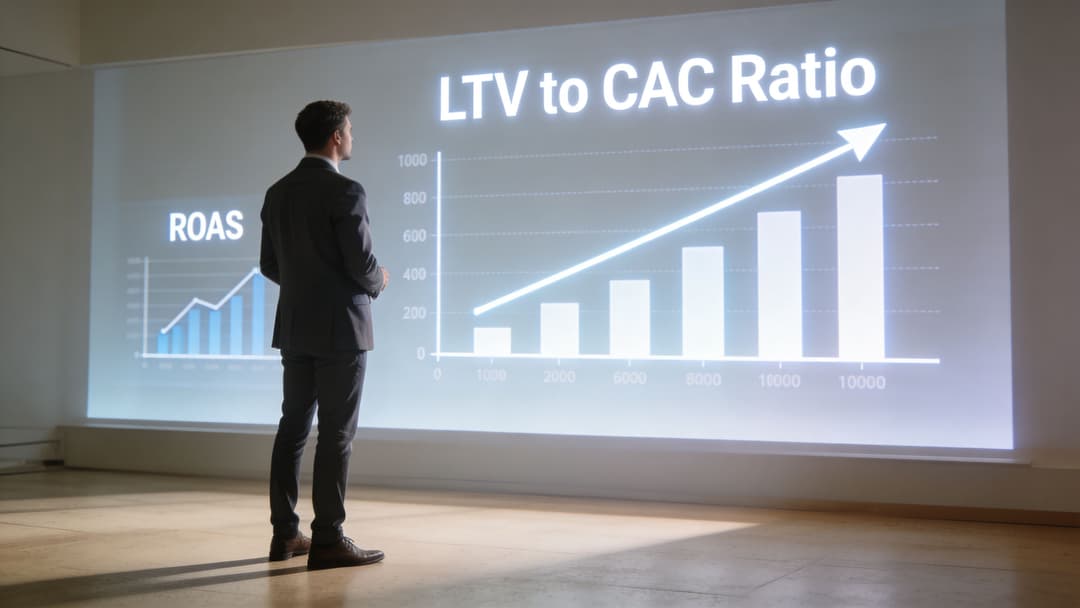
That’s why experienced operators keep coming back to the LTV to CAC ratio. It combines customer value with acquisition cost, which makes it a much better test of whether growth is durable or just expensive.
What the ratio means
LTV is the value a customer generates over the relationship. CAC is what it cost to acquire that customer. Put them together and you get a cleaner answer to a harder question: did you buy profitable growth, or just revenue that looked good in-platform?
The industry standard CLV/CAC ratio benchmark is 3:1 or higher, meaning for every $1 spent on customer acquisition costs, a business should generate at least $3 in customer lifetime value (source)).
That benchmark is useful because it gives teams a decision threshold. Not a vanity metric, a business threshold.
Why ROAS can mislead
ROAS rewards speed. The ratio rewards sustainability.
A campaign can post attractive early return and still bring in low-value customers. Another campaign can look less efficient at first and still outperform because those customers stay longer or buy more later.
Marketers often get burned by dashboards at this point. Platform reporting often highlights what happened right after the click. The business feels what happens after the customer arrives.
How to use the ratio in campaign decisions
On Meta, this ratio is most useful when you break it down by campaign theme, audience, or offer instead of looking only at an account-wide blended average.
Use it to judge:
- Audience quality by comparing customer value from broad, lookalike, and interest-based segments
- Creative quality by looking at which message angles attract stronger customers, not just cheaper ones
- Offer quality by separating customers who buy on heavy discount from customers who return without one
- Scaling readiness by asking whether a campaign clears the ratio threshold before adding budget
If you want a quick working model before building your own reporting, a simple LTV CAC calculator can help pressure-test the numbers.
What good operators do with weak ratios
They don’t panic and cut everything. They diagnose.
If CAC is too high
Look at:
- Creative fatigue
- Audience saturation
- Poor landing page continuity
- Weak qualification in ad messaging
There are practical levers for this, especially if you’re trying to reduce customer acquisition cost without dragging customer quality down with it.
If LTV is too low
The ad account may not be the only issue.
Check:
- Mismatch between ad promise and product reality
- Poor first-purchase experience
- Weak retention systems
- Discount-led acquisition that attracts the wrong buyer
A campaign with low CAC and low LTV isn’t efficient. It’s just cheap.
The better target
For long-term growth, the goal isn’t the lowest cost to acquire a customer. It’s the best cost to acquire the right customer.
That’s why LTV to CAC beats ROAS as the operating metric for strategic decisions. ROAS still matters for day-to-day control. But when you need to decide what deserves more budget, what belongs in testing, and what’s hurting the business under the surface, the ratio gives you a sharper answer.
Activating CLV Insights in Your Paid Ad Campaigns
Most content stops at calculation. It tells you how to measure CLV after the campaign ends.
That’s useful, but incomplete. Existing content treats CLV as a post-hoc metric to measure campaign success, not as a forward-looking hypothesis to guide budget allocation and creative experimentation in real time, especially on paid social (source)). For a Meta team, that is the primary job. You’re not just reporting value after the fact. You’re trying to use CLV signals to decide what to launch, what to scale, and what to kill.
Start with customer cohorts, not blended account averages
Blended metrics blur too much.
If you want CLV to affect campaign decisions, build customer cohorts around meaningful acquisition slices:
- By campaign
- By audience type
- By creative angle
- By landing page or offer
- By first product purchased
This method helps find the patterns that matter. You may learn that one hook brings in low-intent discount seekers, while another attracts customers who respond well to email, reorder quickly, and build real value.
Use CLV to improve audience strategy
Audience quality isn’t just about conversion rate. It’s about downstream behavior.
A practical workflow looks like this:
- Identify customers with stronger repeat purchase or retention behavior.
- Build source audiences from those customers.
- Test those audiences against broader or colder segments.
- Compare not just CPA, but later customer quality.
That logic also sharpens retargeting. If you already understand remarketing in Facebook, the next step is distinguishing between users likely to convert once and users likely to become valuable customers.
Use CLV to improve creative strategy
Teams often leave money on the table in this area.
A creative that wins clicks and first orders may still attract weak customers. Another may have a higher acquisition cost but a stronger customer profile after the sale. If you never connect creative themes to downstream value, you’ll keep funding what looks efficient instead of what is efficient.
Look at creative through a CLV lens:
Message angle
A price-led angle may pull volume. A quality-led or problem-solution angle may attract customers who stay longer.
Offer framing
Urgency works, but not every urgency hook creates the same customer. Some campaigns train people to buy only when there’s a deal.
Product emphasis
Hero product creatives can drive efficient first purchases. Bundle or system-based creatives may attract buyers with stronger repeat potential.
The best creative isn’t always the ad with the cheapest conversion. It’s the one that acquires customers your business wants more of.
Build reporting that reflects actual customer quality
Many teams still report in two disconnected systems. Ads Manager shows acquisition metrics. Shopify, CRM, or subscription data shows what happened later. That split makes CLV hard to operationalize.
The fix is to create a shared reporting view that connects:
- Spend and CAC
- First-purchase revenue
- Repeat purchase behavior
- Margin or contribution where available
- Cohort value over time
Once those views exist, campaign reviews get much better. You stop arguing about surface metrics and start discussing customer quality.
Where automation helps
Manual CLV analysis gets messy fast when you’re testing lots of variations across creatives, copy, and audiences. That’s where tooling becomes practical, not optional.
Platforms like Ads Manager, your ecommerce platform, and your analytics stack give pieces of the picture. AdStellar AI adds a workflow layer for Meta teams by launching large sets of creative and audience combinations, ingesting historical performance through secure OAuth, and ranking creatives, audiences, and messages against metrics like ROAS, CPL, and CPA. In practice, that kind of setup helps teams narrow the field faster so they can connect high-performing combinations with downstream customer quality instead of reviewing everything manually.
A simple operating routine
If you want CLV to influence paid social without slowing the team down, run a recurring routine:
- Weekly: Review acquisition metrics and early customer quality signals
- Biweekly: Compare cohorts by campaign, audience, and creative angle
- Monthly: Re-rank top spend drivers by estimated or historical CLV
- Quarterly: Rebuild lookalikes, refresh creative strategy, and cut repeat low-value patterns
That’s how CLV becomes useful in the world. Not as a finance slide, but as an operating system for audience selection, creative testing, and budget allocation.
From Metric to Mindset Making CLV Your Growth Engine
Customer lifetime value changes how you judge marketing.
It pushes you past the shallow comfort of first-order efficiency and into the harder, more useful question of customer quality. That shift affects everything: What you count as a winning campaign, which audiences you trust, which creative angles deserve more budget, which offers damage the business even when they boost short-term conversion.
The practical version of what is customer lifetime value in marketing isn’t complicated. It’s the value of a customer over the full relationship, viewed in a way that helps you make better acquisition decisions today.
What to do next
If your team wants to start using CLV without overcomplicating it, do three things first:
- Choose one CLV model that fits your current data reality, even if it’s directional
- Pair CLV with CAC so campaign profitability has a business context
- Review cohorts by audience and creative instead of relying on blended account averages
Then keep improving the model as more data comes in.
A lot of teams wait for perfect attribution, perfect retention curves, or perfect reporting before they start. That delay usually costs more than an imperfect first version. A rough CLV framework that shapes better decisions is more valuable than a polished model nobody uses.
The teams that get the most from CLV don’t treat it as a one-time calculation. They use it as a mindset. Acquire customers who are worth keeping. Build campaigns that attract more of them. Let long-term value, not just short-term efficiency, decide what growth really means.
If your team is testing lots of Meta creatives and audiences, AdStellar AI can help operationalize that work faster. It’s built to launch and rank large volumes of ad variations, learn from historical performance, and give media buyers a clearer way to connect campaign execution with the outcomes that matter most.