You're probably staring at the same question many paid social teams hit every week.
A campaign has been running long enough to produce data. One audience looks efficient on CPA. Another creative drives stronger click-through but weaker conversion quality. A third setup had a great weekend, then cooled off. Budget needs to move today, not next month. The dashboard tells you what happened. It doesn't tell you what's likely to happen next.
That gap is where most wasted spend lives.
A lot of marketers still optimize by combining experience, recent platform metrics, and instinct. That isn't foolish. Good operators develop sharp pattern recognition. But paid media environments shift constantly. Audiences saturate. Creative fatigue creeps in. Competitors change pressure in the auction. What worked last week can become average fast.
Predictive performance modeling gives you a more practical way to decide. Instead of asking only, “Which ad set performed best so far?” you ask, “Given the patterns in our historical data, which combination is most likely to deliver stronger ROAS or lower CPA next?” That's a different operating model. It moves you from reacting to forecasting.
For marketers already doing structured creative testing, this is the natural next step. If creative benchmarking helps you compare assets against each other, predictive modeling helps you estimate future outcomes before you commit more budget.
Introduction Beyond Guesswork and Gut Feelings
A familiar scenario: you've got several Meta campaigns competing for the next slice of budget. One has stronger recent ROAS. Another has cheaper traffic but weaker downstream conversion. A newer campaign has limited history, yet early signs look promising. If you rely only on gut feel, you'll usually favor the campaign that looks best in the rearview mirror.
That's useful, but it's incomplete.
Paid social is more like weather than bookkeeping. A rearview mirror helps you understand the road you already drove. A forecast helps you decide whether to speed up, slow down, or take another route. Predictive performance modeling works the same way. It uses patterns from historical campaign data to estimate what's likely to happen under future conditions.
Why historical dashboards stop short
Dashboards are descriptive. They answer questions like:
- What spent the most: Which campaigns consumed budget
- What converted: Which ads produced purchases or leads
- What efficiency looked like: How ROAS, CPA, or CPL trended over time
Those answers matter. But when you need to make a budget allocation decision, they don't fully answer the operational question: what should you do next?
A campaign can look strong because it benefited from timing, a fresh audience, or a short-lived creative spike. Another can look mediocre because it hasn't had enough data yet or because it's serving in a tougher pocket of inventory. Predictive modeling tries to separate signal from noise.
Strong marketers already read patterns in campaign data. Predictive modeling turns that instinct into a repeatable forecasting system.
What changes when you forecast instead of react
Once you start thinking predictively, your questions become sharper:
- Budget allocation: Which campaign is most likely to improve ROAS if spend increases?
- Creative decisions: Which message and format pairing is likely to sustain performance?
- Audience planning: Which segments are likely to convert efficiently as conditions shift?
- Launch readiness: Which new campaign setup resembles past winners closely enough to test with confidence?
Media buying is full of uncertain decisions made under time pressure. Predictive performance modeling doesn't eliminate uncertainty. It helps you manage it systematically.
What Is Predictive Performance Modeling
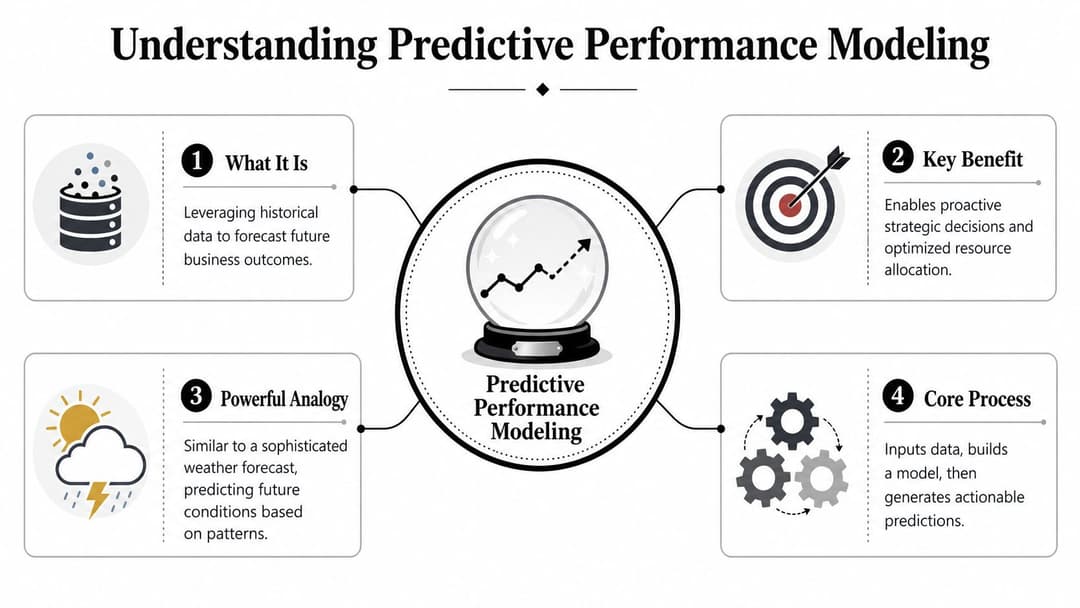
Predictive performance modeling is a forecasting method for marketing decisions. It uses historical campaign data to estimate what is likely to happen next, before you commit more budget. In practice, that means estimating outcomes such as ROAS, CPA, CPL, conversion rate, or the chance that a new creative will perform well enough to scale.
The easiest comparison is a weather forecast for your media budget.
A forecast cannot promise rain at 3:17 p.m. It looks at patterns, current conditions, and prior outcomes to estimate the most likely scenario. Predictive performance modeling works the same way for campaigns. It studies signals such as spend level, audience mix, creative format, message angle, placement, seasonality, and recent performance, then turns those inputs into a probability-based view of future results.
A practical mental model
A useful way to place predictive modeling is to compare it with the other types of analysis marketers already use:
- Descriptive analytics summarizes what already happened.
- Diagnostic analytics examines the factors behind that performance.
- Predictive analytics estimates what is likely to happen under similar or changing conditions.
Predictive performance modeling belongs in that third category, but for marketers the important point is not the label. The important point is that it turns pattern recognition into a repeatable forecasting process you can use for planning, testing, and budget allocation.
Core idea: You train a statistical model on historical campaign patterns so it can estimate future performance for the outcomes that drive business decisions, such as ROAS, CPA, or conversion likelihood.
That shift matters because campaign optimization often breaks down when teams rely on recent results alone. A campaign may look efficient this week because it caught a short-lived pocket of cheap inventory. Another may look weak because it is still in the learning phase. A predictive model helps you judge what performance is likely to persist, not just what happened yesterday.
What predictive modeling does, and what it does not do
Predictive modeling gives you a structured way to make decisions under uncertainty. It does not give certainty.
It also does not replace strategy, creative quality, or clean measurement. If conversion tracking is wrong, the model learns from wrong labels. If your offer is weak, the model may correctly predict poor performance, but it cannot fix the offer for you. The model is best used as a planning tool layered on top of disciplined experimentation and solid campaign operations.
A strong explainer video helps make that jump from concept to application:
Why marketers should care
The business value is straightforward. Predictive performance modeling helps you move from reacting to outcomes toward forecasting them. That changes how budget decisions get made.
Instead of asking, “Which campaign had the best ROAS last week?” you can ask better questions: “Which campaign is likely to hold its ROAS if we increase spend?” “Which audience is likely to convert efficiently once frequency rises?” “Which new ad resembles past winners enough to deserve a larger test?”
That is the primary point of predictive modeling for performance teams. It is not an academic exercise. It is a practical framework for reducing guesswork, setting better expectations, and putting more spend behind the combinations most likely to improve efficiency. For a marketer, that usually comes back to the same outcome: stronger decisions that protect budget and improve ROAS over time.
Common Modeling Approaches Explained
Marketers generally don't need to become model builders. They do need to know which type of model fits which business question. The easiest way to learn them is by tying each one to a real campaign decision.
Regression models for numeric outcomes
Use regression when you want to predict a number.
If your team asks, “What ROAS is this campaign likely to produce?” or “What CPA should we expect if we increase spend?”, regression is usually the starting point. The model learns relationships between inputs and a continuous outcome.
Example use cases:
- ROAS forecasting: Estimate likely return for a campaign setup
- CPA prediction: Predict acquisition cost before scaling budget
- Revenue projection: Estimate downstream value from campaign inputs
Classification models for winner versus loser decisions
Classification models answer yes-or-no or category questions. In performance marketing, that often means deciding whether something is likely to cross a threshold.
Instead of predicting exact ROAS, you might ask, “Is this ad likely to become a high-ROAS asset?” That's a classification problem.
These models are useful when teams want operational simplicity. Green-light or hold. Scale or pause. Test broadly or trim fast.
Time-series models for trend and seasonality
Time-series models focus on what changes over time.
They're useful when performance moves with predictable rhythms, such as day-of-week effects, seasonal buying patterns, promotion windows, or post-launch fatigue. If your conversion rate regularly softens after a sale ends, or spend efficiency shifts around holidays, time-series thinking helps.
Uplift and incrementality-oriented models
Some questions aren't about correlation. They're about causation. You don't just want to know whether people converted after seeing an ad. You want to know whether the ad changed the outcome.
That's where uplift and incrementality thinking becomes useful. It's especially important when you're comparing channels or evaluating whether retargeting is adding value. If you want a clean refresher on that broader measurement challenge, Headline Marketing Agency's guide is a helpful companion read.
Choosing Your Predictive Modeling Approach
| Model Type | Best For... | Example Question It Answers | Complexity |
|---|---|---|---|
| Regression | Predicting exact numeric outcomes | What ROAS is this campaign likely to produce? | Medium |
| Classification | Sorting likely winners from likely losers | Is this ad likely to beat our target CPA? | Medium |
| Time-series | Forecasting trends over time | What will lead volume look like next week? | Medium |
| Uplift modeling | Estimating incremental impact | Which audience changes behavior because of the ad? | High |
| Ensemble approaches | Combining signals from multiple models | Can we improve prediction quality by blending methods? | High |
How marketers usually choose wrong
The most common mistake is picking a model because it sounds advanced rather than because it matches the decision.
If your team needs to forecast budget efficiency next week, a straightforward regression or time-series setup can be more useful than a complex model nobody understands or trusts. If you're working at the portfolio level, the question may belong in a broader measurement framework like media mix modeling, not just ad-level prediction.
The right model is the one that answers the business question clearly enough for someone to act on it the same day.
The Data and Features That Fuel Predictions
Most failures in predictive performance modeling don't start in the model. They start in the inputs.
If campaign naming is inconsistent, attribution windows aren't aligned, or creative labels are missing, the model learns from a messy version of reality. It can still produce output. That doesn't mean the output is trustworthy.
What data usually matters most
For paid social forecasting, marketers typically draw from a few core data groups:
- Performance data: Impressions, clicks, spend, conversions, CPA, ROAS
- Audience data: Segment, geography, demographic grouping, interest or lookalike context
- Creative data: Format, hook, offer framing, visual style, call to action
- Campaign setup data: Objective, placement, budget strategy, bidding approach
- External context: Seasonality, promotions, product launches, site issues, competitive pressure
This is the practical flow from raw data to usable prediction signals:
Feature engineering in plain English
Feature engineering sounds technical, but it's just the act of turning raw inputs into more useful signals.
A raw metric like frequency is informative. A derived feature like “fatigue risk” can be more useful because it combines frequency, time running, and falling click-through or conversion efficiency into one signal the model can read more clearly.
Other examples:
- Creative freshness score: Based on age, spend concentration, and recent engagement decay
- Audience saturation signal: Built from frequency and declining efficiency over time
- Message-audience interaction: Whether a certain angle performs differently for different segments
If your team already reviews historical Facebook ad data usage, you're already halfway there. Predictive modeling formalizes that habit into structured inputs the model can learn from.
The practical rule marketers should remember
Better data beats fancier modeling.
A simpler model trained on clean, consistent campaign data often outperforms a more complex setup fed with inconsistent labels and fragmented history. The model doesn't know your team “meant the same thing” when five naming conventions describe the same audience idea. You have to make the data legible first.
How to Evaluate Your Predictive Models
You launch a new budget increase because the model says a campaign has a high chance of winning. Three days later, ROAS slips, CPA rises, and the team starts asking the right question: was the forecast wrong, or did you read it the wrong way?
That is the main job of evaluation. Predictive modeling is not an academic scorekeeping exercise. It is a way to decide whether a forecast is reliable enough to guide budget shifts, creative rotation, bidding changes, or audience expansion.
Read metrics like a marketer, not a statistician
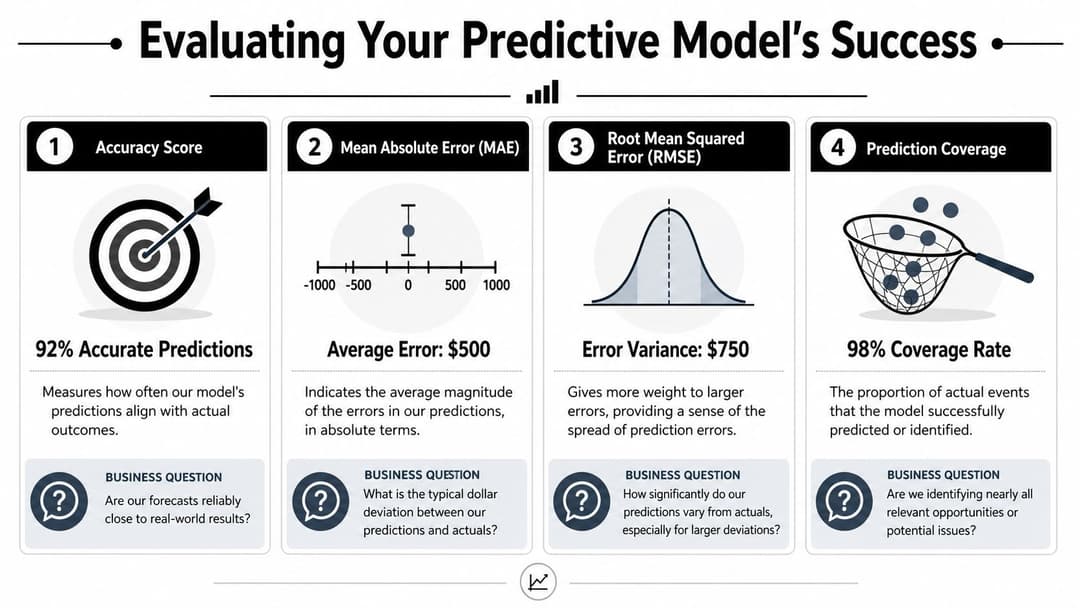
A weather forecast helps because it answers a practical question. Should you carry an umbrella? Model evaluation works the same way. Each metric answers a specific decision question.
For regression problems such as predicting ROAS, CPA, or lead volume:
- MAE: How far off are we on a typical prediction?
- RMSE: How painful are the bigger misses?
- R²: How much of the performance swing can the model explain?
For classification problems such as predicting whether an ad is likely to become a winner:
- Precision: When the model flags a likely winner, how often does that call hold up?
- Recall: How many of the actual winners did the model catch?
- F1: How balanced is the model between being selective and being thorough?
- ROC-AUC: How well can it rank stronger opportunities above weaker ones?
Research summaries on predictive performance report that many published models show strong results, and that the evaluation metric usually depends on the task being predicted, as described in this ScienceDirect overview of predictive performance. That is useful context, but your standard should still be business fit. A model with decent MAE but poor ranking ability may be fine for rough budgeting and bad for choosing which ads deserve more spend.
One score rarely tells the full story
A single headline metric can hide a bad forecasting habit.
A model might rank campaigns in the right order but still overstate confidence. In plain English, it can correctly say Campaign A looks better than Campaign B while badly exaggerating how likely A is to hit its target. That matters because marketers do not just rank options. They place bets with real budget.
A widely used evaluation framework breaks model quality into multiple dimensions, including overall performance, discrimination, and calibration, which you can review in this summary of multi-dimensional model evaluation.
Here is what those ideas mean in campaign terms:
- Discrimination: Can the model separate stronger opportunities from weaker ones?
- Calibration: If the model says an ad has a 70% chance of success, does reality look anything like 70%?
- Overall performance: Across all predictions, how dependable is the system as a forecasting tool?
Calibration is the one many marketing teams skip. That is a mistake. If your model keeps overstating likely success, you will scale too early, set the wrong expectations, and hurt spend efficiency even if the rankings look reasonable.
Validation is your reality check
A model should be tested on data it has not already seen. Otherwise, you are grading memory, not forecasting skill.
Common approaches include holdout testing, cross-validation, and bootstrapping. The idea is simple. Train the model on one slice of history, then test it on another slice it could not memorize. For marketers, this is similar to judging a media buyer by how they handle a new month of spend, not by how well they can explain last month's results.
This is also where context matters. If your team cares most about budget allocation, ranking quality may matter more than perfect point estimates. If your team needs accurate weekly forecasts for pacing, error size matters more. A useful model is the one that matches the decision in front of you, using the same discipline you would apply when reviewing Facebook ad performance metrics and what they actually mean or broader KPI systems such as Wispra insights on SEO measurement.
The practical question is simple: does this model help you make better spend decisions than gut feel alone? If the answer is yes, and the validation holds up on unseen data, then the model is doing its job.
Implementation and Automation with AdStellar
Getting predictive performance modeling into production is less about theory and more about workflow discipline.
A manual process usually looks something like this.
What a team does by hand
- Define the business question. Predict ROAS, flag likely winners, estimate CPA, or forecast lead volume.
- Assemble clean historical data. Pull campaign, ad set, creative, audience, and outcome data into one usable table.
- Create features. Turn raw platform fields into signals like fatigue, recency, or audience-creative interactions.
- Train a model. Choose an approach that matches the decision.
- Validate it. Check whether the model generalizes to unseen data.
- Deploy and monitor. Feed new campaign data in, review predictions, and adjust when conditions change.
That's manageable for a data team. It's slower for an agency or growth team that already has to launch tests, analyze results, and report to stakeholders.
Where automation changes the economics
Operational platforms matter. In Meta ad environments, systems that connect to Ads Manager through secure OAuth and continuously ingest fresh data can keep models current instead of forcing teams into occasional manual refreshes.
One documented example in Meta ad modeling reports that integrating Auto-Learning models with historical performance data can reduce CPA by 25% within 30 days, while identifying strong creative and audience combinations 10× faster than static approaches through secure Meta Ads Manager connections, as described in this predictive analytics example for campaign optimization.
That kind of setup is useful because it closes the loop between past results and future decisions. Instead of a one-time forecast, the system keeps learning.
How this looks in practice
A platform like AdStellar AI's continuous learning workflow fits that operating model by connecting campaign history, updating as new data arrives, and using auto-learning logic to score likely winners before more spend is committed.
For a marketer, the practical value is straightforward:
- Faster testing: You don't need to manually rebuild every decision rule
- More consistent scaling: Strong patterns get surfaced earlier
- Less reactive optimization: Budget moves based on forecasted likelihood, not only yesterday's snapshot
If your team is already managing lots of creative variations, automation isn't about convenience alone. It's about making forecasting usable at campaign speed.
Best Practices and Common Pitfalls to Avoid
Start simpler than you think you need.
A basic model tied to one high-value decision is usually better than a complicated system tied to none. If the model can't influence budget allocation, creative selection, or audience expansion, it's just interesting math.
The habits that keep models useful
- Start with one outcome: Pick one business target such as ROAS, CPA, or lead quality.
- Clean your labels first: Creative tags, audience names, and campaign objectives need consistency.
- Review predictions against decisions: Ask whether the output would change what a buyer does.
- Retrain regularly: Performance conditions don't stay fixed.
A major real-world issue is data distribution shift. Predictive performance often degrades when live data drifts away from the training distribution, a problem highlighted in this research on performance under distribution shift. In advertising, that happens all the time. Audience behavior changes. Seasonality hits. Creative wears out. The model that looked strong last month can become stale unnoticed.
Where people get overconfident
Small or imbalanced samples are dangerous. A model can look impressive in development and still fail in the wild if there weren't enough meaningful events behind the training data. A clinical prediction review warns that apparent performance is often better than true performance and recommends bootstrap-based optimism correction, especially when sample limitations are present, in this review on reliable prediction-model evaluation.
That lesson transfers cleanly to marketing. If you're predicting winners from sparse conversion data, don't trust flashy scores too quickly.
The practical checklist is short. Watch for drift. Validate on unseen data. Don't confuse ranking ability with trustworthy probability estimates. Keep the model attached to a real decision.
If you want a practical way to apply predictive performance modeling in Meta campaigns without building the full workflow from scratch, AdStellar AI is one option to explore. It connects to historical campaign data, supports continuous learning, and helps teams use forecast-driven signals to test, launch, and scale with less guesswork.