Many teams running Facebook ads aren't losing because they picked the wrong button in Ads Manager. They're losing because the workflow is slow, messy, and reactive.
A campaign launches. Then someone duplicates ad sets by hand, swaps two headlines, renames three ads, exports a CSV, and tries to remember which hook was meant for cold traffic versus retargeting. By the time the data is clear enough to act on, the creative is already tiring out and the team is arguing over CTR instead of profit.
That gap gets more expensive when the platform is this large. Meta generated USD 156.8 billion in global ad revenue in 2025 and its ads can reach over 2 billion active users every month, spanning more than one-third of the world's population aged 13 and above, according to Electro IQ's Facebook ad statistics roundup. The opportunity is obvious. The bottleneck is execution.
The teams that gain an advantage don't spend more time inside Ads Manager. They protect time for message strategy, angle testing, and performance review. They tighten tracking, simplify account structure, and use cleaner audience inputs. That's also why first-party signals matter more than ever. If you're still treating your customer data as an afterthought, this primer on first-party data for ad performance is worth a read before you scale anything.
The Modern Challenge of Running Facebook Ads at Scale
The hard part in 2026 isn't access. It's operational drag.
A typical week for a paid social team looks familiar. One person is fixing naming conventions. Another is rebuilding the same audience stack for a new campaign. A media buyer has five tabs open trying to compare copy variants because the account structure never reflected the actual testing plan. None of that improves the offer, the angle, or the sales page.
Where accounts usually break
Most underperforming ad accounts share the same problems:
- Manual duplication everywhere. Teams rebuild campaigns instead of using a repeatable testing system.
- Weak message tracking. They know which ad ID won, but not which promise, objection, or hook won.
- Audience and creative mismatch. The same ad runs to cold prospecting, warm retargeting, and customer upsell traffic.
- Reporting clutter. Clicks and CTR get more attention than purchases, CPA, and ROAS.
Practical rule: If your reporting can't tell you which angle worked for which audience stage, you're not really testing. You're just buying data expensively.
At small spend levels, messy process is annoying. At scale, it becomes the thing that caps growth. You can't improve what you haven't organized, and you can't scale what you can't explain.
What changes when the team gets serious
The shift is simple in theory. Stop treating Facebook as a campaign-building tool and start treating it as a decision engine. That means every setup choice should make future decisions easier.
A clean account gives you faster answers. A clear angle library gives you better creative briefs. Better tracking gives the algorithm cleaner feedback. When teams make those changes, running Facebook ads stops feeling like platform maintenance and starts acting like a real acquisition system.
Building Your Campaign Foundation for Performance
The account should be boring before the creative gets interesting. That's how you keep performance readable.
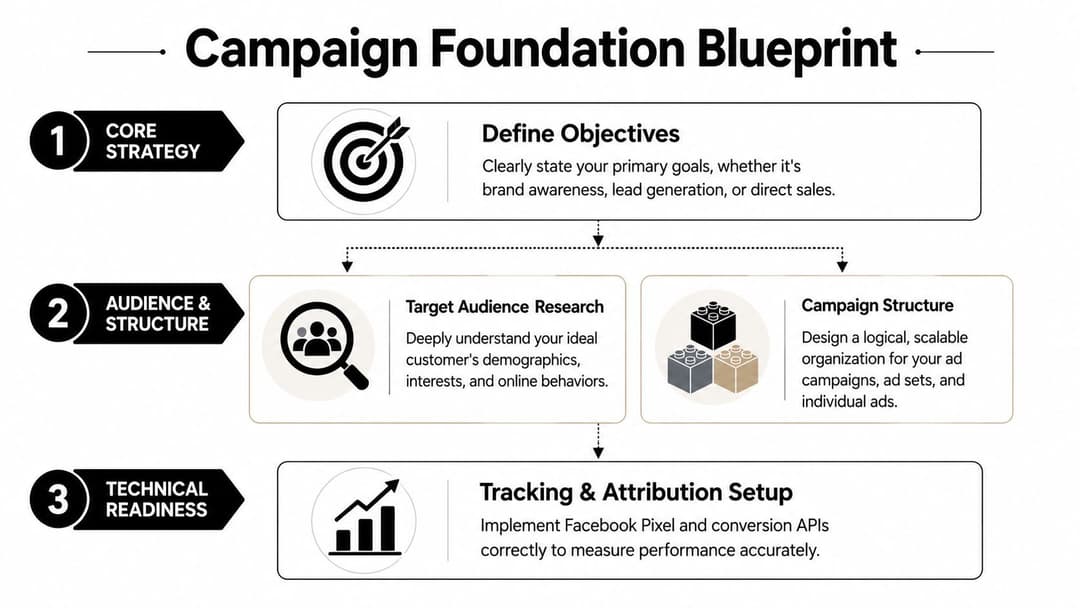
Pick the objective that matches the business action
Teams still make the same early mistake. They choose an objective based on cheap top-line numbers, then wonder why the traffic doesn't convert.
If you want purchases, use a sales objective. If you want qualified leads, use leads. Don't ask Meta to find cheap clicks and then act surprised when it finds people who click a lot and buy rarely. The optimization goal shapes delivery. That decision isn't cosmetic.
A good pre-launch check looks like this:
- Tie the campaign to one business outcome. Purchase, qualified lead, booked call, or another primary conversion.
- Define the result at the ad set level clearly. Avoid muddy setups where prospecting and retargeting optimize toward different real-world goals inside the same test.
- Name campaigns for analysis, not aesthetics. Include market, funnel stage, angle family, and offer type so reporting stays useful later.
If you want a refresher on the mechanics, AdStellar's guide on how to create Facebook ads covers the build process well.
Install tracking before debating creative
Creative can only do its job if tracking is trustworthy.
You need the Meta Pixel implemented correctly and Conversions API configured so the platform receives consistent conversion feedback. Without that, the account starts optimizing against incomplete signals, and performance discussions get distorted fast. Teams often call a creative weak when missing event quality is the issue.
Tracking problems don't show up as an obvious red warning. They show up as confused optimization, unstable reporting, and bad decisions made confidently.
A simple foundation has three layers:
| Layer | What it should do | Why it matters |
|---|---|---|
| Pixel events | Capture key website actions | Gives Meta behavioral signals for optimization |
| Conversions API | Reinforce server-side event delivery | Improves resilience when browser-side data is incomplete |
| UTM and naming discipline | Keep campaign intent visible outside Meta | Makes it easier to compare Meta with CRM and analytics data |
Structure the account so scaling stays clean
The best structure is the one that preserves test clarity. In practice, that usually means separating campaigns by funnel role and keeping ad sets focused enough that you can tell what variable is doing the work.
For lead gen teams, the same logic applies outside e-commerce. The playbooks in AgentPulse's lead generation strategies are useful because they force a cleaner connection between audience intent, offer, and follow-up path.
Use the account hierarchy to answer questions later:
- Campaign level should reflect the optimization goal or funnel role.
- Ad set level should isolate audience, placement strategy, or testing condition.
- Ad level should isolate message, format, and creative variation.
When that structure is right, scaling gets easier because the account tells you what happened without a spreadsheet detective story.
Developing Your Creative and Audience Strategy
Many teams say they're testing creatives. What they're really testing is random surface variation.
One ad uses a testimonial. Another uses a product shot. A third changes the headline. Then the team picks a winner and moves on without understanding why that message worked for that audience at that moment. That's how accounts stall.
The lever is the angle. That's the underlying sales idea behind the ad. Not the image. Not the CTA button. The argument.
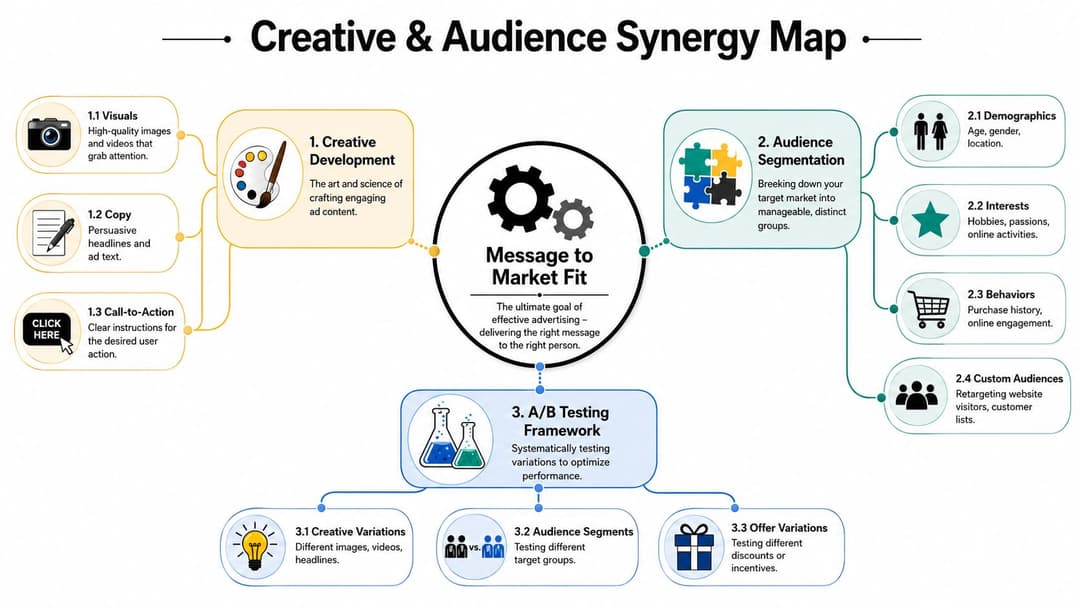
Match the angle to awareness
A cold audience doesn't think like a cart abandoner. A recent buyer doesn't need the same proof as someone who has never heard of you. Yet many teams run one angle across every audience and call it consistency.
That's one of the biggest waste points in running Facebook ads.
Data from Meta practitioners shows that campaigns that explicitly segment ad angles by audience awareness sophistication can achieve 30%+ higher conversion rates compared with broad, unsegmented tests because the message better matches the user's cognitive state. That matters because the same offer can win or fail depending on how it's framed.
A practical map looks like this:
| Awareness stage | What the person usually needs | Angle style that tends to fit |
|---|---|---|
| Unaware | Context and education | Problem introduction, myth-busting, category education |
| Problem-aware | Agitation and clarity | Pain-focused copy, consequence framing, symptom callout |
| Solution-aware | Differentiation | Mechanism, comparison, proof, objection handling |
A problem-agitate ad can work very well for someone who already feels the pain. It often falls flat with unaware traffic because the person hasn't accepted the problem yet. That doesn't mean the copy is bad. It means the timing is bad.
The best creative often loses when it meets the wrong level of awareness.
Build a message matrix, not a pile of ads
Instead of asking, "What ad should we make next?" ask, "Which angle should this audience hear next?"
That changes the workflow. Now you're building a matrix across two dimensions:
- Audience state such as cold prospecting, site visitor, engaged viewer, lead, or customer
- Message type such as education, pain, proof, comparison, urgency, or offer
Each ad becomes a deliberate expression of one angle for one audience state. Reporting also gets cleaner because you're evaluating strategic fit, not just isolated creatives.
Here's a useful way to brief a campaign:
Start with the audience's current belief
- Cold prospecting may need a belief shift.
- Warm retargeting may need proof or urgency.
- Existing customers may need expansion or upsell logic.
Choose one core angle
- Avoid packing three arguments into one ad.
- If the ad is about convenience, let it be about convenience.
Express that angle in multiple formats
- Static image for speed.
- UGC-style video for relatability.
- Short copy and long copy variants for different placements.
Use audiences to sharpen the message
Audience strategy isn't just targeting. It's message control.
Custom Audiences from customer lists, site visitors, and engaged users let you say different things to different people. Lookalikes and broader prospecting pools help you find scale, but the message still has to do the heavy lifting. Strong audience architecture gives your creative room to be more specific.
If your team creates content in-house, the production process matters too. This roundup from Yassine Malti on social media content tools is useful because it illustrates how to build multiple creative formats quickly without losing consistency.
A few patterns tend to hold up in practice:
- Cold prospecting responds better to curiosity, education, or a crisp problem articulation than to heavy discount pressure.
- Warm traffic usually benefits from proof, objections, and more direct asks.
- Customer audiences often need expansion angles, new use cases, or complementary products rather than introductory brand copy.
When teams fix this one layer, campaign reviews get less emotional. You stop saying "the video didn't work" and start saying "the comparison angle beat the educational angle with solution-aware traffic."
That's a much more useful sentence.
Mastering Budgets and A/B Testing Frameworks
Budget strategy should protect the test. That's the standard.
Too many accounts launch with a vague idea, spread spend across too many variables, and then try to read intent from noisy data. A clean budget framework doesn't guarantee a winner, but it does make the loser obvious faster.
Use ABO when learning and CBO when consolidating
ABO gives you tighter control. Each ad set gets its own budget, which is useful when you're trying to isolate an audience or angle test. If you need to guarantee spend to a specific hypothesis, ABO is usually the cleaner option.
CBO is better when you already trust the campaign components and want Meta to shift budget across ad sets based on performance. That's useful later, after you've found combinations worth backing.
A simple decision rule:
- Choose ABO when you're testing new angles, offers, or audience buckets.
- Choose CBO when you already have validated components and want more efficient budget allocation.
- Don't mix testing and scaling logic inside the same campaign unless you want muddy reporting.
Bid with restraint
Most advertisers should start with the platform doing more of the bidding work. Lowest Cost is usually the cleanest starting point because it gives delivery room to learn.
Cost controls can help, but they can also choke delivery if the target doesn't match auction reality. The problem isn't the feature. It's using it before you've learned what the account can produce.
A bid strategy can't rescue a weak offer or a mismatched angle. It can only shape how aggressively you pay for delivery.
Borrow angles instead of worshipping originality
Many teams waste months at this point.
They treat ideation like a blank page exercise when the faster route is pattern recognition. Data from campaigns hitting $50m+ in revenue confirms that 70% of scalable angles are borrowed from other niches and adapted, not invented from scratch. That's one of the most practical insights in modern Facebook advertising because buyer psychology transfers across categories more often than brands expect.
An angle from beauty can become an angle for pet care. A SaaS onboarding hook can become a lead-gen hook for services. What you're borrowing isn't the wording. It's the emotional structure.
Some of the best borrowed frameworks are:
- Fear of decline. Aging, wasted time, lost opportunity, hidden cost.
- Identity upgrade. Become the organized operator, the informed buyer, the better parent, the sharper founder.
- Effort reduction. Faster setup, less confusion, fewer steps, simpler workflow.
- Proof against skepticism. Why this works when the usual alternatives fail.
If your team struggles with test planning, this guide on sample size for testing is a practical companion to angle work because it keeps you from calling winners too early.
After you've mapped a few borrowed frameworks, put them into actual variation sets. This is where workflow tools matter. Platforms that automate bulk ad creation help because they turn one strategic idea into many executable combinations without forcing a media buyer to duplicate assets all afternoon. AdStellar AI is one example. It connects to Meta Ads Manager, generates combinations of creatives, copy, and audiences, and launches them in bulk. The point isn't automation for its own sake. It's preserving human time for the angle decisions that matter.
A quick walkthrough of this testing mindset is below.
Measuring What Matters for Performance
Many accounts look healthy until you ask a hard question. Did the campaign create profitable customer acquisition, or did it just buy activity?
That distinction matters because Facebook gives you a lot of metrics to stare at. Some are useful diagnostics. Some are seductive distractions. If the team isn't careful, click volume becomes a comfort metric and profit gets reviewed too late.
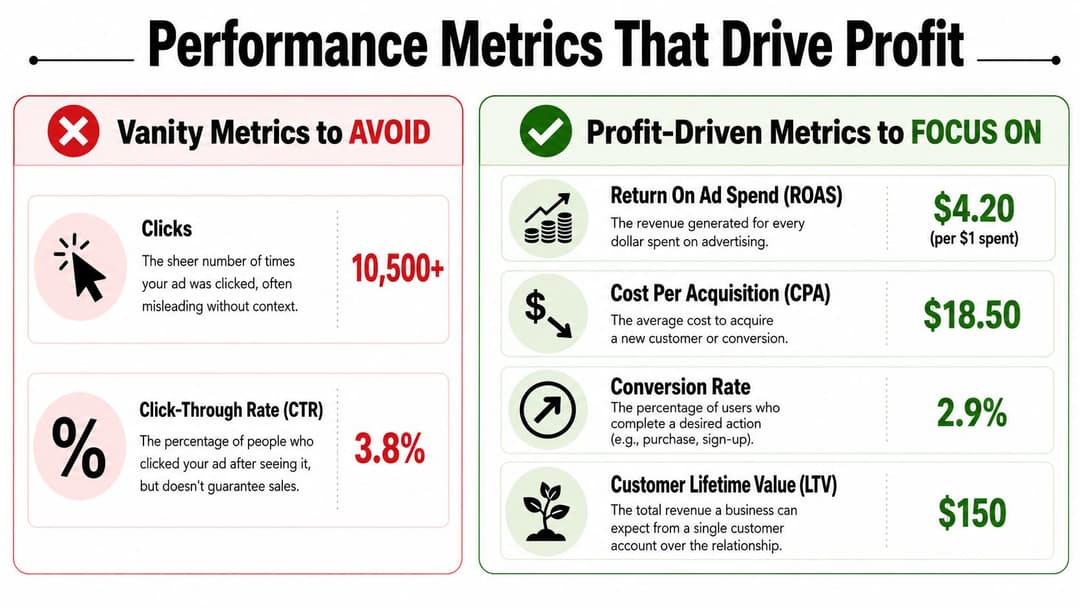
Start with the metrics tied to money
According to Visible Factors' Facebook ads benchmarks, the median ROAS across all industries for 2026 is 1.93x, the median CPA is $38.17, and the median CTR is approximately 2.19%. Those numbers are useful as directional benchmarks, but they don't replace your unit economics.
CTR tells you whether people are engaging enough to click. It does not tell you whether those clicks are valuable. ROAS and CPA get much closer to the business question.
Use a metric hierarchy:
| Priority | Metric | Why it matters |
|---|---|---|
| Primary | ROAS | Shows revenue efficiency against spend |
| Primary | CPA | Shows what it costs to acquire the conversion you care about |
| Primary | Conversion rate | Helps diagnose whether traffic quality and landing page fit are aligned |
| Secondary | CTR | Useful signal for message pull, not proof of profitability |
| Secondary | CPC and CPM | Helpful for diagnosing auction pressure, not for deciding winners alone |
Read Ads Manager like an operator
The fastest way to get misled is to look only at campaign totals. You need breakdowns.
Check performance by placement, device, age band, and audience segment. If mobile drives most of your traffic but a landing page converts poorly there, the issue may not be the ad at all. If one angle holds ROAS while another inflates clicks and drags CPA upward, you need to know that before shifting budget.
If your tracking setup still needs work, this guide to the Facebook Conversions API helps close a common measurement gap.
A practical review cadence looks like this:
- Daily for spend pacing, delivery issues, and severe outliers
- Several times a week for angle-level decisions
- Weekly for budget reallocations and audience pruning
- Less often but deliberately for creative trend review and offer analysis
Good reporting doesn't just tell you what happened. It tells you what to do next.
Treat vanity metrics as clues, not verdicts
Clicks, CTR, thumb-stop rate, and engagement can all help explain behavior. They just shouldn't decide budget on their own.
A high CTR ad can still be weak if it attracts curiosity instead of intent. A lower CTR ad can be stronger if it pre-qualifies the audience and drives cheaper acquisition. That's why mature teams optimize toward the outcome first and use secondary metrics as supporting evidence.
When running Facebook ads, the winning question isn't "Which ad got attention?" It's "Which ad created profitable action from the right audience?"
Scaling Winners and Avoiding Common Pitfalls
A winning ad is fragile right after you find it. It's often self-sabotaged.
They see a strong day, double the budget, expand the audience, add more variants, and stack too many changes at once. Then performance slips and nobody knows which change caused it. Scaling works better when it's disciplined, slower than your impulse, and tied to actual business metrics.
Scale in one direction at a time
There are two practical paths.
Vertical scaling means increasing budget on an existing winner. Use it when the ad set still has room and the audience quality remains stable.
Horizontal scaling means duplicating a strong concept into adjacent audiences, placements, or campaign environments. Use it when the message is proven but you want to test where else it can travel.
The mistake is changing budget, audience, bid strategy, and creative all at once. If performance drops, the data becomes hard to read.
A cleaner approach:
- Keep the original winner intact so you preserve a control.
- Clone into one new condition if you're testing expansion.
- Judge scaling on profitability, not just volume.
Watch frequency before the audience tunes out
Creative fatigue creeps in slowly and then shows up all at once in cost per result.
According to AdEspresso's guide to Facebook ad metrics, advertisers should cap daily ad frequency at 2.0 to 3.0, and when frequency reaches 3, the ad should be retired and replaced with new creative to restore performance and reduce cost per result. That's a useful operating rule because fatigue rarely announces itself politely.
When frequency rises, people don't always click less immediately. Sometimes they click and convert worse. Sometimes your CPM changes while the underlying issue is repetition. That's why creative rotation matters so much during scale.
If an ad has done its job, replace it before the audience punishes you for repeating it.
The common mistakes are usually behavioral
Most scaling failures are less about platform complexity and more about impatience.
Watch for these patterns:
- Killing tests too early. Teams cut ads before enough evidence accumulates.
- Falling in love with CTR. The ad wins attention but loses money.
- Overediting live winners. Small "improvements" reset clarity and often hurt performance.
- Ignoring post-click reality. Landing page friction gets blamed on the ad.
- Scaling without creative backup. The account has one winner and no queued replacements.
The right posture is calm. Strong media buying isn't constant activity. It's selective intervention. Protect the winner, rotate fresh angles in before fatigue hits, and let your reporting tell you when to push versus when to hold.
The Future of Facebook Ads is AI-Driven
The fundamentals haven't changed. Good offers still matter. Clear angles still matter. Audience-message fit still matters.
What has changed is the volume of execution required to compete. Running Facebook ads well now means building more variants, reading more data, and moving faster without losing strategic clarity. That combination is hard to maintain with manual workflows alone.
The marketer's job is becoming more valuable, not less. But the valuable part isn't bulk duplication, naming cleanup, or exporting reports. It's deciding which audience needs which message, which borrowed angle is worth adapting, and which winners deserve more budget.
That's where AI starts to make sense. Not as a substitute for judgment, but as infrastructure for it. If you want a deeper view of how this shift is changing campaign operations, AdStellar's perspective on AI-powered Meta ads is a useful place to start.
The teams that win won't be the ones doing the most manual work. They'll be the ones with the cleanest feedback loops, the strongest angle libraries, and the fastest path from insight to launch.
AdStellar AI helps performance teams turn strategy into execution inside Meta faster. If you're managing repeated creative tests, multi-audience launches, and constant reporting loops, AdStellar AI gives you a structured way to generate variations, launch campaigns in bulk, and review which messages, creatives, and audiences are driving ROAS, CPA, or CPL.