Let's be honest, "optimizing" your Facebook ads can feel like a guessing game. You tweak a headline here, adjust a budget there, and hope for the best. But true Facebook ads optimisation isn't about random adjustments or chasing vanity metrics.
It’s a disciplined, data-backed cycle: you set clear goals that matter to your bottom line, you test relentlessly, you dig into the performance data, and you make smart changes to drive down costs and boost results. This isn't about guesswork; it's a framework for turning ad spend into predictable revenue.
The Four Pillars of Modern Optimisation
Forget the generic tips you've read a hundred times. This is a playbook for performance marketers who need their ad spend to translate directly into profit. We’re moving beyond surface-level stats to focus on what actually grows the business.
A truly modern optimisation strategy stands on four core pillars. Get these right, and you're ahead of 90% of advertisers.
- Profit-Driven Goals: Aligning every campaign with tangible business outcomes, not just platform metrics like clicks or reach.
- A Rock-Solid Data Foundation: Implementing the Meta Pixel and Conversions API (CAPI) correctly is non-negotiable. You need to feed the algorithm clean, high-quality data.
- Systematic Creative Testing: Constantly testing ad concepts, copy, and formats to discover what actually convinces people to act.
- Intelligent Scaling: Knowing exactly when—and how—to pump more budget into your winning campaigns without wrecking your efficiency.
To really hammer home how much the game has changed, let's look at the shift in thinking over the past few years.
Core Pillars of Facebook Ads Optimisation
| Pillar | Outdated Approach (Pre-2024) | Modern Best Practice (2026) |
|---|---|---|
| Goal Setting | Optimising for low Cost Per Click (CPC) and high Click-Through Rate (CTR). | Optimising for profit: Return on Ad Spend (ROAS), Customer Lifetime Value (CLV). |
| Data & Tracking | Relying solely on the Meta Pixel, often with gaps in tracking. | Using Meta Pixel + Conversions API (CAPI) for a full-funnel view. Feeding first-party data back to Meta. |
| Creative Strategy | Relying on a single "winning" ad and running it into the ground. | A continuous, structured testing framework for ad concepts, copy, and formats. |
| Scaling | Aggressively increasing budgets on any ad with a low CPA. | Methodically increasing spend on proven, profitable campaigns while monitoring efficiency. |
This table makes it clear: what worked a few years ago will get you left behind today. The focus has decisively moved from cheap attention to measurable profit.
The Big Shift: Optimising for Profit, Not Clicks
The old school of thought was obsessed with metrics like Cost Per Click (CPC) and Click-Through Rate (CTR). While they can be useful for diagnosing a problem, they don't pay the bills. Effective Facebook ads optimisation today is all about business impact.
The single most important mental shift for any performance marketer is to stop optimising for platform metrics and start optimising for profit. Your North Star KPIs should be Return on Ad Spend (ROAS), Cost Per Lead (CPL), and, ultimately, Customer Lifetime Value (CLV).
This is where a strong first-party data strategy becomes your secret weapon. When you track actual sales and lead quality in your CRM or e-commerce platform and feed that information back to Meta, you're not just telling the algorithm to find cheap clicks. You're teaching it what a truly valuable customer looks like for your business.
This data feedback loop is the greatest competitive advantage you can build. If you want to go deeper on the fundamentals, our guide to paid social advertising strategies provides some excellent background.
This guide will walk you through each of these components, giving you a strategic mindset laser-focused on profitability and efficiency.
Building a Campaign Foundation That Wins
Before you even think about tweaking a bid or split-testing a new creative, your campaign’s success has already been half-decided. The real wins in Facebook advertising come from a rock-solid foundation—a campaign structure built for clean testing, fast learning, and predictable results.
Without this, you're just throwing spaghetti at the wall. Let's make sure it sticks.
The first, and most common, mistake I see is a mismatch between the campaign objective and the actual business goal. It’s tempting to choose "Traffic" when you want website visitors, but what you really need are leads or sales. Meta's algorithm is incredibly literal. If you ask for clicks, it will find you people who love to click, not necessarily people who love to buy.
For any business focused on performance, you should be living in the 'Lead Generation' or 'Sales' objectives. This tells Meta to go find users who have a history of actually completing these valuable actions, not just window shoppers.
Structuring Ad Sets for Clean Data
A messy account structure is the enemy of good data. If you want to truly understand what’s driving performance, you have to isolate variables. This means every ad set should be testing one specific thing—whether that's an audience, a placement, or a creative angle.
Never, ever cram multiple audiences into one ad set. Don't mix a Lookalike Audience with an interest-based one. Keep them separate. This is the only way you’ll be able to clearly see which one is delivering a better Cost Per Lead (CPL) or Return on Ad Spend (ROAS).
The goal is to create a controlled environment. When you launch, you want to be able to confidently say, "This ad set is testing my best customers lookalike," and "This other ad set is testing people interested in my competitors." This clarity is the bedrock of successful Facebook ads optimisation.
This clean approach also helps you sidestep audience overlap, a silent killer of campaign performance. This happens when your own ad sets compete against each other for the same users, driving up your costs and muddying the data. A well-organized account is non-negotiable, and you can get a deeper look in our guide on setting up your Facebook Ad Account correctly.
Setting Budgets and Placements Strategically
When you're kicking off a new campaign, you need to give the algorithm enough fuel to learn without setting your entire budget on fire. A solid rule of thumb is to set a daily budget that can generate at least 50 conversions per ad set per week. This gives Meta's system enough data points to exit the dreaded "learning phase" and start optimizing effectively.
With your budget in place, you’ll face a big decision: let Meta handle placements automatically, or pick them yourself?
- Advantage+ Placements (Automatic): This is Meta’s default for a reason—it’s usually the best choice. It lets the algorithm hunt for the cheapest and most effective placements across its entire network, from the Facebook Feed to Instagram Reels and beyond.
- Manual Placements: This offers granular control. It's really only useful when your own data proves that one specific placement (like Instagram Stories) massively outperforms everything else, and you want to force your entire budget there.
For most advertisers, especially when starting out, just go with Advantage+ Placements. Let Meta's AI do the heavy lifting and find efficiencies you'd likely miss. You can always check the performance breakdown by placement later and switch to manual if you have a mountain of data telling you to do so.
The numbers back this up. For example, lead generation campaigns hit an average CTR of 2.53%, which is a 61% performance jump over basic traffic campaigns. These figures show where your budget can work hardest from day one, and you can explore more detailed benchmarks on this topic.
Mastering Creative and Audience Testing
When it comes to Facebook ads optimisation, the real battle is won or lost with your creative and audiences. Your campaign structure is just the arena; the ads themselves—and who you show them to—are what truly decide the outcome. Winning here isn't about getting lucky with a single ad. It's about building a disciplined, hypothesis-driven machine for constant testing and learning.
You can't optimize what you don't understand. Every single test should begin with a specific question you want to answer. For example, will a user-generated content (UGC) video outperform a polished studio ad for driving add-to-carts? Does a headline that hits on a "pain point" work better than one focused on benefits? This approach transforms random guesswork into a strategic learning process.
This flow shows the fundamental steps for setting up a structured campaign, which is the bedrock of any reliable testing.
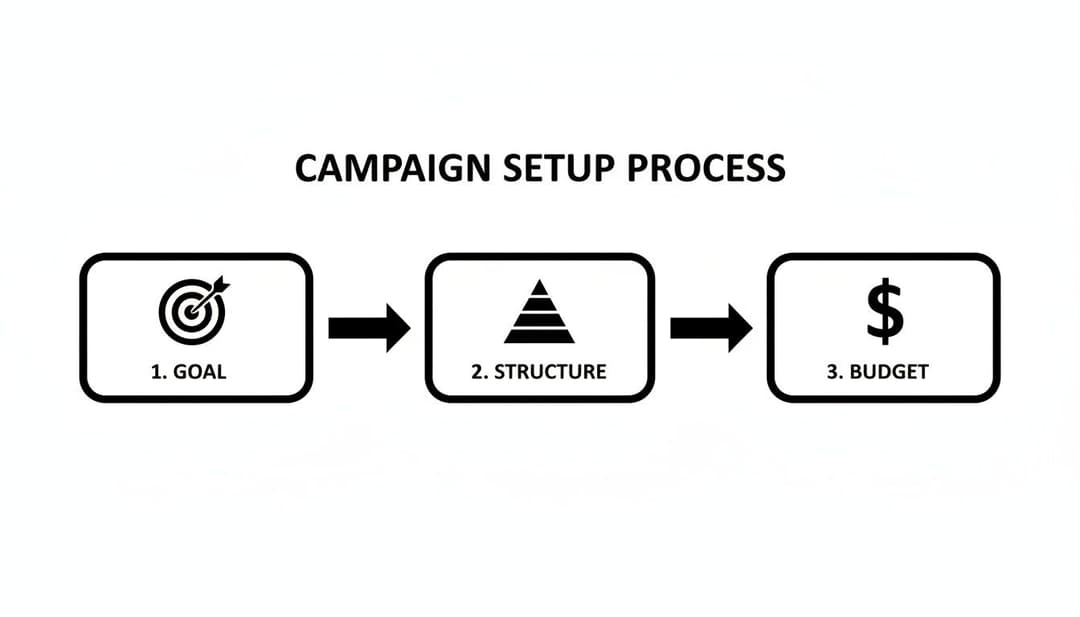
As the diagram makes clear, you need a solid goal, a clean structure, and the right budget before you can hope to gather any meaningful data from your tests.
Designing Your Testing Framework
One of the most common mistakes I see is marketers trying to test too many things at once. If you change the image, the headline, and the audience in the same ad set, you'll have no clue what actually moved the needle. A disciplined testing framework is all about isolating one variable at a time in a controlled environment.
Here’s a simple structure you can put into practice today:
- Create one dedicated test campaign. Inside this campaign, every ad set should target the exact same audience and have the same budget.
- Isolate one variable. For instance, if you're testing copy, the only difference between your ads should be the primary text. Use the same creative and headline for each.
- Let it run and analyze the results. Give the campaign at least 3-5 days or until it exits the learning phase. Then, look for a statistically significant winner based on your main KPI, whether that's Cost Per Lead (CPL) or Return on Ad Spend (ROAS).
Don't get thrown off by daily ups and downs. A real winner isn't an ad that has one good day. A true champion consistently beats the others over a 7-day window, delivering a lower CPA or higher ROAS with statistical confidence.
Once you’ve found a winning element—like a specific headline hook—that becomes your new control. Your next round of testing will then aim to beat that new winner by iterating on another variable, like the creative or the call-to-action. This is the iterative cycle that fuels sustained growth.
Broad Audiences vs. Granular Segments
The days of obsessing over hyper-specific interest targeting are mostly over. Meta’s algorithm has become incredibly sophisticated; it can find the right people in a massive audience pool as long as you feed it good data. Your audience testing strategy should reflect this new reality.
Start with a clean, simple structure to avoid audience overlap and give the algorithm room to breathe:
- Ad Set 1 (Broad): Target a wide demographic in your key markets with very few, if any, interest layers. This is your baseline and, more often than not, it will surprise you with its performance.
- Ad Set 2 (Lookalike): Use a 1% Lookalike Audience built from your best customers (e.g., from a customer list upload). This targets users who share traits with people who have already bought from you.
- Ad Set 3 (Retargeting): Target people who have engaged with your brand recently—think website visitors, add-to-carts, or social media engagers from the last 30-60 days.
This straightforward, three-part approach lets you test prospecting (Broad and Lookalike) against re-engagement (Retargeting) without creating a messy account. If you want to dive deeper into structuring these experiments, check out our guide to running effective ad tests.
The Power of Creative Velocity
For teams that are serious about scaling, the speed at which you can produce, test, and iterate on new ad concepts is a huge competitive advantage. We call this creative velocity. Think about it: a team that can test 20 new creative ideas a month will learn and grow exponentially faster than a team that only tests two.
This is exactly where manual processes start to fall apart. Manually building dozens of ad variations—swapping out images, headlines, and copy—is a tedious, time-sucking process that’s ripe for human error. It’s the single biggest bottleneck for most marketing teams, and it’s the problem AI-driven tools were built to solve.
Platforms like AdStellar AI can take your core assets—images, videos, headlines, and copy—and automatically generate hundreds of unique ad combinations in minutes. You can then launch these structured tests with a single click, turning what used to be a week of painful, manual work into a fast, automated workflow. This frees up your team to focus on high-level strategy and creative brainstorming, dramatically speeding up your journey to finding those next winning ads.
Using First-Party Data for Unbeatable Performance
Let's be blunt: if you're only looking at metrics like clicks and impressions inside Meta's dashboard, you're flying blind. Real, game-changing Facebook ads optimisation starts when you connect your ad spend to what's actually happening in your bank account—and that means getting serious about your first-party data. In a world without third-party cookies, this is your most powerful weapon.
Relying on platform metrics alone is like judging a restaurant by how many people walk through the door, not by how many actually buy a meal. You might see a killer Cost Per Click (CPC), but if those clicks aren't converting, you're just paying for window shoppers. The whole point is to teach Meta's algorithm what a real customer looks like for your business, not just someone who clicks a shiny ad.
This is exactly where your own data—from your CRM, your e-commerce platform, your backend systems—becomes your secret sauce. When you feed that high-quality, real-world purchase data back to Meta, you close the loop. You’re giving the algorithm the exact feedback it needs to stop chasing clicks and start finding more of your best customers.
Building Your Data Infrastructure
Look, having a solid data infrastructure isn't just a "nice-to-have" anymore. It's the foundation of any advertising effort that aims to be profitable. The good news? It's not as complex as it sounds. Your two core tools are the Meta Pixel and the Conversions API (CAPI).
- Meta Pixel: This is the little snippet of code you place on your website. It's great for tracking on-site actions like page views, add-to-carts, and when someone starts to check out.
- Conversions API (CAPI): This is the powerhouse that works with the Pixel. It sends data directly from your server to Meta's server. This connection is way more reliable and bypasses all the tracking issues caused by iOS updates, ad blockers, and browser privacy settings.
I like to think of the Pixel as a scout on the ground, reporting what it sees. CAPI, on the other hand, is the direct, secure line to HQ. You absolutely need both. For a full technical walkthrough, check out our guide to the Meta Conversions API. Seriously, getting this combo right is a non-negotiable for any advertiser focused on performance.
Moving Beyond Platform Metrics
Once your data is flowing correctly, you can finally stop obsessing over vanity metrics and start focusing on what actually drives your business forward. Your new North Star metrics should be tied directly to profitability.
These are the numbers that really matter:
- Return on Ad Spend (ROAS): The ultimate bottom line. For every $1 you spend on ads, how many dollars in revenue do you get back?
- Customer Acquisition Cost (CPA): How much does it actually cost you to get one new paying customer? This has to be sustainable and well under your customer's lifetime value.
- Customer Lifetime Value (CLV): What's the total revenue you can expect from a customer over their entire relationship with you? Knowing this number tells you exactly how much you can afford to spend to acquire a new one.
The best advertisers I know live and die by these numbers. They know their break-even ROAS by heart and can tell you their max allowable CPA in their sleep. Every decision—whether to scale up a campaign or kill it—is driven by this hard data, not by a fluctuating click-through rate.
This isn't just theory. As business growth becomes more dependent on first-party data, the strategic need for this infrastructure is crystal clear. Recent 2026 data projections confirm that this translates directly into better ad targeting and a much higher return on ad spend. We've seen businesses that invest in this data foundation experience major optimisation gains, often within just 2-4 weeks of getting their enhanced conversion tracking dialed in. You can get more details on this by exploring key optimization insights.
By feeding Meta these profitability metrics, you empower its algorithm to do its job. You're no longer just asking for cheap traffic; you're telling it to go out and find people who will become valuable, long-term customers. This fundamental alignment is the key to scaling your ad spend with confidence.
You’ve found a winner. The ROAS is looking great, your cost per acquisition is solidly in the green, and all the data is screaming, “This is working!”
Now for the tricky part—the part where so many advertisers stumble. It's time to scale up without torpedoing the very ad that’s bringing you success. This is a delicate dance, and making a wrong move can shock the algorithm and erase all your hard-won progress.
The biggest myth out there? That you can just double or triple the budget on a hot ad set and watch the profits roll in. That’s a surefire way to kill your momentum. Meta's algorithm needs time to find your audience at a larger scale, and a sudden, massive budget hike just resets its learning process, often sending your performance off a cliff.
Scaling isn't about speed; it's about stability. The real goal is to make gradual, percentage-based increases that give the algorithm room to breathe and adapt without resetting its progress.
Here’s the battle-tested rule of thumb: increase the budget on a winning ad set by no more than 20% every 2-3 days. This slow-and-steady method is your best friend. It keeps you out of the dreaded "learning phase" and allows the system to expand your reach while keeping your core metrics, like ROAS and CPA, right where you want them.
Vertical vs. Horizontal Scaling
Scaling isn't just about throwing more money at an ad; it's about spending it strategically. There are two main ways to grow your successful campaigns: vertical and horizontal scaling. Knowing which one to use, and when, is what separates the pros from the amateurs.
Vertical Scaling: This is the most direct approach. You’re simply increasing the budget on your existing, high-performing ad sets. Think of it as adding more fuel to a fire that’s already burning bright. You're telling Meta you want more of the same results from the same audience. The 20% rule is perfect for this.
Horizontal Scaling: This is where you get a bit more creative. Instead of just upping the budget, you duplicate your winning ad set and point it at a new, similar audience. For example, if your 1% Lookalike of "Purchasers" is crushing it, you could duplicate that ad set and target a 1-3% Lookalike or even a totally new interest-based audience. This lets you find fresh pockets of customers without messing with the performance of your original winner.
So, how do you choose?
- Go with vertical scaling when: Your audience is still large and your frequency is low (ideally under 3). This is a clear signal that there’s plenty of room to grow within your current audience before people start getting tired of your ad.
- Switch to horizontal scaling when: You notice your CPA starting to creep up with vertical scaling, or you're ready to expand your reach into entirely new customer segments.
Know When to Hand the Reins to AI
While manual scaling gives you a ton of control, sometimes the smartest play is to let Meta's AI do the heavy lifting. This is where Advantage+ Shopping Campaigns (ASC) come in.
ASC campaigns are built to automate targeting and delivery, scouring Meta’s entire user base to find the best opportunities for you.
Once you’ve identified a handful of winning creatives and ad copy variations from your testing, a powerful move is to consolidate them into a single Advantage+ Shopping Campaign. By feeding ASC your proven winners, you’re giving the algorithm the best possible chance to succeed right out of the gate. From there, it can use its massive data-crunching power to find customers more efficiently than you ever could with manual targeting.
This strategy is an absolute game-changer for e-commerce brands with a clear conversion goal, like a purchase. It simplifies your account, taps into Meta's most advanced machine learning, and has become a true cornerstone of modern Facebook ads optimisation.
How AI Tools Automate Your Optimisation Workflow
We’ve all been there—stuck in spreadsheets, manually building out endless combinations of headlines and images. That kind of grunt work is not just slow and full of potential for human error; it's a massive bottleneck that kills your ability to scale. This is precisely where AI-powered platforms come in, letting media buyers finally step away from the tedious tasks and back into high-level strategy.

These tools plug right into your Ads Manager and take over the most draining parts of the job. Imagine being able to generate hundreds of ad variations—mixing and matching different images, headlines, and body copy—in just a few minutes. That capability alone completely changes what’s possible with your testing.
Automated Creative Analysis and Insights
One of the best parts about these platforms is how they dig into your historical performance data. Instead of you having to manually sift through dashboards and reports, the AI does the heavy lifting, pinpointing your top-performing creative, best audience segments, and most effective messaging hooks.
The AI serves up clear, actionable insights on what to do next. It might, for example, discover that your ads featuring user-generated content (UGC) videos are driving a 25% lower Cost Per Lead than your polished studio assets. That gives you a crystal-clear directive for your next creative sprint.
This analysis goes deeper than just telling you which ads work. It actually breaks performance down to the component level, showing you which specific headlines or images are your real workhorses.
Accelerating Your Testing Cycles
Once you’re armed with these insights, you can speed up your testing cycles dramatically. AI-driven tools can automatically assemble brand-new campaigns using your proven winning components. This process ensures you're always launching with your strongest assets, massively improving your odds of hitting a home run right from day one.
This shift is even reflected in Meta's own ad systems. Meta’s heavy investment in its AI-powered advertising has fundamentally improved how performance metrics translate into real business results. For instance, after doubling the GPU computing power for its Generative Ads Recommendation Model (GEM), backend improvements led to a 12% increase in ads quality.
Automating creative production and analysis gives you a level of speed and precision that’s just impossible to achieve manually. To see exactly how this works in the real world, you can explore our guide on using AI for Facebook ads. These platforms make sophisticated optimisation accessible, freeing up your team to focus on what really matters—strategy and growth.
Frequently Asked Questions About Facebook Ads Optimisation
When you're deep in the weeds of Meta ads, the same questions tend to pop up again and again. Let's cut through the noise and tackle some of the most common ones we hear from performance marketers just like you.
How Often Should I Optimise My Facebook Campaigns
I get it. The temptation to jump in and tweak your campaigns every single day is real, especially when you see a dip. But more often than not, that’s the worst thing you can do.
Any new campaign needs at least 3-5 days just to get its footing and exit Meta's learning phase. Messing with it during this time is like pulling a plant up to see if the roots are growing—you're just disrupting the process. The algorithm is busy gathering data, so let it work.
Once you’re out of the learning phase, a good rhythm is checking in 2-3 times per week. You're looking for trends over a 7 or 14-day window, not reacting to a single day's blip. Big moves, like killing an ad set or cranking up the budget, should only happen when you have solid data to back them up, not just a gut feeling.
What Should I Check First If My ROAS Is Dropping
Seeing your Return on Ad Spend (ROAS) suddenly tank is every marketer's nightmare, but don't panic. There’s a logical trail of breadcrumbs to follow. Your first stop should always be the frequency metric. If it’s creeping past 3-4 in a short span, your audience is likely seeing your ads way too often and tuning them out.
If frequency looks fine, work your way through this quick diagnostic checklist to find the culprit:
- Placement & Device Analysis: Dive into your performance breakdowns. Is one specific placement, like the Audience Network, suddenly dragging everything down? Or maybe desktop performance has fallen off a cliff?
- CTR vs. CVR Trends: Look at your click-through rate (CTR) and conversion rate (CVR). A sinking CTR usually means your creative is getting stale. If your CVR is the problem, something is likely wrong with your landing page or your offer itself.
- Audience Changes: Did you recently tweak your targeting? Even a seemingly small change can have massive ripple effects on who sees your ads and how they perform.
What Is a Good Benchmark for CPL or ROAS
This is the million-dollar question, and the honest, no-fluff answer is: it completely depends. A "good" Cost Per Lead (CPL) for a high-ticket B2B service might be $150, but for a DTC brand selling t-shirts, it could be $15.
The only benchmark that truly matters is your own break-even point. Forget chasing arbitrary industry averages. Your goal is to remain profitable relative to your unique business economics.
Before you spend another dollar, you need to know your numbers inside and out. Calculate your break-even ROAS and the absolute maximum CPA you can afford. These are your north stars. A 2x ROAS might be a disaster for a low-margin business but a home run for one with high margins. Know your numbers, and you'll always know what "good" looks like for your business.
Ready to stop the manual grind and accelerate your results? AdStellar AI helps performance marketers launch, test, and scale Meta campaigns 10x faster. Automate your creative testing and get AI-driven insights to double down on what works. Unlock more revenue from Meta with AdStellar AI.