What Is Paid Social Advertising, Really?
Imagine trying to sell high-end hiking gear. You could put up a giant billboard on a busy highway, hoping a few outdoor enthusiasts happen to drive by. Or, you could set up a booth right inside a popular mountaineering club’s community center.
Paid social advertising is the digital version of that community booth. It’s not about shouting into the void; it's about paying to have a conversation with the right people, in the digital spaces they already love and hang out in.
This strategic approach turns social platforms into powerful customer acquisition engines by systematically reaching beyond your existing followers.
The 'Pay-to-Play' Model for Precision Reach
At its heart, paid social advertising is a "pay-to-play" model where you pay platforms like Meta, TikTok, or LinkedIn to place your content directly in front of specific users. Unlike organic social media, which relies on engaging your current followers, paid social has one main job: to reach new, highly targeted audiences at scale.
Your organic posts are fantastic for nurturing your community and building brand loyalty. But let's be honest—social media algorithms intentionally limit the reach of unpaid business content, often showing it to just a tiny fraction of your followers. Paid social is how you break through that ceiling.
Paid social advertising gives you direct control over who sees your message. Instead of hoping the right people stumble upon your content, you pay to ensure it lands directly in their feeds, based on their specific interests, demographics, and online behaviors.
Creating Demand vs. Capturing Demand
Another crucial distinction is how paid social fits in with search ads. Search engine advertising (like Google Ads) is phenomenal at capturing existing demand. When a user searches for "best waterproof hiking boots," your ad appears. They already know they have a problem and are actively hunting for a solution.
Paid social, on the other hand, is a master at creating demand. Your ad for innovative, lightweight hiking boots might pop up in the feed of someone who follows mountaineering pages, buys outdoor gear, and lives near a national park. They weren't actively searching for boots right then, but your ad presents a compelling product that aligns perfectly with their passions, sparking a desire they didn't even know they had.
For a comprehensive look at how this fits into a broader strategy, you can explore our guide on building a paid media strategy.
Choosing Your Paid Social Advertising Platforms
Before you spend a single dollar on a paid social campaign, you have a critical decision to make: where will you actually run your ads? This isn't just a minor detail—it's the foundational choice that can make or break your entire strategy.
Every social network is its own unique world, complete with its own culture, lingo, and user behavior. Your job is to find the digital neighborhood where your ideal customers hang out and then show up in a way that feels natural and welcome.
After all, trying to sell enterprise software on a platform built for dance trends is like setting up a Savile Row tailor shop at a skate park. Success in paid social comes down to matching your product and message to the right audience in the right environment.
Finding Your Audience Where They Are
Today’s social media world is dominated by a handful of major players, but each one offers something different for advertisers.
Meta (Facebook & Instagram): This is the undisputed giant for most direct-to-consumer (DTC) and e-commerce brands. With its enormous user base and incredibly detailed targeting options, Meta is the go-to for everything from building brand awareness to driving immediate sales.
LinkedIn: The ultimate B2B playground. If you're targeting professionals, C-suite executives, or people in niche industries, no other platform comes close to the targeting precision LinkedIn offers.
TikTok: Now the epicenter of short-form video and Gen Z culture, TikTok is a powerhouse for product discovery. Brands that can tap into authentic, entertaining, and trend-driven content can see explosive growth here.
Pinterest: Think of Pinterest as a visual search engine where users go to plan and find inspiration. It's an absolute goldmine for brands in verticals like home décor, fashion, weddings, food, and DIY projects.
To help you decide, here’s a quick breakdown of how these platforms stack up for marketers.
Paid Social Platform Comparison for Marketers
| Platform | Primary Audience | Best For | Top Ad Formats |
|---|---|---|---|
| Meta (Facebook & Instagram) | Broad (Millennials, Gen X) | E-commerce, Local Business, DTC | Image Ads, Video Ads, Carousels, Stories |
| Professionals, B2B Decision-Makers | B2B Lead Gen, Professional Services | Sponsored Content, Message Ads, Lead Gen Forms | |
| TikTok | Gen Z, Young Millennials | Brand Awareness, Viral Marketing | In-Feed Video Ads, Branded Hashtag Challenges |
| Predominantly Female, Planners | E-commerce, Visual-First Brands | Promoted Pins, Video Pins, Shopping Ads |
While a multi-platform strategy often works best, this table gives you a starting point for prioritizing where to focus your initial efforts and budget.
The image below perfectly illustrates the shift from the "spray and pray" method of old-school advertising to the laser-focused approach of paid social.
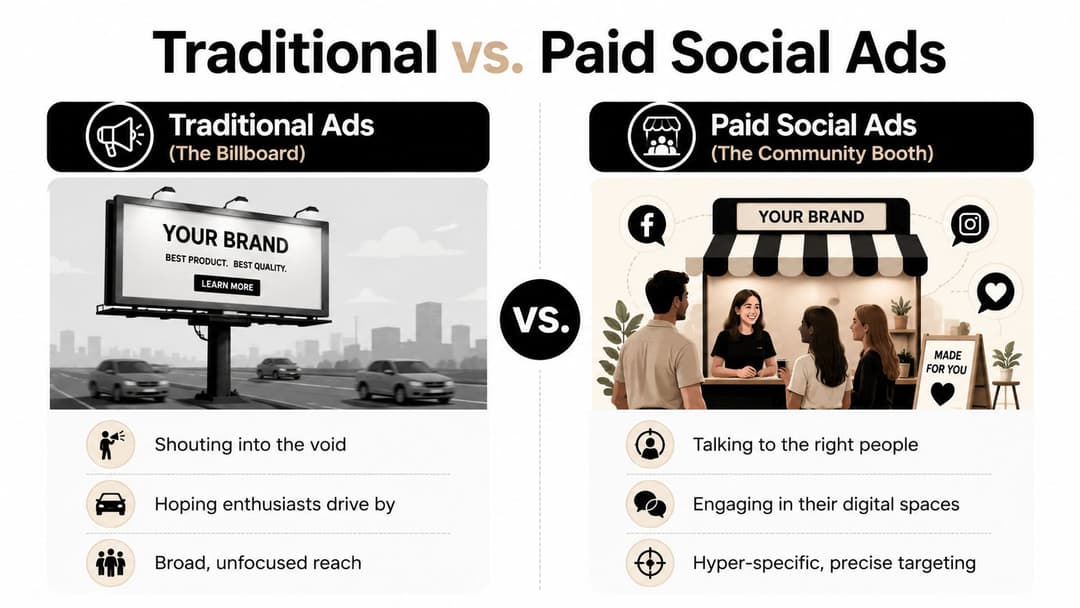
The takeaway here is simple but profound: paid social stops you from hoping the right person sees your ad and empowers you to ensure they do. It’s a move from broadcasting a message to having a targeted conversation. You can dive deeper into the various platforms for digital marketing in our comprehensive guide.
Dominant Platforms and Their Performance
While it's smart to diversify, the data consistently points to one platform leading the pack in raw performance. Recent marketing data from 2026 shows that Meta continues to deliver the highest return on investment (ROI) for most advertisers.
In a massive survey of marketers, 28% named Facebook their top-performing platform, with Instagram right behind at 22%. With an average cost-per-click (CPC) of just $0.94 and a cost-per-mille (CPM) of $2.81, paid social is still one of the most efficient ad channels available. For well-run campaigns, Facebook e-commerce ad ROI can even average 4.8x, blowing away the 2.4x return on ad spend (ROAS) seen on some newer platforms. For more stats on social ad performance, you can explore the full research findings on Sprinklr.com.
Choosing a platform isn't just about the number of users; it’s about the context in which those users engage. On LinkedIn, they're in a professional mindset, open to career and business solutions. On Pinterest, they're in a planning mindset, open to product ideas and inspiration.
This context is your secret weapon. When you understand a user's intent on a given platform, you can craft a message that meets them exactly where they are. This dramatically boosts your campaign's effectiveness. The best platform isn't always the biggest—it's the one where your message feels right at home.
Setting Campaign Objectives and Targeting Strategies
A paid social campaign without a clear goal is like throwing money at a billboard in the middle of the desert. You’re spending cash, sure, but are you reaching anyone who matters? Before you even think about creative or copy, you have to answer a simple, crucial question: "What, exactly, am I trying to achieve?"
Every major social platform builds its campaigns around this very question. Your business goal becomes the instruction you give the platform's algorithm, telling it precisely what success looks like and what kind of user to go after.
Aligning Objectives with the Marketing Funnel
Think of your customer’s journey as a classic marketing funnel. Each stage has a corresponding set of campaign objectives you can select right inside your Ads Manager.
Awareness: This is your first handshake with a new audience. You’re not going for the hard sell; you’re just trying to get on their radar. The objectives here are straightforward: Reach (getting your ad in front of the maximum number of people) and Brand Awareness (showing your ad to people the algorithm thinks will remember it).
Consideration: Your audience now knows you exist. The next step is to pull them in and get them to learn more. This is where objectives like Traffic (sending people to your website or landing page), Engagement (sparking likes, comments, and shares), and Lead Generation (gathering contact info with in-app forms) come into play.
Conversion: This is the bottom of the funnel, where you ask for the sale or another key action. The goal is to drive bottom-line results, whether that’s a purchase, a demo sign-up, or an app install. The primary objective is usually Sales or Conversions, which tells the algorithm to find users who are most likely to take that final step.
The Power of Hyper-Specific Audience Targeting
Once you’ve set your objective, you get to the real magic of paid social: audience targeting. This is where you move beyond simple demographics and start painting a detailed picture of your ideal customer.
Effective targeting isn't about reaching the most people; it's about reaching the right people. Paid social platforms allow you to build audiences based not just on who they are, but what they do and what they love.
This is all made possible through a few powerful layers of targeting:
Interest Targeting: You can target users based on the pages they follow, the content they interact with, and the topics they've shown an interest in—think "sustainable fashion" or "B2B software." To really get this right, you need a solid strategy. We break it down in our guide to mastering interest-based targeting.
Behavioral Targeting: This lets you reach people based on their past actions, like online purchase behavior, what kind of phone they use, or even recent life events like getting engaged or moving to a new city.
Custom Audiences: This is your chance to reconnect with a warm audience. You can upload your own data—like a customer email list or a list of recent website visitors—to retarget people who already know your brand.
Lookalike Audiences: This might be the most powerful tool in the entire paid social toolbox. You provide a "source" audience, like your top customers or most engaged followers, and the platform’s algorithm goes out and finds millions of new people who share similar traits and behaviors.
How to Know if Your Paid Social Ads Are Working
Running a paid social campaign without tracking performance is like throwing your marketing budget into a black hole. You know money is going in, but you have no idea what’s happening on the other side. Are you generating leads? Driving sales? Or just lighting cash on fire?
To get a real answer, you have to move beyond vanity metrics like likes and shares. It’s time to focus on the hard data that connects your ad spend directly to your business goals. This isn't about drowning in spreadsheets; it's about finding clarity and making smart, confident decisions with your budget.
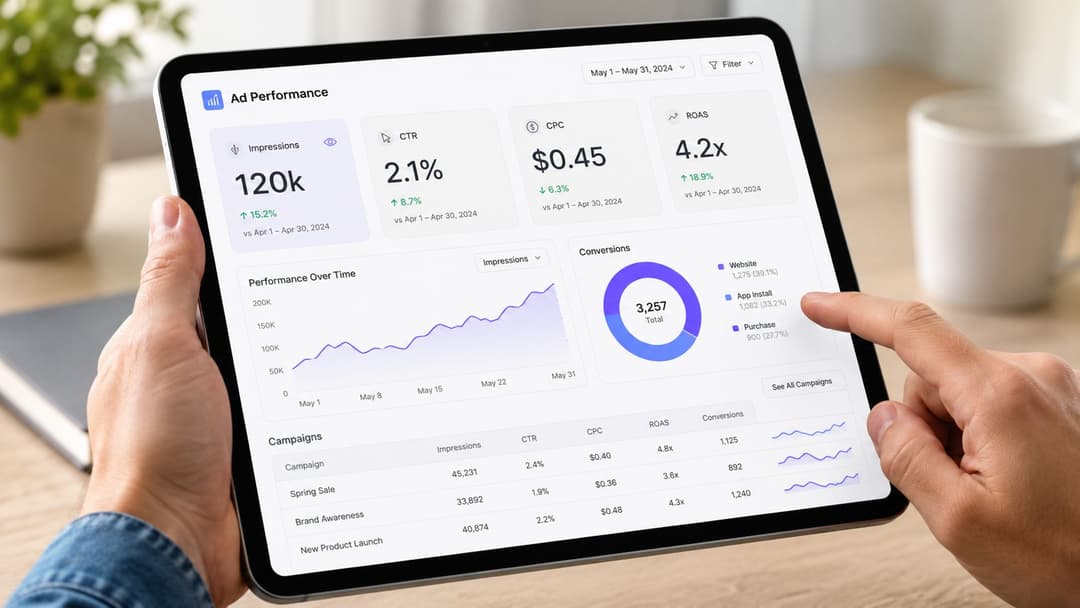
Core Metrics That Define Success
Every campaign has a story to tell, and key performance indicators (KPIs) are the language it speaks. Instead of getting lost in your Ads Manager dashboard, start by homing in on these essentials.
- Impressions: This is simply the total number of times your ad was shown. It's your starting point, especially for awareness goals.
- Clicks (All): How many times did people click anywhere on your ad? This signals that something about your ad sparked their initial interest.
- Click-Through Rate (CTR): Here’s where it gets interesting. CTR is the percentage of impressions that turned into a click. A high CTR tells you your creative and copy are doing their job and stopping the scroll.
- Cost Per Click (CPC): This is the average price you pay every time someone clicks your ad. For any campaign driving traffic, this is a fundamental measure of how efficiently you're spending.
- Cost Per Acquisition (CPA): This is your total cost to get one new customer or qualified lead. For any campaign focused on conversions, this is your North Star.
The One Metric to Rule Them All: ROAS
While all those metrics are crucial for diagnosing how your campaign is running, there's one that truly proves its value to the business: Return on Ad Spend (ROAS).
ROAS tells you exactly how much revenue you’re generating for every single dollar you spend on ads. If you have a 3:1 ROAS, you made $3 for every $1 you invested. It’s the ultimate measure of profitability and the number your CFO actually cares about.
And the potential here is massive. Paid social has become an absolute powerhouse, with global ad spend projected to hit around $242 billion in 2026. This boom is fueled by incredible efficiency; the average ROAS from paid social was recently calculated at $5.28 for every $1 spent, blowing many other digital channels out of the water. That kind of return is only possible thanks to the hyper-specific targeting platforms now offer. You can see more on these trends and explore social ad spend insights on LinkedIn.
A Note on Attribution: Attribution is simply how social platforms give credit for conversions. An "attribution window" (like a 7-day click or 1-day view) is the timeframe after someone sees or clicks your ad where a conversion can be credited back to it. Getting a handle on your platform’s attribution model is non-negotiable for accurately judging performance.
With all the privacy changes in recent years, making sure your conversion data is accurate is more important than ever. Implementing server-side tracking is the best way to do this. For anyone advertising on Meta, our guide on how to set up the Facebook Conversion API in our detailed guide is a great place to start.
Creating Ads That Actually Drive Results
You can have the most precise targeting and the biggest budget in the world, but if your ad is a dud, none of it matters. In the world of paid social advertising, the creative—your image, video, and copy—is your single greatest weapon. It’s what stops the scroll and makes someone feel something.
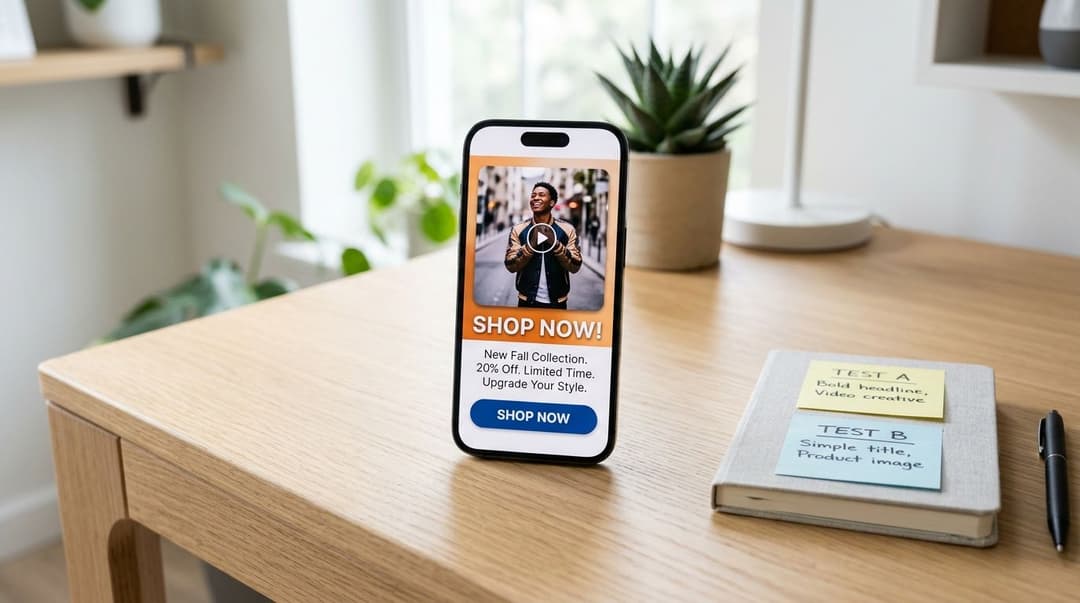
Think of it this way: targeting gets your ad in front of the right person, but great creative is what convinces them to pay attention. This means thinking mobile-first, since that’s where nearly everyone will see your ad. You have about three seconds to make an impression. Make them count.
Go All-In on Short-Form Video and Authentic Content
The growth in paid social is staggering, with global ad spend projected to hit a massive $317.3 billion in 2026. A huge piece of that pie is short-form video. It's not just a trend; it's an absolute powerhouse, delivering the highest ROI of any video format at 41%. For modern performance marketers, it’s no longer optional.
Another unstoppable force is influencer marketing, which is on track to become a $32.55 billion industry by the end of 2026. The reason is simple: it works, delivering an average ROI of $5.78 for every $1 spent. In fact, a whopping 94% of organizations say influencer marketing beats out their traditional ads. The lesson here is clear: authentic, user-generated-style content feels real, and it connects on a much deeper level. You can explore the full social advertising statistics on SQ Magazine to see just how much the landscape has shifted.
The Discipline of A/B Testing
Guesswork is the fastest way to burn through your ad budget. The best marketers I know don't operate on gut feelings—they run on data. This is where the discipline of A/B testing, or split testing, becomes your best friend.
A/B testing is simply the process of running multiple versions of an ad at the same time to see which one performs best. It’s the scientific method for marketing, turning your "I think this will work" into "I know this works."
Instead of launching one ad and crossing your fingers, you methodically test different components to see what actually moves the needle. This is how you consistently improve your campaigns and get better results over time.
You can test just about anything, but here are the usual suspects:
- Creative: Pit a static image against a short video. Or try a clean product shot versus a candid lifestyle photo.
- Headline: Does a headline framed as a question get more clicks than a direct statement?
- Primary Text: Test short, punchy copy against a longer, more detailed description.
- Call to Action (CTA): Which button works better for your audience? "Shop Now" or "Learn More"?
By changing just one variable at a time, you can pinpoint exactly what makes an ad a winner. This process is what separates the pros from the amateurs, ensuring every dollar you spend is working as hard as it possibly can.
How to Scale Your Campaigns with AI and Automation
Managing a few successful ads is one thing. Scaling those wins into thousands of high-performing variations is a completely different ballgame. As you grow, you inevitably hit a wall built of manual repetition, creative fatigue, and an overwhelming amount of data.
This is where smart automation comes in. Modern AI tools go way beyond simple schedulers to automate the most grueling parts of paid social advertising. They help turn campaign chaos into clarity, freeing up your team to focus on big-picture strategy instead of getting lost in the weeds.
Turning Data into Action Automatically
The real magic of AI is its ability to learn from performance data and then actually do something about it. Think of it as a tireless junior marketer who can:
- Automate Ad Creation: Generate hundreds of ad variations in minutes, not days. AI can mix and match different headlines, images, and audience segments to find new winning combinations.
- Optimize Budget Allocation: Use machine learning to monitor campaigns in real-time, automatically shifting your spend to the ads and audiences that deliver the highest ROAS.
- Streamline Testing: Simultaneously test countless combinations of creative and targeting. This helps you rapidly identify what works without the tedious setup of manual A/B tests.
This isn't about replacing the marketer; it's about giving them superpowers. AI handles the heavy lifting of production and optimization, so you can focus on the strategic decisions that actually drive growth.
To get started, learning about implementing AI marketing strategies can provide a practical roadmap for scaling your campaigns effectively.
Ultimately, AI-driven automation lets you launch more tests, find winning ads faster, and scale your budget with confidence. By adopting these tools, you can drive more revenue with less manual work. For a deeper look at how this is changing the game, explore our insights on performance marketing and AI.
Common Questions About Paid Social Advertising
As you get ready to jump into the world of paid social, a few common questions always pop up. Let's tackle them head-on so you can build your first campaigns with clarity and confidence.
How Much Should I Budget?
Everyone wants a magic number, but the truth is, it depends. A solid starting point for a small business is usually between $500 to $1,500 per month. This gives you enough runway to gather data and see what’s actually working.
Another way to look at it is to set aside 5-15% of your total marketing budget for paid social. Your budget should always tie back to your goals. A brand awareness campaign is all about getting a low cost-per-thousand-impressions (CPM), while a sales campaign hinges on hitting your target cost-per-acquisition (CPA).
The best approach? Start small, prove your return on ad spend (ROAS), and then scale up. This method minimizes your risk while you figure out what's profitable.
Paid Social vs. Organic Social
The key difference here boils down to reach and precision. Think of organic social as speaking to the people already in the room—your existing followers. It’s perfect for building community and nurturing the audience you already have, but its reach is totally at the mercy of platform algorithms.
Paid social advertising, on the other hand, is like buying a megaphone and a map. You pay to get your message in front of a highly specific audience that goes far beyond your current followers. It’s a "pay-to-play" strategy built for hitting specific business goals, like generating leads or driving sales at scale.
For a deeper look into how technology is amplifying these kinds of paid strategies in e-commerce, it's worth learning more about optimizing Shopify with AI.
How Long Until I See Results?
You'll see initial activity like clicks and impressions almost immediately—often within 24 hours. But seeing real business results, like sales or qualified leads, takes a bit more patience. For an e-commerce store, you could see your first sales within a few days.
Keep in mind that most ad platforms have a "learning phase" that can last up to a week. During this time, the algorithm is working to figure out the best way to deliver your ads. As a rule of thumb, give any new campaign at least 2-4 weeks to collect enough performance data before you start making major decisions.
Ready to launch, test, and scale your Meta ads 10x faster? AdStellar AI automates bulk ad creation and uses AI to pinpoint your winning creatives, audiences, and copy. Stop guessing and start driving more revenue with less work. Explore what you can achieve at https://www.adstellar.ai.