Three browser tabs open. Canva for designing your ad creative. Meta Ads Manager for building the campaign. Google Sheets for tracking which audiences performed best last week. Another tab for your analytics dashboard. One more for that competitor research tool.
You've just spent 90 minutes creating what should have been a 20-minute campaign launch.
This is the reality for most Meta advertisers: a fragmented workflow that scatters your process across disconnected tools, each requiring its own login, its own learning curve, and its own data format. You're not just managing ads anymore. You're managing the chaos of managing ads.
A complete Meta ads workflow solution changes this equation entirely. Instead of piecing together your advertising process from multiple platforms, you work within a single integrated system that handles everything from creative generation to performance analysis. The result isn't just convenience. It's a fundamental shift in how quickly you can test, how clearly you can see what's working, and how effectively you can scale winners.
This guide breaks down what makes a workflow truly complete, why integration matters more than individual tool quality, and how to evaluate whether a unified approach fits your advertising needs. We'll explore the five essential pillars every complete solution must include, examine how AI transforms each stage of the process, and show you what a consolidated workflow looks like in practice.
Why Fragmented Ad Workflows Drain Your Budget and Time
The problem with multi-tool workflows isn't immediately obvious. Each individual platform works fine. Canva creates beautiful designs. Meta Ads Manager launches campaigns. Your analytics tool tracks conversions. The breakdown happens in the spaces between these tools.
Consider what happens when you need to launch a new campaign. You design creatives in one tool, download them, upload them to Ads Manager, manually enter headlines and ad copy, build your audience from memory or notes, launch the campaign, then wait for data to populate in your tracking system. Each transition introduces friction. Each handoff creates opportunities for inconsistency.
Context-switching carries a cognitive cost that compounds throughout your day. Every time you move from creative design to campaign building to performance analysis, your brain needs time to reorient. You're not just switching tools. You're switching mental models, remembering different interfaces, and reconstructing the context of what you were trying to accomplish.
But the real damage happens in your data. When creative lives in one system, campaign structure in another, and performance metrics in a third, you lose the connections between them. Which specific creative drove those conversions? Was it the headline, the audience, or the combination? Your spreadsheet shows aggregate numbers, but the granular insights that drive optimization remain buried across disconnected platforms. Understanding why your Meta ads workflow is inefficient is the first step toward fixing it.
This fragmentation creates what I call "optimization lag." By the time you've exported data from Meta, matched it with creative files from your design tool, and analyzed which combinations performed best, the market has moved. Your competitors have already tested and scaled their next iteration. You're making decisions based on insights that took too long to surface.
Manual processes amplify these delays. Launching variations means duplicating ad sets by hand, copying and pasting headlines, uploading multiple creative files one by one. Testing ten variations takes an hour. Testing a hundred becomes impractical. So you test less, learn slower, and miss opportunities that more agile competitors capture.
The financial cost is harder to quantify but no less real. Every hour spent managing tools instead of optimizing campaigns is budget that could have been reallocated to better-performing ad sets. Every insight that surfaces too late is a winner you could have scaled sooner. Every manual error in campaign setup is spend directed at the wrong audience or creative combination.
The Five Pillars of a Complete Meta Ads Workflow
A truly complete workflow solution must handle five distinct but interconnected functions. Miss any one of these pillars, and you're back to juggling multiple tools.
Creative Generation: The workflow starts with ad creatives. A complete solution generates image ads, video ads, and UGC-style content without requiring external designers, video editors, or actors. This means taking a product URL and producing scroll-stopping creatives ready for testing. It also means the ability to analyze competitor ads from the Meta Ad Library and create similar approaches adapted to your brand. Chat-based editing lets you refine any creative without leaving the platform or waiting for designer revisions.
The key here is speed and iteration. When creative generation happens inside your workflow rather than as a prerequisite to it, you can test more concepts faster. An idea becomes a testable ad in minutes, not days.
Campaign Construction: Once you have creatives, you need to build complete campaigns with audiences, headlines, and ad copy. A complete solution doesn't just provide templates. It analyzes your historical performance data to identify which audiences, headlines, and copy variations have driven results in the past. Then it builds campaigns using these proven elements, explaining its reasoning so you understand the strategy behind every choice. Following a proper Meta ads campaign structure guide ensures your foundation is solid.
This pillar transforms campaign building from guesswork into data-driven decision-making. Instead of wondering which audience to target or which headline to test, you're working from performance evidence.
Launch Automation: Building a campaign is one thing. Deploying it at scale is another. A complete workflow includes bulk launching that creates hundreds of ad variations by mixing multiple creatives, headlines, audiences, and copy at both the ad set and ad level. This happens in minutes, not hours of manual duplication in Ads Manager.
The multiplication effect here is significant. Three creatives times five headlines times four audiences creates sixty variations. A complete solution generates every combination and launches them systematically, ensuring comprehensive testing without overwhelming manual work.
Performance Intelligence: Raw data isn't insight. A complete solution provides real-time intelligence that ranks every element by actual metrics like ROAS, CPA, and CTR. Leaderboards surface top performers across creatives, headlines, copy, audiences, and landing pages. A robust Meta ads campaign scoring system evaluates everything against your specific benchmarks, so you instantly see which elements meet your targets and which fall short.
This pillar answers the question that drives optimization: what's actually working? Not aggregate campaign performance, but granular element-level insights that tell you which creative, which headline, which audience combination delivers results.
Winner Identification: Insights without action remain theoretical. The final pillar organizes your proven performers in a Winners Hub where your best creatives, headlines, audiences, and copy live with real performance data attached. When you build your next campaign, you can instantly add any winner without searching through past campaigns or recreating elements from memory.
This creates a compounding advantage. Each campaign identifies new winners that become available for future campaigns. Your library of proven elements grows, making each subsequent launch more effective than the last.
These five pillars work together as a system. Creative feeds into campaigns. Campaigns launch at scale. Performance data identifies winners. Winners inform the next creative cycle. Break the chain at any point, and you're back to fragmented workflows and disconnected insights.
How AI Transforms Each Stage of the Workflow
AI isn't just a feature in a complete workflow solution. It's the connective tissue that makes integration meaningful. Without AI, you'd have five connected tools that still require manual decision-making at every transition. With AI, you have a system that learns, suggests, and executes based on your actual performance data.
Start with creative generation. AI analyzes product URLs to understand what you're selling, then generates image ads, video ads, and UGC-style avatar content that matches your brand and message. This isn't template-based design where everything looks similar. The AI considers your product category, target audience, and competitive landscape to create unique approaches.
The ability to clone competitor ads from the Meta Ad Library adds another dimension. You can identify successful approaches in your niche, and AI adapts them to your brand without copying them directly. This combines competitive intelligence with creative execution in one step.
But creative AI alone doesn't complete the workflow. Campaign AI analyzes your historical data to build complete Meta campaigns. It ranks every creative, headline, and audience you've tested by performance. Then it constructs campaigns using the elements most likely to succeed based on your past results. Every decision comes with full transparency. The AI explains why it selected specific audiences, why it paired certain headlines with particular creatives, and what performance patterns informed its choices. Leveraging AI for Meta ads campaigns eliminates the guesswork that plagues manual optimization.
This transparency matters because you're not blindly trusting a black box. You're working with an AI that shows its reasoning, allowing you to understand the strategy and override decisions when your market knowledge suggests a different approach.
The continuous learning loop is where AI workflow integration becomes truly powerful. As campaigns run and data accumulates, the AI doesn't just report results. It learns which creative styles resonate with which audiences. It identifies patterns in headline performance. It recognizes when certain copy approaches drive conversions and when they don't.
Each campaign makes the next campaign smarter. The AI's suggestions improve because they're based on an expanding dataset of your actual results, not generic best practices or aggregated industry benchmarks. This creates a personalized optimization engine that gets better at predicting what will work for your specific business, your specific audiences, and your specific goals.
Think of it like this: a traditional workflow requires you to be the intelligence layer connecting creative, campaigns, and insights. You remember what worked last time. You decide which audiences to test. You interpret performance data and adjust accordingly. AI shifts that burden. The system remembers, suggests, and learns while you focus on strategy and creative direction.
The time savings are obvious, but the strategic advantage runs deeper. When AI handles the mechanical work of analyzing past performance and constructing data-driven campaigns, you can test more aggressively. You can explore creative approaches that might not be obvious winners because the system will quickly identify whether they perform. You can scale faster because the AI surfaces winning combinations as soon as they emerge.
Bulk Launching: The Multiplier Effect for Testing
Testing separates advertisers who scale from advertisers who plateau. You can't optimize what you don't test, and you can't test comprehensively if launching variations takes hours of manual work.
Bulk launching solves this by treating ad variations as a multiplication problem rather than an addition problem. Instead of creating ads one by one, you define the components you want to test and let the system generate every combination.
Here's why this matters. Traditional testing might involve launching five ad variations: a few different creatives with different headlines. You test, see what works, then manually create more variations based on those insights. This sequential approach is slow and limits how much ground you can cover. The ability to launch multiple Meta ads at once fundamentally changes your testing velocity.
Bulk launching flips the model. You select multiple creatives, multiple headlines, multiple audiences, and multiple copy variations. The system creates every possible combination at both the ad set and ad level. Three creatives times five headlines times four audiences times two copy variants equals 120 unique ads. The system generates all 120 and launches them to Meta in minutes.
This comprehensive testing reveals interactions you'd miss with sequential testing. Maybe Creative A performs best with Audience 1 but poorly with Audience 2, while Creative B shows the opposite pattern. Maybe Headline X drives conversions when paired with Copy Variant A but not with Copy Variant B. These nuanced insights only surface when you test combinations systematically.
The time savings compound as you scale. Launching 120 variations manually might take four to six hours of clicking through Ads Manager, duplicating ad sets, uploading creatives, and entering copy. Bulk launching handles it in minutes. That time difference isn't just convenience. It's the difference between testing aggressively and testing cautiously because the manual work becomes prohibitive.
More testing means faster learning. When you can launch comprehensive test matrices quickly, you identify winners sooner. You kill losers faster. You reallocate budget to proven performers while competitors are still manually building their second round of variations. An automated Meta ads scaling solution makes this aggressive testing approach sustainable.
The strategic implication is significant: bulk launching makes testing the default rather than the exception. You're not asking "should we test this?" You're asking "what combinations should we include in this test?" The constraint shifts from manual effort to strategic thinking about what's worth testing.
Measuring Success: Insights That Actually Drive Decisions
Data without structure is noise. A complete workflow solution doesn't just collect performance metrics. It organizes them into insights that drive immediate decisions.
Leaderboard rankings provide instant clarity on what's working. Your creatives are ranked by ROAS, CPA, CTR, and other metrics that matter to your business. Same for headlines, ad copy, audiences, and landing pages. You're not scrolling through campaign reports trying to compare performance across dozens of ads. You're looking at a ranked list that shows exactly which elements are winning and which are losing.
This organization transforms how quickly you can act. When you see that Creative A has a CPA 40% lower than your next best creative, you can immediately scale it. When you see that Audience 3 consistently underperforms across multiple campaigns, you can stop wasting budget on it. The insight and the action happen in the same moment. This addresses the common problem of Meta ads reporting being incomplete in native tools.
Goal-based scoring adds another layer of intelligence. Instead of just seeing raw metrics, you set target goals for ROAS, CPA, CTR, and other KPIs. The system scores every element against these benchmarks. An ad that delivers a $30 CPA when your goal is $25 gets scored accordingly. You instantly see which elements meet your standards and which fall short.
This scoring system prevents the common mistake of celebrating absolute improvements while missing relative underperformance. An ad might improve from a $50 CPA to a $40 CPA, which feels like progress. But if your goal is $25 and other ads are hitting $22, that "improved" ad is still a loser. Goal-based scoring keeps you focused on what actually matters: meeting your targets.
The Winners Hub takes this further by organizing proven performers in one place with real performance data attached. When you're building your next campaign, you don't need to remember which creative worked three campaigns ago or search through old ad sets to find that headline that drove conversions. Your winners are organized, labeled, and ready to deploy.
This creates a virtuous cycle. Good performance gets recognized, organized, and reused. Poor performance gets identified and eliminated. Your advertising improves not through guesswork but through systematic identification and scaling of what works.
The difference between this approach and traditional analytics is immediacy. Traditional analytics tell you what happened. A complete workflow solution tells you what happened and makes the next action obvious. The insight and the execution live in the same system, eliminating the lag between knowing and doing.
Putting It All Together: One Platform From Creative to Conversion
Understanding the components matters less than seeing how they connect. A complete Meta ads workflow in action looks like this:
You start with a product URL. The AI generates multiple creative variations: image ads, video ads, UGC-style content. You review them, make refinements through chat-based editing, and approve the ones you want to test. This takes minutes, not days of waiting for designer deliverables.
Next, the AI analyzes your historical campaign data and builds a complete campaign structure. It selects audiences that have performed well for similar products. It suggests headlines based on what's driven conversions in the past. It explains why it's recommending these combinations. You review the strategy, adjust anything based on your market knowledge, and approve the campaign. Proper Meta ads campaign organization ensures every element is trackable and optimizable.
Bulk launching takes over. The system creates every combination of your approved creatives, headlines, audiences, and copy. Hundreds of ad variations get generated and launched to Meta in minutes. Your comprehensive test matrix is live.
As data accumulates, performance intelligence surfaces insights in real time. Leaderboards rank your creatives, headlines, and audiences. Goal-based scoring shows which elements meet your targets. Winners get identified and added to your Winners Hub automatically.
When you're ready to scale, you build your next campaign using proven winners from the Hub. The AI has learned from your results and makes even better suggestions. The cycle repeats, each iteration informed by more data and more winners. This is the power of true Meta ads workflow automation in action.
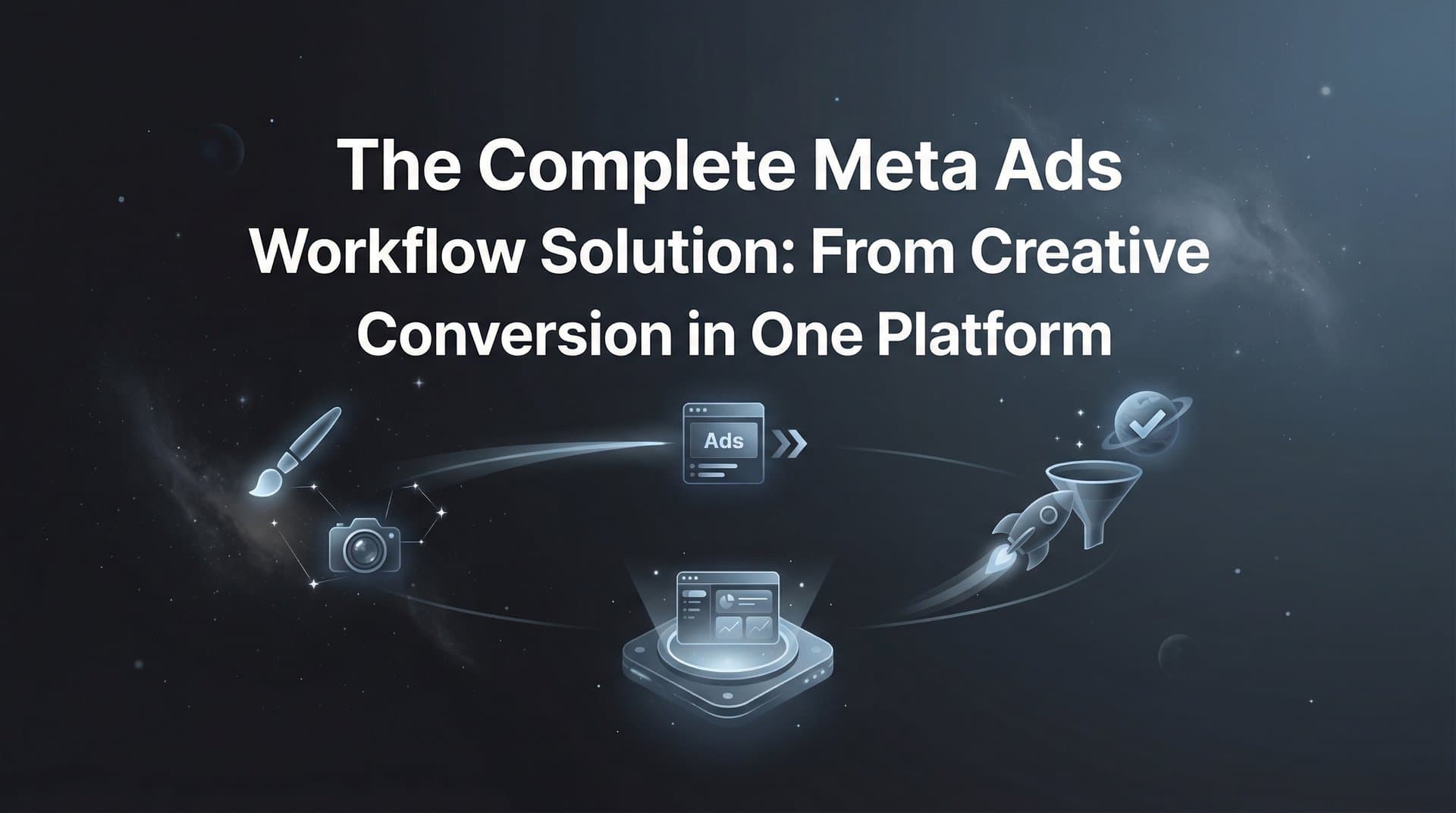
This integrated workflow eliminates the fragmentation that slows traditional advertising. Creative, campaigns, launching, and analytics aren't separate processes. They're connected stages in one continuous system.
Evaluating whether this approach fits your needs comes down to three questions. First, are you currently juggling multiple tools for Meta advertising? If yes, integration offers immediate efficiency gains. Second, do you want to test more aggressively but find manual processes limiting? If yes, bulk launching and AI campaign building remove those constraints. Third, do you struggle to identify which specific elements drive performance? If yes, leaderboard rankings and goal-based scoring provide the clarity you're missing.
Getting started with a unified approach means rethinking your workflow from first principles. Instead of asking "which tool handles this step?" you ask "how does this step connect to the next one?" The goal isn't finding the best creative tool and the best campaign tool and the best analytics tool. The goal is finding one system where creative, campaigns, and analytics work together seamlessly.
Your Next Steps: From Fragmented to Unified
The case for a complete Meta ads workflow solution isn't about individual features. It's about integration. When creative generation, campaign building, bulk launching, performance intelligence, and winner identification exist in one system, each component amplifies the others. Insights flow directly into action. Winners get identified and reused immediately. Learning compounds with every campaign.
Fragmented workflows force you to be the integration layer. You're the one connecting creative to campaigns, campaigns to insights, insights to the next iteration. A complete solution shifts that burden to the system, freeing you to focus on strategy, creative direction, and scaling what works.
The transformation isn't just about working faster. It's about testing more comprehensively, identifying winners more quickly, and scaling proven performers more aggressively. These advantages compound. Each campaign makes the next campaign better because the system learns from your actual results.
AdStellar delivers this complete workflow in one platform. Generate image ads, video ads, and UGC creatives with AI. Build campaigns based on your historical performance data with full transparency into every decision. Launch hundreds of variations in minutes. Surface winners with leaderboard rankings and goal-based scoring. Organize proven performers for instant reuse in future campaigns.
Ready to transform your advertising strategy? Start Free Trial With AdStellar and be among the first to launch and scale your ad campaigns 10× faster with our intelligent platform that automatically builds and tests winning ads based on real performance data.
The difference between fragmented and unified workflows isn't incremental. It's exponential. Every hour you save on manual processes is an hour you can spend on strategy. Every insight that surfaces immediately is an opportunity you can capture before competitors. Every winner you identify and reuse is a compounding advantage that makes your next campaign stronger than your last.
Your Meta advertising workflow either works for you or against you. Make it work for you.