You’re probably in the same spot most paid social teams hit sooner or later. The campaign brief is clear, the offer is solid, and the media budget is ready. Then creative becomes the bottleneck. Someone has to write angles, someone has to mock up banners, someone has to resize assets, and by the time everything is live, half the testing appetite is gone.
That’s why the conversation around the artificial intelligence banner needs to change. Most content online shows polished concepts and design inspiration. Very little of it shows how to build a repeatable system that turns banner production into a performance input instead of a creative guessing game.
Beyond Inspiration The Case for Performance-Driven AI Banners
Your campaign is ready to launch. Budget is approved, targeting is set, and the offer is strong. Then the banner choices come down to a few polished concepts pulled from a moodboard, and the team ends up debating what looks good instead of what is likely to convert.
That is a significant limitation with most artificial intelligence banner content online. Inspiration galleries can help a designer get unstuck, but they do not give media buyers a system for producing enough variation to test message, angle, offer framing, and visual treatment against revenue.
For paid social teams running Meta at scale, banner production is not a design exercise alone. It is a throughput problem tied directly to performance. Meta has publicly argued that more creative variation improves delivery and results, which is why the practical value of AI is not "better looking" banners. It is the ability to produce structured variants fast enough to support real testing and fast enough to keep up with audience fatigue.
I have seen the same trade-off repeatedly. Teams that build banners manually protect craft, but they usually limit test volume. Teams that use AI without a performance framework get volume, but they flood the account with weak variations that teach them nothing. The win is in the middle. Use AI to create controlled variation around a clear hypothesis, then judge the output by ROAS, CPA, click quality, and conversion rate.
That is the difference between creative inspiration and a performance system.
Practical rule: If your team can only test a small batch of banners each cycle, you are not running a creative system. You are running a narrow opinion test.
For teams that want a clearer view of how creative fits into acquisition economics, this guide to performance marketing fundamentals is a useful reference. If your banners also need to work across display environments, it helps to explore VAA's display advertising expertise so the creative matches placement behavior instead of treating every impression like a feed placement.
The same principle applies to AI banner testing. More variation only matters if each version has a job. One banner may test urgency. Another may test product clarity. Another may test whether a simpler background improves thumb-stop rate. Without that structure, AI just helps teams produce more noise.
Here is what usually improves first when banners are managed this way:
- Creative volume becomes usable: teams can test enough variants to learn which message-audience combinations deserve more budget.
- Feedback loops tighten: results come back faster because new concepts do not wait on long production cycles.
- Creative decisions get tied to business outcomes: winning banners are chosen by purchase efficiency, not internal preference.
- Scaling gets easier: strong concepts can be refreshed and expanded before fatigue drags down return.
That shift matters because banners influence more than click-through rate. They shape who clicks, what expectation they bring to the landing page, and whether the traffic can convert profitably. AI helps only when it is connected to that full chain.
Crafting Your AI Banner Creative Strategy
An artificial intelligence banner performs best when the strategy is set before the prompt is written. AI is fast, but it’s still directional. Give it a vague brief and it will produce vague work at scale.
In practice, I’d treat banner strategy the same way strong media buyers treat account structure. If the objective is blurry, the output gets noisy.

Start with one hard objective
DeepMind’s AlphaGo beat Lee Sedol in 2016 by learning strategic patterns from millions of games, not by brute force alone. For marketers, the useful analogy is simple. AI works when it’s trained or directed toward a clear win condition such as ROAS or CPA (reference).
Your banner strategy needs that same clarity.
Pick one primary metric for the campaign:
- ROAS: Best when your offer, conversion path, and attribution are stable enough to judge revenue quality.
- CPA or CPL: Better when you need a tighter acquisition target and want creatives filtered through cost efficiency.
- Attention or click quality: Useful earlier in the funnel when the banner’s job is to earn the next action, not close the sale.
What usually fails is blending all of them into one brief. “Drive efficient scale, premium positioning, and broad awareness” gives your creative system too many jobs.
Build around message pillars, not random prompts
Before generating anything, define the three to five ideas your banners will rotate through. Most accounts don’t need dozens of concepts. They need a few strategic concepts expressed in many variations.
A clean framework looks like this:
| Pillar | What it says | When to use it | ||---|---| | Product value | Why the offer matters | Cold traffic and broad prospecting | | Outcome promise | What improves after purchase | Solution-aware audiences | | Proof or mechanism | Why your approach is different | Skeptical or comparison shoppers | | Urgency or action | Why act now | Retargeting and offer-led campaigns |
Each pillar should be specific enough that a designer or AI model can turn it into visual and copy direction. “Innovation” is too abstract. “Save setup time with prebuilt workflows” is usable.
If you need a framework for turning broad campaign goals into usable creative logic, this guide to an AI ad strategy generator is a practical next read.
Map audience perception before you map visuals
AI-related creative often drifts into one of two traps. It becomes too technical for mainstream buyers, or too generic for technical buyers.
That’s why audience perception matters before design style. Ask four questions:
Are they AI-native or AI-skeptical?
A technical founder may respond to dashboards, workflows, and product logic. A broader consumer audience may need simpler benefit-led language.Do they want speed or certainty?
Some audiences buy because it saves time. Others buy because it reduces risk.Is the offer emotional or operational?
Beauty, fitness, and lifestyle brands can lean into aspiration. B2B and SaaS often need clarity and process.What does “modern” mean to them?
For some segments it means sleek and minimal. For others it means human, useful, and easy to trust.
Don’t ask the banner to invent positioning. The positioning should already exist in the brief.
Translate strategy into visual territories
Once the metric, pillars, and audience are defined, choose visual territories instead of one fixed concept. That gives you controlled variety.
For example:
- Interface-led: Product screens, dashboards, UI fragments, performance overlays.
- Human outcome-led: People using the product, before-and-after context, emotional payoff.
- Conceptual AI-led: Abstract shapes, data flows, machine intelligence motifs.
- Offer-led: Bold typography, product image, simple contrast, direct CTA.
Good creative strategy narrows the field without suffocating variation. That’s the balance you want. Enough structure to keep assets on-brand, enough range to let testing reveal what the market prefers.
Generating Banner Visuals and Copy with AI
Production is where teams either save time or create a bigger mess. AI can generate a lot quickly. That doesn’t mean every output is usable.
The useful way to build an artificial intelligence banner is to separate the job into two streams. First, generate visual directions. Second, generate copy angles. Don’t ask one prompt to do everything.

Prompt visuals like a creative director
Strong image prompts usually include five parts:
- Subject
- Brand style
- Composition
- Placement context
- Constraints
Here’s a practical base formula:
Create a banner ad visual for [product or offer]. Style is [clean SaaS / premium DTC / playful consumer / editorial]. Show [subject]. Composition should leave clear space for headline and CTA. Format for Meta ad placement. Use [brand colors or design cues]. Avoid clutter, distorted hands, unreadable UI, extra text, and busy backgrounds.
Then adapt by visual territory.
Interface-led prompt
- Create a Meta banner for a growth platform. Show a modern analytics dashboard on a laptop screen with clear chart hierarchy, dark interface, minimal desk setting, premium lighting, negative space on the left for headline, polished but realistic, no visible logos, no embedded text.
Human outcome-led prompt
- Create a Meta ad banner for a wellness product. Show a person in a bright home environment using the product naturally, candid expression, clean composition, soft daylight, premium lifestyle photography style, space at the top for short headline, no stock-photo stiffness, no text baked into image.
Conceptual AI-led prompt
- Create an abstract artificial intelligence banner visual using flowing data lines, layered depth, subtle glow, black and white palette with one accent color, modern editorial feel, high contrast focal point, simple background, room for copy, no cliché robots, no tiny details.
That last line matters. “No cliché robots” is often a quality-saving constraint.
Write copy in batches, not one line at a time
The jump made by GPT-3 was that a broad language model could generate coherent output across many tasks. The verified data notes that GPT-3 launched with 175 billion parameters, and that ChatGPT later reached 100 million users in two months, showing mainstream readiness. In marketing, these tools can produce hundreds of ad copy variations in minutes, and Gartner surveys in 2023 found they can automate 80% of ad copy variations (reference).
That scale is useful only if you structure the ask.
Use this copy prompt framework:
You are writing Meta banner ad copy for [brand/product]. Audience is [segment]. Primary pain point is [pain]. Primary desired outcome is [outcome]. Generate [number not specified in final output, so use “multiple”] headline options, primary text options, and CTA angles. Tone should be [direct / premium / playful / technical]. Keep language specific, clear, and performance-oriented. Avoid hype, vague claims, and filler. Focus on one promise per variation.
Then create separate batches by angle:
- Problem-first
- Benefit-first
- Mechanism-first
- Offer-first
- Objection-handling
Here are examples you can model:
Problem-first prompt
- Write Meta banner headlines for a brand whose audience wastes time building ad variations manually. Use concise language. Emphasize friction, slow workflows, and missed testing opportunities.
Benefit-first prompt
- Write ad copy for a DTC brand focused on easier creative production and faster launch cycles. Keep tone confident and practical. No exaggerated claims.
Mechanism-first prompt
- Write copy that explains how historical performance data informs better banner decisions. Make it easy to understand for a non-technical marketer.
Use a short review layer before export
The fastest teams still review outputs with a checklist. Without that, AI saves time upstream and creates cleanup downstream.
Use this review pass:
- Message match: Does the visual support the promise in the copy?
- Single focus: Is there one clear idea, not three competing ones?
- Scroll stop: Does the image create contrast in-feed?
- Brand fit: Would this still look like your company if the logo were removed?
- Placement fit: Is text likely to remain readable after cropping?
For marketers building this process more systematically, an AI banner maker workflow can help standardize production rules before the assets hit Ads Manager.
A practical resizing check also matters. If you’re adapting creatives for social surfaces beyond your ad set, AliSave Pro's Facebook cover tips are useful for understanding how image proportions and safe zones affect what appears on screen.
Keep media specs operational, not theoretical
Don’t let a strong concept die because the export doesn’t match placement realities.
| Placement | Recommended Resolution (pixels) | Aspect Ratio | Key Considerations |
|---|---|---|---|
| Feed | 1080 x 1080 | 1:1 | Good default for broad use, keep headline area centered |
| Feed | 1080 x 1350 | 4:5 | Takes more screen space, watch lower-edge cropping |
| Stories | 1080 x 1920 | 9:16 | Leave safe space at top and bottom for UI overlays |
| Reels | 1080 x 1920 | 9:16 | Motion-first environment, static banners need stronger focal point |
| Right column or display-style adaptation | 1080 x 1080 | 1:1 | Simplify copy and visual density |
Video can also sharpen your thinking about structure and variation before you finalize your static set:
A banner generator is only productive if it reduces revision cycles, not if it floods your folder with assets nobody wants to launch.
Building a Bulletproof A/B Testing Framework
Monday morning, the account shows 24 AI-generated banners live across Meta. By Friday, nobody can explain why two ads worked, three were paused, and the rest burned budget without producing a clear lesson. This is the main problem with artificial intelligence banner testing. Production got faster, but decision-making did not.
A useful testing system turns AI output into repeatable gains in ROAS. Without that system, creative volume becomes a reporting problem.
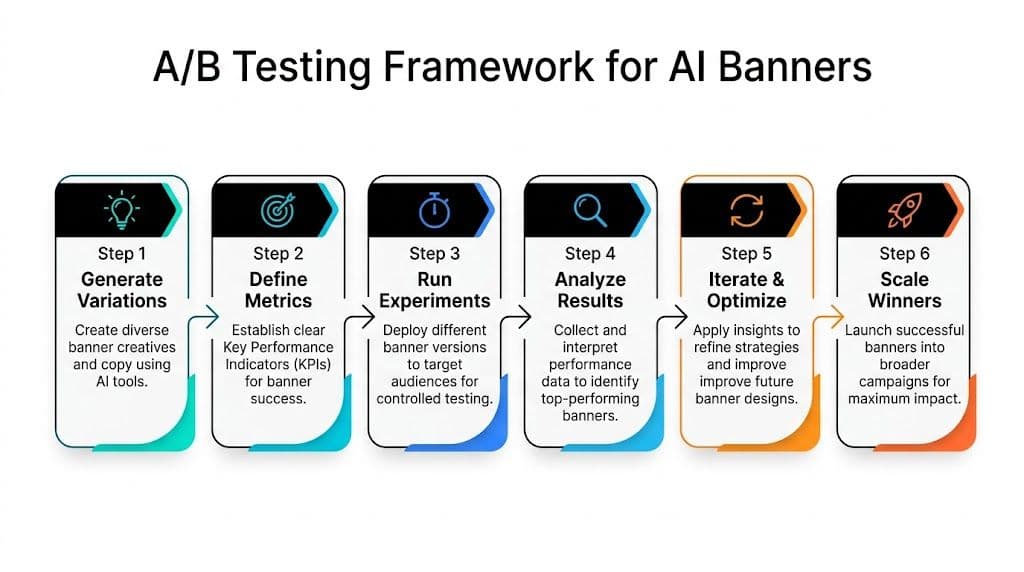
Test one layer at a time
If the goal is to scale what works, isolate the variable that changed. Otherwise, Meta delivers a result, but the team learns very little from it.
Use a clean sequence:
Visual test first
Keep headline, body copy, CTA, audience, and placement fixed. Change only the image style, composition, or layout.Headline test second
Lock the best-performing visual. Then test message angles against the same asset.Offer framing third
After visual and headline direction are clear, test discount framing, urgency, social proof, or benefit-led positioning.Audience fit last
Change audience after the creative signal is clearer, unless the campaign is built for exploration from the start.
This takes more discipline than loading every variation into one ad set. It also gives you something you can use in the next campaign.
Match each test to one primary KPI
Every test should answer one question. The KPI needs to match that question.
A simple operating model works well:
- Visual tests: watch click quality, hold rate, and early engagement.
- Headline tests: watch CTR, landing page view rate, and conversion quality.
- Offer tests: watch CPA, CPL, or ROAS.
- Audience-message fit tests: watch efficiency by segment and spend stability.
I usually kill tests that mix funnel stages too early. A banner built to stop the scroll may not win on last-click ROAS in the first few days, and that does not automatically make it weak. It may be doing its job at the top of the funnel while a second asset closes harder lower down.
Field note: Judge the creative by the job you assigned it, not by every metric at once.
Build a testing matrix your team will maintain
Overcomplicated frameworks die fast. The practical version is small, named clearly, and tied to a decision rule before launch.
| Test ID | Variable being tested | Constant elements | Success metric | Decision rule |
|---|---|---|---|---|
| V1 | Image style | Same copy, same audience | Click quality | Keep top visual direction |
| H1 | Headline angle | Same image, same audience | CTR and conversion quality | Remove weak angles |
| O1 | Offer framing | Same image and headline family | CPA or ROAS | Promote efficient offer framing |
The naming matters more than teams expect. If a buyer, designer, or founder cannot read the test name and understand what changed, reporting gets muddy fast.
Run controlled experiments inside Meta
Meta will not fix a messy test design for you. Set up the campaign so delivery noise stays as low as possible.
Use these operating rules:
- Keep budget logic stable: Large spend changes in the middle of the test make comparison weaker.
- Limit edits during learning: Repeated edits reset delivery patterns and blur the read.
- Control placements when comparing creatives: A banner tested across very different placements can produce false winners.
- Log launch conditions: Record audience, objective, optimization event, attribution setting, and naming convention.
Creative testing also gets stronger when the post-click experience is tested with the same discipline. Teams refining both sides of the funnel should review this split testing landing pages guide.
If you want a tighter operating model for campaign experimentation, use this guide on how to test ads methodically inside Meta campaigns.
Know what usually breaks the test
Bad reads usually come from a few predictable mistakes.
- Too many variables changed at once: You cannot tell whether the image, headline, offer, or CTA caused the lift.
- Stopping after early movement: Volatility in the first phase often reflects delivery patterns, not a durable winner.
- Scaling tiny differences: A small edge is not always enough to justify more budget.
- Treating each ad as a one-off: Winning creatives usually belong to a broader family of hooks, layouts, or offers.
- Ending after one result: The point is to build a repeatable system for generating, testing, and scaling AI banners, not to find one lucky asset.
Strong A/B testing feels plain because the process is plain. Generate a batch. Isolate one variable. Compare against a clear metric. Keep the pattern that improves performance. Then run the next round.
Automating and Scaling Winners with AdStellar AI
Manual testing works until volume catches up with your team. Then the same bottleneck returns in a different form. Instead of struggling to create banners, you struggle to organize them, launch them, rank them, and recycle what you’ve learned into the next campaign.
That’s where automation stops being a convenience and starts being an operational advantage.
The practical issue isn’t whether your team can generate dozens of artificial intelligence banner concepts. It’s whether someone can connect those concepts to account history, launch them in a structured way, and identify which combinations deserve more budget without rebuilding the same campaign logic every week.
Where manual workflows start to break
Teams often hit the same friction points:
- Creative files live in too many folders.
- Naming conventions drift.
- Historical learnings sit inside people’s heads, not in a reusable system.
- Winning combinations get copied by hand.
- New launches repeat old mistakes because nobody can trace what worked effectively.
This creates a false sense of speed. Ads go live, but the learning layer stays weak.
What automation should actually do
A useful scaling system should handle four jobs well.
First, it should ingest historical performance data so new creative decisions don’t start from zero.
Second, it should rank new combinations against the metric that matters, whether that’s ROAS, CPL, or CPA.
Third, it should make launch easier, because a great testing plan still dies if the upload process is slow.
Fourth, it should turn winning patterns into reusable building blocks for the next round.
That’s the operational logic behind platforms built for creative-scale media buying. For example, AdStellar’s AI optimization workflow is designed to connect with Meta Ads Manager through secure OAuth, ingest historical performance, rank creatives and audiences against campaign goals, and help teams use those learnings to assemble new launches from proven combinations.
What works in practice
The strongest automation setups don’t remove human judgment. They move humans to the right level of judgment.
A media buyer should still decide:
- which audience buckets deserve fresh exploration
- which offer deserves budget concentration
- when a creative family has enough proof to scale
- when a concept needs retirement even if one asset still looks decent in a report
The system should handle the repetitive layer. Humans should handle the strategic layer.
If your team still spends most of its time building ad variations, naming assets, and stitching campaigns together, you haven’t automated the expensive part.
A simple scaling model
A strong workflow usually follows this order:
| Stage | Human role | System role |
|---|---|---|
| Input | Set objective and message pillars | Pull historical account signals |
| Production | Approve visual territories and copy angles | Generate combinations at volume |
| Testing | Decide experiment design | Organize launch and surface performance patterns |
| Scaling | Choose what gets more budget | Prioritize likely winners based on live results |
That division matters because speed without structure usually creates waste. Structure without speed usually kills testing ambition. Good automation gives you both.
What not to automate blindly
Some things still need deliberate review:
- Brand-sensitive claims: AI shouldn’t improvise language that legal or compliance teams need to approve.
- Category nuance: B2B, DTC, and lead gen each reward different creative behaviors.
- Creative fatigue calls: A system can flag performance change, but a marketer still needs to judge whether the problem is the banner, audience saturation, or offer erosion.
The payoff from automation is less about replacing work and more about preserving learning. That’s what lets a team scale output without diluting decision quality.
Advanced Tactics and Avoiding Banner Blindness
A Meta account can look healthy on the surface and still drift into creative fatigue. CTR holds for a week, then softens. CPC climbs. Frequency is not extreme, but new banner variants keep looking like slight edits of the same ad. That pattern shows up often with AI-generated creative because production gets faster before differentiation gets better.
Banner blindness usually starts there. The issue is not volume. The issue is repeated visual logic. If every asset uses the same polished lighting, the same centered product crop, the same futuristic gradient, and the same headline structure, the audience stops processing the ad as new.
Use AI for breadth. Keep human judgment on the final mile
AI is excellent at producing range fast. It can give a team ten visual territories, twenty headline options, and every required aspect ratio in a fraction of the usual time. That speed matters, especially on Meta where creative iteration drives a large share of account learning.
But speed alone does not protect performance.
The final pass should still come from someone who understands what makes a banner feel specific to the brand and distinct in-feed. In practice, that review should focus on a few things:
- visual hierarchy that makes the first message obvious
- typography choices that do not feel templated
- brand cues that separate your ad from generic AI output
- removal of distracting artifacts or stock-looking details
- emotional tone that fits the offer and audience stage
I have seen many AI banners clear an internal review because they looked clean on a desktop board. They failed in-feed because they looked interchangeable with five other ads in the same category.
Rotate the variable that is actually tiring out
Many teams refresh everything at once after performance drops. That makes it harder to identify what caused the decline and what fixed it. A better approach is targeted rotation.
If thumb-stop rate drops but conversion rate from click stays stable, the visual system is often the problem. If CTR holds but CVR falls, the offer, landing page alignment, or message promise may be the issue. If cold audiences weaken while retargeting stays efficient, the account may be overusing familiar creative patterns at the top of funnel.
Use that signal to rotate one layer at a time:
- keep the offer and change the visual style
- keep the layout and test a different copy angle
- keep the copy and swap the emotional framing
- keep the core concept and replace the opening focal point
That creates cleaner learnings and protects spend.
Localization needs design judgment, not just translation
AI can translate copy fast. It cannot reliably judge whether a banner feels native to the market. Layout density, color use, image context, and what looks credible in one region can feel off in another.
That is why localized banner review should include a marketer or designer who knows the audience, not just the language. For teams tightening that review process, these advertising banner design principles are useful for checking hierarchy, clarity, and focal point before a new asset enters rotation.
Protect the account from its own historical bias
Models trained on account winners tend to repeat yesterday's answers. That helps at first. Then it narrows the creative range and teaches the system to imitate patterns that are already close to fatigue.
The fix is straightforward. Keep three creative groups live at the same time.
| Bucket | Purpose |
|---|---|
| Proven winners | Hold stable performance and defend ROAS |
| Iterative variants | Extend successful themes without copying them exactly |
| Controlled wildcards | Test unfamiliar angles before the account gets stale |
This structure gives you a practical trade-off. Winners protect revenue. Variants build on known demand signals. Wildcards prevent the account from collapsing into polished repetition.
AdStellar AI fits best here as an operations layer, not as a substitute for judgment. It helps performance teams generate Meta ad variants, organize them against historical signals, and keep testing volume high enough to find new winners before banner blindness starts dragging down ROAS.