You’re probably in one of two spots right now. Either you’re early in your paid social career and want a credential that proves you understand Meta’s ad ecosystem, or you already run campaigns and want to tighten the gaps in your fundamentals before you scale harder.
Both are valid reasons to go after the meta certified digital marketing associate exam.
The mistake I see most often is treating this certification like a finish line. It isn’t. It’s a strong baseline. It gives you the language, platform logic, and operating model behind Meta advertising. That matters. But once you’re in a real account, nobody pays you for memorizing definitions. They pay you for building campaigns cleanly, reading weak signals correctly, and making better decisions faster than the next buyer.
That’s why the credential is still worth taking. It forces structure. It tests the parts many newer media buyers skip. And if you use it the right way, it becomes the foundation for much better execution in Ads Manager and beyond.
Understanding the Meta Associate Certification
You pass the exam, add the badge to LinkedIn, and then open a live ad account with real budget behind it. That’s usually the moment people realize what this certification does well and where it stops. It gives you the platform foundation. It does not give you operating judgment, testing discipline, or a system for scaling with automation.
That’s still a good reason to take it.
The Meta Certified Digital Marketing Associate is Meta’s entry-level certification for marketers who need working knowledge of advertising across Facebook, Instagram, Messenger, and WhatsApp. I recommend it to early-career media buyers, in-house marketers, and freelancers who want a structured baseline instead of scattered YouTube advice and half-learned tactics.
What the credential actually covers
The exam tests the core mechanics of Meta advertising: account structure, campaign setup, ad creation, audience targeting, measurement, and policy. Those topics sound basic until you see how many account problems come from getting the basics wrong. Poor naming conventions, the wrong objective, weak audience logic, and policy mistakes create expensive friction later.
If you’re still shaky on the platform itself, get familiar with Facebook Ads Manager workflows before you spend time drilling exam terminology. The interface matters because the exam expects you to understand how the system is organized, not just memorize definitions.
Here’s the practical snapshot:
| Attribute | Detail |
|---|---|
| Credential | Meta Certified Digital Marketing Associate |
| Level | Entry-level |
| Exam duration | 90 minutes |
| Passing score | 700 out of 1,000 |
| Cost | $99 |
| Languages | Multiple languages available |
| Skills validated | Ad account management, ad creation, targeting, performance analysis, policies, and best practices |
| Preparation support | Meta Blueprint training |
| Career value | Useful for proving baseline platform fluency to employers and clients |
| Access support | Meta has offered scholarship-based access programs for eligible learners in the US |
Who gets the most value from it
This certification is strongest for people who need proof of platform literacy before they have a long track record.
That usually includes:
- Junior media buyers who need to show they understand Meta’s campaign structure and terminology
- In-house marketers who are about to manage spend directly instead of handing everything to an agency
- Freelancers who need a trust signal while they build case studies
- Growth generalists who already work across email, landing pages, and analytics but need stronger paid social fundamentals
It also helps career changers. If you understand marketing but hesitate once you get inside Ads Manager, the certification gives you a cleaner starting point.
Why the certification still matters
There are plenty of digital marketing certificates. This one still has value because it maps directly to a platform people use every day to buy traffic, test creative, and report results. Hiring managers know what Meta is. Clients know what Meta is. That familiarity matters more than a generic course badge from a provider nobody recognizes.
The bigger reason is operational. The exam forces you to learn the language of the platform correctly. That helps in real accounts when you’re reviewing attribution settings, diagnosing delivery issues, or deciding whether a problem comes from creative, audience, setup, or measurement.
The real trade-off
The certification is a strong first step. It is not the full job.
It will not teach you how to build a testing cadence across multiple audiences, how to judge creative fatigue before performance drops hard, or how to use AI tools to speed up research, reporting, and variation building without creating noisy campaigns. Those skills come from account work.
That gap is exactly why the certification still matters. You need the foundation before automation becomes useful. AI can help you move faster, generate angles, summarize reporting, and surface patterns. It cannot fix weak fundamentals inside campaign structure or sloppy thinking about objectives and measurement.
Get the cert for the baseline. Then use that baseline to make better decisions in live accounts, where speed only helps if your fundamentals are sound.
Your Four-Week Exam Preparation Roadmap
Failure on this exam isn't due to its impossible difficulty. They fail because they study in the wrong order. They over-focus on campaign setup, skim the fundamentals, and leave reporting until the end.
That’s exactly where people get trapped.
Analysis of exam results shows that Create and Manage Ads can account for nearly 46% of the questions, but weaker performance in fundamentals and reporting still keeps candidates below the 700 passing score. That pattern comes from this exam result analysis and score breakdown.
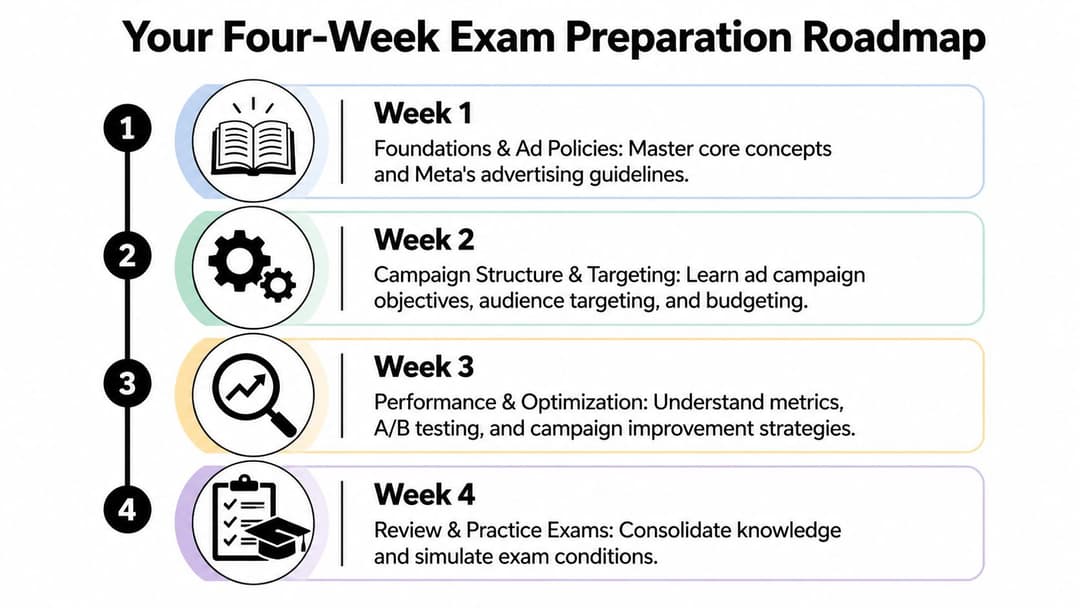
Week 1 Build your base in fundamentals
Start with the topics newer marketers usually rush past. You need to know what Meta is asking before you try to game the test.
Focus your first week on:
- Advertising basics such as campaign objectives, the role of the Meta ecosystem, and how businesses use Facebook and Instagram ads.
- Platform presence including business setup logic, account relationships, and the structure behind ad delivery.
- Policies and best practices because exam questions often punish sloppy assumptions here.
Use short study blocks. Read a concept, then restate it in your own words. If you can’t explain why one objective fits a business goal better than another, you don’t know it well enough yet.
A lot of candidates want to skip this because it feels less tactical. That’s the wrong move. Fundamentals are where the exam checks whether you understand Meta’s language, not just its buttons.
Week 2 Go deep on campaign creation and management
In this phase, you spend the biggest share of your effort.
You should know how campaigns, ad sets, and ads relate to each other. You should also understand targeting options, budget logic, placements, and what changes at each level of the build. These areas carry the heaviest exam weight, and practical platform time in them pays off fast.
Use this week for repeated platform drills:
- Create campaigns from scratch for different business goals.
- Build audiences using saved, custom, and lookalike logic where available in your practice environment.
- Edit placements and budgets so the interface feels familiar under pressure.
- Review ad-level choices such as creative setup, copy variants, and destination handling.
The people who pass comfortably usually stop “studying” for this section and start rehearsing inside the platform.
Week 3 Learn reporting well enough to avoid easy misses
Often, otherwise solid candidates lose points. They know how to launch ads, but they can’t read results cleanly.
Spend this week getting comfortable with reporting views, performance interpretation, and common optimization logic. Don’t memorize random metrics in isolation. Learn how they relate to business questions.
Use prompts like these:
- What metric helps answer whether the campaign is profitable?
- What result would make you review audience quality versus creative quality?
- When should a marketer compare performance across ad sets versus ad level?
Reporting questions often look simple. They aren’t. Meta likes to test whether you can pick the best answer for a stated objective, not whether you’ve seen a term before.
Week 4 Simulate the exam, then tighten weak spots
The last week is not for cramming everything again. It’s for fixing what still breaks under pressure.
Run timed practice sessions. Review every wrong answer. Then ask a harder question than “what was the right choice?” Ask why the wrong option looked tempting.
Use a short review checklist:
- Revisit low-confidence domains instead of rereading your strongest material.
- Practice under time pressure so the pace of a 90-minute exam feels normal, not rushed.
- Write down pattern errors such as confusing objective selection with optimization action.
- Review policies once more because these questions can be easy points if you stay precise.
How to allocate your effort
The best study plans aren’t equal across all topics. They’re weighted.
A practical split based on the exam breakdown is:
| Study area | Priority |
|---|---|
| Create and Manage Ads | Highest |
| Advertising Fundamentals | High |
| Establish Platform Presence | Moderate |
| Reporting | Moderate but easy to underestimate |
| The Value of Facebook | Lower, but still review it |
The trap is obvious. People see “lower weighting” and assume “safe to ignore.” That’s how they land just under the passing score.
Essential Hands-On Practice in Ads Manager
Knowing the right answer on paper is useful. Being able to move through Ads Manager without hesitation is better.
The exam rewards platform familiarity, and real work definitely does. If you need a walkthrough before you start drilling, this guide on how to use Facebook Ads Manager is a solid refresher.

Build muscle memory with repeatable workflows
Open Ads Manager and practice actions in a sequence. Don’t wander through menus hoping familiarity will happen on its own.
Work through these exercises:
- Create one campaign per objective type you encounter in your study materials. The goal isn’t launch volume. The goal is recognizing how setup choices change based on business intent.
- Build audience variations. Practice narrowing, broadening, and comparing audiences so you stop treating targeting like a single field to fill in.
- Adjust placements intentionally. You need to understand the difference between accepting default delivery and making a placement decision based on the ad experience.
- Set budgets at the right level. Many weak account builds happen because buyers know where a budget field lives but not why they’d choose one level over another.
Practice the parts that slow people down
The hardest exam moments usually aren’t conceptually advanced. They’re operationally fuzzy. The candidate roughly knows the answer but hasn’t spent enough time in the interface to trust their own thinking.
That’s why I like using a checklist instead of open-ended study.
| Hands-on drill | Why it matters |
|---|---|
| Create a campaign from scratch | Reinforces structure and objective alignment |
| Build an audience from existing data sources when available | Sharpens targeting logic |
| Compare placements for mobile and desktop experiences | Connects setup to delivery context |
| Review ad previews before publishing | Builds quality-control habits |
| Pull a custom report view | Improves reporting fluency |
| Inspect performance at campaign, ad set, and ad level | Trains diagnostic thinking |
If you want a broader conceptual companion while you practice, Maeve’s guide to Advanced Social Media Advertising is useful because it helps connect tactical setup to wider strategy.
Use reporting drills, not just launch drills
A lot of candidates enjoy building campaigns because it feels active. Fewer enjoy reporting because it feels slower. That’s exactly why reporting becomes a weak point.
Spend time inside reporting views and ask practical questions:
- Which ad is getting attention but not moving the business goal?
- Which audience is producing cleaner downstream performance?
- What would make you test creative first instead of targeting first?
Those questions matter more than memorizing a menu path.
A short visual walkthrough can help if you learn better by watching someone move through the platform in real time:
What works and what doesn’t
What works is repetition with intent. Build, review, rebuild. Force yourself to explain each setting before clicking through it.
What doesn’t work is passively watching tutorials and telling yourself you’ll “figure it out on the job.” That approach usually produces buyers who can launch ads, but can’t troubleshoot them.
A clean account structure comes from discipline, not from clicking faster.
Deconstructing Sample Exam Questions
The exam doesn’t just test recall. It tests judgment inside Meta’s framework. That means the right answer is often the one that best fits the business objective, even when more than one option sounds plausible.
That’s where sample questions help, as long as you don’t use them to memorize patterns blindly. Use them to sharpen elimination.

If you want extra practice on testing your ad thinking, this resource on testing ads effectively is useful because it trains the same kind of scenario evaluation the exam expects.
Sample question one objective alignment
Question: A local business wants more people to visit its website and complete a contact form. What should the marketer focus on first?
Correct thinking: Start with the business goal and choose the setup that best supports website actions, not vanity engagement.
Why this is usually right: The exam rewards alignment between goal and campaign intent. If the stated aim is site visits and form completion, answers centered on awareness or engagement are usually weaker unless the question gives a strong reason to prioritize them.
Why wrong choices look tempting:
- A response built around reach can sound efficient, but it doesn’t directly support the stated conversion behavior.
- An engagement-heavy answer can feel attractive because it seems cheaper or broader, but it drifts away from the actual business outcome.
- A creative-first answer may matter later, but it doesn’t solve the first-order problem of objective fit.
Sample question two audience logic
Question: A marketer wants to reach people similar to existing customers. Which audience approach is most appropriate?
Correct thinking: Choose the answer that uses an existing customer source as the basis for expansion.
Why this is usually right: Meta distinguishes between broad interest-based discovery and audiences derived from known customer data. The wording “similar to existing customers” is the clue.
Distractor analysis:
- Interest targeting can absolutely work, but it doesn’t answer the “similar to existing customers” requirement as precisely.
- Saved audiences may include useful filters, but they are not the same as using existing customer data to inform prospecting.
- A placement answer is irrelevant. The exam often includes one option from the wrong category to catch people who are reading too fast.
Read the noun in the question carefully. If Meta asks about audience type, don’t choose a setting from another layer of the account.
Sample question three reporting interpretation
Question: A campaign is delivering results, but costs are rising. What should the marketer review before making changes?
Correct thinking: Review performance data in context before reacting to a single number.
This type of question tests whether you can diagnose instead of panic. Rising costs could reflect creative fatigue, audience saturation, lower-quality traffic, or a reporting window issue. The best answer is usually the one that points to reviewing relevant performance indicators and breakdowns before making a tactical adjustment.
Why wrong answers pull people in:
- “Increase budget” sounds proactive, but it may worsen the issue.
- “Duplicate the ad set” sounds tactical, but it doesn’t explain the root cause.
- “Change everything at once” is the classic novice move. The exam tends to punish it.
Sample question four policy and account judgment
Question: An ad is rejected. What should the marketer do next?
Correct thinking: Review the policy reason, assess the creative or copy issue, and make a compliant correction.
This seems easy, but exam writers make the wrong options sound practical.
- One wrong answer usually suggests just resubmitting the same ad.
- Another may suggest changing unrelated settings.
- A third may imply that policy decisions are random and should be ignored.
The right answer is the one that respects the review system and focuses on compliance.
A better way to review practice questions
Don’t score yourself only on correct answers. Score yourself on reasoning quality.
Use this mini-framework after each practice set:
- Find the keyword. Business goal, audience type, reporting issue, or policy signal.
- Identify the account layer. Campaign, ad set, ad, audience, measurement, or compliance.
- Eliminate category mismatches. Many wrong answers live in the wrong layer.
- Choose the answer closest to Meta’s intended best practice.
That process is more reliable than trying to outsmart the exam.
Final Preparations and Test-Day Strategy
The last day before the exam shouldn’t feel like a desperate sprint. If your study plan worked, the final stretch is about reducing friction and staying sharp.
The exam lasts 90 minutes, and that’s enough time if you don’t get stuck trying to force certainty on every hard question. Keep moving. Use review flags when needed. Protect your pace.
The 24-hour checklist
Use the day before the exam to remove obvious stressors.
- Confirm your setup early. Don’t leave technical checks to the final hour.
- Clear your desk and workspace. A simple environment reduces proctor issues and helps you focus.
- Review policy basics one last time. A compact refresh is better than opening ten new tabs.
- Sleep instead of cramming. Mental clarity beats one more shaky review session.
If you need a concise policy refresher before test day, this guide to Facebook ad policy basics is useful.
How to manage the clock during the exam
Start with the easiest wins. Early momentum matters because it settles your nerves and preserves time for scenario questions.
Use a simple approach:
| Situation | Best move |
|---|---|
| You know the answer quickly | Select it and move on |
| Two answers seem plausible | Eliminate what is clearly weaker, then flag if needed |
| You feel stuck in the wording | Re-read the business objective, not just the options |
| You’re running short on time | Finish every unanswered question before returning to flags |
Don’t burn several minutes proving you’re right on one question while easier points sit unanswered later in the exam.
How to think when a question feels tricky
Meta likes “best answer” logic. That means more than one option may be partially true. Your job is to choose the one that best fits the exact scenario.
When you hit a difficult item, ask:
- What’s the business goal?
- Which account layer is this asking about?
- Which option solves the stated problem most directly?
- Which answer sounds reasonable but introduces a different objective?
That last question saves a lot of points.
What not to do on test day
Don’t change multiple answers at the very end just because anxiety spikes. Don’t assume a familiar term means the answer is right. Don’t rush policy questions.
Steady beats clever here. Clean reading, disciplined elimination, and basic time control are enough.
Beyond the Badge How to Make Your Certification Work
You pass the exam, add the badge to LinkedIn, and start applying. Then the interview shifts from certification topics to questions like these: How do you structure tests when creative volume is low? What do you do when CPA rises but click-through rate holds? How do you keep launch speed up without creating reporting chaos?
That is the actual handoff point.
The Meta Associate certification proves you understand the platform well enough to make sound entry-level decisions. It does not prove that you can run a fast testing system, judge creative quality, or scale spend without wasting budget. Those are separate skills. The strong career move is to treat the certification as your floor, then build operating ability on top of it.

Where the badge helps immediately
The credential still has practical value right away.
It gives hiring managers a quick signal that you know Meta terminology, campaign structure, objective selection, account setup, and core policy boundaries. In freelance work or agency sales, it also lowers the trust barrier. A prospect may not know whether you can produce results yet, but they can see that you took the time to learn the platform properly.
It also gives you better language for interviews. Instead of saying you have “some experience with Facebook ads,” you can speak clearly about how campaigns, ad sets, ads, targeting, placements, tracking, and reporting fit together. That alone makes you sound more credible.
As noted earlier, Meta also connects certified professionals to a career network. That can help if you are trying to turn the certification into interviews, not just a resume line.
Where the badge stops carrying the conversation
Teams do not hire paid social marketers just to identify the right objective in Ads Manager. They hire people who can produce useful tests, read weak and noisy signals, and make budget decisions without drifting into random changes.
That gap shows up fast in live accounts.
A certified marketer might know how to launch a conversion campaign. A strong operator knows when the account needs new hooks, when the audience is not the actual problem, and when the reporting window is too short to call a test. The exam gives you the vocabulary. Repeated account work gives you judgment.
Modern Meta work also rewards speed, but not sloppy speed. AI tools can help you generate more variants, organize creative inputs, and reduce repetitive setup work. That matters because scale usually breaks teams at the workflow level first. They know what to do, but they cannot do enough of it consistently.
The badge shows platform fluency. Your workflow shows whether you can turn that fluency into output.
How to present your certification like someone who actually runs campaigns
Keep the explanation grounded in execution.
Say that the certification gave you a solid base in campaign structure, objective choice, measurement, and policy-aware setup. Then explain what you built on top of that. Good examples include a testing process for new creatives, a naming and reporting system that speeds up analysis, or an automation layer that cuts manual launch work.
That second part matters more than many candidates realize. Employers and clients want proof that you can handle the workload inside a real account, not just pass a standardized exam.
If your role spans paid and organic coordination, learning how to automate social media posts can also tighten the content pipeline that often feeds ad creative testing.
The stronger career position
The best use of the meta certified digital marketing associate credential is simple. Use it to get the fundamentals right, then build systems that let you test faster and make better calls.
That usually means three things:
- cleaner account structure
- a repeatable creative testing process
- selective automation that saves time without hiding the logic behind the campaign
Marketers who combine certification-level knowledge with that kind of operating discipline are far more useful than marketers who stop at the badge. If you want a clearer sense of what mature execution looks like in practice, reviewing different Facebook ad services for campaign management and scaling can help you benchmark your own process.
If you’ve got the fundamentals down and you’re ready to launch, test, and scale Meta campaigns with less manual work, AdStellar AI is built for that next step. It helps growth teams generate and publish large volumes of Meta ad variations quickly, learn from historical performance, and focus budget on what’s working.