A look alike model is one of the most effective tools in a performance marketer's arsenal. At its core, it's a way to find new people who look and act just like your very best customers.
Think of it as creating a 'digital twin' of your most valuable audience segments. This lets ad platforms like Meta scan through millions of users to find new people who share the same online behaviors, interests, and demographics. It turns your hard-earned customer data into a powerful, scalable engine for finding new ones.
What Is a Look Alike Model and How Does It Drive Growth
Imagine you run a specialty coffee subscription box. You know your best customers are people who buy whole beans every month, engage with your brew-guide emails, and follow independent roasters on social media.
A look alike model takes that specific profile and finds thousands of other people who fit the same mold, even if they've never heard of your brand. It’s a proven method for taking a small, high-performing group and multiplying your reach with incredible accuracy.
This isn’t just a shot in the dark; it’s a sophisticated, data-driven process. The ad platform analyzes a seed audience—your handpicked list of top-tier customers—to build out a detailed profile of what makes them tick. From there, its algorithm scans its entire user base to find people who match that profile, creating a massive, highly relevant audience ready for your ads.
The Core Mechanics of a Look Alike Model
To really master lookalike audiences, you need to understand what's happening under the hood. The whole system is built on a few key components. Getting these right is the difference between a campaign that just runs and one that consistently delivers growth.
Let's break down the fundamental pillars that make every lookalike audience work. This table offers a quick reference for what goes into building one from the ground up.
Core Components of a Look Alike Model
| Component | Description | Key Question to Ask |
|---|---|---|
| Seed Audience | The foundation of your lookalike. This is the source list of users you provide to the platform, like top spenders or recent purchasers. | Who are my absolute best customers, and what defines them? |
| Similarity Score | The platform’s algorithm analyzes thousands of data points to see how closely new users match the behaviors and traits of your seed audience. | What specific signals (interests, demographics, behaviors) make my seed audience unique? |
| Audience Size | You choose how broad or narrow you want your lookalike to be, typically expressed as a percentage (e.g., 1%, 3%, 5%) of a country's population. | Do I need maximum precision (smaller audience) or broader reach (larger audience)? |
| Data Freshness | Lookalikes are not static. The data from your seed audience can become stale, so it's important to refresh it to reflect your current best customers. | When was the last time I updated my seed audience to reflect my newest high-value customers? |
Moving from a 1% lookalike (highly similar, smaller audience) to a 10% lookalike (less similar, broader reach) is a classic trade-off between precision and scale.
Ultimately, lookalike models are non-negotiable for any modern marketer focused on growth. They build the bridge between the customers you have and the millions of potential customers you haven't met yet.
Getting your seed data right is the first and most critical step. To learn more about preparing your customer lists for this process, check out our guide on what is audience segmentation. This strategic approach to targeting is what separates campaigns that sputter out from those that achieve predictable, scalable results.
How the Lookalike Model Engine Actually Works
Lookalike models can feel like a bit of a black box. You feed them your best customer data, and they spit out a massive new audience that’s supposed to perform just as well. But what’s really happening under the hood?
Think of it this way: your seed audience is a detailed recipe, and the platform’s AI is the master chef. This isn't just about basic ingredients like age or location. The AI "chef" digs into thousands of data points—patterns in online behavior, content engagement, and historical purchase signals—to build a rich, multi-dimensional profile of your ideal customer. The whole system is a marvel of modern data science, often built and refined by a specialized Machine Learning Engineer.
This flowchart gives you a bird's-eye view of how a platform takes your initial data and expands your reach.
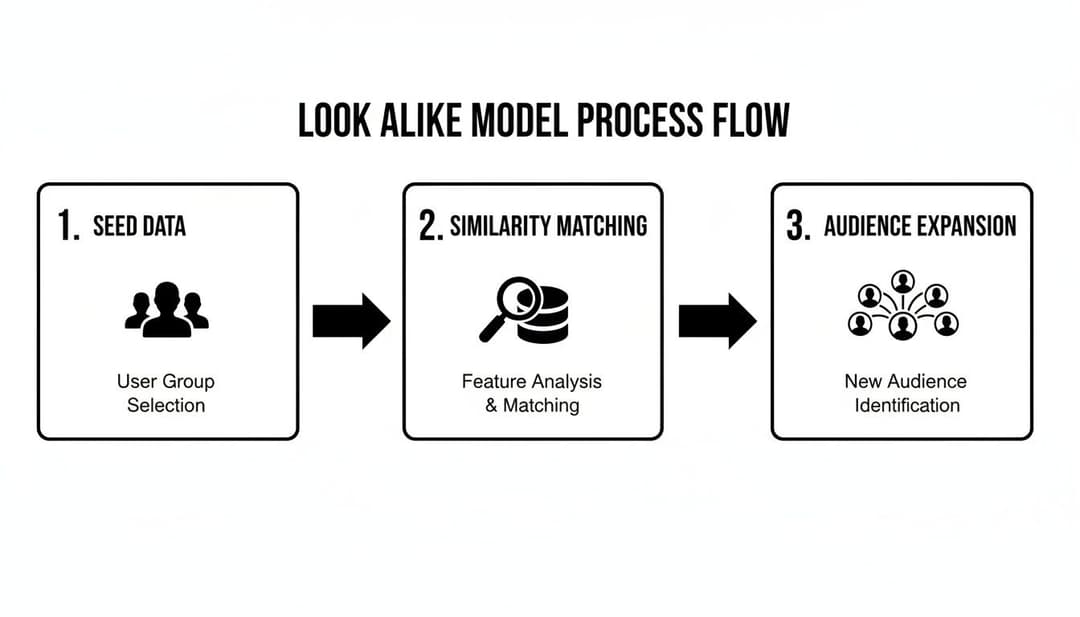
As you can see, the process moves from a small, known group to a huge new audience. The magic happens in that middle stage, where the AI finds new users who share the same "digital DNA" as your best customers.
Balancing Reach and Relevance
Once the AI understands who you’re looking for, you get to decide how strictly it should stick to that profile. You do this by choosing a similarity percentage, which controls the trade-off between the size of your new audience and its precision.
A smaller percentage (like 1%) builds a tight, precise audience that’s a very close match to your seed data. A larger percentage (like 10%) gives you far more scale but at the cost of that close similarity.
Choosing the right percentage is a critical step that hinges entirely on what you’re trying to achieve with your campaign.
1% Lookalike: Think of this as your high-precision tool. It creates a smaller, more concentrated audience that mirrors your seed list almost perfectly. This is your go-to for direct-response campaigns where the goal is driving sales or high-quality leads. You'll likely pay a higher CPM, but the improved conversion rate often makes it worth it.
10% Lookalike: This is your broad-reach instrument. The audience is much larger, but the connection to your seed data is looser. This approach works well for brand awareness campaigns, introducing your product to a wider market, or when you simply need to fill the top of your funnel at scale.
In the end, there's no single "best" percentage. The most successful strategies almost always involve testing multiple lookalike audiences (e.g., 1-3%, 3-5%, and 5-10%) to discover which one hits that sweet spot of scale and return on ad spend (ROAS) for your specific goals. If you're looking to make this testing process faster and more efficient, you can see how AI for ads can accelerate your campaign optimizations.
Crafting the Perfect Seed Audience for Maximum Results
The success of any lookalike model hinges entirely on its starting point. While the platform's AI does the heavy lifting of finding new users, you're the one giving it directions. Think of your seed audience as the "master blueprint" for your entire targeting strategy; a flawed blueprint doesn't just lead to a flawed result—it guarantees it.
We’ve all heard it a thousand times: garbage in, garbage out. The quality of this initial group is the single most important lever you can pull. A lookalike audience built from a generic, low-intent list will always get crushed by one built from your absolute best customers.

Why Quality Trumps Quantity
It’s a common mistake for marketers to use the biggest seed audience they can find, like "All Website Visitors" or "All Purchasers." The logic seems sound—more data points should equal a better model, right? Not exactly. This approach actually dilutes the quality of the signal you're sending to the algorithm.
The AI can’t tell the difference between your one-time discount shoppers and your loyal, high-spending advocates. It just sees a massive, messy list. The real goal is to get specific and strategic. Instead of a broad list, zero in on high-value segments that represent the exact type of new customer you want to attract. This is where you’ll find a genuine competitive advantage.
To build these powerful segments, you need to get comfortable with your first-party data. Learning more about how to identify a target audience is the perfect place to start building that foundation.
Building a High-Intent Seed Audience
Your best sources for seed data are always rooted in high-intent actions. These are the signals that tell the algorithm to find more people who don’t just browse, but who actually convert and add real value to your business.
Try building lookalikes from these kinds of high-quality seed audiences:
- Customer Lists by Value: Don't just upload every customer you have. Segment them. Create a list of your top 10-25% of customers by lifetime value (LTV). These are your VIPs, and finding more people just like them is a direct path to boosting revenue.
- High-Frequency Purchasers: Pinpoint customers who have made three or more purchases in the last 180 days. This group proves loyalty and repeat buying behavior—a priceless trait to replicate.
- High Average Order Value (AOV): Segment users whose AOV is above your site-wide average. This tells the platform to search for users who are comfortable spending more.
This isn't just theory—it has a direct impact on the bottom line. For instance, a major retailer found that building a lookalike model from their first-party data led them to acquire customers with 17% higher average revenue per transaction. At the same time, this strategic approach cut their cost-per-acquisition (CPA) by 20%.
Key Takeaway: The more specific and value-driven your seed audience is, the more efficient and profitable your lookalike campaigns will become. Stop telling the algorithm to find "more customers" and start telling it to find "more of your best customers."
One of the biggest mistakes a paid social manager can make is assuming a lookalike model works the same everywhere. It doesn’t. The strategy that absolutely crushes it on one platform can be a complete dud on another.
To get the most out of your ad spend, you have to understand the core philosophies behind how Meta and Google use this technology. They’re just built differently.
Meta’s ad platform is the seasoned veteran in the room. Its AI has spent over a decade learning from user behavior, and frankly, it’s gotten incredibly good at it. What does this mean for you? You can—and should—trust it with broader instructions.
Think of Meta's lookalike function as creating a highly filtered guest list for an exclusive party. You hand over your list of VIPs (your seed audience), and Meta’s AI goes out and finds new people who match that exact profile with stunning precision. For a deeper dive into this, check out our guide on Facebook Lookalike Audiences.
Because the system is so mature, the best practice is often to give the algorithm more room to run. This means feeding it larger, high-quality seed audiences and testing wider lookalike percentages, like a 3-5% or even a 5-10% audience. Meta’s machine is powerful enough to sift through these larger pools and find gold.
The New Google Demand Gen Approach
Google, on the other hand, just made a fundamental change to how its system thinks about lookalikes, and many advertisers are still catching up.
As of March 2026, Google announced that lookalike audiences in its Demand Gen campaigns are no longer a strict targeting rule. Instead, they’re now treated as an optimization signal. Previously, your ads were boxed in, shown only to users inside your lookalike segment. Now, the AI uses that audience as a starting point and is free to find new users outside that list if it predicts they’ll convert.
This new approach is like giving the bouncer at your party a description of your ideal guest instead of a strict list. You’re trusting the bouncer's judgment to let in people who fit the vibe, even if they weren't on your original list.
This shift means you’re giving Google’s AI far more autonomy. Your lookalike settings now guide the algorithm's expansion rather than restricting it. When you lean into this and provide strong data, these models can seriously improve your lead gen for PPC campaigns, turning audience targeting into a much more dynamic growth engine.
Look Alike Model Behavior Meta vs Google (2026)
So, what does this all mean for your day-to-day campaign management in 2026? The key is adapting your mindset and strategy to each platform's unique logic. This table breaks down the core differences in how lookalike audiences function on the two largest ad platforms, helping you adapt your strategies accordingly.
| Feature | Meta Ads | Google Demand Gen |
|---|---|---|
| Function | A strict targeting rule. Ads are shown only to users inside the defined lookalike audience. | An optimization signal. The AI uses the lookalike as a guide but can target users outside it. |
| Analogy | A highly filtered guest list for an exclusive party. | A general description of the ideal guest for the bouncer. |
| Best Practice | Use larger seed audiences and test broader lookalike percentages (e.g., 3-10%). | Focus on providing high-quality seed data; the AI handles much of the expansion. |
| Control | More direct control over audience definition and size. | Less direct control; you are trusting the algorithm's expansion logic. |
Ultimately, succeeding with lookalikes on both platforms requires a flexible approach. On Meta, you are the architect, meticulously designing the audience. On Google, you’re more of a guide, pointing the AI in the right direction and trusting it to find the way.
How AdStellar AI Accelerates Lookalike Success
Let’s be honest. Manually building, testing, and scaling every possible lookalike model is a massive bottleneck for any growth team. In theory, you should be testing dozens of variations—different seed audiences, creative angles, and lookalike percentages—but in practice, this is an incredibly time-consuming grind.
The challenge isn't just the initial setup; it’s the constant management. How can you realistically launch, monitor, and iterate on hundreds of ad combinations without getting buried inside Ads Manager? This operational drag is exactly the problem that AI-powered platforms like AdStellar were built to solve.
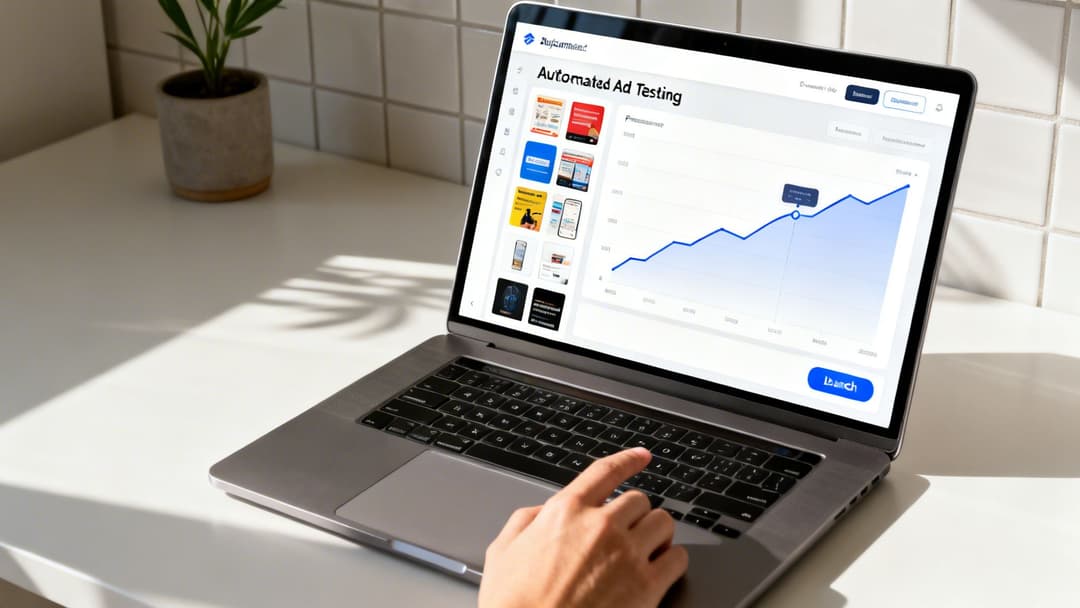
Instead of forcing you through a painful manual process, AdStellar automates the entire workflow. You can generate hundreds of audience, creative, and copy combinations and push them live to Meta in minutes. This speed allows your team to move from a great idea to an active test faster than ever before.
Automated Testing and Intelligent Scaling
AdStellar’s AI doesn't just launch ads and hope for the best. It meticulously analyzes performance data to find what actually works. The platform automates the tedious but essential process of testing different lookalike percentages against your top-performing creative assets.
For instance, you could simultaneously test:
- A lookalike from your "Top 10% LTV Customers" seed audience at 1%, 3%, and 5%.
- Another lookalike from your "Purchased 3+ Times" seed audience at those same percentages.
- All of these audience tests running against your five best video ads and three strongest copy variations.
Building this testing matrix by hand would take hours of painstaking work. AdStellar builds it in seconds. The platform's AI then analyzes real-time performance, identifying the winning combinations based on your primary goal, whether that’s ROAS, CPA, or another key metric.
This approach finally answers the fundamental question of scale: "How can I realistically implement all of this?" By automating the grunt work, you free up your team to focus on high-level strategy instead of getting stuck in the weeds of campaign setup.
From Insights to Action
Once winning combinations are found, AdStellar automatically scales the budget toward them, making sure your ad spend is always allocated to the highest-performing lookalike models and creatives. It turns the complex theory of lookalike testing into a repeatable, data-backed system for growth.
The system is designed for rapid iteration. AdStellar's AI even analyzes your historical data to recommend the most promising seed audiences to start with, taking the guesswork out of your initial setup. This kind of smart automation is powered by a continuous learning loop that gets smarter with every campaign you run. You can see how this works by learning more about the continuous learning features of AdStellar.
Ultimately, using an AI platform transforms your lookalike strategy from a slow, manual process into a dynamic engine for audience discovery and revenue growth. It closes the gap between knowing what you should do and having the capacity to actually do it at scale.
Common Questions About Lookalike Models
Even the best paid-social teams get tripped up by the same questions when they start using lookalike audiences. Getting the details right isn't just about ticking boxes—it can be the difference between a breakthrough campaign and a frustrating waste of ad spend.
We've seen these questions come up time and time again. Here are the straight-up answers you need to build and manage these audiences like a pro.
How Long Should I Wait Before Creating a Lookalike Model?
I know the ad platforms let you get started with a seed audience of just 100 people, but don't fall for it. That's a technical minimum, not a recipe for success.
For a lookalike that actually performs, you need to be patient. Wait until you have at least 500-1,000 high-value conversions—think actual purchases or qualified leads—from a single country in the last 60-90 days.
Why? A bigger, more recent dataset gives the algorithm a clean, powerful signal to work with. Starting too soon with a handful of conversions just feeds the algorithm junk data, leading to poor matches and burned budgets. A strong seed audience is the foundation for everything, so give it the time it needs.
Should I Exclude My Seed Audience from Lookalike Campaigns?
Yes. Absolutely. 100% of the time.
The whole point of a lookalike campaign is to find new people who behave like your best customers. If you don't exclude your seed audience, you’re just paying to advertise to people who have already bought from you or signed up.
This rookie mistake inflates your cost-per-acquisition (CPA), messes with your performance metrics, and annoys your loyal customers with ads for introductory offers they can't use. It’s a simple one-click exclusion in your ad set settings. Don’t skip it.
What Are the Most Common Reasons My Lookalike Model Is Underperforming?
If your lookalike campaign is falling flat, it almost always comes down to one of three culprits.
First, check your seed audience quality. A lookalike built from low-intent actions like "page views" is never going to perform as well as one built from high-intent "purchases." Garbage in, garbage out. The quality of your input directly dictates the quality of your audience.
Second, play with your lookalike percentage. If a tight 1% lookalike is giving you sky-high CPMs, the audience might be too small and competitive. Try broadening your reach to a 3-5% audience. On the flip side, if a massive 10% lookalike isn't converting and the CPA is a disaster, you need to tighten up your targeting to a more precise 1-2% group.
Third, stop blaming the audience for bad creative. You can have the most perfectly crafted audience in the world, but it can’t save a stale or irrelevant ad. If you're targeting new prospects, you need fresh creative that speaks to them. These AI-driven audiences are a testament to platform advancements; in fact, Meta's ad revenue surged to $164.5 billion in 2024, a 22% year-over-year increase, largely fueled by its sophisticated audience modeling.
Key Insight: Underperformance is rarely a single-variable problem. It's an interplay between your seed data quality, audience size, and the creative you pair with it. Systematically test each element to diagnose the issue.
Ready to move past manual testing and scale your lookalike campaigns? With AdStellar AI, you can launch, test, and optimize hundreds of audience and creative combinations in minutes, not days. Stop guessing and start growing. Discover how AdStellar AI can unlock more revenue from your ad spend today.