You open Ads Manager, look at a tired campaign, and ask a simple question that turns out not to be simple at all: how do i write an advertisement that performs.
Most advice online treats ad writing like a copywriting exercise. Write a catchy headline. Add a benefit. End with a CTA. That’s fine if you’re making one ad for a school project.
It’s not fine if you’re running Meta for a real business.
Paid social doesn’t reward isolated brilliance. It rewards systems. You need messaging that matches the audience, creative that fits the moment, and a workflow that can produce enough variations to keep learning before fatigue sets in. Good ad writing still matters a lot. Nielsen found creative quality drove 65% of an ad’s sales lift in 2006, while by 2017 the impact of media factors like targeting and reach had grown from 15% to 36% across cross-media campaigns, which is why copy has to work with targeting instead of apart from it (Nielsen).
That’s the frame to use. You’re not just writing ads. You’re building a repeatable way to test messages, find winners, and scale them without burning out your team.
Foundations Before You Write a Single Word
Most weak ads fail before the copy doc opens.
They fail because the marketer doesn’t know which buyer they’re talking to, what that buyer already believes, or which product angle deserves the spotlight. Clever phrasing can’t rescue fuzzy strategy.

Start with segments, not a single avatar
A lot of teams still write for “the customer.” That usually means they write vague copy that tries to appeal to everyone and lands with no one.
A stronger approach is to split your market into distinct groups based on behavior, awareness, or buying intent. That could mean:
- Cold prospects: They don’t know your brand. Lead with the problem or desire.
- Warm visitors: They know you, but haven’t acted. Lead with proof, clarity, and friction reduction.
- Retargeting pools: They viewed a product, added to cart, or bounced. Lead with the exact objection likely blocking purchase.
- Existing customers: They already trust you. Lead with expansion, upsell, or a new use case.
If you need a clean process for this, this guide on identifying a target audience is useful: https://www.adstellar.ai/blog/how-to-identify-a-target-audience
Find the language customers already use
Don’t invent messaging in a vacuum. Pull raw language from places where buyers speak without a filter.
Look at:
- Sales calls and demos
- Support tickets
- Product reviews
- Comment sections
- Reddit threads and community posts
- Search queries inside your site
You’re looking for repeated phrases. Not just what people want, but how they describe the pain.
“Need better sleep” is generic.
“Wake up at 3 a.m. and can’t get back down” is usable copy.
Practical rule: If your ad language sounds more polished than your customer’s own words, it’s often less persuasive.
Match the product feature to a real outcome
Features matter, but only after the reader understands why they should care.
A simple mapping exercise helps:
| Feature | Functional value | Emotional value |
|---|---|---|
| Fast onboarding | Saves setup time | Feels easy to start |
| Waterproof material | Holds up outdoors | Removes worry |
| Automated reporting | Reduces manual work | Feels under control |
Without a value bridge, most ads flatten out. They jump from feature to CTA with no value bridge in the middle.
Research on ad effectiveness backs this up. Strategic audience segmentation improves relevance, and a 10% increase in average viewer focus across mediums correlates with a 17% increase in spending. The same research also warns against knowledge bias, which is the assumption that audiences understand your ad as well as you do (iMotions).
Know where the buyer is in the journey
The same product needs different copy depending on awareness.
Use this rough model:
Problem-aware
They feel the pain, but don’t know the solution. Write into the problem.Solution-aware
They know the category. Differentiate your mechanism or promise.Product-aware
They know you. Focus on objections, proof, and urgency.
If your ads aren’t converting, the problem often isn’t “bad copy.” It’s that the message is one stage ahead of the buyer.
The Core Components of High-Performing Ad Copy
A Meta ad has three jobs. Stop the scroll. Create enough interest to earn the click. Tell the user what to do next.
That sounds basic, but a lot of underperforming ads miss one of those three.
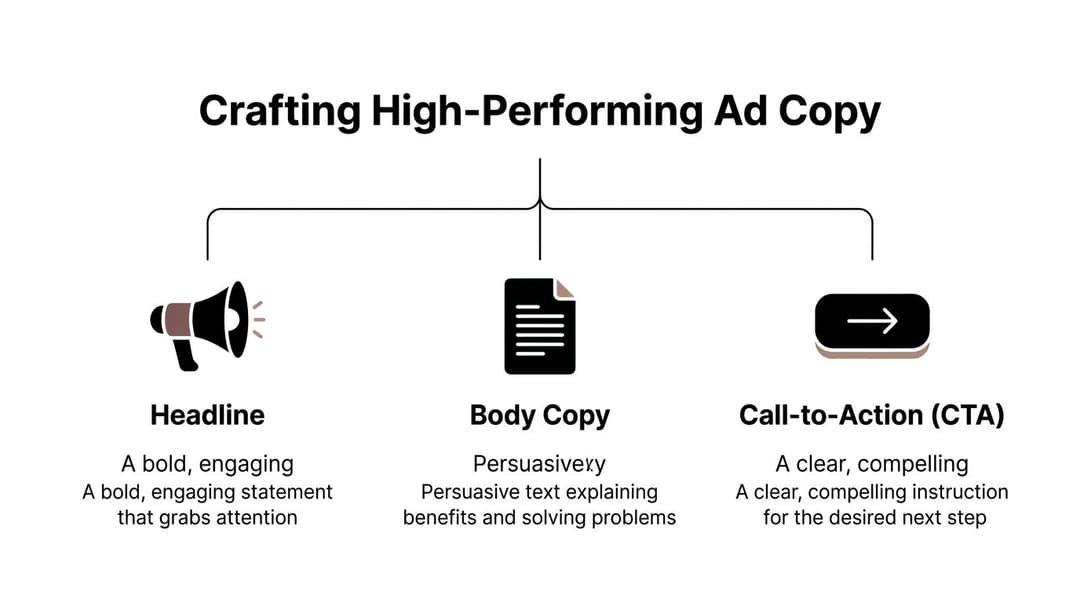
Write the headline for interruption
The headline isn’t there to be pretty. It’s there to earn attention in a crowded feed.
Good headlines usually do one of these well:
- Call out the audience: “For runners who hate bulky jackets”
- State the outcome: “Learn piano without reading sheet music”
- Create contrast: “All the flavor, none of the crash”
- Introduce a mechanism: “The budgeting app built for irregular income”
Bad headlines tend to sound like brand slogans. They’re vague, self-congratulatory, and detached from what the user wants.
Compare these:
- Weak: Premium skincare for modern lifestyles
- Better: Dry, tight skin by noon? Start with this barrier-support routine
The second one creates context. It feels like it belongs to a person, not a brand deck.
Use body copy to move one objection
The body copy doesn’t need to explain everything. It needs to move the reader from hesitation to the next action.
Two frameworks still hold up if you use them loosely.
PAS works well for direct response.
- Problem
- Agitate
- Solve
Example:
- You’re spending hours reporting on campaign results.
- By the time the spreadsheet is done, the data is already stale.
- Use a dashboard that shows performance fast enough to act on it.
AIDA works well when the offer needs more build-up.
- Attention
- Interest
- Desire
- Action
For Meta, compress it. Users won’t read a mini sales page in the feed unless the creative and offer are already strong.
About personalization, this isn’t optional anymore. Approximately 90% of advertisements today incorporate targeting or personalization, and a 2013 study found retargeted banner ads showing previously viewed products were six times more effective at generating sales than standard banners (RNO1).
That’s why generic body copy underperforms. If the audience is segmented, the message should be too.
End with a CTA that matches intent
A CTA fails when it asks for too much, too soon, or says nothing specific.
Use the CTA to reflect the level of commitment:
- Cold traffic: Learn more, See how it works, Watch demo
- Warm traffic: Compare plans, Start free trial, Shop now
- Retargeting: Complete your order, Claim your offer, Come back to your cart
The best CTA usually feels like the natural next step, not a command pasted at the end.
If you work across channels, not just Meta, this piece on AI Affiliate Writing for TikTok Shop is a useful companion because it shows how platform context changes the way hooks and calls to action need to sound.
For a tighter checklist of what belongs inside the ad unit itself, use https://www.adstellar.ai/blog/what-to-include-in-ad-copy
A quick breakdown helps keep the writing sharp:
From Copy to Campaign with a Powerful Creative Brief
A strong ad usually dies in review when the team never aligned on what the ad is supposed to do.
Copy says one thing. Design interprets it another way. The media buyer targets an audience the message wasn’t written for. Then everyone debates performance on a launch that was muddled from the start.
What a useful brief actually includes
Keep the brief short enough to use and specific enough to remove ambiguity.
Include these fields:
- Audience definition: Who this variation is for, and what they already know
- Core message: The one thing the ad should communicate
- Offer and CTA: What action the user should take next
- Visual direction: Product close-up, founder face, UGC feel, static graphic, testimonial, before-and-after, and so on
- Do-not-miss details: Claims, disclaimers, pricing language, brand constraints
- Success metric: Whether the ad is judged on ROAS, CPL, CPA, or another business KPI
That last part matters. If design thinks the goal is engagement and the media buyer needs purchases, the creative will drift toward the wrong outcome.
Briefs should translate strategy into production
The brief is where research becomes executable.
A copy angle like “save time” is too loose. A production-ready brief says something closer to this:
Warm audience of previous site visitors. Main friction is setup complexity. Lead with ease of getting started. Show product in use, not polished lifestyle imagery. CTA should invite low-friction action.
That gives the designer a lane. It gives the editor a lane. It gives the media buyer a lane.
Keep one brief per angle, not one brief per campaign
A common mistake is building one master brief for a whole launch. That creates broad, compromised creative.
Instead, build separate briefs for each messaging angle. One for pain-point copy. One for social proof. One for offer-led retargeting. One for comparison messaging.
That’s how you preserve signal in testing. Each ad set has a clear idea behind it.
If you want examples of campaign concepts that translate well into briefs, this library of creative ad campaign ideas is a good reference point: https://www.adstellar.ai/blog/creative-ad-campaigns
A B Testing That Actually Teaches You Something
You launch six new Meta ads on Monday. By Thursday, one is clearly ahead. CTR is up, CPA looks acceptable, and everyone wants to roll out more versions.
Then the problem shows up. The winning ad changed the hook, the visual, the CTA, and the audience at the same time, so the team learned almost nothing it can reuse at scale.
That is the gap in a lot of ad testing. The account gets a temporary winner, but the team does not build a system for producing the next 20 useful variations.
Test one major variable per question
A test should answer a single strategic question.
Start with variables that can change budget allocation, creative direction, or audience-message fit. On Meta, that usually means angle, format, proof type, or ask. Tiny wording changes can wait until you know the broader message class deserves more spend.
Here are strong first-test options:
- Hook angle: problem-first versus desired-outcome-first
- Primary text approach: concise conversion copy versus objection-handling copy
- Creative format: product demo versus founder video versus customer-style UGC
- Offer framing: discount-led versus value-led
- CTA intensity: soft click versus direct purchase ask
A simple structure looks like this:
| Test element | Version A | Version B |
|---|---|---|
| Hook | Problem-first | Benefit-first |
| Creative | Product demo | Testimonial |
| CTA | Learn more | Shop now |
Run one of those comparisons at a time. If you stack every variable into the same test, you get a result without getting insight.
Write the hypothesis before you launch
Good tests start before the ads go live.
Write one sentence that defines the bet. Example: abandoned-cart visitors may respond better to reassurance about setup time than to urgency about limited stock. That sentence forces clarity on audience, friction, and message. It also makes post-test review faster because the team can judge whether the assumption held up.
I use a simple rule here. If a test cannot be explained in one sentence, it is probably too messy to teach anything useful.
Read performance at the message-system level
Meta does not reward isolated copy craft. It rewards combinations that fit the audience, placement, and stage of awareness.
That means results should be reviewed across a few dimensions at once:
- Audience segment
- Placement
- Creative type
- Message angle
- Funnel stage
The same promise can fail in broad prospecting and work well in retargeting. A polished product video can underperform in Stories and still convert in Feed. Teams that only look at blended account numbers miss those patterns, and then they produce the next batch of ads from the wrong lesson.
For a more detailed framework on structuring these experiments, use this guide to testing ads in a way that produces clear learnings.
Build tests for scale, not just for one winner
This matters even more when the account needs high-volume creative output.
A strong testing program should tell the team what to make more of. If founder-led reassurance wins with warm traffic, the next step is not to clone the exact ad forever. The next step is to produce controlled variations around that pattern: new hooks, new objections, new visual executions, same core angle.
That is where automation starts helping strategy instead of replacing it. A tool like AdStellar AI can generate structured variants around a proven message so the team can test faster without turning the account into random creative clutter. The same logic applies to video testing too. If your account relies on creator-style assets, an AI UGC video generator can help expand formats around a winning script or offer.
Keep a testing log your team can actually use
Every test should leave behind a reusable conclusion.
Document what the team learned in plain language:
- Which pain points stop cold traffic
- Which proof elements increase trust for warm audiences
- Which visual formats support each angle
- Which CTAs attract clicks without purchase intent
- Which offers work better by funnel stage
Over time, that testing log becomes a production asset. It gives copywriters better prompts, gives designers clearer direction, and gives media buyers stronger inputs for the next round of spend. That is how A B testing turns from campaign activity into a repeatable system for scaling ad copy on Meta.
Scaling Your Winners with AI and Automation
Manual ad writing breaks first at the exact point your account needs more output.
You find a winning angle, performance starts to slip, and suddenly the team needs more headline variants, more body copy options, more audience-message combinations, and fresh creative built around the same core promise. That’s where the usual “write a better ad” advice stops being useful.

The real bottleneck is production volume
Performance marketers increasingly ask how to create and test 100+ ad copies weekly to combat ad fatigue, and one cited industry angle notes CTR can drop 34% after 7 days on Meta. That’s exactly why single-ad workflows break down under pressure, and why bulk generation and ranking systems have become more relevant for teams buying at scale (Cody See).
The point isn’t to flood the account with random variants.
The point is to generate structured variations around proven ingredients:
- Winning hooks
- Audience-specific pain points
- Offer frames
- Different CTA intensities
- Visual pairings for each message
That lets you refresh without discarding what already works.
Automation should multiply judgment, not replace it
There’s a bad way to use AI for ads. Prompt it once, copy the output, launch ten generic variations, and wonder why none of them hold.
There’s a useful way too. Feed the system clear inputs, segment by audience, anchor each batch to a real angle, then review and rank outputs like a media buyer, not like a spectator.
That same mindset applies to adjacent formats. If your Meta account also depends on creator-style assets, an AI UGC video generator can help produce more visual variations around the messages you already know matter.
What scale should actually look like
A scalable workflow usually follows this order:
Identify a winning concept
Example: objection-handling copy beats generic benefit copy for warm traffic.Explode the concept into variants
Rewrite the same idea for different segments, offers, and visual treatments.Launch in batches
Keep naming conventions and testing structure tight enough to compare cleanly.Rank by business outcome
Don’t reward ads only because they attract cheap clicks.
One tool built around this workflow is AdStellar AI. It connects with Meta Ads Manager, generates large sets of creative, copy, and audience combinations, and ranks performance against goals like ROAS, CPL, or CPA. The practical value is speed and structure, not magic. You still need to choose the right angles and decide what deserves more spend.
If you want a broader view of where AI fits into campaign creation, this overview is a good place to start: https://www.adstellar.ai/blog/ai-for-ads
Measuring What Matters and Optimizing for Growth
An ad isn’t good because it gets attention. It’s good because it helps the business acquire customers efficiently.
That’s why post-launch analysis should start with business metrics first, then drill into creative diagnostics second.
Watch the metrics that change decisions
Your account may prioritize ROAS, CPL, CPA, or another acquisition metric. Use the KPI that maps to the campaign’s actual job.
Then diagnose underneath it with supporting signals:
- CTR: Tells you whether the hook and creative earn interest
- Conversion rate: Tells you whether the click quality and landing experience hold up
- Frequency: Tells you whether the same people keep seeing the ad
- Breakdowns by audience and placement: Tells you where performance is coming from

Don’t optimize from unstable data
A critical part of campaign management is tracking impression frequency to avoid over-exposure and ad fatigue. Industry standards also require campaigns to meet minimum impression thresholds before the data is stable enough to support optimization decisions, and relying only on high-level aggregate metrics can hide important performance differences (GWI).
That matters in practice.
If you cut an ad too early, you may kill a useful concept before it had enough delivery to read clearly. If you leave it running too long at high frequency, you may mistake repetition for strength while performance deteriorates.
Look at trends, not single snapshots. A winner usually leaves a pattern before it leaves a conclusion.
The tightest optimization loop is simple. Keep what produces the business result. Refresh what’s fatiguing. Cut what burns spend without teaching you anything.
If your team is stuck between writing better ads and producing enough of them to test properly, AdStellar AI is built for that middle ground. It helps marketers generate bulk Meta ad variations, launch structured tests faster, and rank creative, audience, and message combinations against the KPIs that matter.