For marketing agencies, the pressure to deliver faster results with tighter budgets has never been higher. Manual campaign setups, endless creative iterations, and fragmented reporting are no longer sustainable. This is where AI transforms agency operations from a reactive service to a proactive growth engine. The right ai tools for marketing agencies don't just automate tedious tasks; they unlock predictive insights, scale creative testing, and centralize workflows, allowing your team to focus on strategy instead of spreadsheets.
This guide cuts through the noise to showcase 12 essential AI platforms, categorized by function, so you can build a tech stack that drives real client ROI and internal efficiency. We've structured this list as a comprehensive resource, focusing on practical use cases, honest limitations, and implementation advice for each tool. You will find direct links and screenshots to help you evaluate which solutions best fit your agency's specific needs and client demands.
We'll explore platforms for paid media automation, content creation, social media management, and SEO. To truly scale agency growth and prepare for the future, exploring comprehensive lists like the 12 Best AI SEO Tools to Dominate Search in 2025 can provide agencies with a competitive edge. This list is designed to be your go-to reference for integrating AI into your workflows, helping you identify the best platforms to streamline operations, enhance campaign performance, and ultimately, scale your agency's growth. Let's dive into the tools that will make it happen.
1. AdStellar AI
AdStellar AI stands out as a premier choice among AI tools for marketing agencies focused on mastering Meta advertising. It's an AI-first platform engineered to automate and optimize the entire lifecycle of Meta ad campaigns, from initial concept to scalable execution. The platform’s core strength lies in its ability to dramatically accelerate the highly iterative process of ad testing, claiming to help teams launch, test, and scale campaigns up to 10 times faster. This isn't just about speed; it's about intelligent, data-driven velocity.
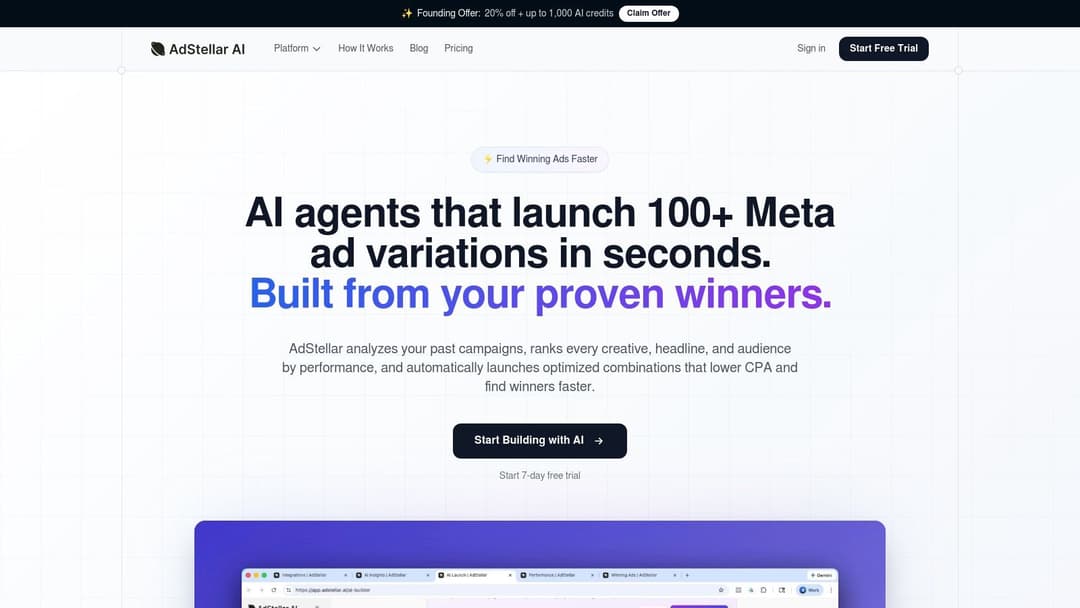
By securely connecting to a client's Meta Ads Manager, AdStellar AI ingests historical performance data to understand what has previously worked. Its AI then generates hundreds of creative, copy, and audience variations in minutes. This allows an agency to move from strategy to live testing with unparalleled efficiency, pushing all variants live with a single click and bypassing the tedious manual setup in Ads Manager.
Key Features and Agency Use Cases
- Bulk Generation & Launch: Agencies can instantly create and deploy a massive volume of ad variations for A/B testing. This is ideal for quickly identifying winning combinations for new clients or testing new angles for established accounts without spending days on manual configuration.
- AI Insights & Optimization: The platform analyzes incoming performance data and ranks creatives, audiences, and ad copy against key metrics like ROAS, CPL, or CPA. This provides clear, actionable intelligence, enabling account managers to confidently reallocate budget to top performers and justify strategic decisions to clients.
- Continuous Learning & Auto-Scaling: AdStellar's "AI Launch" feature builds new campaigns using elements from previously successful ads. Its models automatically identify and scale high-performing assets as new data becomes available, creating a self-optimizing campaign ecosystem that reduces manual oversight.
- Centralized Workflow: It consolidates campaign management, creative asset libraries, audience building, and performance analytics into one unified dashboard. This structured, repeatable workflow is invaluable for agencies managing multiple client accounts, ensuring consistency and efficiency across the team.
Pros and Cons
| Pros | Cons |
|---|---|
| Massive speed and scale for creative and audience testing. | Meta-only focus, requiring separate tools for other ad channels like Google or TikTok. |
| Data-driven optimization provides clear signals on winning ad elements. | Pricing and social proof are not public, necessitating a demo to evaluate cost and ROI. |
| Auto-learning models reduce manual work in scaling successful campaigns. | |
| Centralized workflow improves agency efficiency and standardization. | |
| Secure OAuth integration with Meta Ads Manager for direct, reliable data access. |
Implementation and Pricing
Getting started requires connecting your Meta Ads Manager via a secure OAuth process. The platform is designed for performance marketers, so teams familiar with Meta's advertising ecosystem will find the interface intuitive. Agencies can leverage the centralized media library and audience modules to streamline asset management across multiple client accounts. To fully harness its capabilities, teams should explore the AI-powered strategies for Facebook ads that platforms like this enable. Learn more about applying AI to your Meta campaigns.
Pricing details are not publicly listed on the website. Interested agencies must request a demo to receive a custom quote based on their specific needs and ad spend volume.
Website: https://www.adstellar.ai
2. Smartly.io
Smartly.io is a powerhouse for creative and media buying automation, specifically engineered for agencies managing significant ad spend across multiple social platforms like Meta, TikTok, and Pinterest. Its core strength lies in its ability to generate thousands of creative variations from a single template, allowing agencies to test and personalize ads at a scale that's impossible to achieve manually. This makes it one of the most robust ai tools for marketing agencies focused on high-volume paid social.
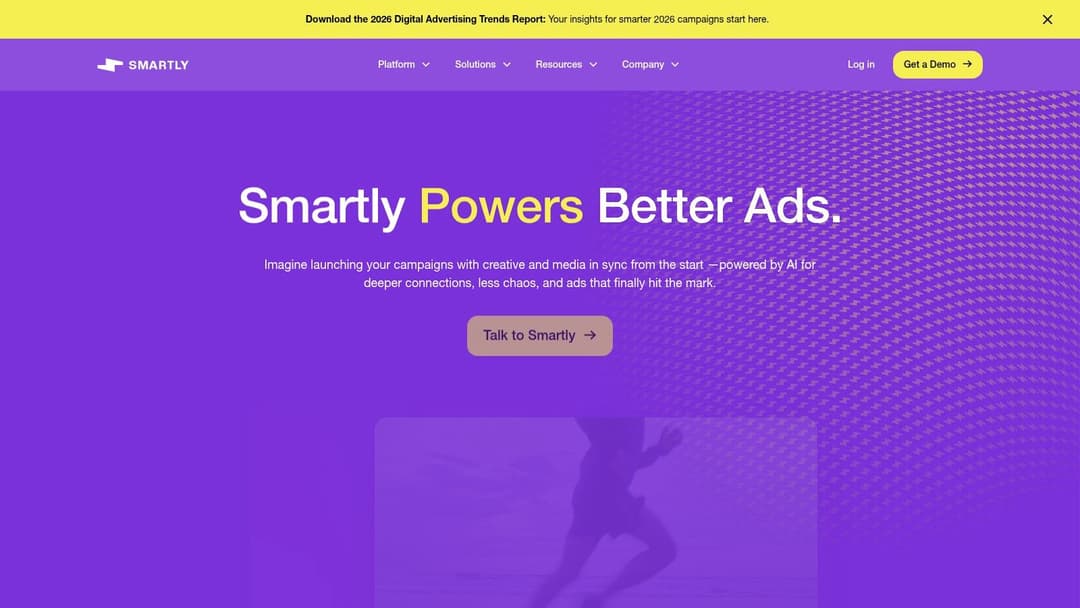
Unlike tools focused on a single part of the process, Smartly.io centralizes creative production and campaign execution into one unified workflow. Its AI-driven optimization engine uses rules-based automation to adjust bids and shift budgets toward the best-performing creatives and audiences, saving countless hours of manual campaign management.
Key Features & Use Cases
- Creative Automation: Use dynamic image and video templates to pull from product feeds or data sources, creating personalized ads for different segments. An e-commerce agency, for example, could automatically generate localized video ads featuring top-selling products for dozens of different regions.
- Cross-Channel Orchestration: Manage and automate campaigns across multiple social publishers from a single interface.
- Predictive Budget Allocation: The platform's AI analyzes performance data to recommend and automatically reallocate budgets to maximize ROI across campaigns.
- Automated Testing: Set up complex A/B and multivariate tests for creative, copy, and audience combinations with automated performance tracking.
Pricing & Implementation
Smartly.io operates on a custom pricing model, typically a percentage of ad spend with a monthly minimum fee. This structure makes it more suitable for agencies managing budgets in the tens of thousands per month or higher. There is no free trial, and access requires a sales demo and a custom quote. Integration is straightforward but requires dedicated setup time to connect ad accounts and data feeds properly.
| Feature | Pro | Con |
|---|---|---|
| Scale & Automation | Unmatched for high-volume creative production and testing. | The learning curve can be steep for new users. |
| Pricing Model | Predictable fee structure tied directly to managed ad spend. | Cost-prohibitive for smaller agencies or clients. |
| Cross-Channel Management | Centralizes campaign operations, reducing manual cross-platform work. | Focus is primarily on paid social, less on search or display. |
Website: https://www.smartly.io
3. Skai (formerly Kenshoo)
Skai is an enterprise-grade omnichannel advertising platform designed for agencies managing massive, complex media budgets. It excels at unifying search, retail media, social, and app advertising into a single dashboard. Powered by its proprietary Celeste AI, Skai provides sophisticated tools for planning, automation, and competitive analysis, making it a top-tier choice among ai tools for marketing agencies with large, multi-channel clients.
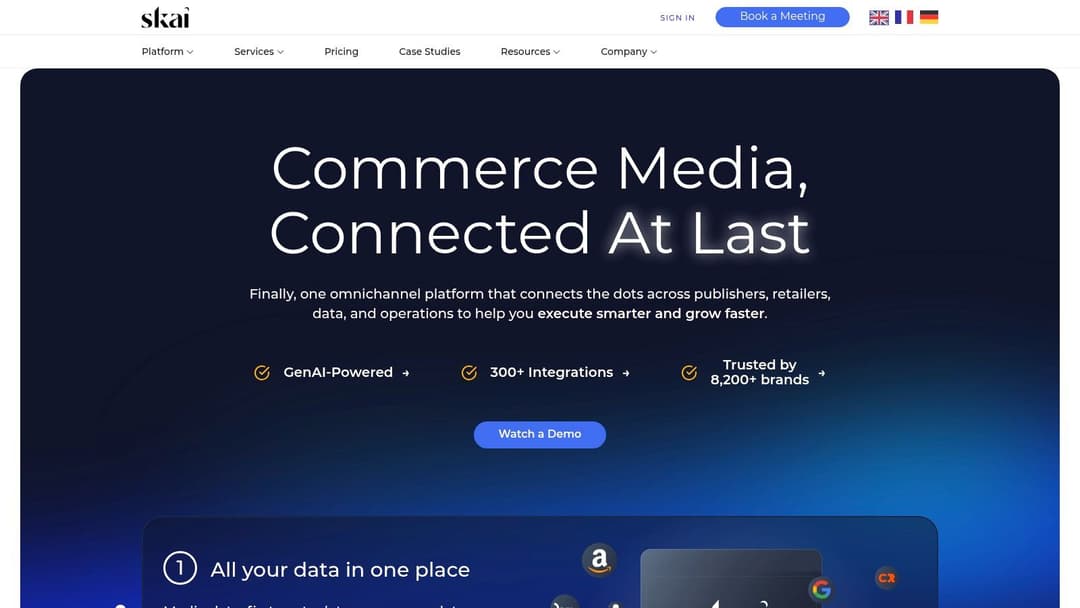
Unlike platforms specializing in one or two channels, Skai's strength is its breadth, covering over 120 publishers. Its AI engine focuses on strategic optimization, automating bids, budgets, and testing across the entire customer journey. This provides agencies with a holistic view of performance and the intelligence to make smarter, data-driven decisions at scale.
Key Features & Use Cases
- Omnichannel Campaign Management: Execute and manage campaigns across search engines (Google, Bing), retailers (Amazon, Walmart), social platforms (Meta, Pinterest), and app stores from one interface.
- AI-Driven Automation (Celeste AI): Use AI to automate bidding strategies, reallocate budgets based on performance predictions, and conduct automated campaign audits and quality assurance checks.
- Competitive Insights & Planning: Leverage market intelligence tools to analyze competitor strategies, identify market trends, and inform media planning before launching campaigns.
- Customer Journey Intelligence: Connect disparate data points to understand how different channels and touchpoints contribute to conversions, enabling more effective full-funnel strategies.
Pricing & Implementation
Skai’s pricing is geared toward large enterprises, with transparent flat annual platform fees tiered by spend. These fees typically start in the six-figure range annually, making it inaccessible for smaller agencies. Implementation is a significant undertaking, requiring dedicated resources to integrate ad accounts, data feeds, and analytics across its extensive network of publishers.
| Feature | Pro | Con |
|---|---|---|
| Omnichannel Coverage | Deep integration with 120+ publishers for complex account management. | Enterprise orientation means higher cost and complexity. |
| Pricing Model | Predictable flat annual fees help with large-scale budget planning. | The six-figure entry price is prohibitive for most small agencies. |
| AI & Automation | Sophisticated AI for strategic, cross-channel optimization. | Can be overkill and overly complex for less mature organizations. |
Website: https://skai.io
4. Madgicx
Madgicx is a specialized AI media buying platform designed to optimize and automate Meta ad campaigns, making it a strong contender among ai tools for marketing agencies focused on standardizing their paid social workflows. It provides a comprehensive suite of features, including AI-driven campaign audits, intelligent audience targeting, and powerful automation rules. The platform excels at translating complex performance data into actionable insights that save media buyers significant time.
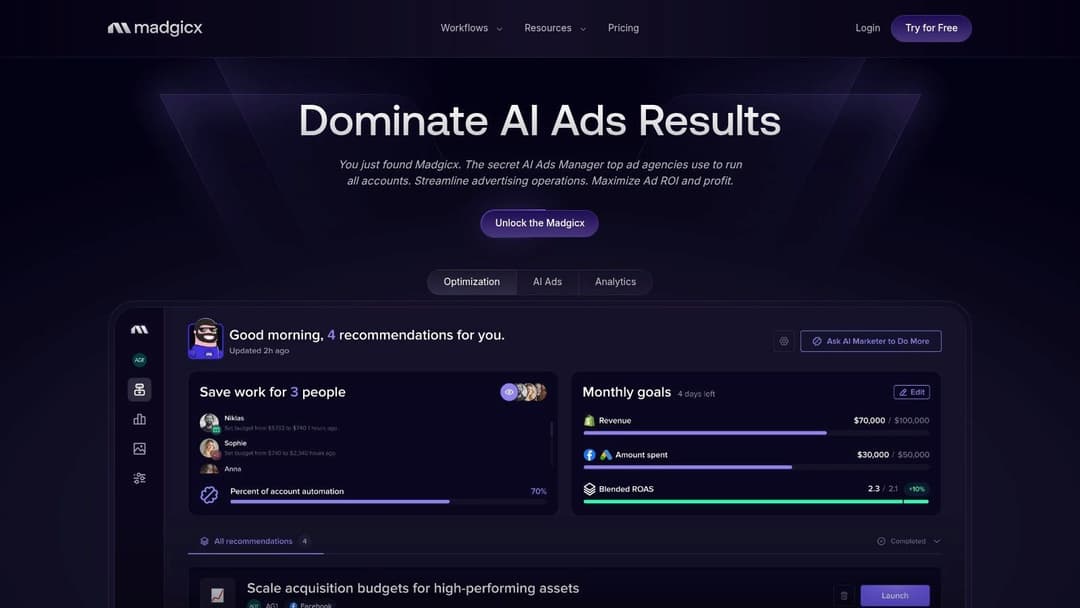
What sets Madgicx apart is its focus on providing a holistic Meta management experience. From AI-generated ad copy and creative analysis to one-click reporting and cloud tracking add-ons, it consolidates multiple functions that agencies would otherwise need separate tools for. This centralized approach helps streamline operations and improve campaign efficiency across client accounts.
Key Features & Use Cases
- 360° Meta Audits: Instantly analyze ad accounts to identify underperforming assets, audience overlap, and optimization opportunities. This is ideal for quickly onboarding new clients and establishing a baseline for improvement.
- AI Audience Building: Discover and launch new high-intent audiences based on your best-performing customer segments, moving beyond Meta's native targeting limitations.
- Automation Rules: Create custom rules to automatically pause low-performing ads, scale winning campaigns, and adjust budgets based on real-time KPIs like ROAS or CPA.
- Creative Testing: Use AI insights to understand which creative elements are driving results, a core principle also seen in dynamic creative optimization.
Pricing & Implementation
Madgicx offers tiered pricing that scales with monthly ad spend, with plans starting from a more accessible entry point compared to enterprise-level platforms. This makes it viable for both growing and established agencies. While there's a free trial available, some of the more advanced features, like cloud tracking or one-click reports, are sold as add-ons. Implementation involves connecting your Meta Ad Account, which is a straightforward process.
| Feature | Pro | Con |
|---|---|---|
| Specialization | Purpose-built for Meta, providing deep, platform-specific insights. | Limited utility for agencies managing campaigns on other channels. |
| Pricing Model | Tiered plans make it accessible for agencies of various sizes. | Advanced features requiring add-ons can increase the total cost. |
| Onboarding & Audits | AI-driven audits dramatically speed up new client analysis. | Some user reports mention friction with billing and refund processes. |
Website: https://madgicx.com
5. Revealbot
Revealbot empowers marketing agencies with granular, rules-based automation for paid ad campaigns on Meta, Google, and TikTok. Instead of a "black box" AI, it provides a transparent "if-this-then-that" logic that allows agencies to scale their best practices without ceding full control. This makes it one of the most practical ai tools for marketing agencies that need to automate routine optimizations like pausing underperforming ads, scaling winning ad sets, or adjusting bids based on custom KPIs.
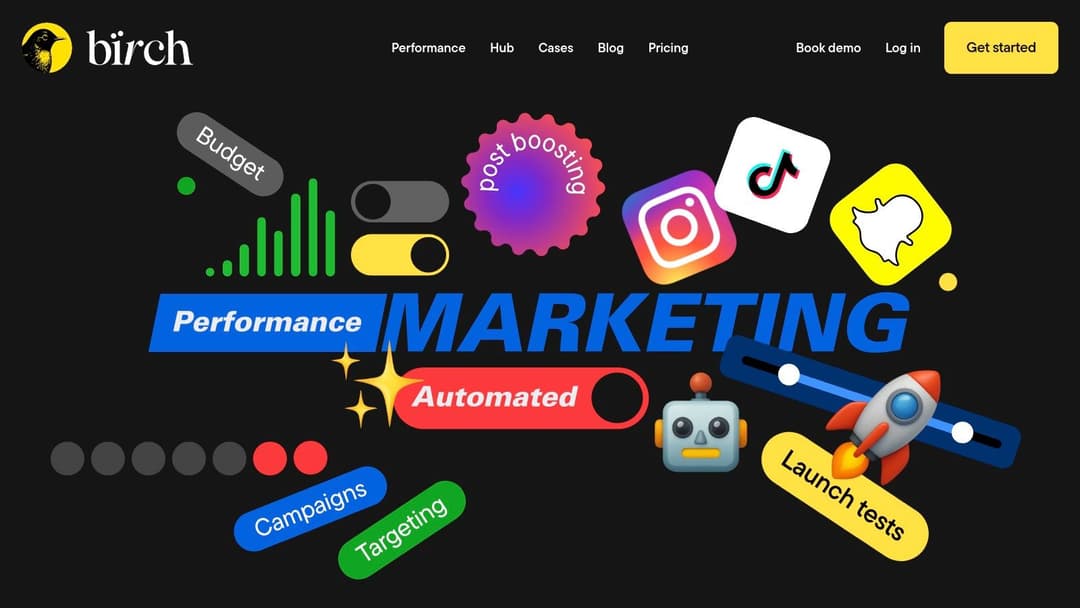
Unlike platforms that fully abstract campaign management, Revealbot gives media buyers the building blocks to construct their own automated workflows. This approach is ideal for agencies that have already identified successful strategies and now need a reliable way to execute them 24/7 across dozens of client accounts, ensuring consistent performance and freeing up strategists to focus on higher-level tasks.
Key Features & Use Cases
- Cross-Platform Automated Rules: Create custom rules based on any metric available in the ad platform's API. For example, an agency can automatically increase the budget by 20% on any ad set with a ROAS above 4.0 that has spent at least $50 in the last 24 hours.
- Auto-Boosting Posts: Set up rules to automatically promote top-performing organic posts based on engagement metrics like shares, comments, or reaction counts, turning organic wins into paid ads seamlessly.
- Bulk Creation & Management: Use a spreadsheet-like interface to create and edit hundreds of campaigns, ad sets, or ads at once, saving significant time on campaign setup and adjustments.
- Automated Reporting & Alerts: Configure custom alerts via Slack or email for important performance changes, like a sudden drop in CTR or a spike in CPA, enabling rapid response.
Pricing & Implementation
Revealbot offers tiered pricing based on monthly ad spend, starting from $99/month for up to $10,000 in spend. This makes it accessible for smaller and mid-sized agencies. A 14-day free trial is available to test the platform's full feature set. Implementation is straightforward, involving connecting ad accounts via API, but mastering the advanced rule builder requires a learning period to maximize its potential.
| Feature | Pro | Con |
|---|---|---|
| Control & Transparency | Rules-based system offers precise control over automation logic. | The learning curve can be steep for setting up complex rules. |
| Pricing Model | Accessible entry-level pricing and a generous 14-day free trial. | Advanced features are gated behind more expensive tiers. |
| Cross-Channel Management | Automates actions across Meta, Google, and TikTok from one place. | Focus is on rule-based execution, not creative generation. |
Website: https://revealbot.com
6. Optmyzr
Optmyzr is an advanced PPC management and optimization toolkit designed for agencies that need to scale their Google and Microsoft Ads operations efficiently. It acts as an intelligence layer on top of ad platforms, using AI-driven suggestions and rule-based automation to streamline complex campaign management tasks. This makes it an essential one of the ai tools for marketing agencies looking to standardize workflows and improve performance across a large portfolio of search-focused clients.
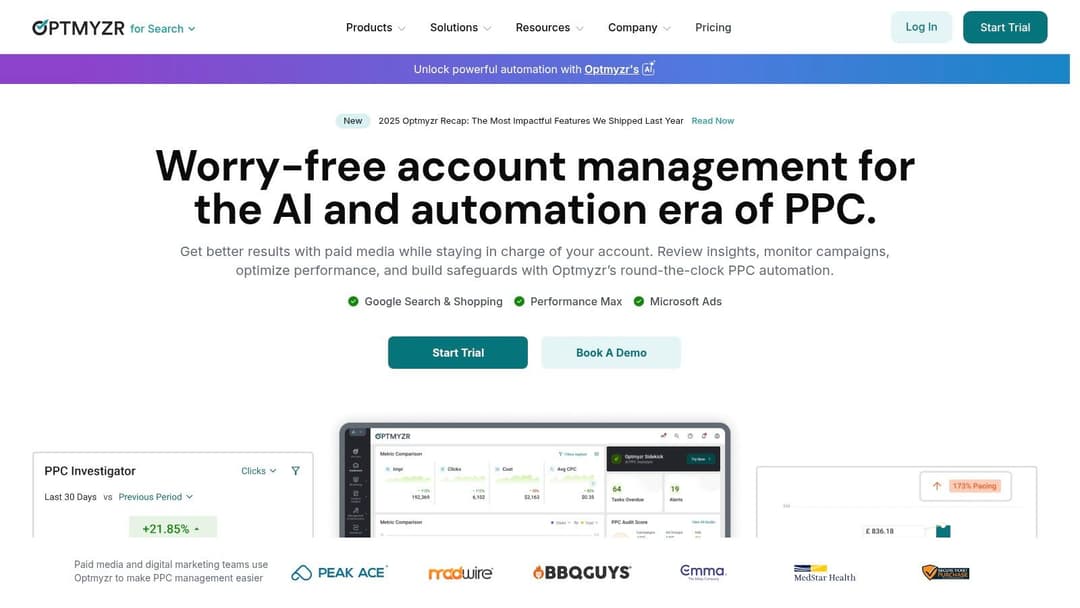
Unlike native ad platform tools, Optmyzr provides sophisticated scripts, alerts, and reporting templates that save hours of manual analysis. Its AI-powered "optimizations" identify opportunities for bid adjustments, keyword additions, and budget shifts, allowing account managers to implement vetted changes with a single click instead of digging through endless data tables.
Key Features & Use Cases
- One-Click Optimizations: The AI engine suggests specific improvements like adjusting bids for high-performing keywords, pausing underperforming ads, or adding negative keywords, which can be implemented instantly.
- Rule Engine & Automation: Agencies can create custom, multi-step "recipes" to automate routine tasks. For example, an agency could build a rule that automatically pauses any keyword with a CPA above $50 and below 2 conversions in the last 14 days.
- Enhanced Reporting: Build custom, white-labeled performance reports and dashboards for clients that go beyond the native reporting capabilities of Google Ads.
- PPC Policy & Alert System: Set up alerts to monitor accounts for anomalies, such as sudden drops in impressions or broken landing page URLs, ensuring issues are caught before they impact performance.
Pricing & Implementation
Optmyzr offers several tiered plans with both monthly and annual billing options, starting from a few hundred dollars per month, making it accessible to agencies of various sizes. They offer a 30-day money-back guarantee, allowing teams to test its value. Implementation involves securely connecting Google, Microsoft, and other ad accounts via API. While the core setup is quick, customizing the rule engine and reporting for specific agency workflows requires a dedicated investment of time.
| Feature | Pro | Con |
|---|---|---|
| Workflow Efficiency | Drastically reduces time spent on manual account checks. | Deeper automation frequencies can incur extra fees or overages. |
| Pricing & Accessibility | Flexible plans and a money-back guarantee lower entry barriers. | Social and Amazon Ads support requires purchasing separate add-ons. |
| Control & Customization | The Rule Engine allows for highly specific, custom automation. | Can feel overwhelming for beginners without a strong PPC background. |
Website: https://www.optmyzr.com
7. Jasper
Jasper is an AI content automation platform built specifically for the needs of marketing teams and agencies. It moves beyond simple text generation with features like agentic AI, collaborative workspaces, and strong brand governance. This allows agencies to accelerate on-brand content creation across multiple channels, from blog posts and social media updates to ad copy and email campaigns, making it a versatile choice among ai tools for marketing agencies.

What sets Jasper apart is its focus on enterprise-grade control and scalability. With its "Jasper IQ" features, agencies can ensure all generated content adheres to specific client brand voices, style guides, and product catalogs. This solves a major pain point of using generative AI in a professional setting: maintaining brand consistency across a high volume of outputs.
Key Features & Use Cases
- Marketing-Specific AI Agents: Deploy autonomous agents for tasks like SEO optimization, content personalization, and audience-specific copy generation. For instance, an agency can use an agent to rewrite a core piece of content for five different target personas.
- Canvas & Studio Workspaces: Build repeatable, no-code workflows for common content tasks, such as creating a complete blog post from a simple brief or generating a month's worth of social media content.
- Brand Governance (Jasper IQ): Upload brand guides, product information, and style rules to ensure the AI's output is always on-brand and factually accurate for each client.
- Content Creation: While tools like Jasper excel at general content creation, a specialized AI-powered LinkedIn Post Generator can streamline content for specific platforms.
Pricing & Implementation
Jasper offers several tiers, starting with a Creator plan for individuals. The Pro and Business tiers are designed for teams and agencies, offering more collaboration features, brand voices, and advanced workflow automation. Pricing is available on their website, with custom quotes for enterprise-level needs. Implementation is fast, but maximizing its value requires dedicating time to set up Jasper IQ with each client's specific brand assets and guidelines.
| Feature | Pro | Con |
|---|---|---|
| Brand Controls | Excellent for maintaining brand consistency across clients. | Advanced orchestration requires higher-priced Business tier. |
| Marketing Focus | Purpose-built for marketing operations and workflows. | Can be more complex than simpler, single-purpose writing tools. |
| Enterprise Security | Strong security posture suitable for sensitive client data. | Some key enterprise features are locked into top-tier plans. |
Website: https://www.jasper.ai
8. Copy.ai
Copy.ai positions itself as an AI-powered content and workflow platform, designed for agencies aiming to standardize and scale their content creation processes. It moves beyond simple text generation by offering an AI Agent Studio, which allows teams to build repeatable, brand-safe workflows for everything from ad copy and SEO briefs to sales emails. This focus on automated systems makes it a practical choice among ai tools for marketing agencies that need to enforce content consistency across multiple client accounts.
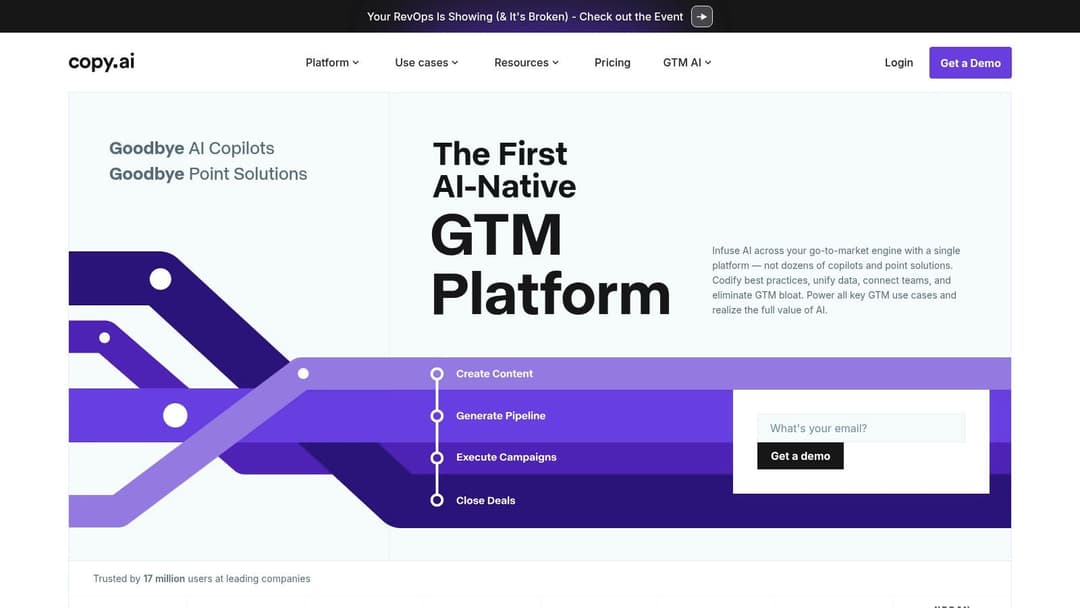
Unlike competitors that often lock users into a single model, Copy.ai provides multi-model access to leading LLMs like those from OpenAI, Anthropic, and Google. This flexibility allows agencies to choose the best model for a specific task, whether it's creative brainstorming or data analysis. Its brand guardrails and project-based organization are particularly useful for keeping client work separated and aligned with distinct brand voices. For agencies exploring alternatives in this space, here is a detailed comparison of Jasper AI alternatives.
Key Features & Use Cases
- AI Agent Studio: Build custom, repeatable workflows for common agency tasks. For example, create an agent that takes a simple product description and automatically generates a full set of ad copy, social media posts, and a short promotional email.
- Brand Voice Guardrails: Define specific brand tones, styles, and key information for each client to ensure all AI-generated content remains consistent and on-brand.
- Multi-Model Access: Flexibly switch between different large language models to optimize for cost, speed, or creative output for any given task.
- Workflow Automation: Use workflow credits to automate content pipelines, such as generating SEO-optimized blog outlines from a list of keywords.
Pricing & Implementation
Copy.ai offers a free plan with a word limit, a Pro plan for individuals at $49/month, and a Team plan at $249/month for small teams, which includes more workflow credits. Enterprise solutions are available with custom pricing. The platform is web-based and requires no complex setup; agencies can get started quickly by creating projects and defining brand voices for their clients.
| Feature | Pro | Con |
|---|---|---|
| Flexibility | Multi-model access provides versatility for different content needs. | Workflow credits can cap the volume of automation on lower-tier plans. |
| Ease of Use | Intuitive interface with fast setup for new clients and projects. | Advanced workflow creation requires a learning curve to master. |
| Pricing & Scalability | Affordable entry points make it accessible for smaller agencies. | High-volume automation can become costly without an enterprise plan. |
Website: https://www.copy.ai
9. HubSpot Marketing Hub
HubSpot Marketing Hub is an all-in-one, CRM-native platform where marketing automation is deeply integrated with sales and service functions. Its AI features assist with content creation, lead scoring, and campaign optimization, making it one of the most comprehensive ai tools for marketing agencies that need a unified client management and execution system. The platform’s strength is its ability to connect every marketing action directly to a customer record, providing a complete lifecycle view.

Unlike point solutions, HubSpot centralizes everything from email and landing pages to ad management and reporting within its CRM. This allows agencies to not only execute campaigns but also to demonstrate their direct impact on leads, deals, and revenue, strengthening client relationships. Its AI-powered features, like the campaign assistant for generating great ad copy, help streamline creative workflows directly within the platform.
Key Features & Use Cases
- AI-Assisted Content Creation: Generate copy for emails, landing pages, and social media posts, or create entire blog outlines with AI assistance.
- Predictive Lead Scoring: Use AI to automatically score leads based on their likelihood to close, helping sales teams prioritize outreach.
- Workflow & Sequence Automation: Build complex, trigger-based marketing automation workflows to nurture leads through the entire funnel.
- Integrated CRM & Reporting: Connect all marketing activities to customer data for advanced attribution reporting and a single source of truth.
- Agency Partner Program: Access dedicated agency resources, training, and client management tools for streamlined operations.
Pricing & Implementation
HubSpot's pricing is tiered (Starter, Professional, Enterprise) and based on the number of marketing contacts. While the Starter plan is accessible, the Professional and Enterprise tiers, which contain most advanced AI features, require significant investment and mandatory onboarding fees. Implementation is extensive but well-supported, requiring careful planning to migrate data and set up client portals.
| Feature | Pro | Con |
|---|---|---|
| Integration | All-in-one platform connects marketing, sales, and service data. | Can feel overly complex if only using marketing features. |
| Pricing Model | Clear packaging by team maturity and feature needs. | Contact-based pricing can escalate costs quickly as lists grow. |
| Agency Support | Robust partner program with extensive training and resources. | Mandatory onboarding fees for Pro/Enterprise plans are costly. |
Website: https://www.hubspot.com/products/marketing
10. Semrush
Semrush is an all-in-one marketing suite that has evolved into an AI-assisted powerhouse for SEO, content, and competitive intelligence. For agencies, it serves as a central hub for keyword research, competitor analysis, site audits, and rank tracking. Its AI features, like the SEO Writing Assistant and topic research tools, are designed to streamline content operations, making it one of the most comprehensive ai tools for marketing agencies focused on organic growth.
What sets Semrush apart is the breadth of its toolkit. An agency can move from performing a technical site audit to generating an AI-powered content brief and tracking SERP visibility all within the same platform. This integration eliminates the need for multiple single-purpose tools, providing a unified data source for client reporting and strategic planning.
Key Features & Use Cases
- AI-Powered Content Briefs: Generate detailed content outlines based on top-ranking competitors for a target keyword, including recommended word count, semantics, and questions to answer. This is perfect for briefing content writers and ensuring SEO alignment from the start.
- Keyword & Competitor Research: Use AI to uncover keyword gaps, analyze competitor backlink profiles, and identify new content opportunities.
- SEO Writing Assistant: Get real-time feedback on content drafts for readability, tone of voice, SEO optimization, and originality directly within Google Docs or WordPress.
- Rank & Visibility Tracking: Monitor daily keyword rankings and overall search visibility for clients, with automated reporting features suitable for agency workflows.
Pricing & Implementation
Semrush offers tiered monthly subscriptions (Pro, Guru, Business) starting around $129.95/month, with pricing increasing based on the number of projects, keywords tracked, and features. Many valuable tools, like social media scheduling and local listings, are paid add-ons. There is a limited free trial available. Implementation is simple: just connect a client's domain and Google Analytics/Search Console accounts to start gathering data.
| Feature | Pro | Con |
|---|---|---|
| Toolkit Breadth | A vast range of SEO and content tools are available under one login. | Add-ons and extra user seats can make the total cost high. |
| Agency Features | Strong reporting, project management, and client visibility controls. | The platform can feel overwhelming for beginners due to its scope. |
| Market Stability | A long-standing, stable platform with continuous AI-driven updates. | The potential acquisition by Adobe may lead to future packaging changes. |
Website: https://www.semrush.com
11. Hootsuite
Hootsuite is a veteran social media management platform that has evolved to incorporate AI, making it a foundational tool for agencies managing numerous client profiles. Its strength lies in centralizing social media workflows, from content creation and scheduling to engagement and reporting. For agencies looking to streamline operations, Hootsuite provides a unified dashboard that prevents the chaos of logging into multiple native platforms.
Unlike hyper-specialized AI writing tools, Hootsuite integrates its AI assistant, OwlyWriter AI, directly into the content creation process. This allows teams to generate captions, find content ideas, and repurpose top-performing posts directly within their scheduling workflow. This integration of creation and execution makes it one of the more practical ai tools for marketing agencies focused on daily social media management. For a broader view, you can discover more about the social media advertising software landscape.
Key Features & Use Cases
- AI-Powered Content Creation: Use OwlyWriter AI to instantly generate platform-specific captions, post ideas, and hashtags, overcoming creative blocks and saving time. An agency could use it to create five different caption variations for a client's campaign in seconds.
- Smart Scheduling: The "Best Time to Post" feature analyzes audience engagement patterns to recommend optimal publishing times, maximizing organic reach.
- Unified Inbox: Manage comments, direct messages, and mentions from all connected social profiles in a single stream, ensuring timely client engagement.
- Team Collaboration & Approvals: Set up custom approval workflows, allowing junior team members to draft posts and have them reviewed by managers or clients before publishing.
Pricing & Implementation
Hootsuite offers several tiered plans, including Professional and Team plans, with a 30-day free trial available. Pricing typically starts around $99/month, scaling up based on the number of users and social profiles. Enterprise-level features and advanced analytics often require a custom quote. Implementation is user-friendly, involving connecting social profiles via secure OAuth, which can be done in minutes.
| Feature | Pro | Con |
|---|---|---|
| Workflow Efficiency | Excellent for centralizing scheduling and engagement. | Advanced analytics and listening are often locked in higher tiers. |
| Pricing & Accessibility | Clear pricing tiers and a free trial make it easy to start. | Can become expensive as teams and client accounts scale. |
| AI Integration | AI assistant is seamlessly integrated into the composer. | AI features are more for assistance than deep strategic analysis. |
Website: https://www.hootsuite.com
12. G2
While not an AI tool itself, G2 is an indispensable marketplace for discovering, comparing, and vetting them. For agencies, it serves as a crucial first step in the procurement process, offering a comprehensive landscape of available software. Its strength lies in aggregating user-verified reviews, detailed feature comparisons, and category-specific grids, allowing agencies to efficiently shortlist the best ai tools for marketing agencies based on client size, industry, and specific needs.
G2’s value extends beyond simple listings. Its regularly updated taxonomy means new categories like "AI Sales Assistants" or "Generative AI Platforms" are constantly added, reflecting the fast-moving market. This helps agencies stay ahead of the curve and find niche solutions they might otherwise miss. The platform's comparison grids are particularly useful for creating a business case for a new tool purchase for a client.
Key Features & Use Cases
- Category Research & Filtering: Use dedicated category pages (e.g., "Marketing Automation") with advanced filters for company size, industry, and feature requirements to narrow down options. An agency could filter for AI content tools that integrate with HubSpot for mid-market B2B clients.
- Verified Reviews & Ratings: Read authentic, in-depth reviews from real users to understand a tool's practical strengths and weaknesses beyond the marketing copy.
- Competitor & Alternative Analysis: Each product page includes a grid of top alternatives, providing a quick way to benchmark features and user satisfaction scores against direct competitors.
- Buyer Intent Data: For vendors, G2 offers data on which companies are researching their products, but for agencies, this signals market trends and popular tool stacks.
Pricing & Implementation
G2 is free to use for browsing, researching, and comparing software. Pricing information for the tools listed is often provided by the vendors and can range from transparent tiers to "request a quote." Implementation is not applicable, as G2 is a research platform, not a SaaS tool to be integrated. Its primary function is to facilitate the decision-making process before implementation begins.
| Feature | Pro | Con |
|---|---|---|
| Vendor Coverage | Extremely broad, covering established leaders and new entrants. | Listings rely on vendor-provided information, which can be biased. |
| User Reviews | Verified reviews provide invaluable, real-world insights. | Review quality can vary; some are less detailed than others. |
| Ease of Comparison | Comparison grids make side-by-side feature analysis simple. | Pricing information is not always available directly on the site. |
Website: https://www.g2.com
Top 12 AI Marketing Tools Comparison
| Platform | Core features | Target audience | Unique selling points | Price & trial |
|---|---|---|---|---|
| AdStellar AI (Recommended) | AI-powered bulk creative, copy & audience generation; Meta OAuth ingest; AI Insights & AI Launch | Performance marketers, growth teams, e‑commerce/DTC, agencies, B2B SaaS | Generate 100s of variations in minutes; ranks creatives by ROAS/CPL/CPA; auto‑launch & scale winners; centralized workflows | Pricing not public — demo/trial on request |
| Smartly.io | Template-driven image/video automation; cross-channel campaign orchestration; automated testing | Agencies and high‑volume advertisers across social channels | Cross‑publisher creative automation; Adobe CC integration; built for large scale | Percent-of-spend pricing with monthly minimum; custom quotes; no free trial |
| Skai (formerly Kenshoo) | Omnichannel (120+ publishers); AI-driven optimization (Celeste); planning & competitive insights | Enterprises and agencies with multi‑million media budgets | Enterprise-grade omnichannel coverage and deep analytics | Enterprise pricing (often six‑figure annual); custom quotes |
| Madgicx | Meta-focused AI audits, audience building, automation rules, creative testing | Meta performance marketers and agencies | Meta partner; 360° audit dashboards; AI assistants for ad generation | Tiered pricing by spend; entry plans available; add-ons for advanced features |
| Revealbot | Cross-platform automated rules, bulk edits, auto‑boosting, alerts | Agencies needing granular automation across Meta/Google/TikTok | Strong cost-to-value for mid-market; scalable rules & auto‑boosting | Mid-market pricing; 14‑day free trial |
| Optmyzr | PPC Rule Engine, Campaign Automator, AI Blueprints; add-ons for Social/Amazon | Search-focused agencies and enterprises | Repeatable AI blueprints; flexible billing; SSO/API for enterprise | Monthly/annual plans; 30‑day money‑back guarantee; social via add‑on |
| Jasper | AI content agents, Canvas workflows, brand governance (Jasper IQ) | Agencies and marketing teams producing multi‑channel copy | Marketing-specific agents, brand controls, enterprise security | Tiered plans; Business/Enterprise for advanced orchestration |
| Copy.ai | Multi-model agents, Content Agent Studio, brand guardrails, unlimited chat | Small agencies and teams needing fast copy workflows | Affordable entry plan; agent-driven workflows; quick setup | Transparent affordable entry plans; workflow credits on mid tiers |
| HubSpot Marketing Hub | CRM-native ads management, automation, personalization, reporting | Agencies wanting integrated CRM + marketing governance | Deep ecosystem, client governance, agency training & support | Starter/Pro/Enterprise tiers; onboarding fees at higher levels; contact‑based pricing |
| Semrush | Keyword & competitor research, site audits, content briefs, rank tracking | SEO/content agencies and research teams | Broad SEO & competitive toolkit with agency controls | Subscription with add‑ons; extra users/add‑ons increase cost |
| Hootsuite | Post scheduling, unified inbox, AI caption tools, basic listening | Agencies managing many social profiles | Robust multi‑profile management and team workflows | Tiered plans; trials and nonprofit discounts; enterprise quotes for advanced features |
| G2 | Category pages, verified reviews, comparison grids, buyer intent data | Agencies shortlisting and benchmarking marketing tools | Large vendor coverage and review-driven comparisons | Free for buyers; vendor listing and premium features vary by vendor |
Building Your Agency's AI-Powered Future
Navigating the landscape of AI tools for marketing agencies can feel like exploring a new frontier. We've journeyed through a comprehensive list of platforms, from specialized ad automation powerhouses like AdStellar AI and Smartly.io to content creation engines like Jasper and all-in-one marketing hubs like HubSpot. The central theme is clear: AI is no longer a futuristic concept but a present-day imperative for agencies striving for efficiency, scalability, and superior client outcomes. The era of manual campaign builds, endless A/B testing spreadsheets, and gut-feeling optimizations is rapidly giving way to data-driven, automated workflows that free up your most valuable resource: your team's strategic expertise.
The key takeaway is not to adopt AI for its own sake, but to use it as a strategic lever. The most successful agencies will be those that thoughtfully integrate these technologies to solve specific, persistent bottlenecks. Adopting the right suite of AI tools for marketing agencies isn't about replacing human talent; it's about augmenting it, allowing your team to focus on high-value activities like client strategy, creative direction, and relationship management, while the machines handle the repetitive, data-heavy lifting.
Your Action Plan: How to Build Your Agency's AI Stack
So, where do you begin? The sheer number of options can be paralyzing. Instead of getting overwhelmed, approach this as a strategic initiative. Use the following steps to build a customized, effective AI toolkit that aligns with your agency’s unique needs and goals.
Conduct an Internal Workflow Audit: Before you even look at a demo, map out your agency's core processes. Identify the most time-consuming, repetitive, and error-prone tasks. Is your team spending 10 hours a week manually creating ad variations for Meta campaigns? Is client reporting a multi-day ordeal every month? Pinpointing these pain points will give you a clear target for your AI tool search.
Prioritize Based on Impact: Once you have your list of bottlenecks, prioritize them based on their impact on profitability and client satisfaction. A tool that automates the entire Meta ad creation and testing process, like AdStellar AI, could offer a massive and immediate return on investment by slashing campaign launch times and improving ad performance. In contrast, a tool that only slightly speeds up a minor task might not be worth the initial investment and training time.
Start Small and Specialized: Don't try to implement five new platforms at once. Select one or two high-priority areas and trial specialized tools first. For agencies heavily focused on paid social, starting with a platform dedicated to Meta ad automation is a logical first step. This focused approach allows for easier implementation, clearer measurement of ROI, and less disruption to your existing workflows.
Evaluate Integration Capabilities: Your AI stack should work as a cohesive ecosystem, not a collection of siloed platforms. As you evaluate options, pay close attention to their integration capabilities. Can your chosen ad tool connect with your reporting dashboard? Does your content AI sync with your project management software? Seamless data flow between tools is critical for maximizing efficiency and unlocking deeper insights.
Final Thoughts: From Adoption to Transformation
The integration of AI tools for marketing agencies is more than just a technological upgrade; it represents a fundamental shift in how modern agencies operate and deliver value. By automating the mundane and providing access to predictive insights, AI empowers your team to perform at a higher strategic level. It transforms your agency from a service provider executing tasks into a proactive partner driving measurable business growth for your clients.
The future of agency work belongs to those who embrace this transformation. By strategically building your AI stack, you're not just staying competitive; you are redefining what's possible, future-proofing your business, and setting a new standard for excellence in the digital marketing landscape.
Ready to eliminate the biggest bottleneck in your Meta advertising workflow? AdStellar AI automates the entire ad creation, testing, and launch process in minutes, allowing your agency to focus on strategy and scale client results. See how our specialized AI can transform your paid social operations by visiting AdStellar AI and booking a demo today.