Facebook ad campaign structures can make or break your advertising results. The difference between a well-architected campaign and a haphazard one often determines whether you're scaling profitably or burning budget on inefficient setups. Traditional manual structuring requires deep platform expertise, countless hours of configuration work, and constant second-guessing about whether you've made optimal choices.
AI-powered ad structure builders are fundamentally changing how digital marketers approach campaign architecture. Instead of manually configuring every campaign element and hoping for the best, AI systems analyze historical performance patterns, audience behaviors, and creative combinations to build optimized structures in minutes. The result? Campaign frameworks that are both strategically sound and operationally scalable.
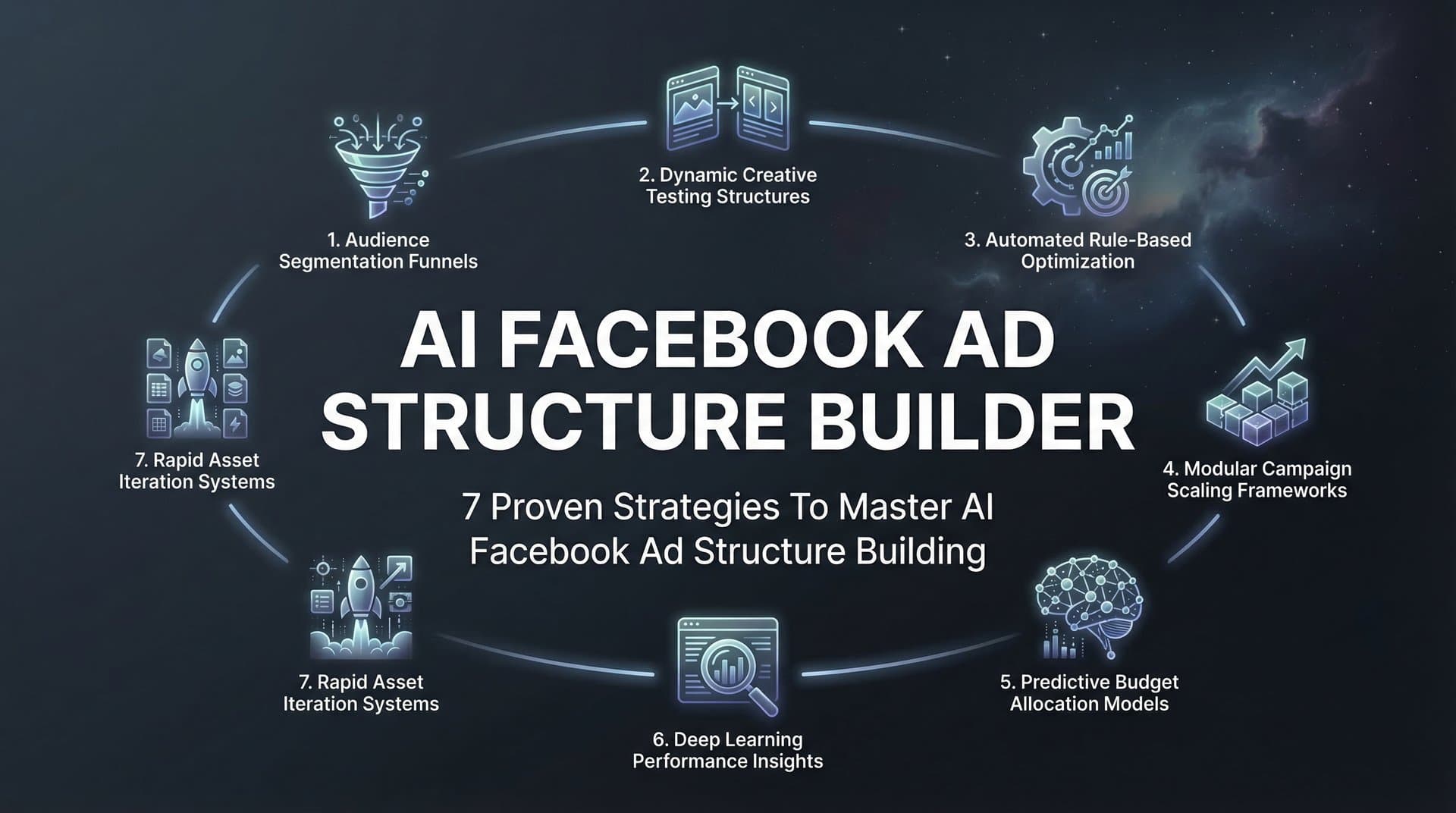
This guide walks through seven proven strategies for mastering AI-driven Facebook ad structure building. These aren't theoretical concepts—they're practical approaches that digital marketers and agencies are using right now to create high-performing campaign architectures that deliver measurable results while dramatically reducing setup time.
1. Start with Historical Performance Data Integration
The Challenge It Solves
Most marketers build new campaign structures in a vacuum, relying on intuition or generic best practices rather than their own proven performance data. This approach ignores the most valuable intelligence available: what has actually worked in your specific account with your actual audiences and creatives.
Without historical data integration, you're essentially starting from scratch with each new campaign, repeating past mistakes and missing opportunities to leverage your winners. The setup process becomes slower and the outcomes more unpredictable.
The Strategy Explained
AI structure builders that connect directly to your Meta account can analyze months or years of campaign performance data before suggesting a single structural decision. These systems examine which audience configurations drove the best results, which creative formats generated the highest engagement, and which budget allocations yielded optimal ROAS.
The AI then uses these insights to inform every structural choice—from how many ad sets to create, to which audience segments deserve their own dedicated structure, to which creative combinations merit testing. This data-driven foundation transforms campaign building from guesswork into strategic architecture based on proven performance patterns.
Platforms like AdStellar AI's Page Analyzer agent specifically review your historical campaign data to identify top-performing elements before the Structure Architect agent begins building your campaign framework. This sequential analysis ensures that structural decisions are grounded in real performance intelligence rather than generic templates.
Implementation Steps
1. Connect your Meta advertising account to your AI structure builder through secure API integration, ensuring the system has access to historical campaign performance data spanning at least 90 days for meaningful pattern recognition.
2. Allow the AI to complete its initial analysis phase, which typically involves examining creative performance metrics, audience response patterns, conversion data, and budget efficiency across your past campaigns.
3. Review the AI's performance insights and top-performing element recommendations before proceeding to structure building, ensuring you understand which historical patterns are informing the proposed architecture.
Pro Tips
The quality of AI recommendations directly correlates with the quality and quantity of historical data available. If you're working with a newer account, consider running a diverse initial campaign to generate performance data that future AI builds can learn from. Also, regularly refresh your data connections to ensure the AI is working with your most recent performance patterns rather than outdated information.
2. Use AI-Driven Audience Segmentation Architecture
The Challenge It Solves
Manual audience structuring often results in either overly broad ad sets that lack precision or excessively fragmented structures that prevent campaigns from achieving optimization velocity. Marketers struggle to determine which audience segments warrant their own ad sets versus which should be combined, leading to inefficient campaign architectures.
This guesswork becomes especially problematic when scaling. What worked as a simple three-ad-set structure at $500/day might completely break down at $5,000/day, requiring painful restructuring mid-campaign.
The Strategy Explained
AI-powered targeting strategists analyze behavioral patterns across your historical audience data to identify natural segmentation opportunities that actually matter for performance. Rather than arbitrarily splitting audiences by demographics or interests, the AI identifies which segmentation approaches have historically produced meaningfully different performance outcomes.
The system examines conversion patterns, engagement behaviors, and response rates across different audience characteristics to determine optimal ad set architecture. If two audience segments consistently perform similarly, the AI recommends combining them into a single ad set for better optimization. If distinct behavioral patterns emerge, it suggests separate ad sets with tailored approaches.
This creates campaign structures where each ad set has a clear strategic purpose backed by performance data. The Targeting Strategist agent in systems like AdStellar AI specifically handles this analysis, building audience architectures that balance precision with optimization efficiency. Understanding campaign structure best practices becomes essential when implementing these AI-driven recommendations.
Implementation Steps
1. Provide the AI with comprehensive audience performance data, including conversion rates, engagement metrics, and cost efficiency across different demographic segments, interest categories, and behavioral groups from your historical campaigns.
2. Review the AI's recommended audience segmentation architecture, paying attention to the rationale for why certain segments are separated versus combined—transparency in these decisions is crucial for understanding the strategy.
3. Implement the recommended structure while maintaining clear naming conventions for each ad set that reflects its specific audience focus, making future optimization and analysis more straightforward.
Pro Tips
Don't override AI audience recommendations based purely on assumptions about how audiences "should" be structured. The AI's suggestions are based on actual performance patterns, which often contradict conventional wisdom. That said, do review the reasoning behind each segmentation decision to ensure it aligns with your strategic objectives and market knowledge.
3. Implement Modular Creative Testing Frameworks
The Challenge It Solves
Creative testing often becomes a chaotic mess when campaign structures aren't designed for systematic experimentation. Marketers launch multiple creative variations without clear attribution frameworks, making it nearly impossible to determine which specific elements—headlines, images, copy angles—are actually driving performance differences.
The result is wasted ad spend on unclear tests and missed opportunities to scale winning creative elements. Without proper structural frameworks, even successful creative tests fail to generate actionable insights for future campaigns.
The Strategy Explained
AI structure builders can create modular campaign architectures specifically designed for creative testing with clear attribution. This means structuring ad sets in ways that isolate creative variables while maintaining statistical validity, allowing you to definitively identify which creative elements drive results.
The AI analyzes your historical creative performance data to curate testing variations based on proven winners. Rather than testing random creative combinations, the system identifies which image styles, headline formulas, and copy approaches have historically performed well, then structures tests around variations of these winning elements.
Systems like AdStellar AI's Creative Curator and Copywriter agents work together to build these testing frameworks. The Creative Curator identifies top-performing visual elements from your history, while the Copywriter generates headline and copy variations based on proven messaging patterns. The Structure Architect then organizes these elements into a campaign framework that enables clear performance attribution. For agencies managing multiple clients, leveraging a campaign builder designed for agencies streamlines this entire process.
Implementation Steps
1. Define your creative testing priorities by identifying which elements you most need to validate—whether that's headline approaches, visual styles, offer positioning, or call-to-action variations—and communicate these priorities to your AI structure builder.
2. Allow the AI to structure ad sets that isolate these creative variables while maintaining enough traffic volume for statistical significance, typically by grouping similar audiences and varying only the creative elements you're testing.
3. Establish clear naming conventions that reflect the creative elements being tested in each ad, making it easy to analyze results and identify winning patterns across your campaign structure.
Pro Tips
Resist the temptation to test too many creative variables simultaneously. Even with AI-powered structure building, testing everything at once dilutes your budget and extends the time needed to reach statistical significance. Focus your testing frameworks on one or two key variables per campaign cycle, then build on those learnings in subsequent campaigns.
4. Apply Intelligent Budget Allocation Across Ad Sets
The Challenge It Solves
Manual budget distribution across ad sets typically relies on arbitrary splits or rough estimates rather than data-driven predictions. Marketers often allocate equal budgets to all ad sets regardless of their performance potential, or make gut-feel adjustments that may not align with actual opportunity.
This approach leaves money on the table by underfunding high-potential ad sets while overspending on segments unlikely to deliver strong returns. The structural inefficiency compounds over time, especially as campaigns scale and budget allocation decisions become more complex.
The Strategy Explained
AI-powered budget allocation analyzes predicted performance potential across your campaign structure to distribute spend strategically rather than uniformly. The system examines historical conversion rates, audience responsiveness, creative performance, and competitive dynamics to forecast which ad sets are most likely to deliver efficient results at different budget levels.
Rather than splitting your total budget evenly or using simple percentage allocations, the AI assigns budgets based on expected return potential. Ad sets targeting proven high-converting audiences with strong creative might receive larger initial allocations, while experimental segments get smaller test budgets until they demonstrate performance.
The Budget Allocator agent in platforms like AdStellar AI handles this strategic distribution, structuring campaigns where budget flows toward opportunity rather than being arbitrarily divided. This creates campaign architectures that are inherently more efficient from launch, with spending aligned to performance potential. Many marketers find that understanding how ad campaign structure works helps them better interpret these AI-driven allocation decisions.
Implementation Steps
1. Input your total campaign budget and any strategic constraints into your AI structure builder, including minimum test budgets for new segments and maximum allocations for individual ad sets based on your risk tolerance.
2. Review the AI's recommended budget distribution across your campaign structure, paying attention to the reasoning behind larger or smaller allocations to specific ad sets—this transparency helps you understand the strategic logic.
3. Monitor early performance data and allow the AI to suggest reallocation adjustments as actual results validate or contradict initial predictions, creating a dynamic budget structure that adapts to real-world performance.
Pro Tips
While AI budget allocation is powerful, maintain some manual oversight during the first few days of campaign launch. If an ad set significantly underperforms or outperforms predictions, you may want to accelerate budget adjustments beyond the AI's conservative reallocation pace. The goal is combining AI efficiency with human strategic judgment.
5. Build Scalable Campaign Hierarchies from Day One
The Challenge It Solves
Many marketers build campaign structures that work perfectly at current spend levels but completely break down when scaling. A campaign architecture optimized for $1,000/day often becomes inefficient or unmanageable at $10,000/day, forcing painful mid-flight restructuring that disrupts performance and wastes the learning phase progress.
This reactive approach to campaign structure creates unnecessary complexity and missed opportunities. By the time you realize your structure can't scale, you've already invested significant budget in a framework that needs rebuilding.
The Strategy Explained
AI structure builders can design campaign hierarchies with scalability built into the architecture from the start. This means creating structures that maintain efficiency and manageability across different budget levels, with clear pathways for adding new ad sets, testing additional audiences, and expanding creative variations without disrupting the core framework.
The AI considers factors like audience size, budget requirements for optimization, and creative testing capacity to build structures that can grow organically. Rather than creating fragile architectures that only work at specific budget levels, the system designs frameworks with room for expansion—whether that's through additional ad sets, increased budgets, or new creative variations.
This forward-looking approach means your campaign structure at launch is already prepared for 2×, 5×, or 10× scale. The hierarchy makes logical sense at any budget level, and you can add new elements without restructuring the foundation. Using ad structure templates as a starting point can accelerate this process significantly.
Implementation Steps
1. Communicate your growth objectives to your AI structure builder, including target budget levels you expect to reach in the next 3-6 months and any planned expansion into new audiences or markets that will require additional ad sets.
2. Review the proposed campaign hierarchy to ensure it includes logical groupings that can accommodate future additions—for example, campaign-level structures organized by funnel stage or product line rather than arbitrary divisions that limit growth.
3. Establish naming conventions and organizational systems that will remain clear and manageable even as your campaign structure grows to include dozens of ad sets and hundreds of ads.
Pro Tips
Think beyond your immediate launch needs when approving AI-generated structures. A slightly more complex architecture that accommodates future growth is often better than a simpler structure that will need complete rebuilding in three months. Ask your AI system to explain how the proposed structure will handle specific scaling scenarios you anticipate.
6. Leverage Bulk Launch Capabilities for Speed
The Challenge It Solves
Manual campaign building is painfully slow, especially when you need to launch multiple ad variations across different ad sets. Creating dozens or hundreds of ads individually through Facebook's interface can take hours or even days, during which market conditions change and opportunities slip away.
This time constraint often forces marketers to launch smaller, less comprehensive tests than they'd prefer. Speed limitations become strategic limitations, preventing you from executing the full scope of your testing and optimization plans.
The Strategy Explained
AI-powered bulk launch capabilities allow you to deploy complete campaign structures—with multiple ad sets and numerous ad variations—in minutes rather than hours. The system builds entire campaign architectures simultaneously, creating all necessary combinations of audiences, creatives, and copy variations based on your strategic framework.
This isn't just about speed for speed's sake. Bulk launching enables more comprehensive testing strategies that would be impractical manually. You can launch 50 ad variations testing different creative and copy combinations across multiple audience segments in the time it would take to manually build 5 ads. The advantages of campaign structure automation become immediately apparent when deploying at this scale.
The key is maintaining quality and strategic consistency while achieving this speed. AI systems like AdStellar AI's bulk launch functionality ensure that every ad follows your brand guidelines, includes proper tracking parameters, and aligns with the overall campaign strategy—even when deploying hundreds of variations simultaneously.
Implementation Steps
1. Define your bulk launch parameters by specifying which creative elements, copy variations, and audience segments should be combined, along with any constraints like maximum ads per ad set or required creative-audience pairings.
2. Review the AI's proposed bulk structure before launching to verify that the combinations make strategic sense and that naming conventions will allow clear performance analysis—this quality check prevents launching dozens of poorly organized ads.
3. Execute the bulk launch during optimal timing windows for your audience, recognizing that deploying comprehensive campaign structures quickly allows you to capitalize on time-sensitive opportunities or market conditions.
Pro Tips
While bulk launching is powerful, avoid the temptation to launch everything possible just because you can. More ads aren't always better—each ad needs sufficient budget to exit the learning phase and generate meaningful data. Use bulk capabilities strategically to deploy well-planned test matrices, not to create overwhelming campaign structures that fragment your budget ineffectively.
7. Create Feedback Loops for Continuous Structure Optimization
The Challenge It Solves
Most campaign structures are static—built once and then left unchanged except for budget adjustments or ad refreshes. This approach misses the opportunity to continuously improve your structural approach based on accumulating performance data and evolving market conditions.
Without systematic feedback loops, you repeat the same structural patterns campaign after campaign, even when performance data suggests better approaches. The insights from each campaign remain siloed rather than informing future structural decisions.
The Strategy Explained
AI systems can create continuous learning loops where each campaign's performance data directly informs future structural recommendations. The AI analyzes what worked and what didn't in your campaign architecture—which audience segments deserved separate ad sets, which creative testing frameworks generated actionable insights, which budget allocation strategies proved most efficient.
These learnings then automatically influence the next campaign structure the AI builds for you. If certain audience combinations consistently outperform isolated segments, future structures will reflect this pattern. If specific creative testing frameworks prove more effective than others, those approaches become the default in subsequent campaigns.
This creates a compounding improvement effect where your campaign structures become progressively more effective over time. Each campaign generates intelligence that makes the next one stronger, building institutional knowledge directly into your structural approach. Comparing campaign builder vs manual approaches reveals just how significant these automated learning advantages become over multiple campaign cycles.
Implementation Steps
1. Establish clear performance metrics that will feed into your AI's learning system, including both primary KPIs like ROAS or CPA and structural efficiency metrics like time-to-optimization or budget utilization rates.
2. Review post-campaign analysis reports generated by your AI system that specifically highlight structural insights—which architectural decisions contributed to success or failure, and what structural adjustments are recommended for future campaigns.
3. Allow the AI to implement proven structural patterns automatically in future campaigns while maintaining oversight of significant architectural changes, creating a balance between continuous improvement and strategic control.
Pro Tips
Document the structural evolution of your campaigns over time to understand how your AI system's recommendations are changing based on performance data. This historical perspective helps you identify long-term patterns and validate that the continuous learning loop is actually improving outcomes rather than just changing approaches arbitrarily.
Putting These Strategies Into Action
The most effective approach to mastering AI-driven Facebook ad structure building is sequential implementation rather than attempting everything simultaneously. Start by integrating your historical performance data—this foundation informs every other strategy and delivers immediate improvements in structural decision-making.
Once your data integration is solid, focus on audience segmentation architecture and creative testing frameworks. These two elements form the core of high-performing campaign structures and generate the most significant efficiency gains. As you become comfortable with AI-driven structural decisions in these areas, expand into intelligent budget allocation and scalable hierarchies.
The marketers seeing the biggest gains are those who treat AI structure building as an evolving system rather than a one-time setup. Each campaign provides new performance data that refines future structural recommendations. This continuous improvement approach compounds over time, with your campaign architectures becoming progressively more efficient and effective.
Bulk launch capabilities become increasingly valuable as your structural frameworks mature. Once you've established proven patterns for audience segmentation, creative testing, and budget allocation, bulk launching allows you to deploy these optimized structures at scale with minimal time investment.
The feedback loop strategy ties everything together, ensuring that insights from each campaign directly inform future structural decisions. This creates a self-improving system where your campaign architecture continuously evolves based on real performance data rather than static best practices.
Ready to transform your advertising strategy? Start Free Trial With AdStellar AI and be among the first to launch and scale your ad campaigns 10× faster with our intelligent platform that automatically builds and tests winning ads based on real performance data. Our seven specialized AI agents—from the Director who orchestrates your entire campaign to the Budget Allocator who optimizes spend distribution—work together to create campaign structures that combine strategic sophistication with operational efficiency.