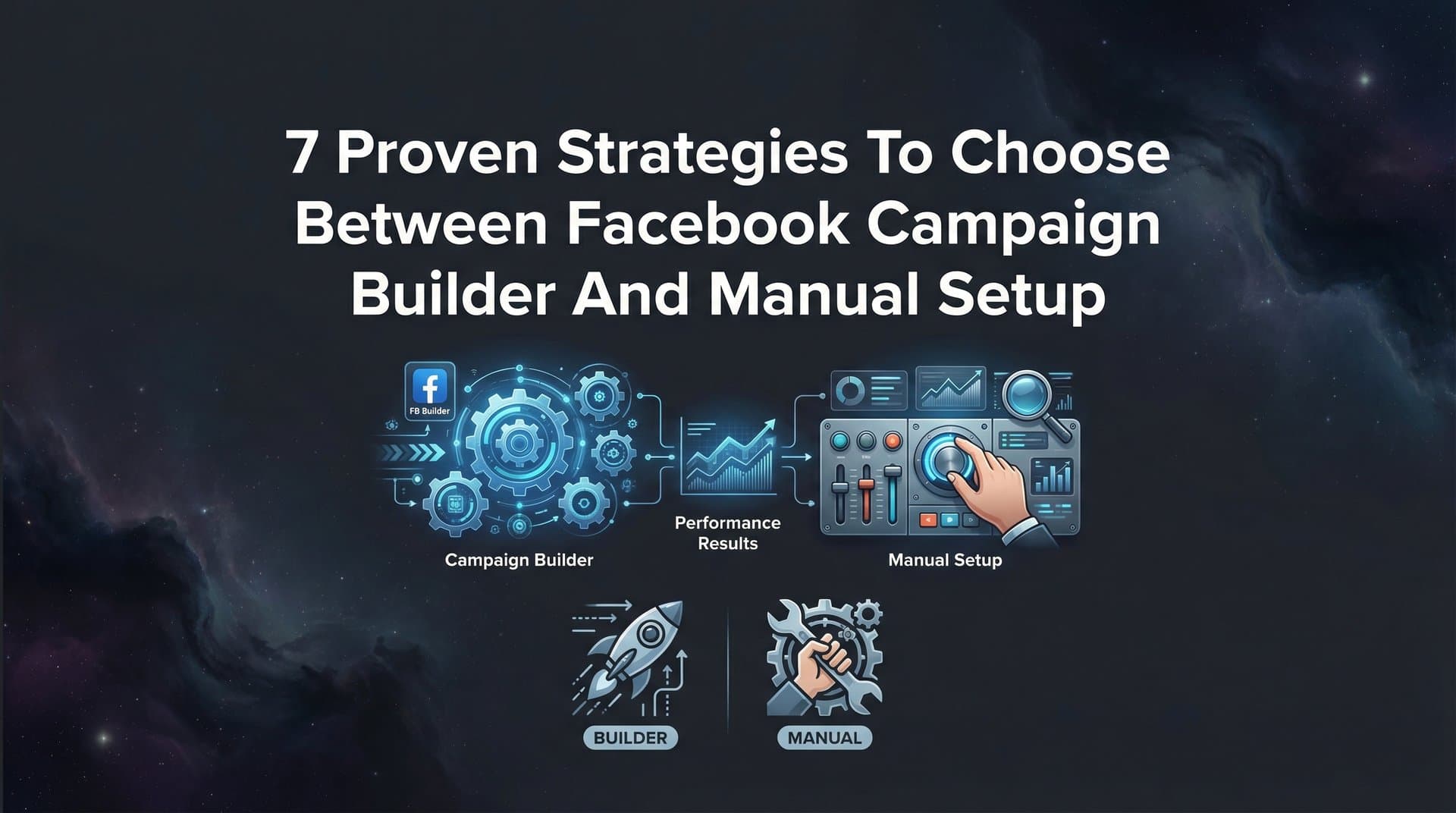
Every time you sit down to launch a new Facebook campaign, you face the same choice: click through Meta's guided campaign builder or dive into manual setup with full control over every parameter. It's not just a matter of preference—this decision shapes your campaign performance, determines how quickly you can launch, and impacts how much control you maintain over your ad spend.
The reality? There's no one-size-fits-all answer.
Digital marketers managing single-brand campaigns face different constraints than agencies juggling dozens of client accounts. A startup testing its first product-market fit needs different capabilities than an established e-commerce brand scaling proven winners. Your team's technical expertise, campaign complexity, and testing velocity all factor into which approach delivers better results.
This guide breaks down seven practical strategies to help you make smarter decisions about when to use automated campaign builders and when manual setup is worth the investment. You'll learn how to assess your specific situation, match your method to your objectives, and build a decision framework that evolves with your performance data. Whether you're launching your first campaign or your thousandth, these strategies will help you choose the approach that aligns with your resources and goals.
1. Audit Your Campaign Complexity Before Choosing a Method
The Challenge It Solves
Campaign complexity varies dramatically based on your objectives, audience structure, and creative requirements. A straightforward awareness campaign targeting a broad demographic differs fundamentally from a multi-stage funnel campaign with exclusion rules, dynamic creative testing, and precise audience layering. Choosing your setup method without assessing complexity often leads to wasted time—either fighting against automation limitations or manually configuring settings that don't require precision control.
The Strategy Explained
Before deciding between builder tools and manual setup, map out your campaign's actual complexity across four dimensions: audience segmentation needs, creative variation requirements, placement control preferences, and conversion tracking specifications. Simple campaigns with single audiences, unified messaging, and standard placements benefit from automated builders that streamline setup. Complex campaigns requiring audience exclusions, specific placement combinations, or custom conversion events demand the granular control that manual configuration provides.
The key is matching your method to your requirements rather than defaulting to one approach. Meta's Advantage+ campaigns work exceptionally well for advertisers seeking simplified setup with machine learning optimization, but they sacrifice the precise audience exclusions and placement controls that some campaigns require.
Implementation Steps
1. Document your campaign requirements before opening Ads Manager: list your target audiences, creative variations, placement preferences, and conversion goals in a planning document.
2. Score your campaign complexity using these criteria: single audience vs. multiple segments (1-3 points), unified creative vs. multiple variations (1-3 points), automatic placements vs. custom selection (1-2 points), standard events vs. custom conversions (1-2 points).
3. Apply this decision rule: campaigns scoring 4 points or less suit automated builders, while campaigns scoring 7+ points warrant manual setup for the control you need.
Pro Tips
Create a complexity assessment checklist and use it consistently across campaigns. You'll start recognizing patterns in which campaign types benefit from automation and which demand manual precision. This framework also helps when explaining setup decisions to clients or stakeholders—you're making data-informed choices rather than arbitrary preferences.
2. Match Your Approach to Your Testing Volume
The Challenge It Solves
Testing velocity directly impacts how quickly you find winning combinations and scale profitable campaigns. Marketers who need to test dozens of creative variations against multiple audiences face a fundamentally different challenge than those running focused tests with limited variables. Manual setup becomes a bottleneck when you're launching high-volume tests, while automated builders may not provide the granular control needed for precise hypothesis testing.
The Strategy Explained
Your testing volume should inform your setup method because the time investment scales differently. Manual campaign setup requires individual attention for audience research, creative organization, placement selection, and budget allocation. When you're testing three ad variations against two audiences, this investment is manageable. When you're testing fifteen creatives across five audience segments with multiple placement combinations, manual setup becomes prohibitively time-consuming.
Automated builders consolidate these steps but may limit your ability to isolate specific variables. The strategic question becomes: do you need speed and scale, or do you need to test precise hypotheses with controlled variables?
Implementation Steps
1. Calculate your monthly testing volume by counting how many unique ad variations you typically launch, multiplied by the number of audience segments you target.
2. Establish your testing velocity threshold: if you're launching fewer than 20 total ad variations monthly, manual setup remains practical; above 50 variations monthly, automation becomes essential for maintaining launch speed.
3. For high-volume testing scenarios, explore platforms like AdStellar AI that combine automation speed with strategic precision—their system can build complete campaigns in under 60 seconds while maintaining transparency over targeting and creative decisions.
Pro Tips
Track your setup time per campaign method for one month. Calculate the actual hours spent on manual configuration versus automated setup. This data reveals your true efficiency baseline and helps justify investment in automation tools when your testing volume demands it. Many marketers discover they're spending 10-15 hours weekly on manual campaign setup that could be automated.
3. Evaluate Your Team's Technical Expertise
The Challenge It Solves
Ads Manager proficiency varies significantly across marketing teams. Junior marketers often struggle with the platform's complexity, making mistakes in audience configuration, placement selection, or budget settings that impact campaign performance. Meanwhile, experienced media buyers may find automated builders frustratingly limiting, unable to implement the sophisticated strategies they've developed. Mismatching your setup method to your team's capabilities leads to either underutilized automation or error-prone manual configuration.
The Strategy Explained
Your team's technical expertise should directly influence which setup method you standardize. Guided campaign builders reduce the learning curve for less experienced marketers by presenting simplified workflows with guardrails that prevent common configuration mistakes. They're particularly valuable for teams with high turnover or those onboarding new members frequently. Manual setup rewards expertise—experienced marketers can implement advanced strategies that automated tools don't support, but only if they possess the technical knowledge to configure settings correctly.
The strategic consideration extends beyond individual capability to team consistency. Even with experienced marketers, manual setup introduces variability in how different team members configure campaigns, potentially impacting performance comparisons.
Implementation Steps
1. Assess your team's Ads Manager proficiency honestly: conduct a skills audit covering audience targeting, placement optimization, budget strategy, and conversion tracking setup.
2. Identify your proficiency gaps and determine whether training investment or automation tools better address them—sometimes automation is more cost-effective than extensive training programs.
3. For teams with mixed experience levels, establish role-based guidelines: junior marketers use guided builders for standard campaigns while senior strategists handle manual setup for complex initiatives.
Pro Tips
Create standardized setup checklists for your team regardless of which method you choose. Even experienced marketers benefit from systematic approaches that ensure consistency. Document your team's setup decisions and build an internal knowledge base that captures why certain configurations work for your specific business—this institutional knowledge becomes invaluable as your team grows.
4. Align Budget Allocation Strategy With Your Method
The Challenge It Solves
Budget control requirements differ dramatically based on campaign objectives and organizational constraints. Some marketers need precise spending limits on individual ad sets to maintain budget discipline across multiple product lines or client accounts. Others benefit from letting Meta's algorithm automatically redistribute budget toward top performers. Choosing a setup method that conflicts with your budget strategy creates ongoing management friction—either fighting against automation you can't control or manually rebalancing budgets that could optimize automatically.
The Strategy Explained
Your budget allocation philosophy should inform your setup method because automated builders typically implement campaign budget optimization (CBO) by default, while manual setup allows granular ad set budgets. CBO works exceptionally well when you trust Meta's algorithm to identify and fund winning combinations, but it removes your ability to enforce specific spending allocations. Manual budget control becomes essential when you need to ensure equal testing investment across variations, maintain separate budgets for different product categories, or comply with client-specific spending requirements.
The strategic question centers on control versus optimization. Automated budget allocation often delivers better overall performance by concentrating spend on winners, but it may not align with organizational requirements for budget predictability and allocation transparency.
Implementation Steps
1. Define your budget control requirements: determine whether you need to enforce specific spending limits on individual audiences, products, or creative variations, or whether you can allow algorithmic redistribution.
2. Test both approaches with similar campaigns to understand how CBO performs for your specific business—run parallel campaigns with identical targeting and creative, one using CBO and one with manual ad set budgets.
3. Establish decision criteria based on campaign type: use automated budget optimization for conversion-focused campaigns where performance matters more than spending distribution, and manual budgets for awareness campaigns or situations requiring equal investment across test groups.
Pro Tips
When using CBO, monitor your budget distribution daily during the learning phase. Meta's algorithm sometimes concentrates spend on a single ad set prematurely, before sufficient data exists to identify true winners. Be prepared to intervene with manual adjustments if automated allocation doesn't align with your testing objectives. Document which campaign types benefit from CBO in your business—this knowledge compounds over time.
5. Consider Scale and Campaign Frequency
The Challenge It Solves
The number of campaigns you launch regularly determines whether setup efficiency becomes a strategic advantage or a minor operational detail. Marketers launching one campaign monthly experience minimal friction from manual setup processes. Agencies managing dozens of client accounts or e-commerce brands running continuous promotional campaigns face a fundamentally different reality—manual setup becomes a significant time investment that delays campaign launches and limits testing capacity.
The Strategy Explained
Campaign frequency creates a compounding effect on setup time investment. The hours spent manually configuring a single campaign seem reasonable, but multiply that by weekly launches across multiple brands or product lines, and the time cost becomes substantial. Automated builders deliver meaningful efficiency gains primarily at scale—the setup time you save on individual campaigns accumulates into significant capacity improvements when you're launching frequently.
This strategy requires honest assessment of your actual launch frequency versus your aspirational testing cadence. Many marketers underestimate how much setup time constrains their testing velocity until they track it systematically.
Implementation Steps
1. Track your actual campaign launch frequency for one quarter: count new campaigns, not ongoing optimizations, to establish your baseline launch volume.
2. Calculate your setup time investment by multiplying average hours per manual campaign setup by your quarterly launch count—this reveals your true time cost.
3. Establish your automation threshold: if you're launching more than 8-10 campaigns monthly, automation tools deliver measurable efficiency gains that justify implementation effort and potential tool costs.
Pro Tips
Consider your growth trajectory when evaluating automation needs. Your current launch frequency may not justify automation investment, but if you're planning to scale testing volume or add new brands, implementing automation infrastructure now prevents future bottlenecks. Platforms like AdStellar AI that offer bulk launch capabilities become increasingly valuable as your campaign volume grows—their system can launch multiple campaign variations simultaneously, dramatically reducing the time between strategy development and campaign execution.
6. Factor in Creative Variation Requirements
The Challenge It Solves
Creative testing approaches vary significantly based on your optimization goals. Some strategies require testing multiple creative variations against a single audience to identify winning messaging. Others demand precise pairing of specific creatives with targeted audience segments. Bulk creative testing benefits from automation that can rapidly deploy numerous variations, while strategic creative-audience matching often requires the manual control to ensure specific combinations are tested as intended.
The Strategy Explained
Your creative testing methodology should inform your setup method because automated builders excel at deploying multiple creative variations quickly but may not provide the granular control needed for hypothesis-driven creative testing. Dynamic creative optimization tools automatically combine your creative elements into multiple variations and test them against your audience, which works well for discovering unexpected winning combinations. However, this approach doesn't suit situations where you need to test specific creative concepts against precisely defined audience segments.
The strategic consideration centers on exploration versus confirmation. Automated creative testing helps you discover what works through broad experimentation. Manual setup allows you to confirm specific hypotheses about which creative approaches resonate with particular audience segments.
Implementation Steps
1. Define your creative testing objectives: determine whether you're exploring broadly to find winning elements or testing specific creative-audience hypotheses based on customer insights.
2. For exploratory testing with high creative volume, leverage automated builders or dynamic creative tools that can rapidly deploy and test numerous variations without manual configuration.
3. For hypothesis-driven testing requiring specific creative-audience pairing, use manual setup to ensure your intended combinations are tested as designed, with sufficient budget allocation to reach statistical significance.
Pro Tips
Create a creative testing matrix before launching campaigns. Document which creative concepts you're testing, which audiences should see them, and why you believe specific pairings will perform well. This planning discipline helps you choose the appropriate setup method and provides a framework for analyzing results. When using automated creative testing, review performance data to identify winning elements, then use manual setup to validate those insights with focused follow-up campaigns.
7. Use Performance Data to Inform Future Method Choices
The Challenge It Solves
Most marketers choose between automated builders and manual setup based on intuition or habit rather than actual performance data. Without systematic tracking of which setup method delivers better results for different campaign types, you're making important strategic decisions without evidence. This leads to inconsistent approaches that may not optimize for your specific business objectives and audience characteristics.
The Strategy Explained
Building a data-driven decision framework requires tracking campaign performance by setup method across sufficient volume to identify meaningful patterns. This means tagging campaigns with their setup approach and analyzing performance metrics by method over time. You're looking for insights like whether automated builders deliver better cost per acquisition for certain campaign objectives, or whether manual setup produces more consistent results for specific audience segments in your business.
The strategic value emerges from recognizing that the optimal approach may differ by campaign type, product category, or seasonal factors. Your performance data reveals these patterns, allowing you to develop nuanced guidelines rather than blanket rules.
Implementation Steps
1. Implement systematic campaign tagging that identifies setup method (automated builder vs. manual) along with other key variables like campaign objective, audience type, and product category.
2. Establish a quarterly review process where you analyze performance metrics by setup method, looking for statistically significant differences in key metrics like cost per result, conversion rate, and return on ad spend.
3. Document your findings in a decision framework that guides future method choices based on campaign characteristics—this becomes your institutional knowledge that improves with each campaign cycle.
Pro Tips
Start with controlled experiments when possible. Run parallel campaigns with identical targeting, creative, and budgets, varying only the setup method. This isolates the impact of your setup approach from other variables. Track not just performance metrics but also time investment—sometimes a slightly lower ROAS from automated setup is worth accepting if it frees up hours for strategic work. Advanced platforms like AdStellar AI provide AI insights dashboards that help you analyze performance patterns across campaigns, making it easier to identify which approaches work best for your specific business.
Putting It All Together: Your Decision Framework
The builder versus manual debate doesn't have a universal answer—it depends entirely on your specific situation, team capabilities, and campaign requirements. The most successful digital marketers don't choose one approach exclusively; they develop decision frameworks that match their method to their objectives.
Start by auditing your campaign complexity and scale. Simple campaigns with straightforward targeting and unified messaging benefit from automated builders that streamline setup and reduce configuration errors. Complex campaigns requiring precise audience exclusions, specific placement combinations, or granular budget control warrant the investment in manual setup.
Consider your team's technical expertise honestly. Guided builders reduce the learning curve for less experienced marketers while preventing common configuration mistakes. Manual setup rewards expertise but only delivers value when your team possesses the technical knowledge to implement advanced strategies correctly.
Factor in your testing volume and launch frequency. If you're launching more than 8-10 campaigns monthly, automation delivers meaningful time savings that compound into significant capacity improvements. Track your actual setup time investment to understand where efficiency gains matter most.
For most digital marketers managing multiple campaigns across different objectives and audience segments, a hybrid approach works best. Use automated builders for speed and consistency on standard campaigns—awareness initiatives, straightforward conversion campaigns, and high-volume creative testing. Reserve manual setup for complex, high-stakes initiatives where precise control over targeting, placement, and budget allocation directly impacts your strategic objectives.
Most importantly, track your results by setup method and let your performance data guide future decisions. Tag your campaigns systematically, analyze performance patterns quarterly, and build institutional knowledge about which approaches work best for your specific business. Your decision framework should evolve as you accumulate data and as platform capabilities change.
Ready to see how AI-powered campaign building can transform your workflow without sacrificing strategic control? Start Free Trial With AdStellar AI and experience how specialized marketing AI agents can build complete campaigns in under 60 seconds while maintaining full transparency over targeting and creative decisions. Join marketers who are launching and scaling campaigns 10× faster with intelligent automation that learns from your performance data and continuously improves your results.