Every campaign build starts with good intentions. You'll set aside an hour, maybe two, to get those new Facebook ads live. But then the reality hits: you're toggling between tabs hunting for that one creative file, manually duplicating ad sets because there's no bulk option, copying and pasting audience parameters you've used a hundred times before, and uploading images one by one while the progress bar crawls forward.
Three hours later, you've launched a single campaign with four ad variations. Your coffee's gone cold. Your inbox is overflowing. And you still have six more campaigns to build this week.
This isn't a productivity problem—it's a workflow problem. The manual campaign building process in Ads Manager was designed for flexibility, not speed. Every click, every field, every upload adds friction. For digital marketers and agencies managing multiple clients or testing at scale, these minutes compound into hours of wasted time every single week.
But here's what's changed: modern tools and AI-powered automation have fundamentally transformed what's possible. Marketers who've optimized their workflows are now launching campaigns in minutes instead of hours. They're testing more variations, moving faster on insights, and spending their time on strategy instead of data entry.
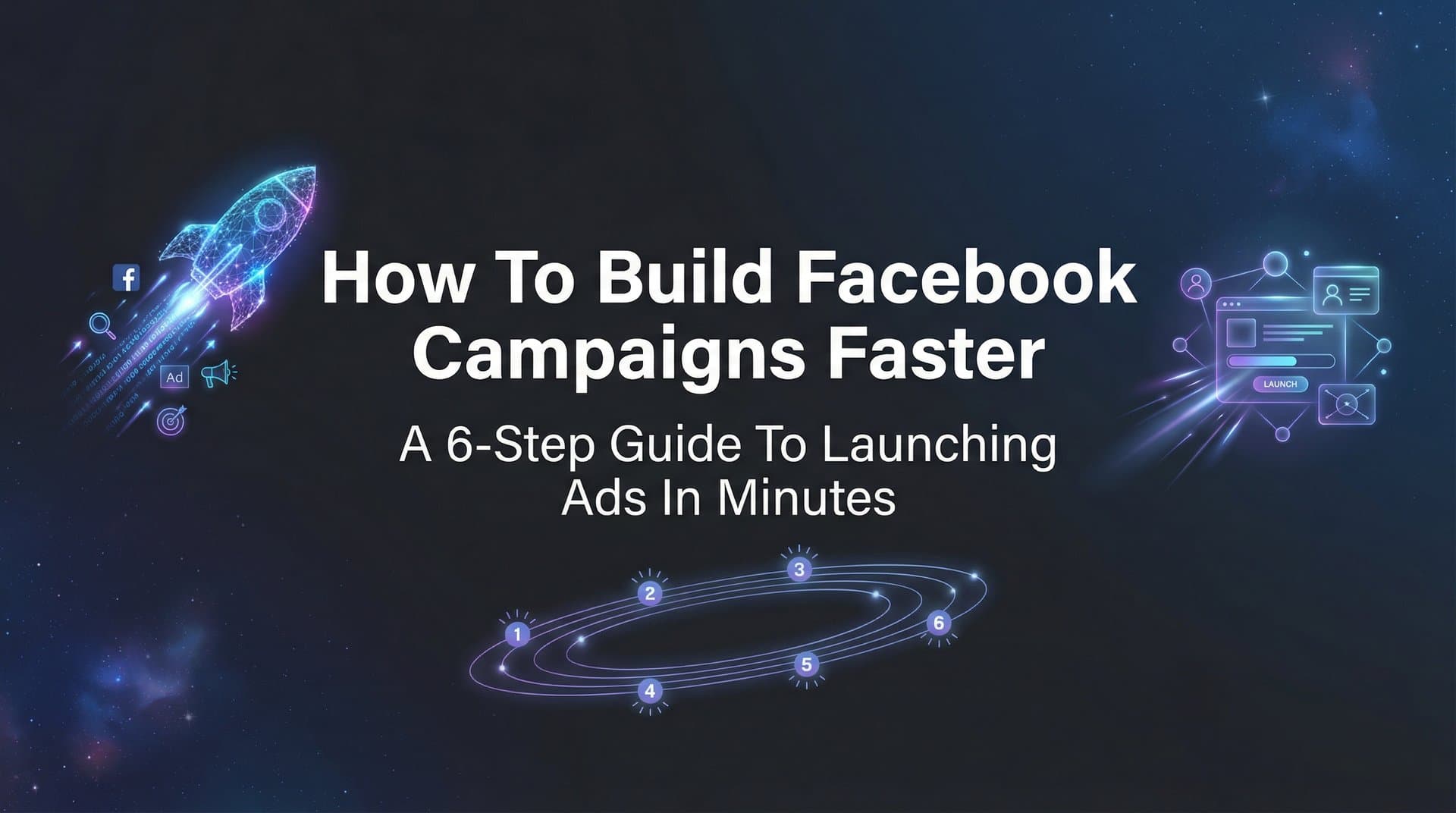
This guide breaks down exactly how they do it. You'll learn six actionable steps that eliminate the friction from your campaign building process—from organizing your assets to leveraging AI automation that handles the heavy lifting for you. Whether you're building your first campaign or your thousandth, these strategies will help you move faster without sacrificing quality.
Step 1: Organize Your Campaign Assets Before You Start
The fastest way to slow down your campaign build? Start without a plan. You'll find yourself mid-setup, realizing you need that product photo from three weeks ago, or hunting through Slack messages for the headline your copywriter sent yesterday. Every interruption breaks your flow and adds minutes to what should be a streamlined process.
Create a centralized folder structure that mirrors your campaign workflow. Organize by client, then by campaign type, then by asset category—creatives, copy variations, audience lists, and reference materials. When you sit down to build, everything you need should be one click away. Many marketers use cloud storage platforms with clear naming conventions: "Client_CampaignName_Creative_V1.jpg" beats "final_FINAL_v3_actualfinal.jpg" every time.
Pre-approval is your secret weapon against mid-build delays. Before you touch Ads Manager, get stakeholder sign-off on all images, videos, and copy variations. There's nothing more frustrating than building an entire campaign only to have a client request changes that force you to start over. Build your approval process into your timeline—it's not overhead, it's insurance against wasted effort.
Here's where experienced marketers gain an edge: they maintain swipe files of proven elements they can pull from instantly. Keep a running document of headlines that drove high click-through rates, primary text variations that resonated with different audience segments, and CTAs that converted. When you're building a new campaign, you're not starting from a blank page—you're remixing elements that already work.
The time investment here pays dividends. Spend 30 minutes organizing your assets once, and you'll save 10 minutes on every campaign build going forward. Most campaign building time waste happens from hunting for materials, not from the actual setup process. Eliminate the hunt, and you've eliminated the biggest bottleneck.
Step 2: Use Campaign Templates to Eliminate Repetitive Setup
Think about how many times you've configured the same campaign settings. Conversions objective. Website as the conversion location. Purchase as the optimization event. Advantage+ placements. Seven-day click, one-day view attribution. You've probably set up this exact configuration dozens of times, clicking through the same menus, selecting the same options, filling in the same fields.
Campaign templates transform this repetitive work into a one-time setup. Create reusable structures for your most common objectives—conversions campaigns for e-commerce, traffic campaigns for content promotion, engagement campaigns for awareness plays. Within Ads Manager, you can duplicate previous campaigns as starting points, but the real power comes from documenting your standard configurations in a reference guide that ensures consistency across your team.
Audience templates deserve special attention because targeting is where most complexity lives. Save your best-performing audience combinations with clear naming conventions. Instead of rebuilding "Women 25-45, interested in fitness and wellness, excluded purchasers" from scratch each time, you've got it saved as "Core_Fitness_Women_Warm." Your targeting library becomes a competitive advantage—you're not just moving faster, you're consistently deploying audiences that you know perform.
Set defaults for the decisions you make the same way every time. If you always use Advantage+ placements for conversion campaigns, make that your template default. If your standard budget allocation is $50/day during testing phases, bake that in. If you consistently optimize for purchases with a seven-day attribution window, lock it down. Templates aren't about rigidity—they're about eliminating decision fatigue on the choices that don't require fresh thinking.
The success indicator is simple: your next campaign should require only customization, not configuration from scratch. You're swapping in new creatives and adjusting audience parameters, but you're not clicking through setup menus making the same selections you made yesterday. When you can launch a campaign in one-third the time because you're only handling the unique elements, you've built templates correctly.
Step 3: Batch Your Ad Variations Instead of Building One by One
Sequential building is the silent productivity killer. You create an ad, upload a creative, write the copy, set the CTA, then repeat the process for the next variation. Each ad requires the same series of clicks, the same form fields, the same upload process. By the time you've built your fifth ad, you've forgotten what you tested in the first one.
Batching flips this approach. Instead of building complete ads one at a time, you group your creative testing by theme. Test five images with identical copy first—upload all five images in one session, apply the same headline and primary text across all variations. Then swap: keep your best-performing image and test five different headlines against it. This systematic approach cuts build time significantly because you're not context-switching between tasks.
The spreadsheet planning phase is where batching really shines. Before you touch Ads Manager, map out your test matrix. List your creative variations down the left column, your copy variations across the top, and identify which combinations you want to test. This bird's-eye view helps you spot redundancies, ensure comprehensive coverage, and calculate exactly how many ads you need to build. Many marketers find that planning their tests in advance reveals they can get the same insights with fewer variations.
Bulk upload features exist precisely for this workflow. Instead of uploading one image, waiting for it to process, then uploading the next, you can queue multiple creatives simultaneously. The same principle applies to video assets. Load everything at once, let the platform process in parallel, and move on to the next task. The time savings compound—what used to take 20 minutes of waiting now happens in the background while you're writing ad copy.
The common pitfall is underestimating how much time you lose to task-switching. Every time you shift from creative selection to copywriting to CTA configuration, your brain needs a moment to reorient. Batching similar tasks keeps you in the same mental mode, maintaining flow state instead of constantly context-switching. When you batch effectively, you'll notice you're not just moving faster—you're making fewer mistakes because you're not juggling multiple mental models simultaneously.
Step 4: Leverage AI Tools to Automate Campaign Building
Manual campaign building assumes you're the best judge of what will work. You select audiences based on intuition, choose creatives based on preference, and allocate budgets based on experience. But what if you could tap into data-driven insights that analyze thousands of performance signals to make those decisions for you?
AI-powered platforms fundamentally change the campaign building equation. Instead of manually configuring every element, these tools analyze your historical performance data to suggest winning combinations before you launch. They identify which creative styles resonated with which audience segments, which headlines drove the highest engagement rates, and which budget allocations generated the most efficient results. The platform becomes your strategic partner, offering recommendations grounded in actual performance rather than guesswork.
Modern AI campaign builders use specialized agents to handle distinct aspects of campaign creation. Think of it like having a team of experts working simultaneously: one agent analyzes your landing pages to understand your offer, another structures your campaign architecture for optimal testing, a third identifies high-potential targeting strategies, while others curate creatives, write copy variations, and allocate budgets based on your goals. This parallel processing approach accomplishes in seconds what would take a human hours to configure manually.
The benefits extend beyond pure speed. Automation delivers consistency—every campaign follows best practices without relying on individual team members to remember every optimization. It enables testing at scale—you can launch multiple Facebook ads quickly to identify winners faster. And it makes data-driven decisions automatic—budget flows to top performers without manual intervention, and underperforming ads pause themselves based on statistical significance.
When evaluating AI campaign builders, transparency matters more than you might think. Some platforms operate as black boxes, making decisions without explaining their reasoning. Look for tools that show you why they made each recommendation—which historical data influenced the targeting suggestion, what performance patterns led to the creative selection, how the budget allocation aligns with your conversion goals. This transparency builds trust and helps you learn from the AI's decisions, making you a better marketer even when you're building manually.
Learning capabilities separate basic automation from truly intelligent systems. The best platforms don't just follow rules—they improve with each campaign you run. They identify patterns in what works for your specific business, adapt their recommendations based on your results, and continuously refine their models as they gather more performance data. This creates a compounding advantage: your campaigns get smarter over time without additional effort from you.
Direct API integration is the technical detail that makes everything else possible. Platforms that connect directly to Meta's advertising API avoid the data sync issues and delays that plague third-party tools. Changes happen in real-time, performance data updates instantly, and you're working with the same information you'd see in Ads Manager—just with AI-powered intelligence layered on top. For example, AdStellar AI uses this direct integration approach, ensuring that its seven specialized agents work with live data to build campaigns that reflect current platform capabilities and performance metrics.
Step 5: Launch Multiple Campaigns Simultaneously with Bulk Tools
Single-campaign launches made sense when you were testing one concept at a time. But modern performance marketing demands rapid experimentation across multiple variables—different audiences, creative approaches, messaging angles, and offer structures. Launching campaigns one by one creates a bottleneck that limits how quickly you can gather insights and optimize toward winners.
Bulk launching transforms your testing velocity. Instead of spending an hour building and launching one campaign, you can deploy an entire test matrix—multiple campaigns with different audience segments, each containing multiple ad variations—in a fraction of the time. This parallel deployment means you're gathering comparative data from day one, identifying winning combinations faster, and iterating based on real performance rather than sequential assumptions.
The workflow shift is substantial. You plan your test matrix in advance, defining which audience segments you want to reach, which creative approaches you want to test against each audience, and what budget allocation makes sense for each test cell. Then you execute the entire plan in one bulk operation. What previously required building five separate campaigns, each with multiple ad sets and ads, now happens through a streamlined process that handles the repetitive work automatically.
Naming conventions become critical when you're launching at scale. Without clear, consistent naming, you'll struggle to analyze results across multiple campaigns. Establish a structure that includes key variables in each campaign name: "Objective_Audience_Creative-Theme_Date." For example: "CONV_Fitness-Women-25-45_Lifestyle-Imagery_2026-02-24." This systematic approach means you can filter, sort, and analyze performance across dimensions without manually digging through each campaign to remember what you tested.
The success indicator here is straightforward: you can launch a full test matrix in the time it previously took to build one campaign. If you used to spend two hours launching a single conversion campaign with four ad variations, and you can now launch five campaigns with four variations each in the same timeframe, you've achieved 5× efficiency. But the real win isn't just speed—it's the strategic advantage of testing more hypotheses simultaneously and reaching statistical significance faster.
Bulk tools also reduce human error. When you're building the same structure repeatedly, copy-paste mistakes happen. You forget to update an audience exclusion, accidentally duplicate a budget instead of changing it, or lose track of which creative goes with which headline. Bulk operations enforce consistency because you're defining the structure once and applying it systematically, rather than manually configuring each instance where small variations can creep in. Understanding the difference between Facebook automation and manual campaigns helps you decide when bulk tools make the most sense.
Step 6: Build a Winners Library for One-Click Campaign Reuse
Your fastest campaigns aren't the ones you build from scratch—they're the ones you build from elements that already work. Every campaign you run generates valuable performance data about what resonates with your audience. The marketers who move fastest are the ones who systematically capture those insights and make them instantly reusable for future campaigns.
Start by identifying and tagging your top-performing ad elements. Which creatives generated the highest click-through rates? Which headlines drove the most conversions? Which audience segments delivered the lowest cost per acquisition? Create a system to flag these winners as they emerge—whether that's a spreadsheet, a folder structure, or a dedicated tool that tracks performance automatically. The goal is building a library of proven components you can pull from instantly when launching new campaigns.
The power multiplies when you track combinations, not just individual elements. That product photo might work well with lifestyle-focused copy but underperform with feature-focused messaging. That audience segment might respond to social proof but ignore urgency-based CTAs. Document what works together, not just what works in isolation. This nuanced understanding lets you deploy winning formulas, not just winning pieces.
One-click campaign reuse is where this library delivers its biggest time savings. Instead of starting every campaign from a blank slate, you're beginning with a proven foundation. You select a winning creative, pair it with a high-performing headline, target an audience that's converted efficiently in the past, and launch in minutes. You're not guessing—you're deploying combinations that have already demonstrated success. The creative work shifts from "what should we test?" to "how can we build on what already works?"
Continuous learning loops take this concept further by improving future campaign performance automatically. Advanced platforms analyze your winners library to identify patterns you might miss manually. They recognize that certain creative styles consistently outperform with specific audience demographics, or that particular messaging angles drive higher engagement during certain seasons. These insights feed back into campaign building, so each new campaign benefits from the collective learning of everything you've run before.
This is why modern AI-powered tools often include features specifically designed for winner reuse. For instance, platforms like AdStellar AI include a Winners Hub that automatically identifies top-performing elements and makes them available for quick deployment in new campaigns. The system learns which combinations drive results for your specific business and prioritizes them in future builds. You're not just moving faster—you're moving smarter, with each campaign building on the proven success of previous efforts.
The compound effect is remarkable. Your first campaign might take the full time to build from scratch. But your tenth campaign using proven elements from your winners library might launch in one-quarter the time with a higher probability of success because you're starting from a foundation of validated performance. This is how experienced marketers achieve seemingly impossible efficiency—they've built systems that make their future work easier with every campaign they run.
Putting It All Together
Building Facebook campaigns faster isn't about cutting corners or sacrificing quality. It's about eliminating the unnecessary friction that slows down the work that actually matters. Let's recap the six-step workflow that transforms your campaign building process:
Organize your assets before you start—centralized folders, pre-approved materials, and swipe files of proven elements mean you're never hunting for files mid-build. Use campaign templates to eliminate repetitive setup—save your standard configurations so you're only customizing the unique elements each time. Batch your ad variations instead of building one by one—group similar tasks together to maintain flow and reduce context-switching. Leverage AI marketing tools for Facebook campaigns to automate campaign building—let data-driven intelligence handle targeting, creative selection, and budget allocation at scale. Launch multiple campaigns simultaneously with bulk tools—deploy entire test matrices in the time it used to take to build one campaign. Build a winners library for one-click campaign reuse—capture what works and make it instantly available for future campaigns.
These steps work together as a system. Organization enables templates. Templates make batching efficient. Batching sets the foundation for automation. Automation powers bulk launching. And bulk launching generates the performance data that feeds your winners library. Each step amplifies the others, creating compound efficiency gains that dramatically reduce your campaign building time.
The strategic advantage extends beyond speed. When you're not spending hours on manual setup, you have time for the work that actually drives results—analyzing performance data, developing creative concepts, refining your targeting strategy, and optimizing based on real insights. You shift from being a campaign builder to being a performance marketer, focused on strategy rather than execution. Learning how to structure Facebook ad campaigns properly from the start makes every subsequent optimization easier.
Modern AI-powered tools have made this workflow accessible to marketers at every level. You don't need a large team or unlimited resources to build campaigns at scale. Platforms that handle the repetitive work automatically—analyzing historical performance, suggesting winning combinations, deploying bulk campaigns, and learning from results—put enterprise-level capabilities within reach of individual marketers and small agencies. Once you've mastered building campaigns efficiently, the next challenge becomes scaling Facebook ads profitably without losing efficiency.
Ready to transform your advertising strategy? Start Free Trial With AdStellar AI and be among the first to launch and scale your ad campaigns 10× faster with our intelligent platform that automatically builds and tests winning ads based on real performance data.
The key takeaway: building Facebook campaigns faster isn't about working harder—it's about working smarter. Every minute you save on manual setup is a minute you can invest in strategic thinking, creative development, and performance optimization. Build the systems once, and they'll accelerate every campaign you launch from that point forward.