Paid advertising has never been more data-intensive. Every campaign you run on Meta generates a continuous stream of signals: auction dynamics shifting by the hour, creative fatigue setting in faster than ever, audience segments responding differently across placements, and budget decisions that can make or break your ROAS before your next weekly review even happens.
The volume of decisions involved in running Meta ads at any meaningful scale has genuinely outpaced what a single human media buyer can manage manually. Bid adjustments, budget reallocation, creative testing, audience analysis: these tasks used to happen in weekly cycles. Today, the platforms that win are the ones operating on near-real-time loops.
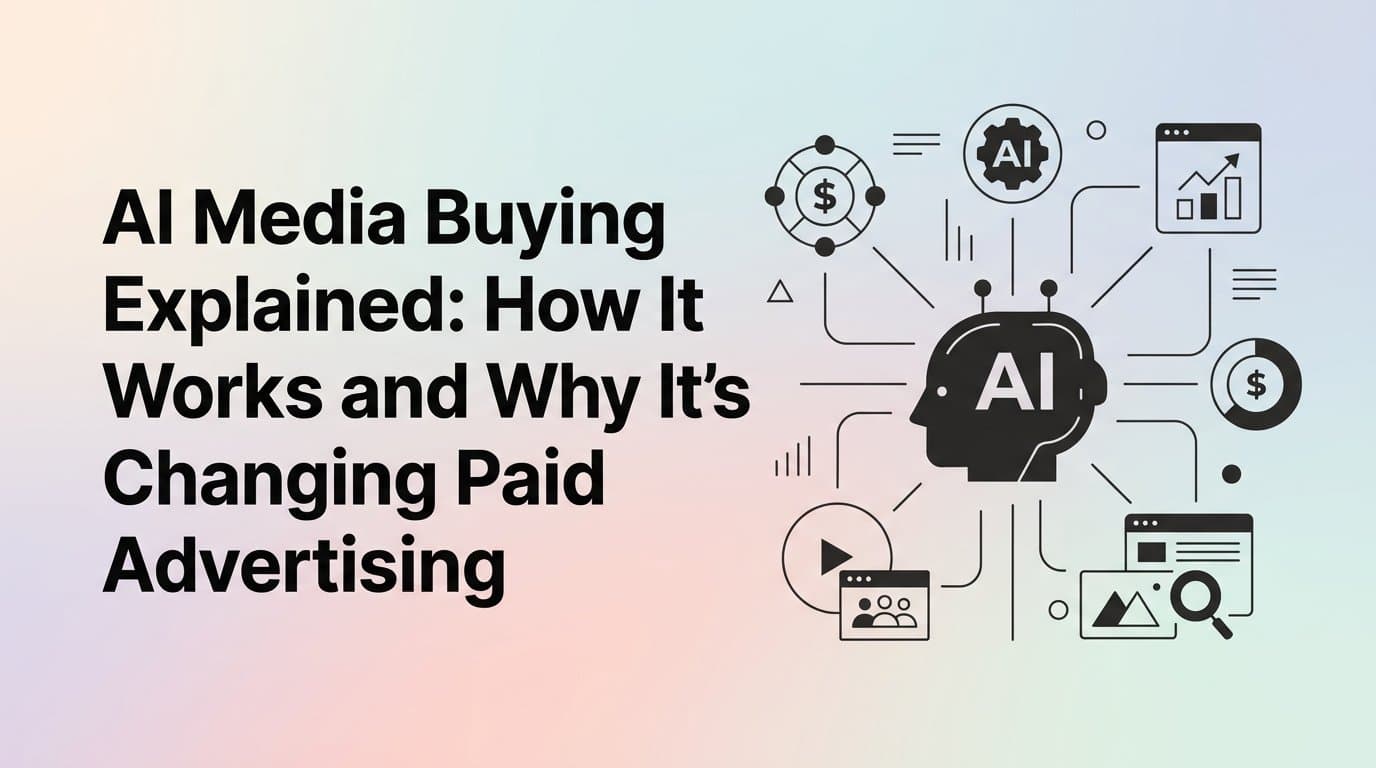
This is exactly the problem AI media buying was built to solve. By applying machine learning and automation across the entire campaign lifecycle, AI media buying transforms what was once a reactive, spreadsheet-heavy process into a continuous optimization engine. In this article, we'll break down what AI media buying actually is, how the technology works under the hood, what specific tasks it handles, how it compares to traditional approaches, and how platforms like AdStellar put it into practice for Meta advertisers.
The Core Idea: What AI Media Buying Actually Does
At its simplest, AI media buying is the use of machine learning and automation to handle the decisions and tasks that a human media buyer traditionally performed. That includes audience targeting, budget allocation, bid management, and creative selection. But the definition gets more interesting when you look at the scope.
AI media buying is not a single feature or a toggle you switch on in your Ads Manager. It is a layer of intelligence applied across the entire campaign lifecycle, from initial planning and creative development through launch, testing, and ongoing optimization. Every stage of that process involves decisions, and AI can inform or automate many of them simultaneously.
The distinction that matters most here is the difference between basic automation and true AI media buying. Basic automation is rules-based. Think of it as if/then logic: if CPC exceeds a certain threshold, pause the ad set. If ROAS drops below a target, reduce the budget. These rules are useful, but they are static. They only respond to the conditions you anticipated when you wrote them.
True AI media buying works differently. Instead of following pre-written rules, machine learning models identify patterns across many variables simultaneously: which audience segments convert at what times of day, which creative attributes correlate with lower CPA, how auction competition affects delivery costs across different placements. The system then uses those patterns to make predictive decisions, and it updates its predictions continuously as new data comes in.
This distinction matters practically. A rules-based system reacts to what already happened. An AI system anticipates what is likely to happen next, based on patterns learned from thousands of data points across your account and, in many cases, broader platform-level signals. That shift from reactive to predictive is what makes AI media buying genuinely different from the automation most advertisers have been using for years.
Under the Hood: How the Technology Actually Works
To understand why AI media buying performs the way it does, it helps to look at what these systems are actually processing. The inputs matter as much as the algorithms.
AI media buying systems draw on a wide range of data sources simultaneously. Historical campaign performance tells the model what has worked before in your account. Audience signals reveal how different segments respond to different messages. Creative attributes, things like image composition, color palette, copy length, and emotional tone, get analyzed for correlations with performance outcomes. Time-of-day and day-of-week patterns affect when the system prioritizes delivery. Competitive auction dynamics influence bidding strategy. And conversion data anchors everything to the outcomes that actually matter: purchases, leads, sign-ups.
The machine learning models processing all of this are looking for combinations. Not just "this audience converts well" but "this audience, paired with this creative style, at this time of day, at this bid level, produces a conversion at this cost." The number of possible combinations across a real Meta account is enormous, which is precisely why human reviewers working from weekly reports cannot match the depth of analysis an AI system runs continuously.
One of the most important components in this process is dynamic creative optimization, commonly called DCO. DCO is the mechanism by which AI tests and serves the best-performing creative variations automatically, without waiting for a human to review results and make a change. Rather than running one ad and checking back in a week, DCO systems launch multiple creative combinations, measure response signals in near real time, and shift delivery toward the variations that are performing best. The feedback loop is continuous rather than episodic.
This is particularly relevant for Meta advertising, where creative quality has become one of the primary levers for performance. As Meta's own delivery system has shifted toward broader, AI-optimized audiences, the creative and bidding layers have grown in importance. DCO lets you test more creative combinations faster, which means you surface winners sooner and reduce the time your budget spends on underperformers.
The models also update over time. Early in a campaign, the AI is working with limited data and making broader predictions. As it accumulates signals specific to your account, your audience, and your creative approach, its predictions become more refined. This learning curve is important to understand when setting expectations for AI media buying: the system gets smarter the longer it runs.
What AI Handles That Human Buyers Used to Do Manually
Let's get specific about the actual tasks AI takes over, because this is where the practical value becomes clear.
Real-time bid adjustments: Human media buyers typically review bids on a daily or weekly basis. AI systems adjust bids continuously based on auction dynamics, audience signals, and conversion probability. That means your budget is being deployed more efficiently at every hour of the day, not just after your next review session.
Budget reallocation between ad sets: When one ad set is outperforming another, AI can shift budget toward the winner automatically. This sounds simple, but doing it manually across a large account with many ad sets running simultaneously is genuinely time-consuming. AI handles it in the background without requiring a human decision at each step.
Audience expansion and lookalike modeling: AI systems can identify audience characteristics that correlate with conversion and expand targeting accordingly. Rather than manually building lookalike audiences and testing them in sequence, AI can explore audience variations simultaneously and weight delivery toward the segments that respond best.
Creative fatigue detection: One of the most underappreciated tasks in Meta advertising is recognizing when a creative has worn out its welcome with an audience. Frequency rises, CTR drops, CPA climbs. AI systems can detect these patterns early and flag or pause fatigued creatives before they drag down overall account performance.
A/B test analysis and creative scoring: Instead of waiting for a test to reach statistical significance before reviewing results, AI systems score creative performance continuously against your benchmarks and surface the winners. This compresses the creative iteration cycle significantly.
The speed advantage here is real. AI can process performance signals and act on them within hours. A human reviewer working from a weekly report is always operating on information that is at least several days old. In a fast-moving auction environment, that lag has a cost.
The scale advantage is equally significant. A skilled media buyer managing a large account is cognitively limited in how many variables they can track simultaneously. AI has no such constraint. It can simultaneously manage hundreds of ad variations, audiences, and placements, scoring each one against your goals without losing track of the full picture. That is the kind of coverage that simply is not achievable through manual management alone.
AI Media Buying vs. Traditional Approaches: What Actually Changes
The traditional media buying workflow follows a familiar pattern. You research your audience, brief a creative team, build your campaigns, let them run for a week or two, pull a performance report, make adjustments, and repeat. Each step involves a handoff, and each handoff introduces delay.
The AI-driven workflow compresses or eliminates many of those handoffs. Creative generation can happen within the same platform as campaign launch. Performance analysis runs continuously rather than weekly. Budget decisions are made based on real-time ROAS and CPA data rather than a report that is already several days old by the time you read it. The cycle that used to take weeks now runs in days or hours.
A common misconception worth addressing directly: AI media buying does not eliminate the need for strategy or creative thinking. It eliminates the repetitive, data-heavy execution tasks so that marketers can focus on higher-level decisions. You still need to define your goals, understand your audience, and develop creative concepts that resonate. What AI removes is the manual labor of testing those concepts at scale, analyzing the results, and acting on them continuously.
For Meta advertisers specifically, the practical differences show up in a few key areas. Creative iteration cycles get faster because you can test more variations simultaneously and get performance signals sooner. Audience testing becomes more granular because AI can explore more combinations than a human could manage manually. And budget decisions get sharper because they are driven by real-time performance data rather than the averaged-out view you get from a weekly report.
It is also worth noting what AI media buying is not. It is not the same as programmatic advertising, which refers to automated ad buying across open exchanges. AI media buying can apply within a single platform like Meta, using machine learning to manage creative, targeting, and bidding decisions above the platform's own delivery layer. The two concepts are related but distinct, and conflating them leads to confusion about what AI tools actually do.
How AI Media Buying Works in Practice on Meta
Understanding the theory is useful. Seeing how it plays out in a real workflow makes it concrete.
Here is what an AI media buying workflow on Meta looks like in practice. You start with your product or offer and use an AI creative tool to generate multiple ad variations: different image treatments, video formats, UGC-style content, headline options, and copy angles. Rather than briefing a designer and waiting days for assets, you have a set of creative variations ready to test in a fraction of the time.
Those variations get launched across multiple audiences simultaneously. Instead of setting up each ad set manually and selecting creatives one by one, bulk launching tools let you define your creative pool, your audience options, and your copy variations, and the system generates every combination and pushes them live. What used to take hours of setup work happens in minutes.
Once the campaigns are live, the AI begins analyzing performance signals. It is not waiting for a weekly report. It is continuously scoring each creative, each audience, and each placement against your target metrics: ROAS, CPA, CTR. Underperformers get flagged or paused. Winners get identified and scaled. The system is making these assessments on a timeline that no human reviewer could match manually.
This is where platforms like AdStellar operationalize AI media buying for Meta advertisers. The platform connects creative generation directly to campaign launch and performance analysis, eliminating the tool-switching and handoffs that slow down traditional workflows. You can generate image ads, video ads, and UGC-style avatar content from a product URL, clone competitor ad formats from the Meta Ad Library, or build creatives from scratch with AI. Then the AI Campaign Builder analyzes your past campaign performance, ranks creatives and audiences by results, and builds complete Meta campaigns with full transparency into the reasoning behind each decision.
The Bulk Ad Launch feature handles the scale problem: generate hundreds of ad variations by mixing creatives, headlines, audiences, and copy, then launch every combination to Meta in clicks rather than hours. As performance data accumulates, the AI Insights leaderboards replace the manual spreadsheet review process entirely. Every creative, headline, copy variant, audience, and landing page gets ranked by real metrics against your own benchmarks, so you can see immediately what is working and why.
The Winners Hub takes this a step further by collecting your top-performing creatives, headlines, and audiences in one place with full performance data attached. When you are ready to build your next campaign, you are not starting from scratch. You are starting from what already works, which is a meaningful advantage that compounds over time.
This end-to-end workflow, from creative generation through launch, testing, and performance analysis, is what distinguishes a true AI media buying platform from a bid management tool that simply adjusts spend on existing assets. The creative layer is not a nice-to-have addition. It is central to how AI media buying delivers results on Meta, where creative quality is increasingly the primary performance lever.
Getting Started: What You Need to Make AI Media Buying Work
AI media buying is powerful, but it is not magic. The quality of what comes out depends significantly on the quality of what goes in. Before you expect the system to optimize effectively, a few prerequisites matter.
Clean conversion tracking: This is non-negotiable. AI systems optimize toward the signals you give them. If your pixel is misfiring, your conversions are being attributed incorrectly, or your tracking setup is incomplete, the AI is learning from bad data and making decisions accordingly. The garbage-in, garbage-out principle applies directly here. Audit your tracking setup before you start expecting AI to improve your results.
Sufficient historical data: AI models learn from your account history. In the early stages of a new account or a new campaign type, the system is working with limited information and making broader predictions. As it accumulates data specific to your audience, your creative style, and your conversion patterns, its recommendations become more refined. This means early campaigns may perform differently than campaigns running after the system has had time to learn. Set your expectations accordingly and resist the urge to make major changes before the learning phase completes.
Clear goal definition: AI optimizes toward whatever objective you give it. If your target CPA or ROAS goal is not clearly defined, the system has no benchmark to optimize against. Before you launch, know your numbers: what does a profitable conversion cost, and what return on ad spend makes the campaign worthwhile? These inputs shape every optimization decision the AI makes.
Quality creative inputs: AI can test and optimize creative variations, but it cannot rescue fundamentally weak creative. If your ads are not visually compelling, your offer is not clear, or your messaging does not resonate with your audience, AI will simply identify the least-bad option among a set of underperformers. Strong creative is the raw material that AI media buying amplifies. Give the system good inputs and the optimization layer adds real value. Give it weak inputs and optimization alone will not bridge the gap.
The practical implication is that AI media buying rewards preparation. The teams that get the most from it are the ones who have their tracking in order, their goals defined, and their creative approach grounded in a genuine understanding of their audience. The AI handles the execution complexity from there.
The Bottom Line on AI Media Buying
The shift AI media buying represents is not just about efficiency, though efficiency is a real benefit. It is a fundamental change in how the optimization loop works: from a manual, reactive process driven by weekly reports to an intelligent, continuous cycle that acts on performance signals in near real time.
Human media buyers are not made obsolete by this shift. Strategy, creative direction, audience understanding, and goal-setting remain human responsibilities. What changes is the execution layer. The bid adjustments, budget reallocations, creative testing cycles, and performance analysis that used to consume enormous amounts of time and attention get handled by systems that can process more data, faster, without the cognitive limits that constrain human reviewers.
For Meta advertisers specifically, this matters more than ever. The platform's shift toward broader AI-optimized audiences means the creative and bidding layers are where performance is actually won. An AI media buying platform that handles creative generation, bulk testing, and real-time performance scoring gives you a meaningful edge in that environment.
If you are ready to see what this looks like in practice, Start Free Trial With AdStellar and be among the first to launch and scale your ad campaigns faster with a platform that handles everything from creative generation through campaign launch and performance analysis, all in one place. The manual process had its moment. The intelligent loop is what comes next.