Running paid ads for a product catalog used to mean hours of manual work: resizing images, writing copy variations, building individual campaigns, and guessing which combination might actually convert. For teams managing dozens or hundreds of SKUs, that process does not scale.
AI product catalog ad creators change the equation entirely. Instead of building ads one by one, you feed your catalog into an AI system and it generates creatives, tests combinations, and surfaces winners automatically. But the technology is only as effective as the strategy behind it.
Marketers who treat an AI ad creator as a simple automation tool often leave significant performance on the table. The ones who get the best results treat it as a strategic system, one that needs the right inputs, structure, and feedback loops to do its best work.
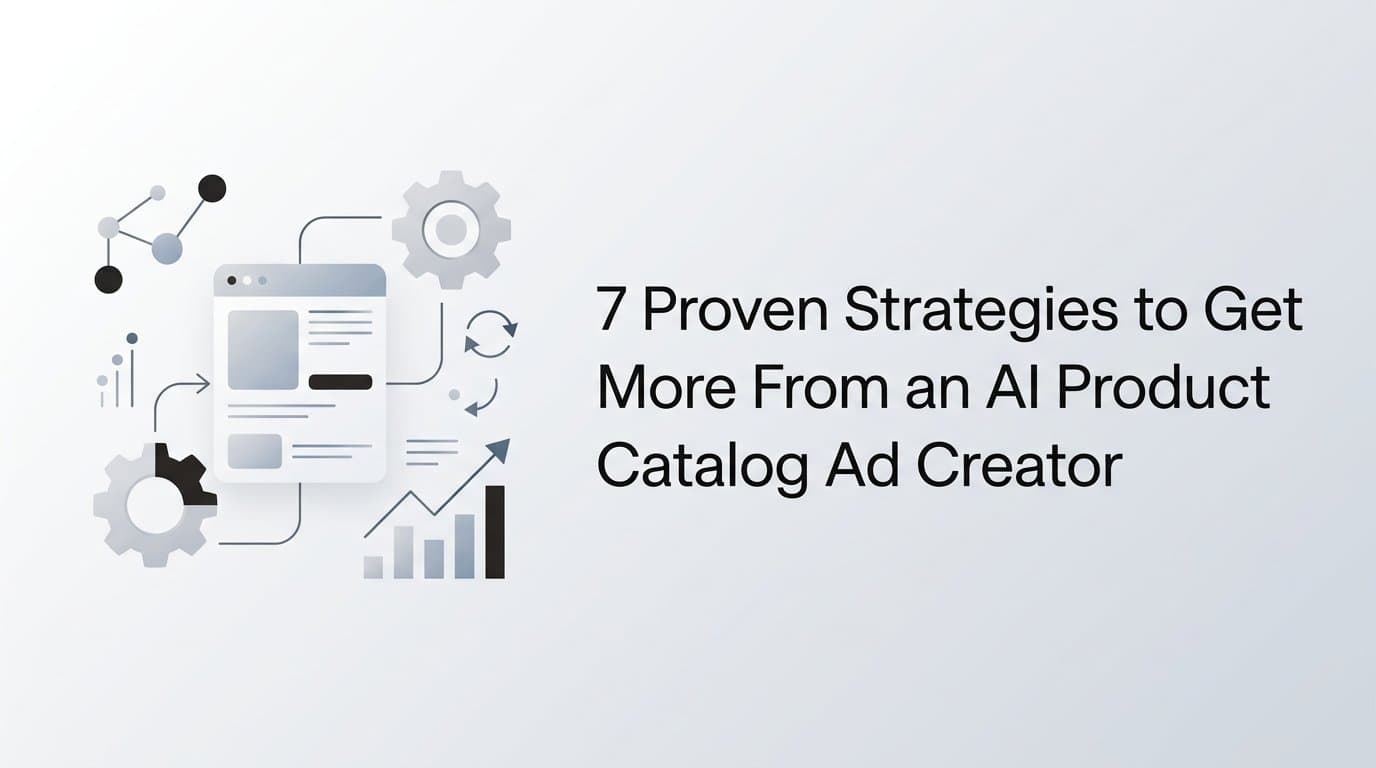
This guide covers seven actionable strategies for getting the most out of an AI product catalog ad creator, whether you are just getting started or looking to sharpen an existing workflow. Each strategy addresses a specific challenge in catalog advertising and gives you a clear path to implementation. From structuring your product data for AI to scaling your winners intelligently, these are the approaches that separate high-performing catalog campaigns from ones that just run.
1. Structure Your Product Data Like Ad Copy, Not a Spreadsheet
The Challenge It Solves
Most catalog feeds are built for inventory management, not advertising. Product titles like "SKU-4421-BLK-LG" or descriptions pulled directly from a supplier sheet give an AI creative tool almost nothing useful to work with. The AI generates copy based on the inputs it receives, so if those inputs read like a warehouse database, the output will too.
The Strategy Explained
Rewriting your catalog data with consumer messaging in mind is one of the highest-leverage improvements you can make before launching a single ad. Think about what a shopper actually needs to know: the benefit, the use case, the differentiator. A product title like "Lightweight Running Jacket, Wind Resistant, Packable" gives an AI creative system far more to work with than a model number ever could.
This applies to descriptions as well. Lead with the benefit, not the feature. Instead of "polyester blend, 200 thread count," try "stays dry on long runs, even in unpredictable weather." Your AI ad creator will pull from this language to build headlines, body copy, and visual concepts that actually resonate with buyers.
Implementation Steps
1. Audit your top 20 products and identify which titles and descriptions are written for inventory versus advertising. These are your starting point.
2. Rewrite each title using this structure: Product Name + Key Benefit + One Differentiator. Keep it under 80 characters.
3. Update descriptions to lead with the primary use case or customer problem solved, followed by supporting features. Aim for two to three benefit-focused sentences.
4. Apply the same structure across the rest of your catalog, prioritizing your highest-revenue and highest-margin SKUs first.
Pro Tips
Keep a "before and after" document as you rewrite. This becomes a reference guide for anyone adding new products to the catalog, ensuring consistent quality across your entire feed. You will also start to notice patterns in which benefit-first language your AI tool responds to most effectively.
2. Segment Your Catalog Into Creative Clusters Before Launching
The Challenge It Solves
Treating every product in a catalog the same way leads to generic ads that speak to no one in particular. A first-time visitor browsing your site needs a completely different message than someone who added a product to their cart and left. When you push your entire catalog through a single creative approach, you are essentially sending the same pitch to people at very different stages of the buying journey.
The Strategy Explained
Segmenting your catalog into creative clusters before you start generating ads gives your AI tool the context it needs to produce relevant, targeted creative. Think about grouping products by price tier, purchase intent signals, and audience stage. Meta's own advertising documentation supports the principle that prospecting audiences and retargeting audiences respond to different creative angles, and your catalog segmentation should reflect that.
A cold-traffic cluster might focus on your best-selling, most accessible products with awareness-stage messaging. A retargeting cluster might highlight the exact products someone viewed, paired with urgency or social proof messaging. A high-ticket cluster might need longer-form copy that builds confidence before asking for the conversion.
Implementation Steps
1. Divide your catalog into at least three audience-stage buckets: prospecting (cold traffic), warm retargeting (site visitors, video viewers), and cart abandonment or past purchaser audiences.
2. Within each bucket, create sub-clusters by price range or product category so the AI can generate creatives with appropriate messaging for each context.
3. Tag each cluster clearly in your campaign structure so you can track performance by segment rather than across the entire catalog at once.
4. Brief your AI creative tool separately for each cluster, specifying the audience stage and the primary message goal for that group.
Pro Tips
Resist the urge to combine clusters to save time during setup. The performance difference between a segmented catalog campaign and a single blanket approach is typically significant enough to justify the extra configuration time up front.
3. Use Competitor Ad Intelligence to Brief Your AI
The Challenge It Solves
Starting from a blank brief is one of the most common reasons AI-generated creatives feel generic. When you give an AI tool minimal direction, it defaults to safe, middle-of-the-road outputs. The result is ads that look like every other catalog ad in your category, which is exactly what you are trying to avoid.
The Strategy Explained
The Meta Ad Library at facebook.com/ads/library is a free, publicly accessible resource that shows you what any brand is actively running on Facebook and Instagram right now. Before you generate a single creative, spend time analyzing what the top performers in your category are doing. Look at creative format choices, headline structures, visual styles, and how they handle pricing or promotions in their copy.
You are not copying these ads. You are extracting patterns and using them to build a stronger brief for your AI. If you notice that the leading brands in your space are consistently using video with text overlays for mid-priced products, that is a signal worth testing. If UGC-style content dominates your category, your AI brief should reflect that direction.
AdStellar takes this a step further by letting you clone competitor ads directly from the Meta Ad Library and use them as a creative starting point. Instead of manually transferring observations into a brief, you can feed the competitor creative directly into the system and generate your own variations from it.
Implementation Steps
1. Search the Meta Ad Library for your top three to five competitors. Filter by platform and look at active ads only.
2. Screenshot or save ten to fifteen ads that appear to be running consistently, since longevity in the library often signals strong performance.
3. Identify three patterns across those ads: a recurring format, a common headline structure, and a visual style that appears frequently.
4. Use those three patterns to write a specific creative brief for your AI tool before generating catalog ads for that product segment.
Pro Tips
Check the Ad Library regularly, not just at campaign launch. Competitor creative strategies shift over time, and monitoring those shifts can give you early signals about what is working in your market before the data shows up in your own account.
4. Launch in Bulk, but Test With a System
The Challenge It Solves
Bulk ad creation is a powerful capability, but generating hundreds of variations without a structured testing plan turns that power into noise. When everything is running at once with no clear hypothesis, it becomes nearly impossible to understand what actually drove results. You end up with data that is hard to interpret and harder to act on.
The Strategy Explained
A structured test matrix gives every variation a purpose. The idea is to isolate variables so you can draw clear conclusions from your results. The three primary variables in catalog advertising are creative type, headline, and audience. By organizing your bulk launches around a matrix that controls for these variables, each ad you run contributes meaningful signal rather than random noise.
AdStellar's Bulk Ad Launch feature is built for exactly this kind of systematic testing. You can mix multiple creatives, headlines, audiences, and copy at both the ad set and ad level, and the platform generates every combination and launches them to Meta in clicks. The key is going in with a defined matrix rather than generating variations without a framework.
Implementation Steps
1. Define your test variables before you generate any ads. Choose one primary variable to isolate per test round: creative type (image vs. video vs. UGC), headline angle (benefit vs. urgency vs. social proof), or audience segment (cold vs. warm vs. retargeting).
2. Build your matrix with a manageable number of combinations per round. Three creative types times three headlines times two audiences gives you 18 combinations, which is a solid starting point without becoming unmanageable.
3. Set a minimum budget and run time for each combination before drawing conclusions. Pulling data too early leads to decisions based on statistical noise rather than real performance signals.
4. After each test round, document which combinations performed above your benchmarks and carry those forward into the next round.
Pro Tips
Keep a simple test log that records your hypothesis, the variables tested, the outcome, and the key learning. Over time this becomes an invaluable reference that prevents you from re-testing the same combinations and helps you build on what you already know works.
5. Let Performance Data Drive Your Creative Refresh Cycle
The Challenge It Solves
Catalog ads tend to fatigue faster than brand campaigns because audiences encounter them repeatedly during shopping research. Meta's advertising resources acknowledge ad fatigue as a real phenomenon: as the same creative reaches the same audience repeatedly, engagement metrics typically decline and costs often rise. Without a system to catch this early, you can lose significant budget to creatives that have already peaked.
The Strategy Explained
The solution is not to refresh creatives on a fixed calendar schedule, since that ignores actual performance signals. Instead, let your ROAS, CPA, and CTR data tell you when a creative is declining. Set benchmark thresholds for each metric based on your historical performance, and when a creative drops below those thresholds for a defined period, that triggers a refresh.
AdStellar's AI Insights feature supports this approach directly. Leaderboards rank your creatives, headlines, copy, audiences, and landing pages by real metrics against the goals you set. When a creative starts slipping in the rankings, you have a clear, data-driven signal to act rather than relying on gut feel or waiting until performance has already deteriorated significantly.
Implementation Steps
1. Establish your performance benchmarks for each catalog segment: your target ROAS, acceptable CPA range, and minimum CTR threshold. These become your refresh triggers.
2. Set a review cadence, weekly for active campaigns, biweekly for lower-spend segments, and check each creative's metrics against those benchmarks.
3. When a creative falls below benchmark for two consecutive review periods, flag it for refresh rather than immediately pausing it. One bad week can be noise; two consecutive weeks is a signal.
4. Use your winners system (covered in Strategy 7) to generate the replacement creative. Pull elements from your top performers and build the refresh around proven components rather than starting from scratch.
Pro Tips
Refresh does not always mean replacing the entire creative. Sometimes changing the headline or swapping the primary image while keeping the same copy structure is enough to reset performance. Test incremental refreshes before rebuilding from the ground up.
6. Match Ad Format to Catalog Product Type
The Challenge It Solves
Not every product in a catalog benefits from the same ad format, and running the wrong format for a product type is a quiet performance killer. A complex tech product that requires demonstration will not perform the same way in a static image as it would in a short video. A simple, visually striking product might not need video at all. Format mismatch wastes budget and suppresses results that the right format would unlock.
The Strategy Explained
Matching format to product type starts with understanding what each format does best. Video ads generally excel for products that benefit from demonstration: apparel in motion, food and beverage, tech gadgets, and anything where the "how it works" is part of the value proposition. Static image ads tend to perform well for clear value propositions, price-focused messaging, and visually distinctive products where a single strong image communicates everything. UGC-style content builds trust and tends to work well for products where social proof and real-world context matter to the buyer.
The traditional barrier to testing all three formats across a catalog was production cost and time. AdStellar removes that barrier. The AI Ad Creative feature generates image ads, video ads, and UGC-style avatar content from a product URL, with no designers, video editors, or actors needed. You can test all three formats against the same product segment and let performance data tell you which one wins.
Implementation Steps
1. Categorize your catalog products by format affinity: demonstration-required products (video), visually simple or price-led products (static image), and trust-dependent products (UGC-style).
2. For your highest-revenue catalog segments, generate all three format types and run them against the same audience to get a clean format comparison.
3. After a sufficient test period, identify the winning format for each product category and make that your default format going forward, while keeping the others as secondary tests.
4. Document format winners by product category so that when you add new products to your catalog, you already have a starting hypothesis for which format to prioritize.
Pro Tips
Format preferences can shift with audience segment. A format that wins for cold traffic might not be the top performer for retargeting. Run format tests at the audience level, not just the product level, to get the full picture.
7. Build a Winners System That Compounds Over Time
The Challenge It Solves
Most teams run strong ads, see good results, and then move on to the next campaign without capturing what made those ads work. The learning evaporates. The next campaign starts from scratch, repeating the same discovery process instead of building on proven foundations. Over time, this approach means you are constantly re-earning performance rather than compounding it.
The Strategy Explained
A winners system is a structured approach to documenting, storing, and reusing your best-performing creative elements. This is not just about saving the ad itself. It is about capturing the specific combination of creative format, headline angle, copy structure, and audience pairing that produced strong results, along with the context for why it worked.
AdStellar's Winners Hub is built around this exact concept. Your best-performing creatives, headlines, audiences, and more are stored in one place with real performance data attached. When you are ready to launch a new catalog campaign, you can select proven winners and instantly add them to your next campaign rather than generating everything from zero.
The compounding effect comes from iteration. Each new campaign does not start from scratch; it starts from your best previous results and tests incremental improvements from there. Over time, your baseline performance improves because your starting point keeps getting stronger.
Implementation Steps
1. Define what qualifies as a "winner" for your account. Set a minimum threshold based on ROAS, CPA, or CTR, and only add creatives that meet or exceed that threshold to your winners system.
2. For each winner, document the creative format, headline structure, primary copy angle, audience segment it ran against, and the performance metrics it achieved.
3. Tag winners by product category and audience stage so you can quickly filter for relevant past performers when building a new campaign.
4. When launching a new catalog campaign, start by reviewing your winners for that category and build your first round of creatives as variations on those proven elements before introducing entirely new concepts.
Pro Tips
Review your winners system quarterly and retire entries that are more than six months old unless they are still actively performing. Creative styles and audience preferences shift, and older winners may no longer reflect what resonates in the current environment. Keep the system current so it stays useful.
Putting It All Together
An AI product catalog ad creator is not a set-it-and-forget-it tool. It is a system that rewards strategic inputs and continuous refinement. The marketers who see the strongest returns are the ones who structure their data thoughtfully, segment their catalog with intent, test systematically, and build feedback loops that make each campaign smarter than the last.
Start with the strategies that address your biggest current bottleneck. If your creatives are weak, begin with data structure and competitor intelligence. If you are already generating ads but not scaling, focus on bulk testing and your winners system. If performance is declining, prioritize your refresh cadence and format matching.
Each strategy compounds on the others. The more you refine your inputs, the better your AI outputs become. And the better your outputs, the more data you have to feed back into the system.
AdStellar is built to support exactly this kind of workflow. From generating image and video ads directly from your product URL to surfacing top performers across every creative, headline, and audience through the AI Insights leaderboard and Winners Hub, it gives you the tools to run catalog advertising at a scale that would otherwise require a full team.
If you are ready to stop rebuilding from scratch every campaign and start compounding your results instead, Start Free Trial With AdStellar and be among the first to launch and scale your catalog ad campaigns faster with a platform that automatically builds, tests, and surfaces winning ads based on real performance data.