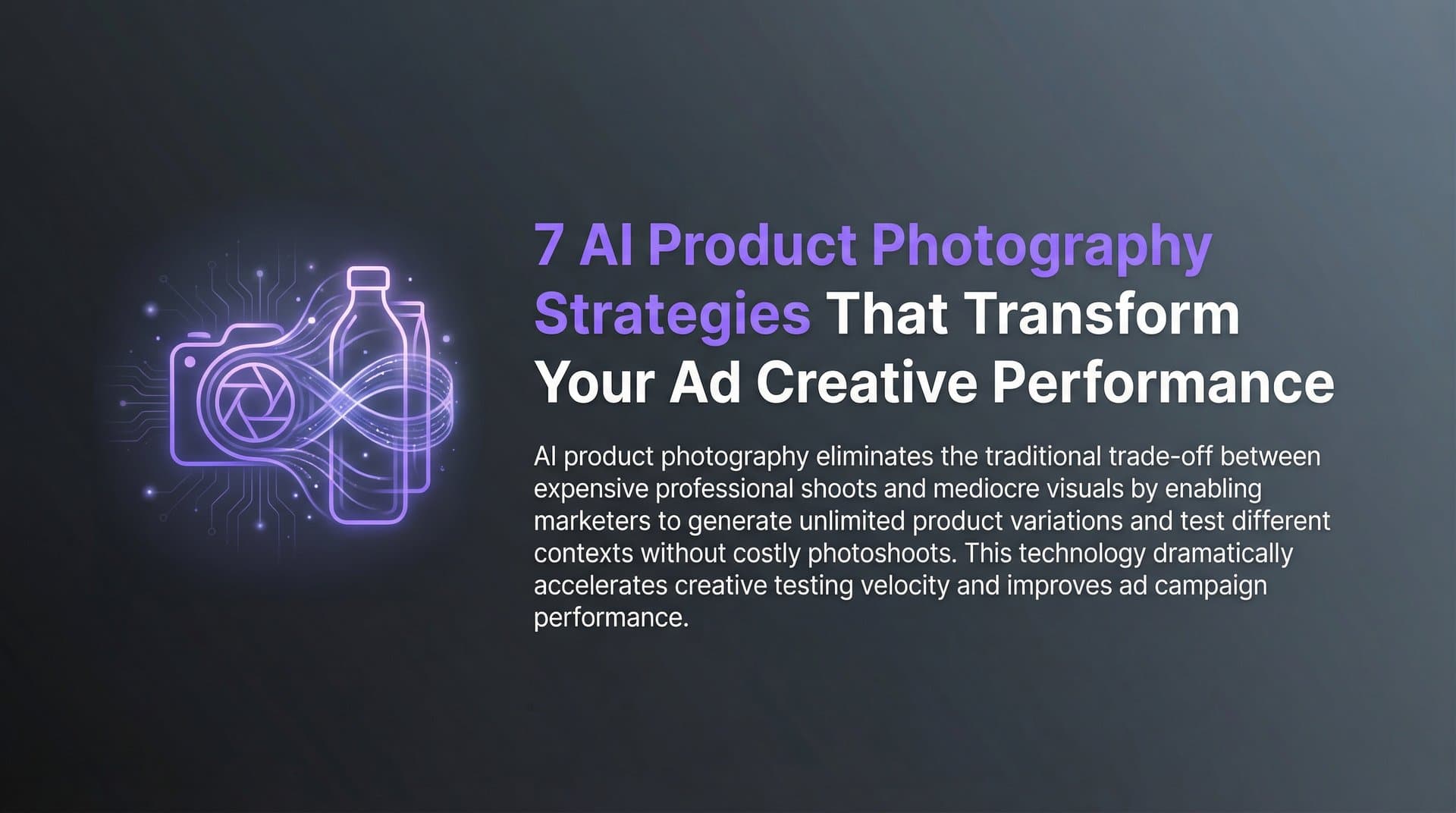
Traditional product photography forces you into an impossible trade-off. You can either invest thousands of dollars and weeks of coordination to create a limited set of professional images, or you can settle for mediocre visuals that fail to capture attention in crowded ad feeds. AI product photography eliminates this constraint entirely.
The technology allows marketers to generate unlimited product variations, test different contexts and backgrounds, and iterate based on real performance data without the overhead of traditional photoshoots. You can explore visual directions that would be cost-prohibitive with conventional methods, scaling your creative testing velocity by orders of magnitude.
This shift matters because ad creative is often the highest-leverage variable in campaign performance. The same product, same offer, and same targeting can produce dramatically different results based solely on how the product is presented visually. AI product photography gives you the flexibility to discover what resonates with your specific audience through systematic testing rather than educated guessing.
The strategies that follow represent proven approaches for integrating AI product photography into your advertising workflow. These are not theoretical concepts but practical frameworks that marketers are using right now to generate better-performing ad creatives at a fraction of traditional costs.
1. Start With High-Quality Source Images
The Challenge It Solves
AI product photography tools are powerful, but they cannot create quality from nothing. If you feed the system blurry, poorly lit, or low-resolution source images, the AI-generated outputs will inherit and often amplify those flaws. Many marketers make the mistake of assuming AI can magically fix bad photography, leading to disappointing results that undermine confidence in the technology itself.
The Strategy Explained
Think of your source images as the foundation for everything AI will build. The better the foundation, the better the final output. This means investing in at least one set of high-quality product photos that meet professional standards for resolution, lighting, and composition.
Your source images should be shot in good natural light or with proper studio lighting, captured at high resolution, and feature the product clearly against a clean background. These become your master assets that AI can then transform into countless variations. The initial investment in quality source photography pays dividends across every AI-generated variation you create afterward.
Implementation Steps
1. Photograph products at minimum 2000x2000 pixel resolution with proper lighting that eliminates harsh shadows and highlights product details clearly.
2. Use a plain white or neutral background for your master shots, giving AI clean edges to work with when generating contextual backgrounds later.
3. Capture multiple angles of each product in your initial shoot, including front, side, and detail shots that showcase key features.
4. Test your source images by generating a few AI variations before committing to full-scale production, ensuring the quality meets your standards.
Pro Tips
Professional smartphone cameras are often sufficient for source photography if you have good lighting and a steady hand. You do not need an expensive DSLR setup, but you do need attention to basic photographic fundamentals. Consider creating a simple lightbox setup for consistent results across your entire product catalog.
2. Generate Context-Specific Backgrounds
The Challenge It Solves
A product photographed on a white background may be technically perfect, but it often fails to connect emotionally with your audience. Different customer segments respond to different contexts. A skincare product might resonate with some audiences when shown in a bathroom setting, while others respond better to outdoor natural environments. Traditional photography requires separate shoots for each context, making comprehensive testing prohibitively expensive.
The Strategy Explained
AI product photography excels at placing your product in diverse environmental contexts without additional photoshoots. You can take a single high-quality product image and generate versions showing it in a modern kitchen, on a rustic wooden table, in a minimalist office, or against a vibrant outdoor backdrop.
This capability transforms how you approach audience segmentation. Instead of showing all audiences the same generic product shot, you can tailor the visual context to match specific demographic preferences, use cases, or aspirational lifestyles. A fitness supplement can appear in a gym setting for one audience segment and in a home kitchen for another, all generated from the same source image. This approach works particularly well when combined with AI product ad generators that handle the entire creative workflow.
Implementation Steps
1. Identify three to five distinct contexts that align with different customer segments or use cases for your product.
2. Generate AI variations placing your product in each context, maintaining consistent product lighting and perspective while changing only the background environment.
3. Create specific ad sets targeting different audience segments with their corresponding contextual variations to test which environments drive the strongest response.
4. Analyze performance metrics across contexts to identify which environmental settings resonate most strongly with each audience segment.
Pro Tips
Start with contexts that directly relate to product usage scenarios rather than purely aesthetic backgrounds. A coffee mug performs better in morning routine contexts than abstract artistic backgrounds, even if the latter looks more visually striking. Relevance typically outperforms pure aesthetics in conversion-focused advertising.
3. Create Multiple Product Angles
The Challenge It Solves
Comprehensive product photography traditionally requires capturing every angle, which multiplies shoot time and costs. You need front views, side profiles, top-down shots, detail close-ups, and packaging views. Coordinating all these angles in a single shoot is complex, and going back for additional angles later means repeating the entire setup process.
The Strategy Explained
AI can generate new perspectives of your product from limited source photography, effectively creating angles you never physically photographed. While this works best when you have at least two or three source angles to work from, the technology can extrapolate additional views that maintain product accuracy and visual consistency.
This approach is particularly valuable for products with simple geometric shapes or consistent patterns. A water bottle, supplement jar, or electronic device can be rotated and viewed from new angles through AI generation. The key is understanding the technology's limitations and using it strategically rather than expecting it to perfectly recreate complex products from a single photo.
Implementation Steps
1. Capture at least three core angles of your product during your initial photoshoot: front view, 45-degree angle, and either side or top view depending on product type.
2. Use AI to generate intermediate angles between your captured shots, creating a more complete visual representation of the product.
3. Review AI-generated angles for accuracy, particularly with text, logos, or complex details that may not render perfectly from all perspectives.
4. Combine your best AI-generated angles with contextual backgrounds to create a comprehensive library of product visuals covering multiple perspectives and environments.
Pro Tips
AI-generated angles work best for hero shots and mid-distance product views. For extreme close-ups showing texture or fine details, stick with traditionally photographed images. The technology excels at maintaining overall product shape and positioning but may struggle with rendering tiny text or intricate surface patterns from new angles.
4. Scale Creative Variations for Bulk Testing
The Challenge It Solves
Effective ad creative testing requires volume. You need enough variations to identify patterns in what works, but traditional photography makes high-volume testing economically unfeasible. Most brands end up testing a handful of creatives, drawing conclusions from insufficient data, and missing opportunities to discover breakthrough visual approaches.
The Strategy Explained
AI product photography removes the economic constraint on creative testing volume. You can generate dozens or even hundreds of variations exploring different backgrounds, lighting conditions, product angles, and compositional approaches. This volume enables systematic testing methodologies where you can isolate specific variables and measure their impact on performance.
The strategy shifts your approach from "create and hope" to "generate and measure." Instead of investing heavily in a few creatives you believe will work, you generate many variations at low cost and let actual performance data reveal what resonates with your audience. This empirical approach consistently outperforms intuition-based creative development, especially when launching bulk Facebook ads for product launches.
Implementation Steps
1. Define the variables you want to test: backgrounds, lighting styles, product angles, or compositional approaches like centered versus rule-of-thirds placement.
2. Generate systematic variations isolating each variable so you can measure its specific impact on performance metrics.
3. Launch variations using bulk ad creation tools that allow you to test multiple creatives simultaneously without manual setup for each variation.
4. Establish a minimum performance threshold based on your target metrics, then scale budget to winning variations while continuously generating new tests.
Pro Tips
Platforms like AdStellar streamline this entire workflow by generating AI creatives and launching them to Meta in a unified interface. You can create hundreds of ad variations mixing different creatives, headlines, and audiences, then let the system surface your top performers based on actual conversion data rather than subjective creative preferences.
5. Maintain Brand Consistency
The Challenge It Solves
AI's ability to generate unlimited variations creates a new problem: maintaining consistent brand identity across all those outputs. Without clear guidelines, AI-generated product images can drift away from your established visual language, creating a disjointed brand experience that confuses customers and dilutes brand recognition.
The Strategy Explained
Effective AI product photography requires establishing brand guardrails that guide generation without stifling creativity. This means defining specific parameters for acceptable color palettes, lighting styles, background types, and compositional approaches that align with your brand identity.
Think of these guidelines as a creative brief for your AI system. Just as you would provide direction to a human photographer about brand aesthetic, you need to encode those same preferences into your AI workflow. The goal is ensuring every AI-generated variation feels authentically connected to your brand while still exploring different creative directions. Understanding how to systematically approach designing ads at scale helps maintain this consistency across hundreds of variations.
Implementation Steps
1. Document your brand's visual identity including approved color palettes, preferred lighting styles, acceptable background types, and compositional guidelines.
2. Create template prompts or presets that encode these brand guidelines, ensuring consistency across all AI-generated variations.
3. Establish a review process where AI outputs are evaluated against brand standards before being used in live campaigns.
4. Build a library of approved AI-generated images that exemplify your brand aesthetic, using them as reference points for future generation.
Pro Tips
Start with tighter constraints and gradually expand creative exploration as you develop confidence in maintaining brand consistency. It is easier to loosen guidelines than to rebuild brand recognition after diluting it with off-brand visuals. Consider creating separate brand presets for different campaign types, allowing more creative freedom for awareness campaigns while maintaining stricter consistency for conversion-focused ads.
6. Combine With UGC-Style Creative
The Challenge It Solves
Polished AI product photography can look almost too perfect, creating a disconnect with audiences increasingly drawn to authentic, user-generated content aesthetics. Pure product shots often underperform compared to creatives that feel more genuine and less overtly commercial, even when the latter are technically lower quality.
The Strategy Explained
The most effective approach combines AI-generated product photography with presentation styles that mimic user-generated content. This means taking your perfectly rendered AI product images and integrating them into contexts that feel authentic rather than staged. Think product photos that appear to be taken in real homes, casual outdoor settings, or everyday use scenarios rather than sterile studio environments.
This strategy acknowledges that people respond differently to content that feels like a recommendation from a peer versus obvious advertising. By wrapping AI-generated product quality in UGC-style presentation, you get the best of both worlds: professional product representation with authentic emotional connection. Learning how to make UGC ads with AI can dramatically expand your creative options.
Implementation Steps
1. Generate AI product images with intentionally imperfect elements like natural lighting variations, casual compositions, or lived-in backgrounds rather than pristine studio setups.
2. Create variations that show products in realistic use contexts, such as someone's actual kitchen counter or bathroom shelf, rather than idealized staging.
3. Test different authenticity levels from highly polished to deliberately casual, measuring which approach resonates most with your specific audience.
4. Consider generating AI avatar-style content that shows virtual people using or holding your product in natural contexts, blending product focus with human elements.
Pro Tips
AdStellar's AI Creative Hub can generate UGC-style avatar content alongside traditional product photography, letting you test both approaches within the same campaign. The platform's AI insights then show you which creative style drives better performance for your specific audience and goals, removing guesswork from the polished-versus-authentic decision.
7. Iterate Based on Performance Data
The Challenge It Solves
Many marketers treat creative development as a one-time effort: generate some variations, launch campaigns, and move on. This approach misses the fundamental advantage of AI product photography, which is the ability to continuously evolve your creative based on what actually works in the market rather than what you think will work.
The Strategy Explained
The real power emerges when you establish a continuous feedback loop between campaign performance and creative generation. Your ad metrics tell you which visual elements resonate with your audience, and you use that intelligence to inform your next round of AI-generated variations. This creates a compounding improvement effect where each iteration is informed by real market response.
This strategy requires shifting your mindset from creative production to creative optimization. You are not trying to create the perfect ad upfront. You are building a system that gets progressively better at understanding what your specific audience responds to, then generating more of those winning elements. Leveraging AI ad performance scoring makes this iteration process significantly more efficient.
Implementation Steps
1. Establish clear performance metrics tied to your business goals, whether that is cost per acquisition, return on ad spend, or click-through rate.
2. Analyze your top-performing creatives to identify common visual elements: specific backgrounds, lighting styles, product angles, or compositional approaches that appear consistently in winners.
3. Generate new variations that emphasize the visual elements present in your best performers while testing incremental changes to optimize further.
4. Create a regular cadence for this analysis and iteration cycle, whether weekly or monthly, ensuring continuous improvement rather than sporadic optimization efforts.
Pro Tips
AI Insights features that rank creatives, headlines, and audiences by performance metrics make this iteration process dramatically faster. Instead of manually analyzing campaign data, leaderboards automatically surface your top performers and score new variations against your benchmarks. This transforms creative iteration from a time-consuming analysis project into a systematic workflow you can execute consistently.
Your Implementation Roadmap
AI product photography is not about replacing traditional photography entirely. It is about expanding your creative capabilities and testing velocity beyond what was previously economically feasible. The strategies outlined here work best when implemented progressively rather than all at once.
Start by ensuring you have high-quality source images for your core products. These become the foundation for everything else. Then move to generating contextual variations for your top-performing products, testing different backgrounds and environments to see what resonates with your audience. As you build confidence with the technology, scale up your creative testing volume and establish systematic processes for maintaining brand consistency.
The marketers seeing the best results treat AI as a creative multiplier rather than a replacement for strategic thinking. They use the technology to explore visual directions they could never afford to test with traditional methods, then let performance data guide which directions to pursue further. This empirical approach consistently outperforms intuition-based creative development.
Integration matters as much as generation capability. The value of AI-generated product images is fully realized when you can quickly test them in live campaigns and measure real performance. Start Free Trial With AdStellar and experience a platform that handles the entire workflow from AI creative generation to campaign launch to performance analysis. Generate image ads, video ads, and UGC-style creatives, then launch them to Meta with AI-optimized audiences and copy. The system automatically surfaces your top performers, creating a continuous loop where performance data informs your next round of creative development.
Start small, measure results, and scale what works. The competitive advantage goes to marketers who can test more creative variations faster and iterate based on real market response rather than subjective preferences.