UGC-style ads are one of the worst-kept secrets in performance marketing. Every experienced Meta advertiser knows they tend to outperform polished brand creative. The problem has never been knowing that UGC works. The problem has always been producing enough of it.
Traditional UGC production is a coordination nightmare. You find creators on platforms like Billo or Fiverr, brief them, wait for drafts, request revisions, wait again, and eventually receive a handful of assets that may or may not land with your audience. By the time you have enough creative volume to run a meaningful test, weeks have passed and your budget has been sitting idle.
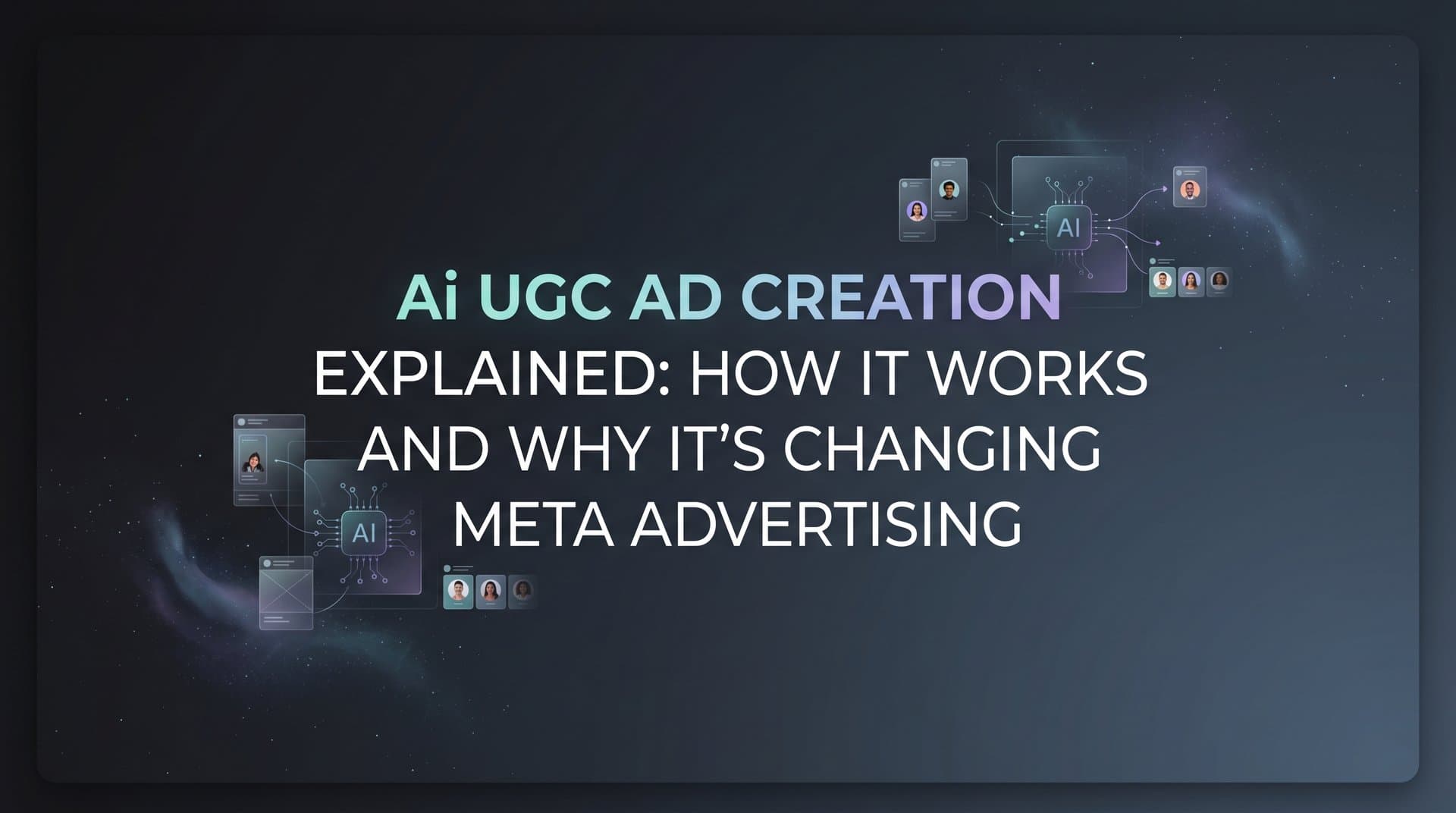
That bottleneck is disappearing. AI can now generate UGC-style video and image ads in minutes, complete with avatar presenters, scripted voiceovers, and the native aesthetic that makes this format work in the first place. This article is a clear explainer covering what AI UGC ad creation actually is, how the underlying technology works, and how performance marketers are using it to scale creative output without building a production team.
Why UGC-Style Ads Dominate the Meta Feed
Before getting into the AI side of things, it helps to be precise about what makes UGC-style ads effective in the first place. In the context of paid social, UGC-style content refers to ads that mimic the look and feel of organic creator posts: a person speaking directly to camera about a product, a casual product walkthrough filmed on a phone, a testimonial-style clip that looks like something a real customer would share.
The key word is "mimic." These ads do not need to be literally created by users to perform like UGC. What matters is the visual language. When an ad looks like it belongs in the feed rather than interrupting it, audiences engage differently. The psychological friction that comes with recognizing an obvious brand commercial drops significantly.
This native feel is why the format resonates so strongly on Facebook and Instagram specifically. Both platforms train users to scroll quickly and filter out anything that registers as advertising. UGC-style content slips past that filter because it uses the same visual cues as organic content: natural lighting, direct address, authentic-sounding language, and an unpolished aesthetic that signals a real person rather than a production team.
There is also a trust dimension. A person talking about a product on camera, even in an ad context, carries more credibility than a brand talking about itself. Audiences are more likely to pause, watch, and consider a recommendation that feels personal rather than promotional.
The traditional production challenge is that these advantages only compound when you have volume. A single UGC-style video is useful. Thirty variations testing different hooks, presenters, and angles is where the real performance data lives. But sourcing, briefing, filming, and editing thirty creator videos is not a realistic workflow for most advertisers. Revision cycles alone can stretch a single deliverable across multiple weeks. That operational reality has historically capped how much UGC testing most teams could actually run.
AI changes that ceiling entirely.
What AI UGC Ad Creation Actually Means
The term gets used loosely, so it is worth being precise. AI UGC ad creation refers to using AI models to generate avatar-based video ads, synthetic voiceovers, and styled image creatives that replicate the look and feel of real creator content, without involving actual people in the production process.
The output looks like UGC. It does not require UGC production.
This distinction matters for a few reasons. First, it clarifies what the technology is actually doing. You are not generating content from real users. You are generating content that uses the same visual and tonal language that makes UGC effective. Second, it helps set realistic expectations about quality and use cases. AI-generated UGC-style ads are designed to perform in feed, not to win creative awards. The benchmark is whether they stop the scroll and drive action, and that benchmark is entirely achievable with current AI generation capabilities.
The format and visual language matter more to ad performance than the production method. Meta's algorithm does not care whether your video was filmed by a real creator or generated by an AI avatar. Your audience does not either, provided the content feels authentic and relevant. Performance marketers who have adopted AI UGC tools are finding that the format advantage transfers cleanly to AI-generated assets when the inputs and prompts are handled correctly.
In terms of what the AI actually needs to get started, the inputs are minimal. A product URL is often enough. The AI can pull product details, imagery, and positioning context from the URL and use that information to generate a script, select an appropriate avatar presenter, and produce a finished video asset. You can also provide brand details directly, upload reference creatives, or point the tool at a competitor ad from the Meta Ad Library to use as a creative brief.
The output is a complete ad asset: a video with an on-screen presenter delivering a scripted walkthrough or testimonial, or an image creative styled to match the native aesthetic of organic feed content. From there, you can refine through chat-based editing, request variations, or move directly into campaign setup.
The practical implication is significant. What previously required a creator brief, a filming session, and an editing timeline can now happen in a single sitting. That shift in production speed is what makes creative volume at scale a realistic goal rather than an operational aspiration.
The Technology Stack Behind AI-Generated UGC Ads
Understanding how the technology works makes it easier to use effectively. AI UGC ad creation is not a single model doing one thing. It is several AI components working together to handle different parts of the production process.
Large language models handle the scriptwriting and ad copy layer. When you provide a product URL or brief, the LLM analyzes the input and generates a script structured for ad performance: a hook that grabs attention in the first few seconds, a value proposition that connects to the target audience, and a call to action that drives the intended behavior. These models are trained on enough advertising context to understand what makes copy work in a paid social environment, not just what makes it grammatically correct.
Generative video and image models handle the visual asset production. For video, this means rendering the avatar presenter, syncing lip movement to the voiceover, and producing a finished clip that looks like it was filmed rather than generated. For image ads, the models produce styled creatives that match the aesthetic of organic content rather than corporate brand templates. The visual quality of these outputs has improved substantially as the underlying models have matured.
Avatar synthesis technology is the component that creates the on-screen presenter. These are synthetic human figures that can deliver scripted content in a range of styles, tones, and visual presentations. The category was established by platforms like HeyGen and Synthesia, and the technology has become commercially mature enough that the output is convincing in a feed context. AdStellar integrates avatar generation directly into its ad creation workflow, which means you are not stitching together a separate avatar tool with your campaign management platform.
Chat-based editing is one of the more practically useful features of AI creative tools. Rather than exporting an asset and sending it to a designer or video editor for revisions, you can refine the creative through natural language prompts. Change the hook, adjust the tone, swap the avatar, update the call to action. The iteration happens in the platform, in conversation, without a production handoff. For performance marketers who are used to waiting days for revision turnarounds, this is a meaningful workflow change.
The competitor ad cloning capability deserves specific mention. The Meta Ad Library is a publicly available tool that lets anyone search and view active ads running across Meta platforms. AI creative tools can pull reference ads directly from that library and use them as creative briefs. You identify a competitor format that appears to be working, the AI analyzes the structure and style, and generates a similar format tailored to your own product and messaging. This is not copying. It is using proven format signals to inform your own creative direction, which is standard practice in performance marketing and now dramatically faster with AI assistance.
Scaling Creative Output: From One Ad to Hundreds of Variations
Creative volume is not about producing more for the sake of it. It is about generating enough test surface area to find what actually works for your specific product and audience.
Meta advertising performance is heavily influenced by creative. The algorithm optimizes toward the assets that drive results, but it needs data to learn from. More creative variations mean more data points, faster identification of winning hooks, and reduced creative fatigue as audiences see the same ads repeatedly. A single creative, no matter how good, will wear out. A library of tested variations keeps performance stable and gives the algorithm more to work with.
The traditional constraint was production capacity. You could only test as many creatives as you could produce, and production was slow and expensive. AI removes that constraint. Generating ten UGC-style video variations from a single product URL takes minutes, not weeks. That changes the economics of creative testing entirely.
Bulk ad creation takes this further by combining creative assets with different headlines, copy variations, and audience targeting to produce hundreds of complete ad combinations ready for launch. Think of it as a matrix: five creatives multiplied by four headlines multiplied by three audience segments produces sixty ad combinations. AdStellar's Bulk Ad Launch feature handles this at both the ad set and ad level, generating every combination and preparing them for launch without requiring you to set each one up manually.
This is where the connection between creative generation and campaign structure becomes important. Generating a hundred ad combinations is only useful if they are organized and launched in a way that produces readable performance data. AI-built campaigns address this by analyzing your historical performance data before the campaign even goes live. The AI Campaign Builder looks at which creative elements, headlines, and audiences have performed well in past campaigns, ranks them by performance, and uses those signals to structure the new campaign intelligently.
The result is that you are not launching a hundred random variations and hoping something works. You are launching variations that are informed by what has already proven effective, with enough breadth to surface new winners and enough structure to interpret the results clearly. The AI explains every decision it makes, so you understand the strategy behind the campaign structure rather than treating the output as a black box.
This combination of AI creative generation and AI campaign structure is what makes scaling creative output a practical performance strategy rather than just a volume exercise.
Finding Your Winners: AI Insights and Performance Scoring
Generating creative at scale is only valuable if you can identify what is working. This is where many advertisers hit a different kind of bottleneck: the analysis problem. When you are running dozens of ad variations across multiple campaigns, manually sorting through performance data to find your winners is time-consuming and easy to get wrong.
AI Insights addresses this by surfacing top-performing creatives, headlines, and audiences through leaderboard ranking based on real metrics. ROAS, CPA, and CTR are the signals that matter, and the leaderboard organizes your creative elements by those metrics so you can see at a glance what is driving results and what is not. This replaces the spreadsheet-and-gut-feel approach with a structured, data-driven view of creative performance.
The goal-based scoring approach takes this further by letting you define your own performance benchmarks. Every advertiser has different targets depending on their margins, funnel structure, and growth stage. A ROAS that represents a win for one business might be below breakeven for another. Goal-based scoring means the AI evaluates every creative element against your specific targets rather than generic industry benchmarks. You set the standard, and the AI scores everything against it.
This matters because it makes the insights actionable rather than just informational. When you can see that a specific hook format consistently scores above your ROAS benchmark while another format consistently underperforms, you have a clear signal about where to focus your next creative iteration.
The Winners Hub brings this full circle. Rather than having winning creatives, headlines, and audiences scattered across campaign reports, the Winners Hub stores your proven performers in one centralized place with their performance data attached. When you are building your next campaign, you can pull directly from that library. You are not starting from scratch. You are building on what has already been validated by real spend and real results.
This creates a compounding advantage over time. Each campaign generates new performance data, new winners get added to the hub, and each subsequent campaign starts from a stronger creative foundation than the one before it. The learning loop gets tighter with every iteration.
A Practical Workflow for AI UGC Ads
The individual capabilities are useful on their own. The real value comes from how they connect into a single workflow. Here is what that looks like in practice with AdStellar.
You start with a product URL. The AI pulls the relevant details and generates UGC-style creatives: avatar-based video ads, image creatives styled for feed, or both. You review the outputs, refine through chat-based editing if needed, and generate variations with different hooks, presenters, or angles. This entire step happens in one session without involving a designer, video editor, or creator.
From there, you move into campaign setup. The AI Campaign Builder analyzes your historical performance data, ranks your creative elements and audiences by past performance, and builds a complete campaign structure. You can review the AI's rationale for every decision before anything goes live. The Bulk Ad Launch feature then generates every combination of creatives, headlines, copy, and audiences and prepares them for launch in clicks rather than hours.
Once the campaign is live, AI Insights tracks performance in real time. The leaderboard surfaces your top performers by ROAS, CPA, and CTR. Goal-based scoring tells you which elements are hitting your benchmarks and which are not. Winners get added to the Winners Hub for use in future campaigns.
A few common questions worth addressing directly. On creative quality: AI-generated UGC-style ads are designed to perform in feed, and the quality bar for that context is achievable with current technology. The goal is not cinematic production. It is native authenticity, and that is what these tools are built to deliver. On brand control: chat-based editing gives you meaningful control over messaging, tone, and visual direction. You are not locked into whatever the AI generates first. On consistency at scale: the Winners Hub and AI Campaign Builder work together to ensure that scaling volume does not mean sacrificing the creative signals that have already proven effective.
AI UGC creation is moving fast. Avatar quality, script sophistication, and format variety are all improving. The advertisers who build fluency with these tools now will have a compounding advantage as the technology continues to develop.
The Bottom Line
The core shift that AI UGC ad creation represents is straightforward: the production bottleneck that has always limited creative testing volume is no longer a fixed constraint. The format advantage of UGC-style content, the native feel, the trust signals, the reduced ad fatigue, is now accessible at any scale without a production team, a creator roster, or weeks of revision cycles.
Performance marketers who have been limited by production capacity can now test the creative volume that the Meta algorithm actually rewards. The question shifts from "how many creatives can we afford to produce?" to "how quickly can we identify what works and scale it?"
AdStellar is built to answer that second question. From generating AI UGC-style creatives from a product URL, to launching hundreds of variations through the AI Campaign Builder, to surfacing winners through AI Insights and the Winners Hub, it handles the full loop in one platform. No stitching together separate tools for creative, launch, and analytics.
Start Free Trial With AdStellar and generate your first AI UGC ad from a product URL. Seven days free, no production team required.