UGC-style ads are the worst-kept secret in Meta advertising. Every performance marketer knows they work. The casual framing, the direct-to-camera delivery, the conversational tone that makes an ad feel less like an ad. These creatives consistently outperform polished brand content because they blend into the feed rather than interrupting it.
The problem has never been knowing that UGC works. The problem has always been producing enough of it to actually test and scale. Finding creators, negotiating rates, writing briefs, waiting on deliverables, managing revisions. It is a slow, expensive process that makes creative testing feel like a luxury rather than a standard practice.
That bottleneck is now being dismantled by AI avatar technology. Marketers can generate realistic, human-like video content featuring synthetic digital personas delivering scripted messages, without a single creator, camera, or editing suite involved. This article breaks down exactly what AI UGC avatar generation is, how the technology works, and how you can use it as part of a real Meta ad strategy. No hype, just a practical explainer for marketers who want to understand the tool before they start using it.
The UGC Advantage and Why Scale Has Always Been the Problem
To understand why AI avatar generation matters, it helps to understand why UGC-style content became such a dominant format on Meta in the first place.
Traditional brand advertising is designed to look like advertising. Clean product shots, polished graphics, professional voiceovers. The visual language signals immediately that you are looking at a paid promotion, and users have become remarkably good at scrolling past it. UGC-style content works differently. It mimics the look and feel of organic posts: a person talking directly to the camera, casual lighting, natural speech patterns, maybe a product held up in frame. The visual cues tell the brain "this is content from a real person," which reduces the instinctive resistance that polished ads trigger.
On Facebook and Instagram, where the feed is a mix of posts from friends, creators, and brands, this native quality is especially valuable. An ad that looks like it belongs in the feed earns more attention, more engagement, and often more conversions than one that announces itself as advertising.
The challenge is that producing authentic UGC-style content at the volume required for real creative testing is genuinely difficult. A proper creative testing strategy on Meta means running multiple variations to identify which hooks, benefit statements, and calls to action resonate with each audience segment. If every variation requires sourcing a new creator or reshooting with the same one, the cost per deliverable climbs fast and the timeline stretches even faster.
Consider what the traditional workflow actually involves. You need to find creators whose style matches your brand, vet their content quality, negotiate rates, write a brief detailed enough to get what you want but loose enough to preserve authenticity, wait for the first draft, provide feedback, wait for revisions, and then repeat the process for every new variation you want to test. For a small team running lean, this is often simply not feasible at scale.
The result is that many marketing teams end up testing far fewer creative variations than the platform rewards. Meta's algorithm responds well to broad creative testing because it gives the system more signal to work with. Teams that can only afford to produce two or three UGC-style creatives per month are working with one hand tied behind their back compared to teams that can generate dozens.
This gap between what UGC demands and what production capacity allows is exactly what pushed the industry toward AI-generated alternatives. The technology did not create the demand. The demand was already there. It just needed a more scalable supply chain. Understanding the true cost of UGC creator production makes the case for AI alternatives even clearer.
What AI UGC Avatars Actually Are
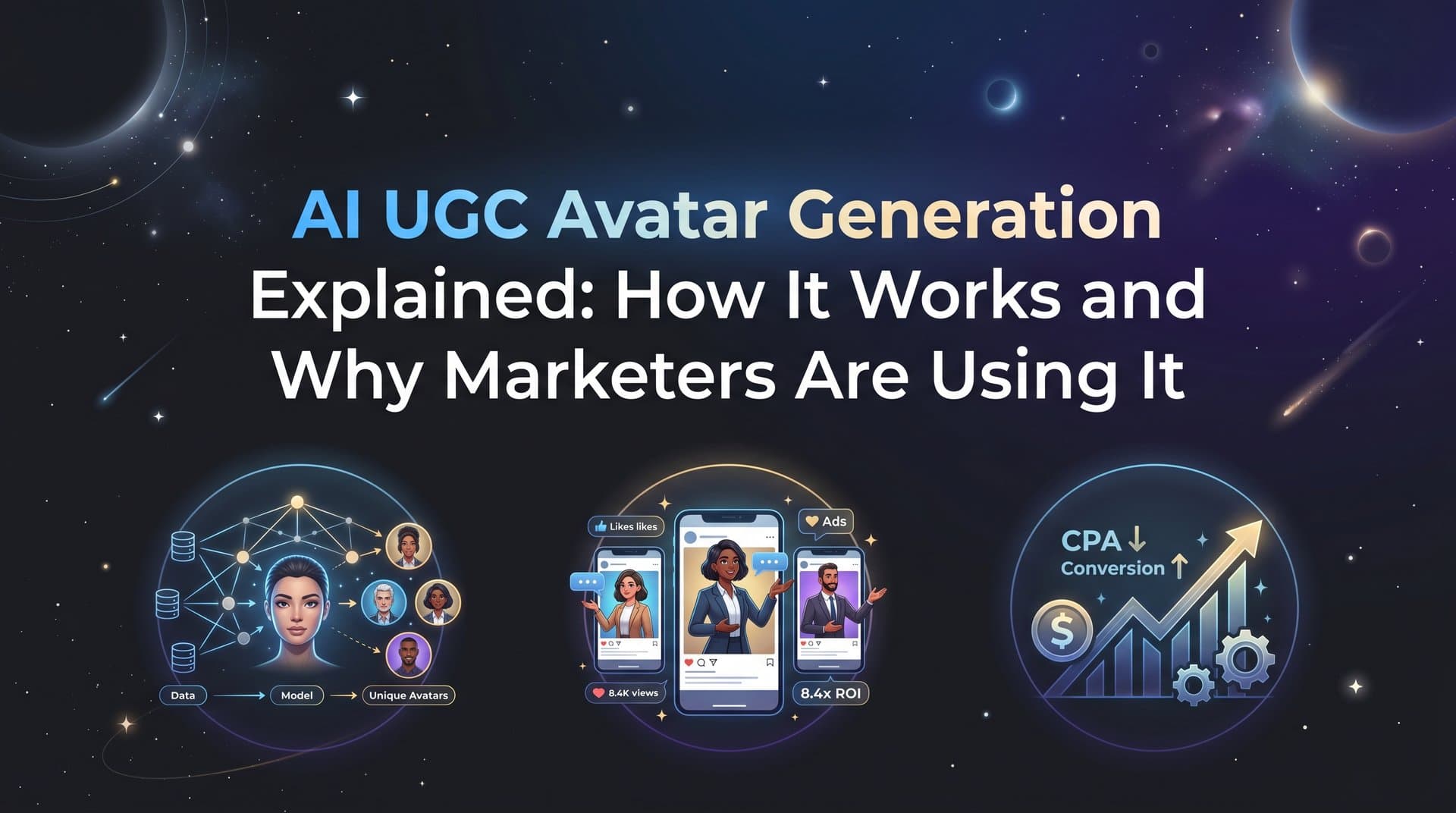
Let's cut through the jargon and explain this clearly. An AI UGC avatar is a synthetic digital persona, a realistic-looking human figure generated by AI, that can deliver scripted video content in a natural, human-like way. No real person appears on camera. No filming takes place. You provide a script, select an avatar, and the system generates a finished video.
The output looks and feels like the kind of content a real UGC creator would produce. A person facing the camera, speaking conversationally about a product, delivering a hook, explaining a benefit, and closing with a call to action. The framing is casual. The delivery feels authentic. The visual style matches what users expect from organic content in their feed.
This is fundamentally different from traditional video production in almost every way. Traditional video requires physical equipment, a location, an actor or creator, lighting, audio recording, and post-production editing. The timeline from brief to finished asset is measured in days or weeks. The cost is fixed per deliverable, which means testing ten variations costs ten times as much as testing one.
AI avatar generation collapses that entire process. The inputs are a script and a generation request. The output is a finished video. The timeline is measured in minutes, not days. And because the marginal cost of generating an additional variation is minimal, testing ten versions of a script costs essentially the same as testing one.
The key output formats mirror what real UGC creators produce. Talking-head videos where the avatar speaks directly to the camera work well for product introductions and brand awareness. Product review formats where the avatar walks through features and benefits are effective for consideration-stage audiences. Testimonial-style creatives where the avatar speaks from a first-person perspective about a product experience closely replicate the format that tends to perform best in the feed. These formats are a core part of what makes synthetic UGC for ads such a compelling production approach.
It is worth being clear about what AI avatars are not. They are not deepfakes of real people. Reputable platforms use purpose-built synthetic personas, not replicas of existing individuals. They are also not perfect substitutes for every type of UGC content. There are situations where authentic human creators still have a meaningful edge, and we will get into those later. But for the core use case of producing scalable, feed-native video content for Meta ad testing, AI avatars are a genuinely capable tool.
How the Technology Works Under the Hood
You do not need to be an AI engineer to use this technology effectively, but understanding the core components helps you work with it more intelligently and set realistic expectations about what it can and cannot do.
Three main technologies work together to produce a finished AI avatar video. The first is text-to-video synthesis, which is the AI model responsible for generating the visual output. It takes text input and produces video frames featuring a realistic human figure. Modern synthesis models have become significantly more capable in recent years, producing output that holds up well at the resolutions and aspect ratios used in Meta ad placements.
The second component is lip-sync modeling. This is the technology that synchronizes the avatar's mouth movements with the audio track. Lip-sync has historically been one of the more technically challenging aspects of synthetic video because even small mismatches between audio and visual movement are immediately noticeable to human viewers. Current lip-sync models have improved considerably and produce results that feel natural in most viewing contexts.
The third component is neural text-to-speech, which generates the voice. Rather than using a flat, robotic synthesized voice, modern TTS systems produce natural-sounding audio with appropriate pacing, emphasis, and tonal variation. The voice can be matched to the avatar's visual presentation and adjusted to suit the tone of the script, whether that is energetic and enthusiastic or calm and informative.
In practice, platforms like AdStellar bring these components together into a workflow that requires very little technical knowledge to operate. You can start with a product URL and let the system generate a script based on your product's features and benefits. You select an avatar from a library of synthetic personas. The platform handles script generation, voice synthesis, lip-sync, and video rendering automatically. What comes out the other end is a finished avatar video ready for ad placement. This is part of a broader shift in how AI ad creation is transforming production workflows.
The chat-based editing capability is where the workflow becomes genuinely flexible. Rather than starting from scratch every time you want to adjust the creative, you can refine specific elements through a conversational interface. Change the hook, adjust the pacing, shift the tone from casual to authoritative, or swap the call to action. These changes can be made and re-rendered quickly, which means iteration is fast and inexpensive.
This iterative capability is important because the first version of any creative is rarely the best one. The ability to refine without rebuilding from scratch is what makes AI avatar generation practical for real creative testing workflows, not just one-off productions.
Where AI UGC Avatars Fit Inside a Meta Ad Strategy
Generating an avatar video is only useful if it fits into a broader strategy. Here is how AI UGC avatar creatives actually slot into a well-structured Meta ad approach.
The most effective way to use avatar ads is as part of a diversified creative testing strategy. Rather than going all-in on one format, smart Meta advertisers test across multiple creative types simultaneously: static image ads, standard video ads, and UGC-style avatar ads. Each format tends to resonate differently with different audience segments and placements. Running all three gives you real data about which format your specific audience responds to, rather than relying on general assumptions about what works.
Avatar creatives are particularly well-suited for this kind of broad testing because of how quickly you can generate variations. Where producing three versions of a standard video ad might take a week and a meaningful budget, generating three avatar ad variations with different scripts, hooks, and avatar styles can happen in a single session. That speed advantage compounds when you consider how many variables are worth testing on Meta. Exploring multivariate testing approaches can help you structure these experiments more systematically.
This is where bulk ad launching becomes a significant operational advantage. A platform like AdStellar lets you combine multiple avatar creatives with multiple headline variations, copy options, and audience targets to generate a large number of ad combinations quickly. Instead of manually building each ad set, you select your inputs and the platform creates every combination and launches them to Meta. What would take hours of manual work in Ads Manager happens in a fraction of the time.
The natural question that follows is: how do you make sense of all that data? Running dozens of variations is only useful if you can identify which ones are actually working. This is where AI insights and performance leaderboards become essential. Rather than digging through raw numbers in spreadsheets, a well-built platform surfaces which avatar scripts, hooks, and formats are driving the metrics that matter: ROAS, CPA, CTR. You can see at a glance which creative elements are performing above your targets and which ones are not.
AdStellar's AI Insights feature does exactly this. It ranks your creatives, headlines, copy, and audiences by real performance metrics and scores everything against your goals. When an avatar creative starts consistently outperforming your benchmarks, it surfaces as a winner. You can then store it in the Winners Hub and pull it directly into future campaigns without having to rebuild it from scratch.
The compounding effect here is real. Each campaign generates performance data. That data informs the next round of creative decisions. The AI Campaign Builder uses historical performance to build future campaigns with better starting points. Over time, you are not just generating creatives faster. You are generating better creatives faster, because the system is learning what works for your specific product, audience, and goals.
Practical Considerations Before You Start Generating
Before you start generating avatar ads, there are a few things worth getting clear on. The technology is capable, but like any tool, how you use it determines how useful it actually is.
Script quality is the primary performance driver. This is the most important thing to understand about AI UGC avatar generation. The avatar itself, its appearance, style, and delivery, matters far less than what it is saying. The hook in the first three seconds determines whether a viewer keeps watching. The benefit statement determines whether they engage. The call to action determines whether they convert. A weak script delivered by a polished avatar will underperform a strong script delivered by a basic one. Invest your thinking time in the script, not the avatar selection. Pairing strong scripts with automated ad copy generation can accelerate this process considerably.
Brand consistency requires intentional management. When you are generating content at scale, maintaining a consistent brand voice across many variations takes deliberate effort. Establish clear guidelines for tone, terminology, and messaging before you start generating. Use those guidelines to brief the AI and review outputs against them. It is easy to end up with a library of creatives that feel disconnected from each other if you are not paying attention to this.
Platform policies around synthetic media are evolving. Meta has guidelines governing the use of synthetic media in advertising, and those guidelines are subject to change as the technology and regulatory environment develop. Before running AI-generated avatar ads, review Meta's current advertiser policies directly. This article is not the right place for specific policy guidance because the details can shift. What matters is that you stay current with the rules and approach synthetic media disclosures with appropriate care.
Know when authentic creators still have an edge. AI UGC avatars are excellent for scale, speed, and cost efficiency. They are not always the right tool. For products where genuine personal experience is central to the trust equation, such as certain wellness categories or highly personal services, real human creators often still outperform synthetic alternatives. Audiences in these categories may be more sensitive to authenticity signals. Similarly, for brands that have built a strong community around real creator relationships, AI avatars may feel off-brand. Use this format where it makes sense and keep authentic creator content in your mix where it adds genuine value.
From Avatar to Live Campaign: The End-to-End Workflow
Let's walk through what the actual workflow looks like when you put all of this together using an AI ad platform.
You start with your product. In AdStellar, you can input a product URL and let the AI generate avatar creatives based on your product's features, benefits, and positioning. The system handles script generation, avatar selection, voice synthesis, and video rendering. If you want to adjust the output, you refine it through chat-based editing without rebuilding from scratch. In a single session, you can produce multiple avatar variations with different hooks, different benefit angles, and different calls to action.
From there, you move into the bulk launch workflow. You combine your avatar creatives with headline variations and copy options, select your target audiences, and let the platform generate every combination. AdStellar creates all the ad variations and launches them to Meta directly. What used to require hours of manual work in Ads Manager is compressed into minutes. This is precisely the kind of efficiency that bulk ad creation tools are designed to deliver.
Once your campaigns are live, the AI Insights leaderboard starts ranking your creatives by real performance metrics. You can see which avatar scripts are driving the best ROAS, which hooks are generating the strongest CTR, and which formats are hitting your CPA targets. Winners get stored in the Winners Hub for immediate reuse. Underperformers get cut or revised.
The continuous learning loop is what makes this compounding over time. Every campaign you run feeds performance data back into the system. The AI Campaign Builder uses that historical data to make smarter decisions about future campaigns, selecting creative elements and audience combinations that have a stronger track record. The more you use the platform, the better it gets at predicting what will work for your specific product and audience.
The practical takeaway for marketers is straightforward. AI UGC avatar generation removes the production ceiling that has historically limited creative testing on Meta. When the cost and time required to produce a new creative variation drops to near zero, you can test more aggressively, learn faster, and scale winning combinations with confidence. Teams that previously tested three or four creatives per month can now test dozens. That is not just an efficiency gain. It is a competitive advantage.
The Bottom Line on AI UGC Avatar Generation
UGC-style content is not going anywhere. If anything, its dominance in the Meta feed is likely to grow as users become even more adept at filtering out traditional brand advertising. The question for performance marketers is no longer whether to invest in this format. It is how to produce it at the volume that effective testing and scaling actually requires.
AI avatar generation answers that question directly. The technology is mature enough to produce realistic, feed-native video content without a real person on camera. The workflows are fast enough to support genuine creative testing at scale. And the integration with AI-powered campaign tools means that generating the creative is only the beginning. You can launch it, test it, measure it, and feed what you learn back into the next round of production, all within a single platform.
The production ceiling that used to gate UGC-style advertising behind creator budgets and timelines no longer has to apply to your team. Any marketer running Meta ads can now access this format, test it properly, and scale what works.
If you are ready to put this into practice, Start Free Trial With AdStellar and be among the first to launch and scale your ad campaigns faster with an intelligent platform that automatically builds and tests winning ads based on real performance data. Generate avatar creatives, launch them to Meta, and let AI surface the winners. No designers, no video editors, no guesswork.