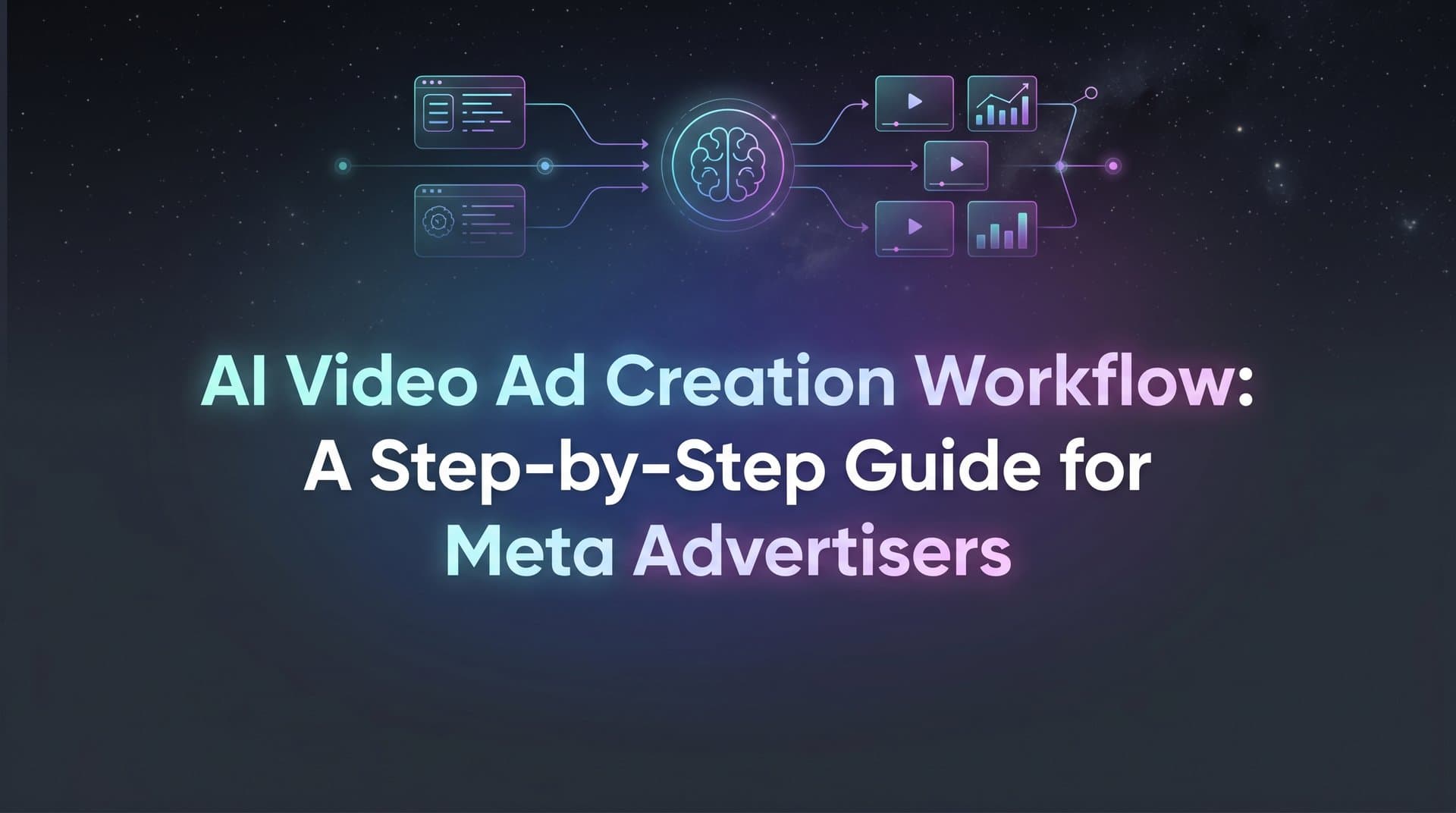
Video ads consistently outperform static images on Meta platforms, but the traditional production process has always been a bottleneck. Hiring videographers, coordinating actors, editing footage, writing scripts, and then rebuilding everything for different audiences and formats can take weeks and cost thousands of dollars per campaign.
AI has fundamentally changed that equation. Today, marketers can go from product URL to launch-ready video ad in a fraction of the time, without a production crew or a video editing background.
This guide walks you through a complete AI video ad creation workflow built specifically for Meta advertisers. Whether you are running campaigns for a single brand or managing accounts for multiple clients, these steps will help you produce scroll-stopping video creatives, test them at scale, and identify your winners faster.
Here is what you will learn across each step: how to brief the AI effectively so it generates relevant, on-brand content; how to create multiple video variations for testing; how to layer in UGC-style creatives that feel native to the feed; how to bulk launch without manual setup; and how to use performance data to continuously improve your creative output.
Each step builds on the last. By the end, you will have a repeatable workflow you can run again and again. The goal is not just to make video ads faster. It is to build a system that gets smarter over time, where every campaign teaches you something that makes the next one better.
Let us get into it.
Step 1: Define Your Creative Brief Before Touching Any Tool
The single biggest mistake marketers make with AI video ad creation is jumping straight into generation without a clear direction. The result is generic output that technically works but does not resonate with any specific audience. Then you spend more time in revision rounds than you would have spent just thinking it through upfront.
Before you open any platform, answer these four questions clearly.
What is your campaign goal? Conversions, traffic, awareness, and retargeting all call for different video structures. A retargeting ad can reference products someone already viewed. An awareness ad needs to introduce your brand quickly and memorably. Know which one you are building before you brief the AI.
Who is your target audience and what do they care about? Identify the specific segment this video is for. Are they first-time buyers who need to understand what your product does? Existing customers who need a reason to upgrade? A cold audience that has never heard of your brand? The video hook, tone, and message should speak directly to that person, not everyone at once.
What format does your placement require? Reels and Stories demand vertical 9:16 video. Feed placements work well with 1:1 or 4:5 formats. If you are building for multiple placements, decide upfront whether you will create separate versions or adapt one master creative. Getting format right before generation saves significant rework later.
What is the core message and call to action? Nail down one central idea the video should communicate and the single action you want the viewer to take. Trying to communicate three things in a 15-second video communicates nothing. One message, one CTA, clear direction for the AI.
Also note any brand constraints before you start: specific colors, tone of voice, product angles that must be shown, or messaging that is off-limits. These details help the AI generate output that is closer to usable on the first pass.
A useful self-check: if you cannot summarize your brief in two to three sentences, you are not ready to generate yet. Spend another five minutes here. It will save you thirty minutes of revisions later. Understanding common Meta advertising workflow bottlenecks can help you anticipate where the brief process typically breaks down.
Success indicator: You have a written brief that covers your goal, audience, format, core message, and CTA before opening your creative tool.
Step 2: Generate Your First Round of Video Variations
With your brief in hand, you are ready to generate. The key principle here is to produce multiple meaningfully different variations in your first pass rather than trying to perfect a single ad before testing it. Performance data should determine which creative wins, not your gut feel in the editor.
Start with your product URL as the input. This allows the AI to pull real product imagery, copy, and context automatically, which produces output that is grounded in your actual product rather than generic placeholder content. It also reduces the amount of manual editing you need to do after generation.
When selecting your video format, you will typically have a few style options to choose from. Image-based video ads combine product images with motion, text overlays, and music to create a polished ad without requiring raw video footage. UGC avatar ads generate spokesperson-style video content using AI avatars, which tend to feel native to the feed and blend into organic content. This style is particularly effective for direct-to-consumer products because it reduces the visual friction that signals "this is an ad" to a scrolling audience.
Generate at least three to five variations in this first round. Vary the hook text across each version since the first one to three seconds of a video ad is widely recognized as the most critical element for stopping the scroll. Also vary the visual style and opening frame where possible. The goal is to have meaningfully different options to test, not five versions of the same ad with slightly different colors.
Once your initial variations are generated, use chat-based editing to refine specific elements without regenerating the entire ad. Adjust the hook text, overlay copy, and CTA independently. This is where you can quickly create additional test variants without starting from scratch each time. For a detailed walkthrough of building video creatives from the ground up, the Instagram ad video creation tutorial covers the full production process step by step.
Think of this step as setting up your creative experiment. You are not trying to find the winner here. You are creating enough variation that the data can tell you what actually resonates.
Success indicator: You have at least three to five meaningfully different video creatives ready for review, each with a distinct hook or visual approach.
Step 3: Research Competitor Video Ads to Sharpen Your Direction
Before you finalize your creative set, spend time understanding what is already running in your category. The Meta Ad Library gives you a live view of active ads from any advertiser, and it is one of the most underused research tools available to Meta advertisers.
Look at competitors who are spending consistently in your space. Active ads that have been running for an extended period are usually performing well enough to justify continued spend. Pay attention to the patterns you see across their video creative: what hooks are they opening with, what formats are they using, what messaging angles appear repeatedly, and what visual styles dominate their feed.
Identifying these patterns serves two purposes. First, it validates format and messaging choices that are already working in your market. If multiple competitors are running UGC-style testimonial videos, there is likely a reason. Second, and more importantly, it reveals the gaps. What angles are your competitors not testing? What pain points are they ignoring? What creative format is completely absent from your category? Those gaps are often where the most interesting opportunities live.
Many AI-assisted ad creation for Meta platforms allow you to clone a competitor ad directly from the Meta Ad Library and use it as a creative starting point. To be clear, cloning means using the structure, format, and creative approach as inspiration, then replacing every element with your own product, branding, and messaging. You are borrowing a proven framework, not copying content.
This research step also helps you make smarter format decisions before investing time in production. If vertical video is dominating your category, that tells you something. If no one is running long-form video, that might be a gap worth testing.
Aim to identify two or three creative angles your competitors are actively using, and at least one angle they are missing. That missing angle often becomes your most interesting test.
Success indicator: You can describe two or three competitor creative patterns and name one creative angle that your market is not currently testing.
Step 4: Build Your Campaign Structure Around Your Video Creatives
Generating great video ads is only half the equation. How you structure your campaign determines whether those creatives actually reach the right people with enough context to convert.
Start by letting the AI analyze your historical campaign data. A well-built AI campaign tool will rank your past creatives, headlines, audiences, and copy by actual performance metrics, then use those rankings to inform the structure of your next campaign. This is where experience compounds: the more campaign data you have, the more targeted the AI recommendations become.
Match each video creative to the audience segment it was designed for. Running all creatives to all audiences at once is inefficient. A video ad built around a specific pain point for a cold audience will not resonate with someone who already purchased from you. Audience-to-creative alignment generally produces stronger results than a blanket approach.
Use an AI-powered ad creation tool to construct your complete campaign structure: campaign settings, ad set targeting, and ad-level creative all built together with a coherent strategy behind them. The key feature to look for here is transparency. You should be able to see the AI rationale for every decision it makes, so you understand the strategy behind the structure, not just the output it produced. That understanding is what allows you to improve your briefs over time.
Before you launch, set your campaign goal and let the AI score each video creative against that goal. An ad optimized for awareness will look different from one optimized for conversions, and your scoring should reflect that. This step prevents you from launching creatives that are misaligned with what you are actually trying to achieve.
Pair each video creative with AI-optimized headlines and ad copy that reinforce the video message. The ad copy should extend the hook, not repeat it. Think of the video as the attention-grabber and the copy as the supporting argument.
Success indicator: Your campaign is structured with clear audience-to-creative alignment, and every element has a documented rationale you can articulate before hitting launch.
Step 5: Bulk Launch Multiple Video Ad Combinations at Scale
Manual ad setup is where a lot of time gets lost. Building each creative, headline, copy, and audience combination one at a time is tedious and error-prone. Bulk launching solves that problem by generating every possible combination and pushing them live simultaneously.
Here is how it works in practice. Take your video creatives, your headline variants, your copy variations, and your audience sets, then mix them together. A bulk ad creation tool generates every combination automatically and launches them to Meta in minutes rather than hours. What would have taken a full day of manual setup becomes a process measured in clicks.
Before you trigger the launch, set your budget parameters and bidding strategy at the campaign level. This ensures every variation operates within the same constraints and you are not accidentally overspending on any single combination before you have data.
One important caveat here: launching at scale is only effective when you have enough budget to generate meaningful data across your variations. A common mistake is launching too many combinations with too little budget, which starves individual ads of the spend they need to exit the learning phase and produce reliable signals. If your budget is limited, reduce the number of combinations rather than spreading too thin across all of them.
Also make sure your creative versions are built for their specific placements. Vertical 9:16 video for Reels and Stories, square or 4:5 for Feed. Serving the wrong aspect ratio to a placement hurts both the viewer experience and your performance data. Reviewing the correct Facebook video ad dimensions before launch ensures your creatives render properly across every placement.
The goal of bulk launching is not just speed. It is to eliminate the manual bottleneck so you can spend your time analyzing results rather than building ad sets. The setup work happens once; the learning happens continuously.
Success indicator: Your campaign goes live with multiple meaningful variations running simultaneously, and the setup took minutes rather than hours.
Step 6: Read Your Performance Data and Identify Winning Creatives
Once your campaign has been running long enough to accumulate meaningful data, it is time to move from creation mode into analysis mode. This is where the AI video ad creation workflow starts to pay compounding dividends.
Use leaderboard rankings to see which video ads are performing best across your key metrics. For conversion campaigns, prioritize ROAS and CPA. For awareness or traffic campaigns, focus on CTR and engagement rate. The metrics you optimize for should match the goal you set in Step 1.
Setting target goals before you launch is important for this reason: it allows the AI to score every creative against your benchmarks rather than just ranking ads against each other. An ad that ranks first in your account might still be underperforming against your actual business targets. Goal-based scoring gives you a more honest read on what is working.
Look beyond CTR when evaluating video performance. A video with a high click-through rate but poor conversion rate often has a misleading hook. It attracted clicks but did not set the right expectations for what came after. That is useful data: it tells you the hook is working but the landing page experience or the post-click message needs attention.
When you identify a winner, dig into why it is working. Is it the hook that is stopping the scroll? The visual style? The specific audience it is matched to? The CTA? Understanding the driver of performance is what allows you to replicate it intentionally rather than accidentally. Teams that build a disciplined Facebook ads workflow optimization process consistently identify winners faster than those relying on intuition alone.
Move winning creatives to your Winners Hub as you identify them. This keeps your best performers organized and accessible for future campaigns, so you are not hunting through old ad accounts to find what worked.
Pause underperforming variations early and redirect that budget toward proven performers. Letting weak ads run out of inertia is a common way to waste spend that could be working harder elsewhere.
Success indicator: You can clearly articulate what is working and why, not just which ad has the best number in the dashboard.
Step 7: Iterate, Clone Winners, and Build a Repeatable Creative System
A single successful campaign is a good result. A system that produces successful campaigns consistently is a competitive advantage. This final step is about turning your wins into a repeatable process.
Start by pulling your best-performing video creatives from your Winners Hub directly into your next campaign. You are not starting from scratch. You are building on a foundation of proven performance data, which immediately raises the floor for your next round of creative.
When you clone a winning ad to create new variations, change one element at a time. Test a new hook while keeping the visual style the same. Test a new visual style while keeping the hook the same. This approach produces cleaner data because you can isolate which change drove the performance difference. Changing multiple elements simultaneously makes it impossible to know what actually moved the needle.
Feed your performance insights back into your creative brief process. If you learned that a specific pain-point hook dramatically outperformed a benefit-focused hook for a particular audience segment, that goes into your brief template for that segment. Over time, your briefs get more specific, your first-pass generation gets closer to usable, and your iteration cycles get shorter.
Your AI platform also gets smarter with every campaign because it has more historical data to analyze when building the next one. The automated Facebook campaign creation recommendations improve as your account accumulates performance history. This is the compounding effect that separates teams who use AI tools strategically from those who use them as a one-time shortcut.
Document what works for each audience segment. Build institutional knowledge, not just one-off wins. When a new campaign manager joins your team or you pick up a new client account, that documentation becomes immediately valuable.
Finally, schedule regular creative refresh cycles. Ad fatigue is a real challenge on Meta. Running the same creative for extended periods typically leads to declining CTR and rising CPMs as your audience becomes desensitized to the ad. Refreshing your creative proactively, before fatigue shows up in your metrics, keeps your performance stable and your cost efficiency intact.
Success indicator: Your second campaign takes less time to set up than your first and produces stronger results because you are building on documented performance data rather than starting from intuition.
Putting It All Together
A repeatable AI video ad creation workflow changes how you approach Meta advertising at a fundamental level. Instead of starting from scratch with every campaign, you build a system where each round of creative informs the next one. The brief gets sharper, the generation gets more targeted, and the results compound over time.
The steps in this guide cover the full loop: brief, generate, research, build, launch, analyze, and iterate. None of them are complicated in isolation. The power comes from running them consistently and treating each campaign as a source of learning, not just a source of results.
The marketers who get the most out of AI ad tools are not the ones who generate the most creatives. They are the ones who pair fast generation with disciplined testing and consistent performance review.
Here is a quick workflow checklist to keep handy:
1. Define your brief: campaign goal, audience, format, core message, and CTA
2. Generate three to five video variations with different hooks and visual styles
3. Research competitor ads in the Meta Ad Library and identify untested angles
4. Build your campaign with AI-matched audiences, headlines, and copy
5. Bulk launch all combinations with placement-specific creative versions
6. Review leaderboard rankings and move winners to your Winners Hub
7. Clone winners, iterate one element at a time, and brief the next round with what you learned
If you want to run this entire workflow inside one platform, AdStellar handles everything from video creative generation to campaign building, bulk launching, and performance insights. You can Start Free Trial With AdStellar and see how much faster your creative-to-launch process can move, with AI that gets smarter with every campaign you run.