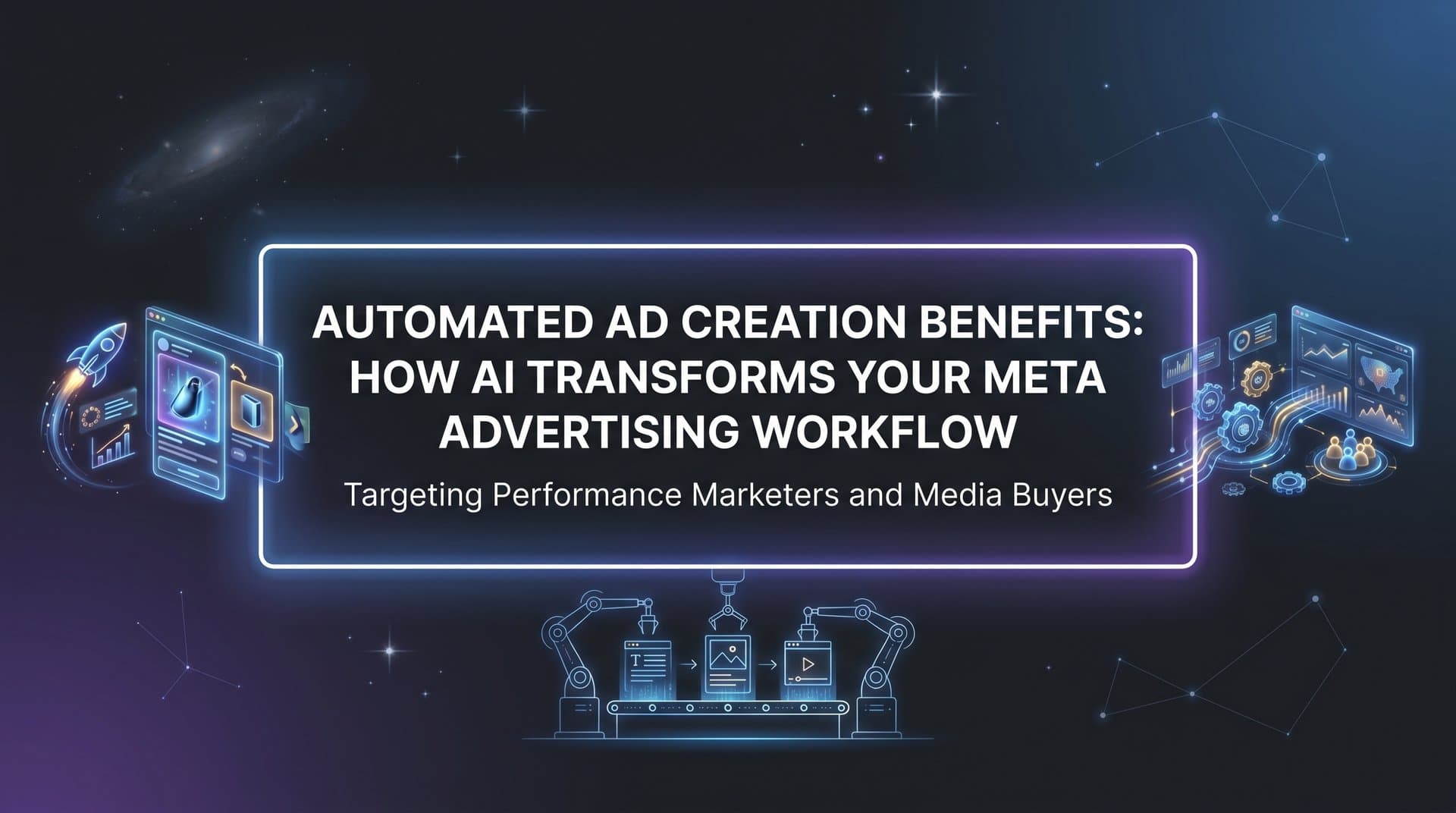
The modern Meta advertising landscape demands something most marketing teams simply can't deliver: an endless stream of fresh, high-performing ad creatives. You need to test multiple angles, refresh winning concepts before they fatigue, and launch campaigns fast enough to capitalize on trending opportunities. Meanwhile, your design team is booked three weeks out, your video editor is juggling five projects, and that promising product launch window is closing fast.
This is where automated ad creation fundamentally changes the game. We're not talking about templated shortcuts that produce generic content. We're talking about AI-powered systems that generate scroll-stopping image ads, video content, and UGC-style creatives while you focus on strategy instead of production logistics.
The benefits of automated ad creation extend far beyond convenience. They represent a complete reimagining of how performance marketers operate in an environment where creative diversity directly impacts campaign performance. Let's break down exactly how automation transforms your Meta advertising workflow and why marketers who adopt these tools are seeing measurable advantages across every metric that matters.
Why Traditional Ad Creation Can't Keep Up With Modern Demands
Meta's algorithm has evolved to reward advertisers who provide creative diversity. The platform needs multiple ad variations to test against different audience segments, optimize delivery based on engagement signals, and maintain performance as individual creatives experience fatigue. This creates a fundamental problem: the algorithm's appetite for fresh content vastly exceeds what traditional creative workflows can produce.
The Volume Bottleneck: Consider what happens when you need to launch a new campaign. You brief your designer on the concept, wait for initial mockups, provide feedback, wait for revisions, and finally approve assets. This process might take three to five business days for a single ad concept. Now multiply that by the ten or fifteen variations Meta's algorithm actually needs to find optimal performance across your target audiences.
The math simply doesn't work. By the time you've produced enough creative variations to properly test your campaign, market conditions have shifted, competitor strategies have evolved, or your promotional window has closed. Traditional workflows create a speed gap between identifying opportunities and executing against them. Understanding automated ad creation vs manual approaches reveals just how significant this gap has become.
Hidden Costs Beyond Designer Time: The bottleneck extends beyond obvious production delays. Every revision cycle consumes strategic bandwidth as marketing managers coordinate feedback between stakeholders. Every delayed launch represents missed testing opportunities where you could have been gathering performance data. Every campaign that launches with insufficient creative variations starts at a disadvantage against competitors who can test more angles simultaneously.
Many marketing teams respond by limiting their testing scope. Instead of exploring ten different creative approaches, they settle for two or three. Instead of refreshing ads proactively, they wait until performance declines. These compromises feel necessary given resource constraints, but they directly limit campaign performance potential.
The reality is that manual ad creation is time consuming and was designed for a different era of digital advertising. It worked when campaigns ran for months with minimal variation. It fails when Meta's algorithm expects continuous creative iteration and rewards advertisers who can deliver it.
Time Savings That Actually Move the Needle
When marketers talk about automation saving time, the conversation often focuses on shaving minutes off individual tasks. The real transformation happens when entire workflows that previously took days or weeks compress into minutes.
Think about the traditional timeline for creating a single video ad. You need to write a script, coordinate with a video editor or content creator, wait for the first cut, review and provide feedback, wait for revisions, and finally export the finished asset. This process typically spans three to seven business days, assuming no scheduling conflicts or miscommunications along the way.
From Days to Minutes: Automated ad creation collapses this timeline dramatically. Platforms like AdStellar can generate video ads, image creatives, and UGC-style avatar content from a product URL in minutes. You're not waiting for external resources to become available or coordinating revision cycles across multiple people. The creative production happens instantly, and refinements happen through chat-based editing rather than email threads and revision requests. Explore Facebook ad creation time reduction strategies to see how leading marketers are implementing these approaches.
This compression creates strategic advantages beyond the obvious time savings. When creative production happens in minutes instead of days, you can respond to market opportunities in real-time. A competitor launches a new product? You can test counter-messaging the same day. A trending topic aligns with your brand? You can capitalize on it while it's still relevant. A campaign starts underperforming? You can test new creative angles immediately instead of waiting for your design queue to clear.
Eliminating Revision Friction: Traditional workflows involve multiple handoffs between stakeholders. The marketer briefs the designer, the designer creates mockups, the marketer provides feedback, the designer makes revisions, and the cycle continues until everyone approves. Each handoff introduces delays and potential miscommunication.
Automated systems eliminate this friction entirely. When you can refine creatives through direct chat-based editing, you're making changes in real-time rather than describing desired changes to someone else. This doesn't just save time—it improves creative outcomes because you can iterate rapidly until the asset matches your vision exactly.
The cumulative impact becomes clear when you're managing multiple campaigns simultaneously. Instead of juggling production timelines for five different creative briefs, you're generating and refining assets on-demand as campaign needs evolve. The time you previously spent on production logistics gets reallocated to strategic thinking: analyzing performance data, identifying new testing opportunities, and optimizing campaign structure.
Scale Your Creative Testing Without Scaling Your Team
Meta's advertising algorithm performs best when it has multiple creative variations to test against different audience segments. More variations mean more data points for the algorithm to optimize delivery, better chances of finding resonant messaging for specific demographics, and improved overall campaign performance. The challenge? Traditional workflows make it prohibitively expensive to produce the volume of creatives that would actually be optimal.
The Math of Manual Production: Let's say you want to test five different creative concepts, each with three headline variations and two audience segments. That's thirty unique ad combinations. If each creative takes your designer three hours to produce (including revisions), you're looking at ninety hours of design work just to launch one properly-tested campaign. Most teams simply can't allocate those resources, so they compromise by testing fewer variations and accepting lower performance potential.
Automated ad creation removes this constraint entirely. When you can generate hundreds of ad variations from a single product URL or concept, the limiting factor shifts from production capacity to strategic thinking. You're no longer asking "How many variations can we afford to produce?" You're asking "What creative angles should we test to find the highest performers?"
Bulk Creation at Campaign Scale: Platforms designed for automated ad creation handle the complexity of mixing multiple elements at scale. You can combine different creatives with various headlines, audiences, and copy variations at both the ad set and ad level. The system generates every combination and launches them to Meta in minutes, creating hundreds of unique ads without manual assembly. Learn more about bulk ad creation for Facebook to understand how this works in practice.
This capability fundamentally changes how you approach campaign structure. Instead of launching with a handful of carefully crafted ads and hoping they perform, you can launch with comprehensive creative coverage across every angle you want to test. The algorithm gets the diversity it needs to optimize effectively, and you get performance data across a much broader range of creative approaches.
The Compound Advantage of Simultaneous Testing: When you test more variations simultaneously, you're not just increasing your chances of finding a winner—you're accelerating your learning curve exponentially. Each ad variation provides performance data about what resonates with specific audience segments. More variations mean more data points, which means faster identification of winning patterns.
This creates a compounding advantage over time. The insights from your first large-scale test inform your second campaign. Those learnings stack with data from your third campaign. Within weeks, you've accumulated performance intelligence that would take months to gather through traditional limited testing approaches. Your campaigns get smarter faster because you're testing at a scale that generates meaningful statistical significance quickly.
Data-Driven Creative Decisions Replace Guesswork
One of the most frustrating aspects of traditional ad creation is the reliance on subjective judgment. You create what you think will perform well based on experience and intuition, launch it, and hope the market agrees with your assessment. Sometimes it works. Often it doesn't. And when it fails, you're back to guessing about what might work better.
Automated ad creation powered by AI fundamentally changes this dynamic by making creative decisions based on actual performance data rather than assumptions. The system analyzes what has worked historically and uses those patterns to inform new creative generation.
Historical Performance Analysis: AI-powered platforms examine your past campaigns to identify patterns in what drives results. Which creative elements appeared in your highest-performing ads? Which headlines generated the best click-through rates? Which audiences delivered the lowest cost per acquisition? This analysis happens across every campaign you've run, creating a comprehensive performance profile of what actually works for your specific products and audiences. Discover how AI ad creation tools for Meta leverage this data to improve outcomes.
When the system generates new creatives, it's not starting from scratch. It's building on proven elements that have already demonstrated effectiveness in your actual campaigns. This doesn't mean creating identical copies of past winners—it means understanding the underlying patterns that made them successful and applying those insights to new creative concepts.
Real-Time Winner Identification: Traditional campaign management requires manually reviewing performance metrics to identify which ads are working. You log into Ads Manager, sort by various metrics, export data to spreadsheets, and try to spot patterns across dozens or hundreds of ad variations. It's time-consuming and easy to miss important signals buried in the data.
Automated systems surface winners automatically based on the metrics you actually care about. Leaderboards rank your creatives, headlines, copy, audiences, and landing pages by ROAS, CPA, CTR, or whatever goals you've set. You can instantly see which elements are driving results and which are underperforming. This visibility transforms how quickly you can optimize campaigns, shifting budget toward winners and cutting losers before they waste significant spend.
Building a Continuous Learning Loop: The most powerful aspect of data-driven automation is how it creates a feedback loop that improves with every campaign. Each test generates performance data. That data informs the next round of creative generation. Those new creatives generate more data. The cycle continues, with each iteration building on insights from previous campaigns.
This means the system gets smarter the more you use it. Your tenth campaign benefits from learnings accumulated across the previous nine. Your fiftieth campaign leverages a massive database of performance patterns specific to your products and audiences. You're not just automating production—you're building an increasingly sophisticated understanding of what drives results for your specific business.
Cost Efficiency Across Your Entire Ad Operation
When evaluating automated ad creation, the cost conversation often focuses narrowly on platform fees versus designer salaries. The real financial impact extends across your entire advertising operation, touching everything from production overhead to media efficiency to opportunity costs.
Reducing Dependency on External Resources: Many marketing teams rely on a combination of in-house designers, freelance creatives, and specialized agencies for different types of content. A designer handles static images, a video editor produces video ads, a copywriter crafts ad copy, and a UGC creator provides authentic-looking content. Each specialist adds cost, coordination overhead, and timeline dependencies.
Automated platforms consolidate these capabilities into a single system. You can generate image ads, video content, and UGC-style creatives without coordinating multiple resources. This doesn't just reduce direct production costs—it eliminates the project management overhead of briefing different specialists, coordinating deliverables, and managing revision cycles across multiple people. Review AI ad creation platform pricing to understand the cost structures of leading solutions.
For agencies managing multiple client accounts, this consolidation creates massive efficiency gains. Instead of maintaining relationships with dozens of freelance creatives or staffing large in-house production teams, you can handle creative production for all clients through a single automated system. The cost savings scale directly with the number of accounts you manage.
Lower Cost-Per-Test Economics: When creative production is expensive and time-consuming, every test carries significant cost. You're not just paying for media spend—you're paying for all the production work required to create the assets you're testing. This creates pressure to limit testing scope, which paradoxically increases your risk of poor performance because you're not exploring enough creative angles.
Automated creation flips this dynamic. When generating a new creative variation costs essentially nothing in time or money, you can test aggressively without worrying about wasted production investment. Failed tests become valuable learning opportunities rather than expensive mistakes. This psychological shift enables more experimental approaches that often uncover unexpected winners.
Reallocating Budget to Media Spend: Consider a typical scenario where a marketing team allocates thirty percent of their budget to creative production and seventy percent to actual ad spend. With automated creation, that production cost approaches zero, allowing you to reallocate nearly the entire budget to media. More media spend means more reach, more conversions, and better overall campaign performance—all without increasing total budget. Understanding the automated ad campaign benefits helps quantify these efficiency gains.
The efficiency gains compound when you factor in reduced waste from poor-performing ads. When you can test more variations and identify winners faster, you spend less money on underperforming creative before shifting budget to better options. The combination of lower production costs and more efficient media spend creates a substantial improvement in overall marketing ROI.
Putting Automated Ad Creation to Work for Your Campaigns
Understanding the benefits of automated ad creation is one thing. Actually implementing it effectively requires a strategic approach that sets you up for success from day one.
Start With Clear Performance Goals: Before diving into automated creation, define what success looks like for your campaigns. Are you optimizing for ROAS, CPA, CTR, or another metric? Setting clear goals allows the AI to score creative elements against your specific benchmarks rather than generic performance indicators. This ensures the system surfaces winners that actually matter for your business objectives.
Many marketers make the mistake of treating automation as a black box that magically produces results. The most successful implementations treat it as a powerful tool that amplifies strategic thinking. You still need to define targeting strategies, set budget parameters, and establish performance thresholds. The automation handles execution at scale, but strategic direction remains your responsibility. Our guide to automated Meta advertising provides a comprehensive framework for getting started.
Leverage Full-Workflow Platforms: The most powerful automated ad creation systems handle more than just creative production. Platforms like AdStellar manage the entire workflow from creative generation through campaign launch to performance analysis. You can generate image ads, video ads, and UGC creatives, then immediately launch them to Meta with AI-optimized audiences, headlines, and ad copy without switching between multiple tools.
This integrated approach eliminates the friction of moving assets between systems. You're not generating creatives in one platform, uploading them to another for campaign management, and analyzing results in a third tool. Everything happens in a unified workflow that maintains context and performance data across every stage.
Build Your Winners Library Systematically: One of the most valuable aspects of automated platforms is how they help you identify and organize proven creative elements. When a headline, image, or audience combination delivers strong results, you want to capture that insight and apply it to future campaigns. Winners Hub features centralize your best-performing elements with real performance data attached, making it easy to select proven components when building new campaigns.
This systematic approach to capturing learnings prevents the common problem where successful creative elements get lost across campaigns. Instead of reinventing your approach each time, you're building on a foundation of proven winners while still testing new variations to find even better performers.
Embrace Transparency in AI Decision-Making: Many marketers remain skeptical of AI-powered tools because they feel like black boxes that make decisions without explanation. Look for platforms that provide full transparency about why the AI makes specific recommendations. When the system suggests particular audiences, headlines, or creative approaches, you should understand the performance data and strategic reasoning behind those choices.
This transparency serves two purposes. First, it builds confidence in the system's recommendations by showing you the data backing each decision. Second, it educates you about what's working in your campaigns, making you a better marketer even when you're not using automation. The goal isn't to replace strategic thinking—it's to enhance it with data-driven insights that would be impossible to uncover manually.
The Competitive Advantage of Automated Ad Creation
Automated ad creation benefits extend far beyond operational convenience. They represent a fundamental shift in competitive positioning for performance marketers who adopt these tools early.
The time savings mean you can respond to market opportunities while competitors are still waiting for creative production. The scale advantages mean you can test more thoroughly and find winning combinations others miss. The data-driven approach means your campaigns get smarter faster through continuous learning loops. The cost efficiency means you can allocate more budget to media spend and less to production overhead.
These advantages compound over time. Your first automated campaign might deliver modest improvements over traditional approaches. Your tenth campaign leverages insights from the previous nine. Your fiftieth campaign operates with a level of performance intelligence that would be impossible to achieve through manual testing at typical production speeds and costs.
The marketers and agencies seeing the biggest impact are those who view automation not as a replacement for creativity, but as a tool that amplifies creative testing at unprecedented scale. They're still bringing strategic thinking, market understanding, and creative direction to their campaigns. They've simply removed the production bottlenecks that previously limited how many ideas they could test and how quickly they could iterate.
For agencies managing multiple client accounts, the operational transformation is even more dramatic. You can handle creative production for dozens of clients without scaling your design team proportionally. You can launch campaigns faster, test more aggressively, and deliver better results while maintaining healthy margins. The platforms that handle the full workflow from creative to conversion eliminate the tool-switching overhead that typically slows down multi-client operations.
Ready to transform your advertising strategy? Start Free Trial With AdStellar and be among the first to launch and scale your ad campaigns 10× faster with our intelligent platform that automatically builds and tests winning ads based on real performance data. Generate scroll-stopping creatives, launch complete campaigns, and surface your winners—all from one platform designed specifically for performance marketers who need results without the production bottlenecks.