Most Meta advertisers aren't losing because they have a bad product or a weak offer. They're losing the creative testing game. You've got a real budget, a product worth selling, and a genuine audience out there waiting to respond. But between you and that winning ad sits a wall of manual work: resizing images in Canva, copying and pasting headlines into spreadsheet trackers, setting up A/B tests one at a time, and waiting days for results before you can iterate again.
That process doesn't just waste time. It burns budget on slow iteration cycles while your competitors test faster, learn faster, and scale faster.
Automated ad variant creation changes the equation entirely. Instead of building one ad at a time and hoping it lands, you generate hundreds of combinations systematically, launch them at scale, and let performance data tell you what to double down on. No guesswork. No bottleneck. No creative team on standby for every test cycle.
This article breaks down exactly how automated ad variant creation works, what it replaces in your current workflow, and how to put it to work on your Meta campaigns starting from where you are right now.
The Manual Variant Problem Every Meta Advertiser Knows
Here's the traditional workflow most Meta advertisers are still running. You brief a designer, wait for a creative, upload it, write a few headline variations, pick an audience, set up the ad set, and launch. Then you wait. A few days later you check performance, make a judgment call on what's working, tweak something, and repeat the cycle.
That cycle is slow by design. And on Meta, slow is expensive.
Creative fatigue is one of the most well-documented challenges on the platform. When the same audience sees the same ad repeatedly, performance degrades. CTR drops. Frequency climbs. ROAS falls. Meta's own guidance acknowledges that creative variety is one of the primary levers advertisers control, and that different formats, messaging angles, and visual styles can produce dramatically different results with the same audience.
The manual workflow can't keep up with that reality. Most teams are producing a handful of creatives per campaign cycle, not dozens. And when you factor in the combinatorial complexity of a real testing matrix, the gap becomes obvious.
Consider a modest testing setup: four headlines, four images, and three audience segments. That's 48 unique combinations. Add a second copy block variation and you're at 96. Introduce a video format alongside your static images and you're well past 150 combinations before you've even touched placement or CTA variations. No team builds and tracks 150 ad variants manually. So most teams don't test at that depth at all.
The result is a predictable pattern: a few creatives get most of the budget, testing is shallow, and the winning ad is often the one that happened to get more impressions early rather than the one that genuinely converts best. Gut feel fills the gap where data should be.
This is the specific problem automated ad variant creation is built to solve. Not just making the manual process faster, but replacing the manual process entirely with a systematic, data-informed approach to building and testing at scale.
What Automated Ad Variant Creation Actually Does
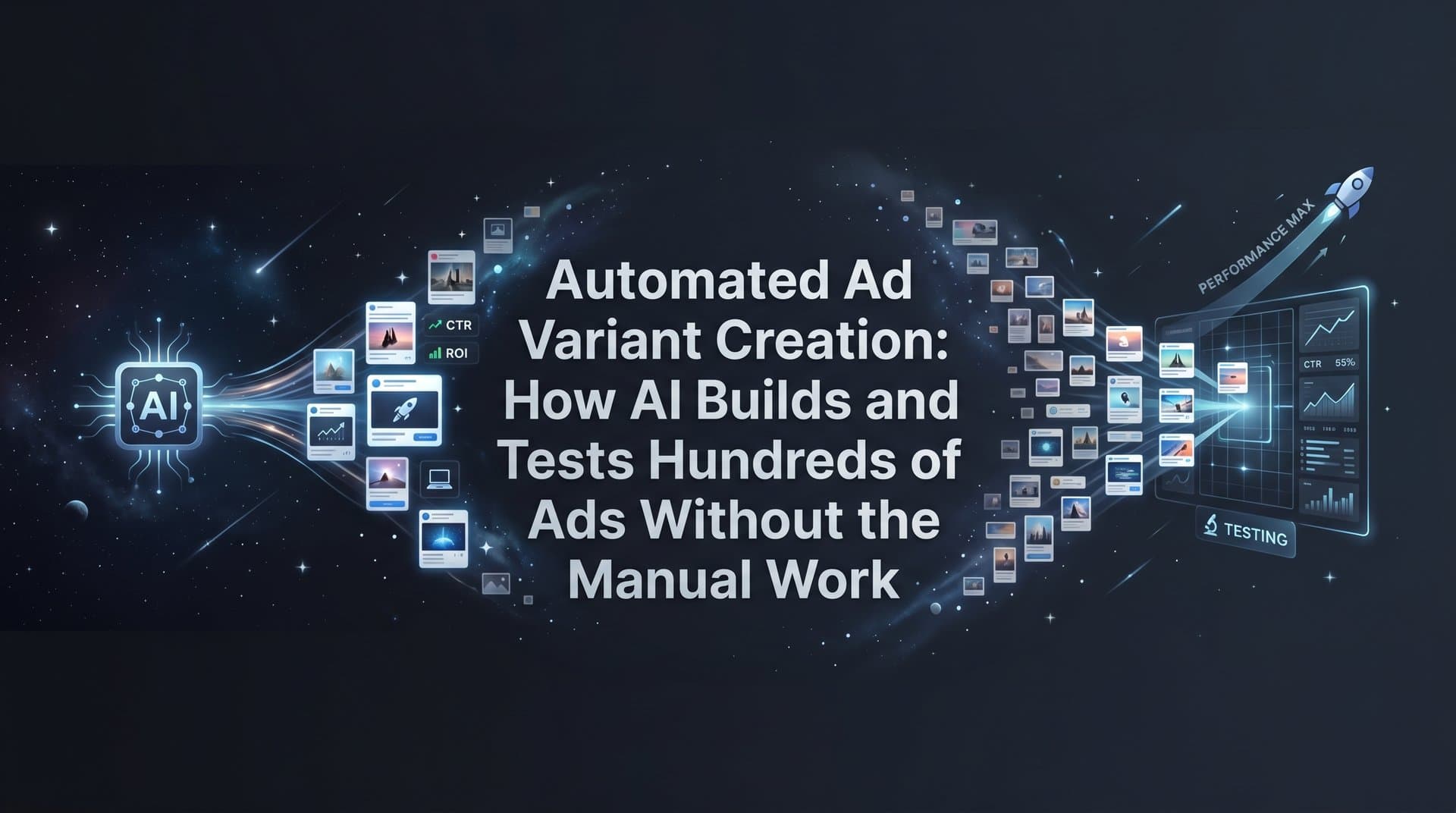
The term sounds technical, but the core idea is straightforward. Automated ad variant creation is the process of using software or AI to systematically generate, combine, and launch multiple versions of an ad by mixing different creative assets, copy elements, headlines, and audience parameters without requiring a human to assemble each combination by hand.
At the basic end of the spectrum, this looks like template-based automation: swap a headline here, change an image there, produce a handful of variations from a fixed structure. It's faster than fully manual work, but it's still limited by what a human decides to put into the template.
AI-driven automation is a different category entirely. Instead of just executing combinations a marketer specifies, an AI system analyzes historical performance data to inform which combinations are worth building in the first place. It looks at which creatives drove the best ROAS in past campaigns, which headlines produced the highest CTR, which audiences converted at the lowest CPA, and uses those signals to prioritize the most promising combinations before a single impression is served.
The range of elements that can be varied in a well-built system is broader than most advertisers realize:
Visual formats: Static image ads, video ads, and UGC-style avatar content each perform differently across placements and audiences. A system that can generate and test all three simultaneously gives you coverage that a single creative format never will.
Copy elements: Headlines, primary text, and CTAs are all independent variables. Changing a headline while keeping the image constant is a legitimate test. So is changing the CTA while keeping everything else fixed. Automation handles both simultaneously.
Audience segments: The same creative can perform very differently across different interest groups, lookalike audiences, and retargeting pools. Variant creation systems treat audience as a variable, not a constant.
Placements and formats: Feed placements, Stories, and Reels have different aspect ratios and user behaviors. A system that adapts creative to placement rather than forcing a single format into every slot improves performance across the board.
The key distinction between basic and AI-driven automation is not just speed. It's intelligence. Basic automation builds more combinations. AI-driven automation builds the right combinations, ranked by their likelihood of performing based on real data from your account.
How the Automation Engine Works Under the Hood
Understanding the mechanics helps you use these systems more effectively. The automation process generally runs in three stages: asset ingestion, combinatorial generation, and structured campaign output.
Asset ingestion is where the system gets its raw material. In a platform like AdStellar, this can happen in multiple ways. You can point the system at a product URL and let AI generate creatives from scratch based on your product's visual and copy elements. You can upload existing creatives from your own library. Or you can clone a competitor's ad directly from the Meta Ad Library and use it as a starting point for your own variations. Each input method produces a set of creative assets that then flow into the generation engine.
Combinatorial generation is where the scale happens. The system takes every creative asset, every headline, every copy block, and every audience segment and builds every possible combination. This isn't random. A well-designed AI system applies a ranking layer before generating combinations, using historical performance data from your account to weight the inputs. Creatives that drove strong ROAS in past campaigns get prioritized. Headlines that consistently produced high CTR get included in more combinations. Audiences that converted efficiently get matched with the highest-confidence creatives first.
This is what separates AI-driven variant creation from simple combinatorial math. The system isn't just building all possible combinations. It's building the most promising combinations first, informed by what has actually worked in your account.
Structured campaign output is the final stage. The combinations don't just exist as a list. They get assembled into complete Meta campaign structures with proper ad sets, audience assignments, placements, and creative pairings. The AI doesn't hand you a pile of assets and leave the campaign architecture to you. It builds the campaign.
The transparency layer matters here too. A well-built system doesn't just produce output and expect you to trust it. It explains the rationale behind its decisions. Why was this headline selected over that one? Why was this audience paired with this creative format? When the system surfaces its reasoning, you stay in control of the strategy. You can course-correct when the AI's assumptions don't match something you know about your market that the data doesn't capture yet.
This combination of scale, intelligence, and transparency is what makes modern automated variant creation genuinely different from the template-swapping tools that came before it.
From Generation to Launch: The Full Workflow in Practice
Knowing how the engine works is useful. Seeing the full workflow from start to launch makes it concrete.
The process starts with creative generation. In AdStellar's AI Creative Hub, you can generate image ads, video ads, and UGC-style avatar content by entering a product URL. The AI pulls visual and copy elements from your product page and builds creatives designed to stop the scroll. If you want to start from a competitor's angle, you can pull an ad directly from the Meta Ad Library and clone it as a starting point, then refine it with chat-based editing until it fits your brand and offer. No designers, no video editors, no back-and-forth briefing cycles.
Once you have a set of creatives, the bulk launch system takes over. This is where the combinatorial power becomes tangible. You feed in multiple creatives, multiple headlines, multiple copy blocks, and multiple audience segments. The system assembles every combination at both the ad set level and the ad level, producing hundreds of distinct ad variations from a set of inputs that a human team would have struggled to combine manually even in a fraction of that volume.
Those variations don't sit in a queue waiting for manual review. They go live to Meta in minutes.
The AI Campaign Builder adds another layer of intelligence to this process. Before the combinations are assembled, AI agents analyze your historical campaign data and rank every creative, headline, and audience by real performance metrics. ROAS, CPA, CTR, all of it gets scored and ranked. The builder uses those rankings to select winning elements and construct complete Meta campaigns with audiences, headlines, and ad copy already optimized before the first impression is served.
The practical result is a workflow that looks like this: enter your product URL or upload your assets, let the AI generate and rank creative combinations, review the campaign structure and rationale, and launch. What used to take a team days of coordination now takes a single marketer a fraction of that time, with significantly more combinations in market and a data-informed starting point rather than a gut-feel one.
Surfacing Winners: How Automation Closes the Loop
Launching hundreds of variants is only valuable if you can figure out which ones are working. This is where the back half of the automation loop becomes just as important as the front half.
After launch, AdStellar's AI Insights system tracks performance across every element in your campaign. Not just at the campaign level or even the ad level, but at the component level. Which specific headline is driving the best CTR across all the ads it appears in? Which image is associated with the lowest CPA regardless of what copy it's paired with? Which audience segment is producing the strongest ROAS even when the creative changes?
Leaderboards rank every creative, headline, copy block, audience, and landing page by real performance metrics. You're not looking at a flat report. You're looking at a ranked list that tells you immediately what's working and what's not, measured against the goals you set.
Goal-based scoring is the mechanism that makes this objective rather than intuitive. You set your benchmarks: a target ROAS, a CPA cap, a CTR floor. The system scores every element against those benchmarks and surfaces winners based on actual performance against your actual goals. There's no ambiguity about what "winning" means because you defined it upfront.
The Winners Hub takes those identified winners and organizes them in a centralized library with their performance data attached. When you're ready to build the next campaign, you don't start from scratch. You pull proven creatives, proven headlines, and proven audiences directly from the Winners Hub and feed them into the next generation cycle.
This is the compounding advantage that separates automated variant creation from one-time testing. Each campaign cycle produces winners. Those winners inform the next round of generation. The AI gets smarter because it has more performance data to rank against. And your campaigns improve continuously rather than resetting every time you launch something new.
Who Gets the Most Value From Automated Variant Creation
The workflow described above is valuable across a range of advertiser types, but the specific benefits land differently depending on your situation.
Performance marketers and in-house teams gain the ability to iterate at a pace that was previously impossible without a large creative team. When you can generate and launch a new round of variants without waiting for a designer or video editor, your testing velocity increases significantly. You spend less time in the production bottleneck and more time analyzing results and scaling what works.
Marketing agencies managing multiple client accounts face a specific scaling challenge: client count grows faster than headcount can. Automated variant creation lets an agency apply the same rigorous testing methodology across every account without building a separate team for each one. The AI handles the combinatorial work. The strategist handles the thinking. That division of labor makes agency-scale operations genuinely sustainable.
Businesses new to Meta advertising often struggle with the chicken-and-egg problem of early-stage testing. You don't have enough historical data to know what works, so every creative decision is a guess. Automated variant creation addresses this by letting data rather than assumptions drive the testing process from the start. Instead of committing budget to one creative direction and hoping it's right, you spread across many combinations simultaneously and let performance tell you which direction to pursue. The learning curve compresses significantly.
Across all three profiles, the common thread is removing the dependency on manual effort and creative intuition at the point where data-driven automation is simply more effective.
Getting Started Without Overcomplicating It
The most common mistake when adopting any new automation tool is trying to do everything at once. Automated ad variant creation works best when you approach it with a clear starting point and a willingness to let the system learn.
Start with a defined goal. Before you generate a single creative, know what you're optimizing for. A specific ROAS target, a CPA cap, a CTR benchmark. The scoring system needs something to measure against. Without a defined goal, "winning" is undefined and the data becomes harder to act on.
For asset inputs, you need less than you probably think. A product URL is enough to get started with AdStellar's AI Creative Hub. The system generates image ads, video ads, and UGC-style content from that URL. If you have existing creatives you know have performed before, add them too. If you've seen a competitor running ads that seem to be working, pull them from the Meta Ad Library and use them as a reference point. The AI handles the generation from there.
The most important mindset shift is treating this as a continuous loop rather than a one-time setup. Your first campaign produces data. That data surfaces winners. Those winners feed into the next generation cycle. The system improves with each round because it has more performance signal to work with. The advertisers who get the most out of automated variant creation are the ones who treat every campaign as an input to the next one, not a standalone event.
The Bottom Line
The gap between having a good product and finding the creative that sells it has always been a testing problem. Automated ad variant creation closes that gap by removing the manual bottleneck that slows down every iteration cycle.
The loop is straightforward: generate at scale using AI-powered creative tools, launch hundreds of combinations without the friction of manual assembly, surface winners using performance data scored against your actual goals, and feed those winners back into the next campaign. Each cycle builds on the last. The system compounds. Your campaigns get smarter without requiring proportionally more effort.
For Meta advertisers who are still building one creative at a time and running shallow A/B tests against a handful of variants, the gap between that approach and a fully automated variant creation workflow is significant. Not just in time saved, but in the depth of testing, the quality of data, and the speed at which you find what actually converts.
AdStellar runs this entire workflow from a single platform. Generate image ads, video ads, and UGC-style creatives from a product URL. Clone competitor ads from the Meta Ad Library. Let the AI Campaign Builder analyze your historical data and build complete Meta campaigns with ranked creatives, headlines, and audiences already selected. Launch hundreds of combinations with Bulk Ad Launch. Track winners in real time with AI Insights leaderboards. Pull proven performers from the Winners Hub into your next campaign.
If you're ready to stop guessing and start testing at the scale Meta rewards, Start Free Trial With AdStellar and run your first automated campaign workflow with a platform built specifically for Meta advertisers who want to move faster and win more.