Let's be honest about where most ad production time actually goes. It is not in the strategy. It is not in the audience research. It is in the assembly: pulling together creatives, writing headline variations, matching copy to visuals, and then manually building out combinations in Ads Manager one by one. For performance marketers running Meta campaigns, this production bottleneck is one of the most frustrating constraints on growth.
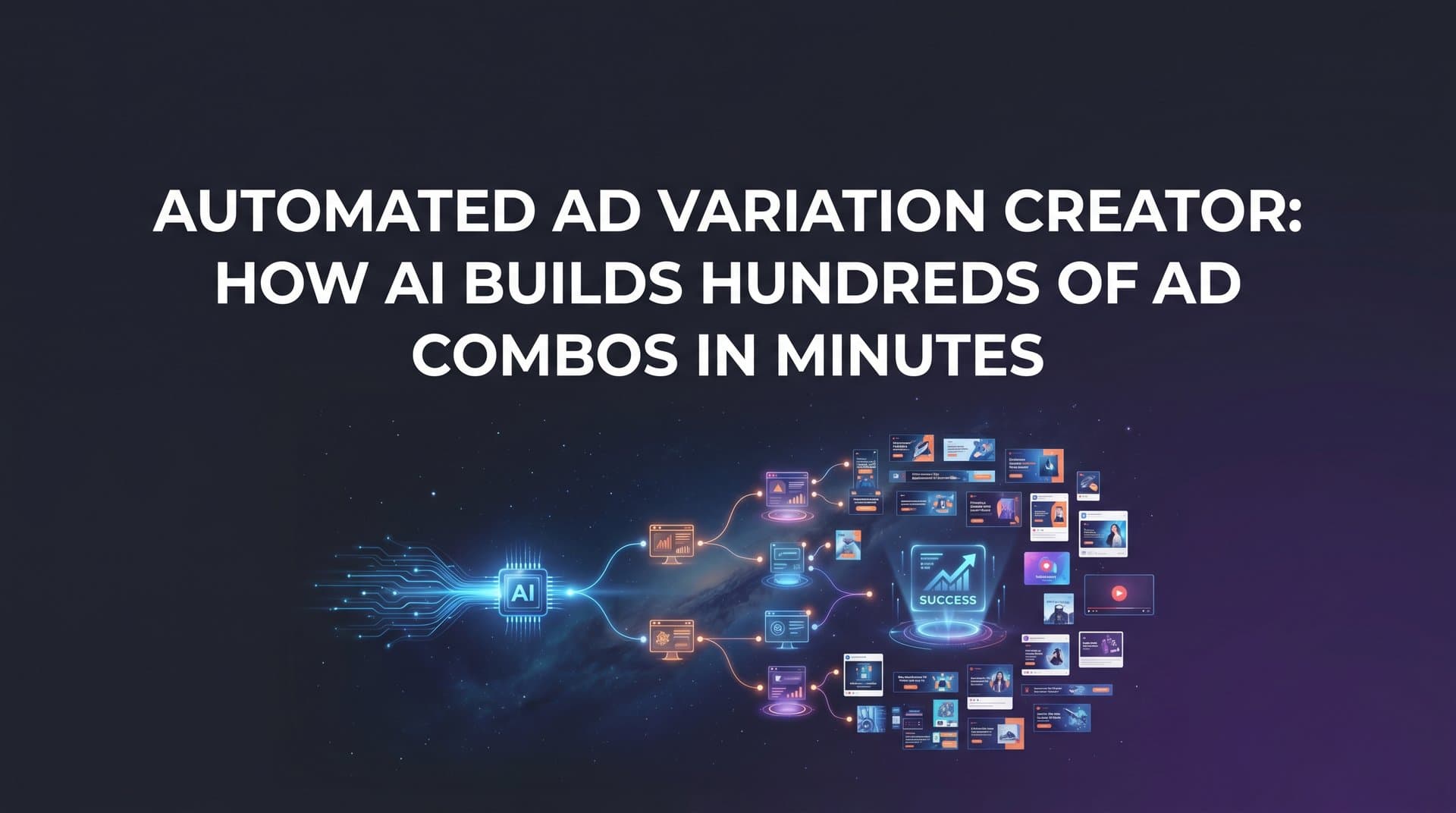
The concept of an automated ad variation creator addresses this directly. These tools use AI to generate, combine, and launch large volumes of ad variations across different creatives, headlines, copy, and audience segments, without requiring a designer for every asset or a media buyer to manually assemble each combination. What used to take days of cross-team coordination can happen in minutes.
This matters more now than it did a few years ago. Meta's algorithm has become increasingly sophisticated at distributing budget toward top-performing variations, but it needs enough variations to work with. Advertisers who can only produce a handful of creatives per week are at a structural disadvantage compared to those who can test dozens or hundreds of combinations simultaneously. The shift toward automation in ad creative production has accelerated precisely because the stakes of testing velocity have risen alongside rising CPAs and more competitive auctions.
This article breaks down how automated ad variation creators work, why they have become essential for scaling Meta campaigns, what separates the strong tools from the basic ones, and how to get started with one. Whether you are a solo marketer, an agency, or an in-house performance team, the mechanics are the same and the efficiency gains are real.
Why Manual Ad Production Creates a Ceiling on Performance
Meta's advertising auction does not just reward the highest bidder. It rewards relevance, engagement, and creative freshness. The algorithm is constantly distributing spend across different audience segments, placements, and times of day, and it needs enough creative variation to find the combinations that resonate. When you run the same three creatives for weeks, you are not just risking creative fatigue. You are also limiting the algorithm's ability to optimize.
This is the core tension in Meta advertising: the platform's machine learning is most effective when it has a diverse pool of variations to test, but producing that diversity manually is expensive and slow.
The traditional workflow looks something like this. A designer produces several visual assets. A copywriter writes multiple headline and body text options. A media buyer then opens Ads Manager and manually assembles combinations, creating individual ads by pairing each creative with each copy variation. The amount of time lost to Facebook ad variations manual work is staggering when you consider the scale required. Then they set up targeting, review everything for errors, and launch. Across a modest test with five creatives and four copy variations, that is twenty ads to build by hand. Add audience segments and the number multiplies further.
For teams without dedicated designers or copywriters, the bottleneck is even tighter. Many small-to-mid-size advertisers simply cannot produce enough fresh creative assets each week to keep up with what Meta's algorithm needs to optimize effectively. The result is a familiar pattern: launch a campaign with a few creatives, watch performance improve initially, then see it plateau and decline as audiences see the same ads repeatedly.
Creative fatigue is well-documented in Meta's own advertiser resources. When audiences see the same creative repeatedly, engagement drops, costs rise, and performance deteriorates. The typical response is to manually refresh creatives, which restarts the slow production cycle. This creates a hamster wheel where marketers spend more time producing assets than analyzing results or refining strategy.
The volume problem is not a niche issue. It affects solo marketers who wear every hat, agencies managing multiple client accounts, and in-house teams at growing companies. The constraint is not ambition or budget. It is production capacity. Understanding automated ad platform vs manual creation tradeoffs makes it clear why so many teams are making the switch.
The Mechanics Behind Automated Ad Variation Creation
Understanding how these tools work makes it easier to evaluate them and use them effectively. At their core, automated ad variation creators take a set of inputs and use AI to generate a matrix of unique combinations that can be launched directly to Meta.
The input side is where modern tools have made significant advances. Rather than requiring you to upload a complete library of finished assets, the best platforms can generate creative assets from scratch. Give the tool a product URL and it can produce image ads, video ads, and UGC-style content without a designer or video editor involved. Platforms like an AI video ad creator for Facebook can handle the entire visual production process. You can also upload existing assets, clone competitor ads from the Meta Ad Library, or use a combination of generated and existing materials. The starting point is flexible.
Once you have a creative pool, the tool combines those creatives with different headlines, ad copy variations, and audience segments to produce a full matrix of unique ads. The combinatorial math here is straightforward but powerful. If you have five creatives, four headlines, and three audience segments, that is sixty unique ad variations. An automated creator builds and structures all sixty in minutes. Doing that manually would take hours, and that is before accounting for the time to actually create the assets in the first place.
Here is where AI-driven tools go beyond what basic template systems offer. A simple variation generator might just shuffle your existing assets into different combinations without any intelligence about which combinations are likely to perform. More advanced platforms analyze your historical campaign data before building anything. They look at which creatives, headlines, and audience pairings have driven the best results in past campaigns, then use those insights to inform which elements to prioritize and how to combine them.
This means the variations you launch are not random. They are informed by what has already worked. The AI creates smarter starting points, which shortens the path to finding winners and reduces wasted spend on combinations that historical data suggests are unlikely to perform.
The launch side of the process is equally important. The best tools connect directly to Meta and push all generated combinations to your ad account in a few clicks, not hours. A capable bulk ad variation launcher eliminates the manual assembly step in Ads Manager entirely, which is often where the most time gets lost in traditional workflows. The entire process from asset generation to live campaign can happen within a single platform session.
What Separates Capable Tools from Basic Ones
Not all automated ad variation creators are built the same. The range goes from simple template-based tools that reshuffle your existing assets to full-stack platforms that handle creative generation, campaign building, and performance analysis in one place. Knowing what to look for helps you avoid tools that add steps rather than remove them.
Native creative generation: The most important differentiator is whether the tool can actually create new assets or only recombine what you already have. Look for platforms that generate image ads, video ads, and UGC-style avatar content from a product URL or brief. The ability to clone competitor ads from the Meta Ad Library is a particularly useful feature for quickly building a creative pool informed by what is already working in your category. An AI UGC ad creator can produce authentic-looking user-generated content at scale, adding another layer of flexibility through chat-based editing that lets you refine creatives through conversation rather than returning to a designer.
Intelligent campaign construction: A strong tool does not just generate variations. It builds complete campaigns with strategic rationale behind each decision. This means analyzing past campaign data, ranking every creative, headline, and audience by performance metrics like ROAS, CPA, and CTR, and using those rankings to construct the next campaign intelligently. Exploring the best automated campaign builders on the market reveals significant differences in how platforms handle this intelligence layer. Transparency matters here. Tools that explain why they made specific recommendations let you learn from the AI's analysis rather than just trusting its output blindly.
Performance tracking and winner identification: Generating and launching variations is only half the job. The other half is knowing what worked and why. Look for built-in leaderboards that rank creatives, headlines, copy, and audiences by real performance metrics. Goal-based scoring that evaluates every element against your specific benchmarks (not generic industry averages) is significantly more useful than raw metric reporting. A centralized Winners Hub that stores your best-performing assets for reuse in future campaigns prevents you from losing track of what worked and having to rediscover it later.
The combination of these three capabilities is what makes a platform genuinely useful versus marginally helpful. Creative generation without performance analysis means you are flying blind after launch. Performance analysis without creative generation means you still have a production bottleneck. The full loop, from generating variations to identifying winners to informing the next round, is where the real efficiency gains compound over time.
From Variation to Validation: How the Testing Loop Works
Launching hundreds of variations is not the goal. Finding the combinations that drive the best results at the lowest cost is the goal. The variation volume is just what makes that discovery process faster and more reliable.
The testing loop works like this. You launch a broad set of variations across different creatives, headlines, copy, and audience segments. Meta's algorithm begins distributing spend based on early engagement signals, naturally directing more budget toward combinations that perform better. Meanwhile, your platform's AI is analyzing results at the element level, not just the ad level. A dedicated automated ad creative testing platform makes this element-level analysis possible at scale.
This distinction matters more than it might seem at first. Ad-level analysis tells you that Ad A beat Ad B. Element-level analysis tells you that a specific headline outperformed all others across multiple creatives, or that a particular visual style consistently drives lower CPAs regardless of which copy it is paired with. That second type of insight is far more valuable because it informs your creative strategy going forward, not just your current campaign.
Think of it this way: if you know that a specific headline wins across five different creatives, you have a proven asset that should anchor your next campaign. If you only know that one specific ad combination won, you have a single data point that may not generalize. Element-level analysis turns individual campaign results into durable creative intelligence.
Advanced platforms take this further through continuous learning. Each campaign cycle feeds results back into the AI's model, which uses that data to make smarter recommendations in the next round. Over time, the platform develops an increasingly accurate picture of what works for your specific brand, audience, and product category. The recommendations it makes in month six are more refined than the ones it made in month one, because it has accumulated real performance data to learn from.
This compounding improvement effect is one of the strongest arguments for committing to a single platform rather than jumping between tools. The longer the AI works with your campaign history, the better its recommendations become, and the faster you can identify winners in each new cycle.
How Different Teams Use Automated Variation Creation
The efficiency gains from automated ad variation creation show up differently depending on team size and structure, but the core benefit applies across all of them: more testing with less production overhead.
Solo marketers and small businesses: For a single person managing their own Meta campaigns, the most immediate benefit is eliminating the need for separate designers, video editors, and copywriters. Generating image ads, video ads, and UGC-style creatives from a product URL means you can produce a full creative set without any external help. Our guide to automated Meta advertising covers how solo operators can set up these workflows from scratch. The time that used to go into coordinating with freelancers or wrestling with design tools gets redirected toward strategy, audience research, and analyzing results. You are not just saving money on production. You are reclaiming the mental bandwidth that production work consumes.
Agencies managing multiple client accounts: For agencies, the leverage is in scale. Bulk ad launching and automated variation creation make it possible to run rigorous creative testing across many client accounts without proportionally expanding the team. Reviewing automated Facebook ad tools for agencies reveals how the best platforms handle multi-account management efficiently. Storing winning assets per client in a centralized hub means proven performers can be rapidly redeployed when launching new campaigns or refreshing stale ones. The agency can deliver more testing volume and faster iteration to each client without the headcount that would traditionally require.
In-house performance teams: For larger in-house teams, the value is in increasing testing velocity without burning out the creative team. Automated variation creation handles the combinatorial work that used to require manual assembly, freeing designers to focus on developing new creative concepts rather than producing slight variations of existing ones. Faster identification of winning combinations means the team can act on insights quickly rather than waiting for statistical significance to emerge from a small test set. The design team stays focused on high-value creative work while the platform handles the scaling and testing infrastructure.
How to Get Started with an Automated Ad Variation Creator
The practical setup process is more straightforward than most marketers expect, especially on platforms designed to minimize friction between input and launch.
The first step is connecting your Meta ad account to the platform. This gives the AI access to your historical campaign data, which it uses to inform creative and audience recommendations from the start. Understanding the full automated Meta campaign setup process helps you prepare your account for the best results. The more campaign history you have, the more the AI has to work with, but even new accounts can benefit from the generation and bulk launching capabilities immediately.
Next, input your product URL or upload existing assets. If you are starting fresh, let the AI generate creatives across formats based on your product information. If you have existing assets you want to test alongside AI-generated ones, upload them and mix them into the creative pool. This is also the stage where you can clone competitor ads from the Meta Ad Library to quickly add proven creative formats to your test set.
From there, select or customize your headlines and ad copy. The AI will suggest options based on your product and historical performance data, but you can edit, add, or replace any element through chat-based editing. Define your audience segments, set your performance goals so the scoring system has clear benchmarks to evaluate against, and then bulk launch all combinations to Meta in a few clicks.
A few tips for getting the most out of the process: start with genuine diversity in your inputs. Different visual styles, different value propositions, different tones in your copy. The AI needs meaningful variation to work with. If all five of your creatives look nearly identical, the combinatorial output will be similarly narrow. Give the AI distinct angles to test and it will surface more actionable insights. Also, set specific performance goals rather than generic ones. The more precisely you define what winning looks like for your campaign, the more accurately the scoring system can rank your variations against those benchmarks.
The Bottom Line on Automated Ad Variation Creation
The era of manually assembling ad variations one by one is ending. Not because the craft of advertising is becoming less important, but because the production work that used to consume most of a marketer's time can now be handled by AI. What remains is the higher-value work: setting strategy, interpreting insights, and making decisions about where to take campaigns next.
Automated ad variation creators give performance marketers the ability to test at the scale Meta's algorithm actually demands, without the production overhead that used to make it impractical for anyone without a large creative team. The combination of AI-generated creatives, intelligent campaign building, bulk launching, and element-level performance analysis creates a system where each campaign cycle builds on the last.
If you are still manually assembling ad combinations or waiting on designers to produce fresh variations, you are leaving testing velocity on the table. The competitive gap between advertisers who can generate and test hundreds of variations per week and those who can manage a handful is widening.
Start Free Trial With AdStellar and see how AI-powered creative generation, bulk launching, and performance insights work together as one system. The 7-day free trial gives you full access to generate creatives, build campaigns, and surface winners without any upfront commitment. Visit adstellar.ai to get started.