The creative that crushed it last week barely breaks even today. Your top-performing ad just hit creative fatigue, and now you're scrambling to design new variations while your cost per acquisition climbs. This cycle repeats weekly, sometimes daily, and each time it happens, you're racing against declining performance with a limited creative team and an even more limited budget.
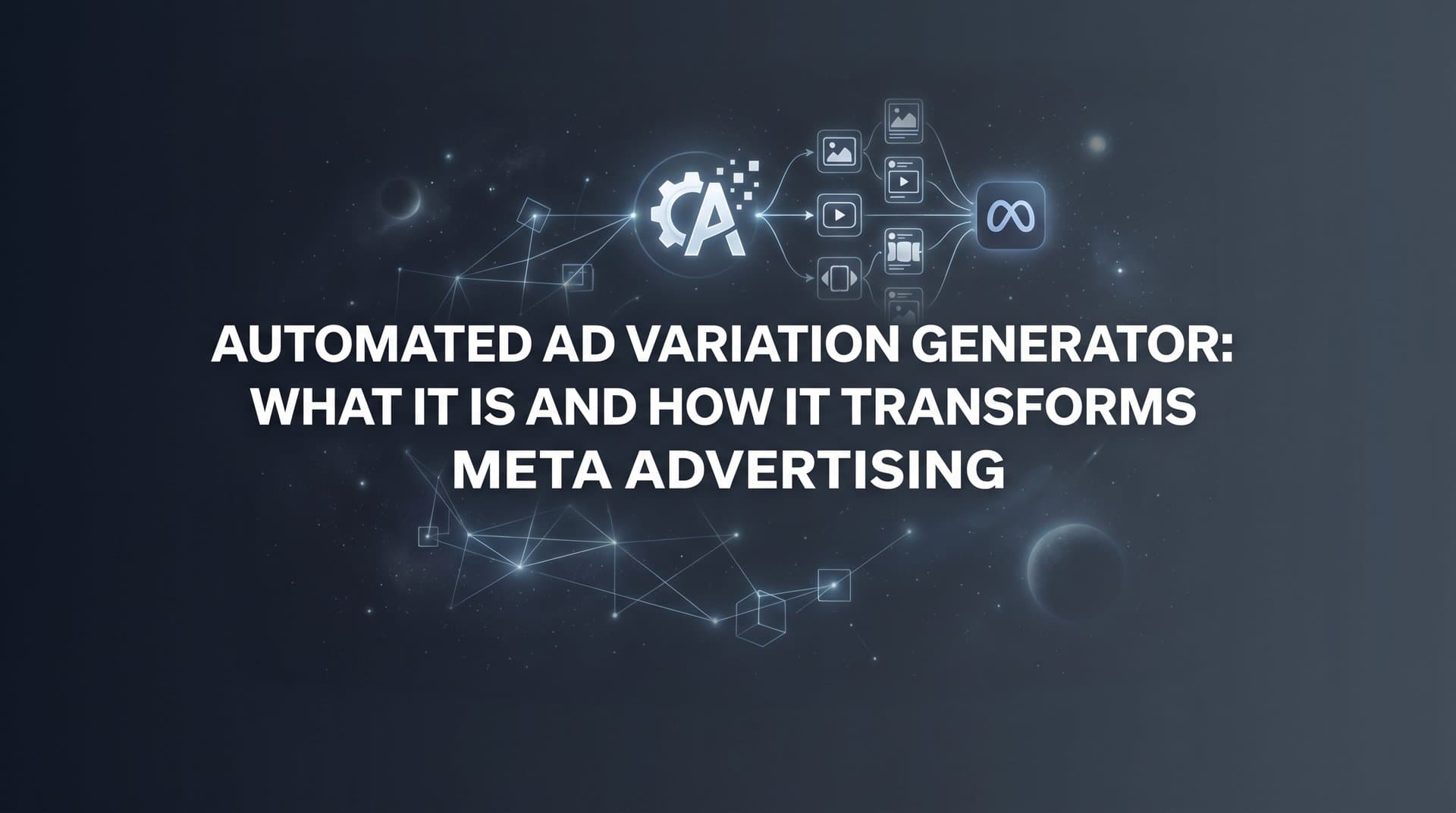
This is where automated ad variation generators fundamentally change the game. Instead of manually designing five or ten new ad concepts and hoping one works, these AI-powered systems generate hundreds of strategic variations in minutes, test them systematically, and surface the winners automatically. For performance marketers and agencies managing Meta advertising at scale, this technology represents a shift from reactive creative firefighting to proactive, data-driven optimization.
The economics are straightforward: more variations tested means faster discovery of winning combinations. When you can test fifty creative hypotheses in the time it used to take to test five, you compress months of learning into weeks. The question isn't whether automated variation testing improves performance. The question is whether you can afford to keep testing manually while your competitors systematically explore ten times more creative territory.
How AI Transforms Creative Elements Into Performance Data
An automated ad variation generator doesn't just randomly mix and match creative elements. The technology starts by analyzing your existing campaigns to understand which specific components drive results. The AI examines every image, headline, body copy segment, and call-to-action you've run, then correlates each element with performance metrics like click-through rate, conversion rate, and return on ad spend.
Think of it like reverse engineering your best performers. If your top three ads all feature product close-ups with benefit-focused headlines and urgency-driven CTAs, the system identifies these patterns as performance indicators. It's not making subjective creative judgments. It's processing actual outcome data to determine which creative DNA consistently produces results.
The real power emerges in combinatorial generation. Once the AI understands which elements perform, it systematically creates every logical combination. Take three high-performing images, five proven headlines, four effective copy variants, and three converting CTAs. That's 180 unique ad variations, each one a strategic hypothesis about what might resonate with your audience.
But here's where machine learning elevates the process beyond simple permutation. Predictive models analyze historical performance patterns to forecast which new combinations are most likely to succeed before you spend a dollar testing them. If data shows that lifestyle imagery performs better with aspirational headlines while product shots work better with feature-focused copy, the AI prioritizes those pairings in your test queue.
This approach transforms creative testing from an art project into a scientific process. You're not guessing which creative direction might work. You're systematically exploring the performance landscape, guided by data about what has actually driven conversions in your account. The AI handles the computational heavy lifting while you focus on strategic decisions about which creative territories to explore.
The feedback loop continuously improves the system's predictions. As new variations launch and performance data flows in, the AI refines its understanding of what works for your specific audience, product, and market. What starts as educated guesses based on general patterns evolves into precise predictions tailored to your unique advertising context. This is why automated ad variation testing has become essential for competitive advertisers.
The Mathematical Reality of Manual Creative Testing
Let's talk about what manual ad creation actually costs at scale. Your designer spends three hours creating a new ad concept. Your copywriter spends another hour writing three headline options and body copy. Your media buyer spends thirty minutes setting up the campaign. That's 4.5 hours of labor for one ad variation. If you're testing five concepts, that's nearly 23 hours of work, almost three full business days.
Now consider the statistical implications. With five variations in your test, you're exploring five data points in an enormous possibility space. If one wins, great. But what if the winning combination was actually your second-best image with your third-best headline and your top-performing copy? You'd never discover it because testing every combination manually would require creating 45 ads if you're mixing three images, three headlines, and five copy variants.
The time constraint forces a trade-off that kills performance. You either test fewer creative concepts, which means slower learning and higher opportunity cost, or you test more variations but wait longer between tests, which means your winning ads hit creative fatigue before you've identified their replacements. Either way, you're operating with incomplete information about what actually works. Understanding the AI ad generator vs manual creation comparison reveals just how significant this gap has become.
Human creative bias compounds the problem. Designers and copywriters naturally gravitate toward concepts they find aesthetically pleasing or conceptually interesting. These preferences don't correlate with conversion rates. The ad you think looks "too aggressive" might be your best performer. The headline you consider "too simple" could drive the highest click-through rate. Manual creation injects subjective filters that prevent you from discovering objectively effective combinations.
There's also the consistency problem. When you're manually creating variations, maintaining systematic testing becomes nearly impossible. You might test three headline options with one image, then test two different images with completely different headlines. This scattered approach makes it difficult to isolate which specific elements drive performance. You end up with winners, but you don't understand why they won, which makes it harder to replicate success.
The resource allocation question becomes critical as you scale. If you're managing campaigns for multiple products or clients, manual variation creation doesn't scale linearly. It scales exponentially. Each additional product or account multiplies the creative workload, forcing you to choose between testing depth (more variations per campaign) and testing breadth (covering more products or accounts). Automated variation generation eliminates this trade-off entirely.
What Modern Variation Generators Actually Do
Today's automated ad variation generators handle the complete creative production workflow, not just simple text swaps. The technology can generate original image ads from product URLs by analyzing the product, understanding its key features and benefits, and creating visual concepts that highlight those elements. Feed it your e-commerce product page, and it produces multiple image variations showcasing different angles, benefits, or use cases.
Video creation follows similar logic but adds motion and narrative. The system can generate video ads that demonstrate product usage, highlight key features through animated text overlays, or create UGC-style content using AI avatars that deliver scripted messaging. This capability is particularly valuable because video production traditionally requires the most time and specialized skills, creating the biggest bottleneck in manual workflows. Learn more about how AI video ad generators for Meta are transforming creative production.
The bulk launching capability is where systematic testing becomes reality. Instead of creating and launching ads one at a time, you define your test parameters once: which creatives to test, which headlines to try, which audiences to target, which copy variants to include. The system generates every combination across both ad set and ad level, creating hundreds of unique ads that test different hypotheses simultaneously.
This isn't random generation. The AI applies strategic logic to determine which combinations make sense. It won't pair a luxury-focused headline with budget-conscious copy, or match lifestyle imagery with technical feature descriptions. Each variation represents a coherent creative hypothesis designed to resonate with a specific audience segment or messaging angle.
Real-time performance tracking transforms raw data into actionable insights. As your variations run, the system monitors every metric that matters: click-through rates, conversion rates, cost per acquisition, return on ad spend. But it goes beyond simple reporting. The AI identifies statistical significance, determining which performance differences represent genuine winners versus random variance.
The competitive cloning feature addresses a common challenge: what do you do when you see a competitor's ad that's clearly performing well? Modern variation generators can analyze ads from Meta's Ad Library, understand their structure and messaging, and generate similar variations adapted to your product and brand. This isn't copying. It's learning from proven concepts and applying those lessons to your unique context.
Integration with campaign management completes the workflow. Generating variations is valuable, but only if you can launch them efficiently to Meta and track their performance accurately. The best automated campaign builders handle the complete process from creative generation through campaign setup, audience targeting, and performance analysis, eliminating the manual handoffs that slow down testing cycles.
The Intelligence Layer That Drives Decisions
Behind every automated variation generator is an intelligence layer that makes strategic decisions about what to test and how to interpret results. This AI analyzes your historical campaign data to identify patterns: which creative elements consistently perform, which audiences respond to specific messaging, which combinations drive the best return on ad spend.
The system builds a performance profile for every component in your creative library. Each image gets scored based on how it's performed across different campaigns, audiences, and time periods. Headlines are ranked by click-through rate and conversion contribution. Copy variants are evaluated for their ability to drive action. This granular analysis creates a foundation for intelligent variation generation.
When you launch a new test, the AI doesn't just create random combinations. It prioritizes variations that combine proven high performers with strategic new elements, balancing exploration of new creative territory with exploitation of known winners. This approach maximizes learning while minimizing wasted spend on combinations unlikely to succeed.
Building Campaigns That Learn From Themselves
The true power of automated variation testing emerges when generation connects to optimization in a continuous learning loop. AI campaign builders analyze your past performance to inform future variation strategies, creating a system that gets smarter with every campaign you run. The more data you feed it, the better it becomes at predicting which new combinations will succeed.
This process starts with comprehensive historical analysis. The AI examines every campaign you've run, identifying not just which ads won, but why they won. It looks at the specific creative elements, the audience characteristics, the timing, the competitive context, and the user journey from ad click to conversion. This deep analysis reveals patterns that would be invisible in manual review.
Leaderboards transform raw performance data into strategic guidance. Instead of drowning in spreadsheets, you see ranked lists of your top-performing creatives, headlines, copy variants, audiences, and landing pages. Each element is scored against your specific goals, whether that's maximizing ROAS, minimizing CPA, or driving the highest click-through rate. The system shows you exactly which components deserve more investment and which should be retired.
Goal-based scoring adapts to your business objectives. If you're focused on customer acquisition, the AI prioritizes variations that drive the lowest cost per acquisition. If you're optimizing for revenue, it surfaces combinations that generate the highest return on ad spend. This customization ensures that "winning" variations align with your actual business goals, not just vanity metrics.
The winners library concept compounds learning over time. Every high-performing element gets saved with its complete performance context: which audiences it resonated with, which products it sold effectively, which time periods it excelled in. When you build your next campaign, you're not starting from scratch. You're building on a foundation of proven performers, dramatically increasing your baseline success rate. This is the core principle behind automated ad creative testing platforms.
This creates a competitive moat that widens with time. Your first month using automated variation testing might show modest improvements as the system learns your audience and product. By month six, the AI has analyzed thousands of data points specific to your business, giving it predictive capabilities that manual testing simply cannot match. Your creative decisions become increasingly precise because they're informed by an ever-growing dataset of what actually works for your specific context.
The transparency of AI decision-making matters here. The best systems don't just tell you which variations to run. They explain why, showing you the data and logic behind each recommendation. This builds trust in the system and helps you understand your audience better, creating a feedback loop where AI insights inform human strategy, which then guides the next round of AI-powered testing.
Who Gains the Biggest Advantage From Variation Automation
Performance marketers managing multiple accounts or high monthly ad spend face a creative production bottleneck that automation directly solves. When you're responsible for optimizing campaigns across different products, audiences, or geographic markets, manual variation creation becomes the limiting factor in your testing velocity. Automation lets you maintain aggressive testing schedules across all accounts simultaneously, discovering winners faster and scaling them more confidently.
Marketing agencies benefit even more dramatically because the economics of client service transform. Instead of dedicating designers and copywriters to manual ad creation for each client, agencies can deploy automated variation generators that produce hundreds of strategic tests per client per month. This shifts the agency's value proposition from creative production to strategic optimization, allowing teams to serve more clients without proportionally increasing headcount.
E-commerce brands with large product catalogs face a unique challenge that automated variation generators address perfectly. When you have hundreds or thousands of SKUs, creating unique ad creative for each product manually is economically impossible. Tools like a Shopify ad variation generator make it feasible to generate product-specific variations at scale, ensuring that every item in your catalog gets optimized advertising support rather than generic campaigns that treat all products the same.
The technology also levels the playing field for smaller teams competing against larger competitors. A solo performance marketer using automated variation testing can explore more creative territory than a team of five running manual campaigns. The constraint shifts from human labor to strategic thinking about which hypotheses to test, which is exactly where individual expertise should focus.
Brands operating in fast-moving markets where creative fatigue happens quickly gain significant advantages. Fashion, consumer electronics, and seasonal products all require constant creative refreshment. Automated variation generation ensures you always have new creative ready to deploy when performance dips, eliminating the scramble to produce emergency replacements for fatigued ads. For online retailers specifically, automated ads for online stores have become a competitive necessity.
Making Automated Variation Testing Work For Your Business
Start with your proven winners as the foundation for variation testing. Identify your top three to five performing ads from the past 90 days and analyze what makes them work. Is it the imagery style? The headline structure? The offer presentation? Use these elements as your baseline components, then create systematic variations that test one element at a time while keeping winners constant.
Setting clear performance benchmarks before launching tests prevents the common mistake of declaring winners too early or letting losers run too long. Define your target ROAS, acceptable CPA, and minimum CTR based on historical performance. Configure your automated system to flag variations that exceed these benchmarks and pause those that underperform, ensuring you're always allocating budget to productive tests. Our guide to automated ad testing covers these configuration details in depth.
The integration point matters more than many marketers realize. Automated variation testing works best when it's embedded in your ongoing campaign optimization cycle, not treated as a separate experiment. Make variation generation a weekly ritual: review last week's winners, generate new variations that build on those insights, launch tests, and repeat. This rhythm ensures continuous learning and prevents the performance valleys that happen when you run the same creative too long.
Document your learnings systematically even though the AI tracks performance automatically. Create a simple log noting which creative approaches worked for which products or audiences. Over time, these observations reveal strategic patterns that inform not just your ad testing but your broader marketing strategy. You might discover that benefit-focused messaging outperforms feature descriptions for certain customer segments, or that user-generated content styles convert better than polished brand imagery.
Scale your testing gradually as you build confidence in the system. Start with one product or campaign, master the workflow, understand how the AI makes decisions, and validate that automated variations perform as well or better than manual creative. Once you've proven the concept, expand to additional products or accounts, using your initial learnings to accelerate success across your portfolio. A bulk ad variation launcher becomes invaluable once you're ready to scale across multiple campaigns.
The Future of Advertising Belongs to Systematic Testing
Automated ad variation generators represent more than a productivity tool. They fundamentally change the competitive dynamics of digital advertising by making systematic, data-driven testing accessible to any marketer willing to embrace the technology. The advantage no longer goes to whoever has the biggest creative team. It goes to whoever can test the most strategic hypotheses and learn from results the fastest.
The implications extend beyond immediate performance improvements. As AI systems accumulate more data about what works for specific products, audiences, and markets, they develop increasingly sophisticated understanding of advertising effectiveness. This creates a compounding advantage where each campaign makes future campaigns smarter, building a knowledge base that manual testing could never match in scale or precision.
The shift from subjective creative decisions to objective performance data changes how marketing teams operate. Debates about which ad looks better become irrelevant when you can test both versions and let results decide. Creative becomes less about individual brilliance and more about systematic exploration of what resonates with real audiences. This doesn't diminish the importance of creative thinking. It focuses that thinking on strategic hypotheses rather than execution details.
Looking forward, the technology will continue evolving toward even more sophisticated prediction and automation. Future systems will likely anticipate creative fatigue before it happens, automatically generating replacement variations and queuing them for launch. They'll identify micro-segments within your audience that respond to specific creative approaches and generate targeted variations automatically. The workflow will become increasingly hands-off, with human oversight focused on strategic direction rather than tactical execution.
The competitive reality is straightforward: advertisers who embrace automated variation testing will systematically outperform those who don't, simply because they'll test more hypotheses, learn faster, and scale winners more confidently. The question isn't whether to adopt this technology. The question is how quickly you can integrate it into your workflow before your competitors gain an insurmountable learning advantage.
Ready to transform your advertising strategy? Start Free Trial With AdStellar and be among the first to launch and scale your ad campaigns 10× faster with our intelligent platform that automatically builds and tests winning ads based on real performance data.