Most marketers are still testing ads the way we did five years ago: launch version A, wait a week, launch version B, compare results, repeat. Meanwhile, your budget drains while you wait for "enough data" on each test. By the time you find a winner, the market has moved on, or worse, you've burned through your quarterly budget testing variations that never had a chance.
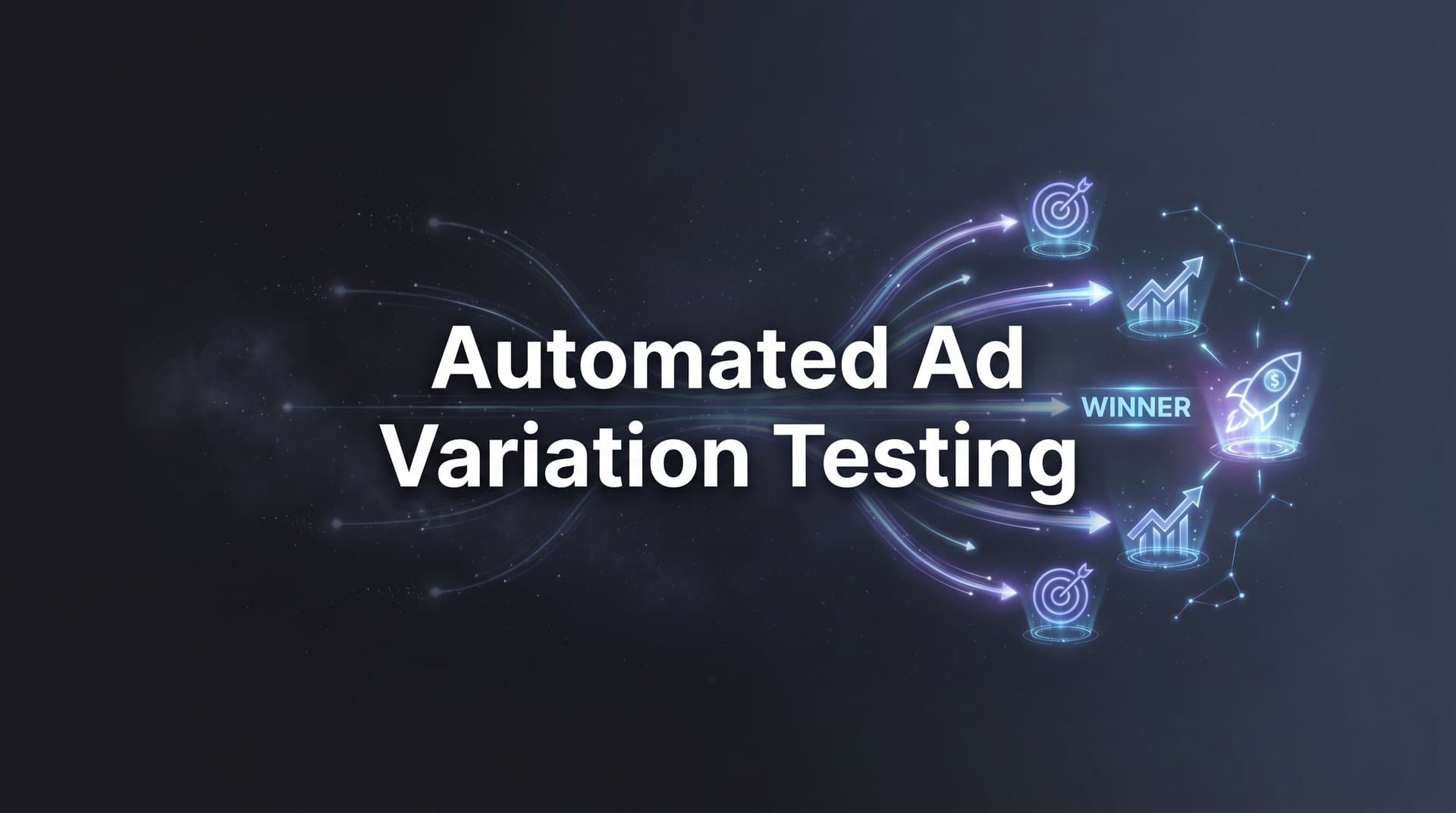
Automated ad variation testing flips this entire approach. Instead of testing one combination at a time, you test hundreds simultaneously. Instead of waiting weeks for results, AI surfaces your winners in days. Instead of guessing which creative might work, you let performance data tell you exactly what resonates with your audience.
This guide breaks down how automated variation testing actually works, what you can test at scale, and how to build a continuous optimization loop that gets smarter with every campaign. Whether you're running Meta ads for a small business or managing multi-million dollar budgets for clients, understanding this approach will fundamentally change how you think about ad optimization.
The Fatal Flaw in Traditional A/B Testing
Here's the math that breaks manual testing: you have 5 different headlines you want to test. You also have 5 images that could work. And you've identified 5 audience segments worth exploring. That's 125 unique combinations.
If you test these one at a time, running each for a week to gather statistically significant data, you're looking at over two years of testing. Even if you speed it up and test one combination every three days, that's still a full year. Your product will have changed. Your market will have evolved. Your competitors will have lapped you twice.
But the timeline isn't even the biggest problem. The real issue is budget efficiency. When you test sequentially, you're essentially gambling that your first few tests will include the winning combination. If your best-performing ad happens to be headline #4 with image #3 targeting audience #5, and you started testing headline #1 with image #1 targeting audience #1, you've burned through significant budget on underperformers before you ever discover what actually works.
Then there's human bias. We naturally gravitate toward testing variations that make intuitive sense to us. The headline that sounds clever. The image that looks professional. The audience that matches our assumptions about our customer. This means we often never test the combinations that could deliver breakthrough results because they don't fit our preconceived notions of what should work.
Manual testing also creates artificial constraints. You limit your tests to what you can reasonably manage in a spreadsheet. You avoid testing certain combinations because tracking them feels too complex. You make compromises based on operational convenience rather than strategic value. The result? You optimize within a narrow range of possibilities while your potential best performers never get tested at all. Understanding what A/B testing in marketing really means helps clarify why these limitations matter so much.
The Mechanics of Automated Variation Testing
Automated ad variation testing starts with combinatorial generation. You provide your creative elements: your headlines, your images or videos, your ad copy variations, your audience segments. The system then generates every mathematically possible combination of these elements.
This is where the power becomes obvious. Those 5 headlines, 5 images, and 5 audiences we mentioned? A human would struggle to even list all 125 combinations correctly, let alone create and launch them. An automated system generates all 125 variations in seconds, creates the ad sets in your ad platform, and launches them simultaneously.
The deployment happens with intelligent budget distribution. Rather than splitting your budget evenly across all variations, which would give each test too little spend to generate meaningful data, the system allocates budget based on early performance signals. Variations that show promise get more budget to confirm their performance. Variations that underperform get minimal spend before being paused. This dynamic allocation means you're always directing more resources toward potential winners.
Real-time performance tracking runs continuously across all variations. The system monitors every metric: click-through rates, conversion rates, cost per acquisition, return on ad spend. But it's not just collecting numbers. It's analyzing patterns, identifying statistical significance, and flagging which variations are genuinely outperforming others versus which ones just got lucky with their first few conversions.
The speed advantage here is dramatic. Where manual testing might take weeks to identify a winning combination, automated testing can surface clear winners in 48-72 hours. The system isn't smarter than you at predicting what will work. It's just faster at letting the market tell you what works through actual performance data. This is why so many marketers struggle when Facebook ad testing takes weeks using traditional methods.
Modern platforms also handle the technical complexity automatically. Creating 125 ad variations manually in Meta Ads Manager would take hours of repetitive clicking and data entry. Automated systems generate the variations, upload the creative assets, configure the targeting, set the budgets, and launch everything with a few clicks. What used to be a full day of work becomes a five-minute task.
How AI Accelerates the Process
The latest evolution in automated testing adds AI analysis on top of the automation. The system doesn't just track which combinations perform well. It identifies why they perform well by analyzing patterns across your winning ads.
If your top five performing ads all use lifestyle images rather than product shots, the AI flags that pattern. If headlines that ask questions consistently outperform declarative statements, the system learns that preference. If a particular audience segment responds better to benefit-focused copy while another segment prefers feature-focused messaging, the AI maps those relationships.
This pattern recognition becomes increasingly valuable over time. After running several automated tests, the AI has enough historical data to make informed recommendations for your next campaign. It might suggest testing more variations of elements that have proven successful while avoiding combinations that have consistently underperformed. The system essentially builds institutional knowledge about what works for your specific business and audience.
What You Can Test When Automation Removes the Limits
Creative variations form the foundation of most automated tests. You can test different images, from product photography to lifestyle shots to illustrations. You can test video ads against static images, or test multiple video concepts simultaneously. UGC-style content, professional photography, and AI-generated creatives can all compete against each other in the same test.
Format variations matter more than many marketers realize. The same core message delivered as a carousel ad, a single image ad, and a video ad can produce dramatically different results. Automated testing lets you explore all these formats simultaneously rather than committing to one based on assumptions.
Copy elements offer rich testing opportunities. Headlines are the obvious starting point, but you should also test variations in your primary text, your call-to-action buttons, and your ad descriptions. The interaction between these elements matters. A headline that works well with one CTA might fail with another. Automated testing reveals these relationships. You can even generate ad variations with AI to quickly create dozens of copy options to test.
Consider testing different angles in your messaging. One variation might emphasize the problem you solve. Another highlights the outcome customers achieve. A third focuses on how your solution works. A fourth leads with social proof. Testing these different approaches simultaneously shows you which resonates most with your audience.
Targeting variables multiply your testing possibilities. Different audience segments often respond to different creative approaches. Automated testing lets you discover these preferences by running the same creative variations across multiple audiences and identifying which combinations perform best.
You can test broad audiences against narrow ones. Interest-based targeting against behavioral targeting. Lookalike audiences at different percentage ranges. Custom audiences built from different data sources. Each targeting approach might reveal different winning creative combinations.
Placement testing used to be an afterthought, but it deserves strategic attention. An ad that crushes in Facebook Feed might flop in Instagram Stories. A video that works on Reels might need different messaging for in-stream video placements. Automated testing across placements reveals which creative works where, letting you optimize your budget toward the highest-performing placement and creative combinations.
Advanced Testing Strategies
Once you're comfortable with basic variation testing, you can layer in more sophisticated approaches. Test different value propositions to see whether price, quality, speed, or convenience drives more conversions for your product. Test different customer personas by creating variations that speak to different use cases or pain points.
Seasonal variations become testable at scale. Create holiday-themed versions of your core ads and test them against evergreen versions. The automated system will tell you exactly when the seasonal creative starts outperforming the standard creative, and when it's time to switch back.
You can even test different campaign objectives against each other. Run the same creative variations optimizing for conversions versus optimizing for landing page views. The performance data might reveal that certain creatives work better for different optimization goals, informing your campaign structure decisions.
Interpreting Results: From Data to Decisions
Performance leaderboards transform raw data into actionable insights. Instead of staring at spreadsheets trying to compare conversion rates across dozens of ad variations, you see your variations ranked by the metrics that matter to your business. If you care about ROAS, your leaderboard shows which variations deliver the highest return. If you're optimizing for cost per acquisition, the ranking reflects that priority.
The key is setting your goals before you launch tests. Define your target ROAS, your acceptable CPA, your minimum click-through rate. The system then scores every variation against these benchmarks. You can instantly see which variations meet your standards and which fall short, without manually calculating whether a 2.8 ROAS is good enough when your target is 3.0.
Statistical significance matters more than most marketers realize. A variation that generated three conversions at $15 each might look better than one that generated 30 conversions at $18 each, but the sample size makes all the difference. Automated testing platforms calculate confidence intervals and flag which results are statistically meaningful versus which ones are just noise.
Look for the indicator that shows you've reached significance. Some platforms use confidence scores. Others show you the sample size needed for reliable conclusions. Don't make decisions based on early data from variations that have only spent $50. Wait until the system confirms you have enough data to trust the results. A solid Meta campaign testing framework helps you establish these benchmarks from the start.
The most valuable insight comes from isolating which specific element drove performance. If headline A with image B targeting audience C delivered your best ROAS, you need to understand whether that success came from the headline, the image, the audience, or the specific combination of all three.
Advanced testing platforms help you answer this question by showing performance patterns across elements. If headline A performs well across multiple images and audiences, you know the headline is the driver. If image B only wins when paired with headline A, you've discovered a specific combination effect rather than a universally strong creative.
Metrics That Actually Matter
Click-through rate tells you whether your creative captures attention. Low CTR means your visual or headline isn't compelling enough to stop the scroll. High CTR with low conversions means your ad promises something your landing page doesn't deliver. Use CTR to evaluate your creative's stopping power, but never in isolation.
Cost per acquisition reveals efficiency. You might have a variation with a stellar CTR that still delivers terrible CPA because it attracts clicks from people who aren't actually interested in buying. Conversely, a variation with modest CTR but highly qualified traffic might deliver the lowest CPA in your test.
Return on ad spend is the ultimate metric for e-commerce and revenue-focused campaigns. A variation might have higher CPA than another but still deliver better ROAS if it attracts higher-value customers. Always evaluate CPA and ROAS together to understand the full picture.
For awareness campaigns, focus on cost per thousand impressions and engagement rate. These metrics tell you how efficiently you're reaching people and how compelling they find your message. An ad with high engagement but low conversions might be perfect for top-of-funnel awareness while a low-engagement, high-conversion ad works better for retargeting.
Creating a Self-Improving Testing System
The real power of automated variation testing emerges when you close the loop between testing and creation. Your test results shouldn't just tell you which ads to scale. They should inform what you create next.
After each test, analyze your winners for patterns. If lifestyle images consistently outperform product shots, create more lifestyle content for your next test. If questions in headlines drive better results than statements, write more question-based headlines. If certain color schemes or visual styles show up repeatedly in your top performers, lean into those aesthetics in future creative.
This creates a compounding effect. Your first round of testing might identify a few winners from a relatively random pool of variations. Your second round, informed by those results, has a higher baseline quality because you're creating variations based on proven patterns. Your third round gets even better. Over time, even your "losing" variations perform better than your original winners because you're building on accumulated knowledge. Implementing automated creative testing strategies makes this continuous improvement cycle sustainable.
Organize your proven performers in a winners library. When you launch a new campaign, you shouldn't start from scratch. Pull your best-performing headlines, your top images, your winning audience combinations. Test these proven elements against new variations. This approach gives you a performance floor: you know you can at least match your previous results while exploring potential improvements.
Some platforms automatically tag and categorize your winners, making this process seamless. You can filter by performance metrics, by campaign type, by audience, or by time period. Need a headline for a retargeting campaign? Pull up your top-performing retargeting headlines from past tests. Launching a new product? Reference the creative style that worked for similar product launches.
How AI Learning Accelerates Improvement
Modern platforms don't just store your historical data. They analyze it to make increasingly intelligent recommendations. The AI learns that certain headline structures work better for your brand. It identifies which audience segments respond to which creative approaches. It maps relationships between elements that human analysis might miss.
When you start building your next campaign, the AI can suggest variations based on this learning. It might recommend testing a new headline variation that follows the same structure as your previous winners. It could suggest pairing a new image with copy that has historically performed well with similar visuals. These recommendations aren't random. They're based on patterns in your actual performance data.
The system gets smarter with every campaign you run. The first test provides baseline data. The second test adds context. By the fifth or sixth test, the AI has enough information to make genuinely insightful recommendations that can dramatically improve your results. This is why treating automated testing as an ongoing practice rather than a one-time experiment delivers exponentially better results over time.
Implementation: From Theory to Practice
Start with clear goals and realistic benchmarks. Before you launch any automated test, define what success looks like. What's your target ROAS? What CPA can your business profitably sustain? What conversion rate would you consider a win? These benchmarks guide both your test design and your interpretation of results.
Your benchmarks should be based on real data when possible. If you've been running ads manually, use your historical performance as a baseline. If you're starting fresh, research industry standards for your vertical and adjust based on your specific business economics. A SaaS company with high lifetime value can accept higher CPA than an e-commerce store with thin margins.
Balance test volume with budget constraints. Testing 125 variations sounds great until you realize each variation needs at least $50 in spend to generate meaningful data. That's $6,250 just to complete one test. For most businesses, this isn't realistic. Start with a smaller test: maybe 3 headlines, 3 images, and 2 audiences for 18 total variations. Get comfortable with the process, then scale up your testing as budget allows. A bulk ad variation launcher makes managing these tests far more practical.
The goal isn't to test everything at once. It's to test systematically and learn continuously. Running a smaller test every two weeks generates more learning than running one massive test per quarter. The frequency of testing matters as much as the scale.
Integrate automated testing into your regular workflow rather than treating it as a special project. Every campaign should include a testing component. When you launch a new product, build testing into the launch plan. When you create seasonal campaigns, test variations of your seasonal creative. When you refresh your evergreen campaigns, test new variations against your current winners.
This integration is easier than it sounds. With the right platform, launching an automated test takes the same amount of time as launching a single ad manually. You're just uploading multiple creative options and letting the system handle the combinatorial work. Once you experience how little extra effort this requires, testing becomes a default part of your process rather than an occasional optimization exercise. Exploring Facebook ad testing automation tools can help you find the right solution for your workflow.
Avoiding Common Pitfalls
Don't test too many variables at once in your first attempts. If you test 10 headlines, 10 images, 5 audiences, and 3 placements simultaneously, you create 1,500 variations. Even with automation handling the logistics, interpreting results from such a large test becomes challenging. Start simpler, learn the process, then expand your testing scope.
Give your tests enough time to reach statistical significance. The automated system might surface early winners after 24 hours, but those results could be flukes. Most tests need at least 48-72 hours and several dozen conversions per variation before you can trust the results. Resist the urge to make decisions too quickly.
Don't ignore the losers. Your underperforming variations contain valuable information. If every variation with a particular image performs poorly, you've learned something important about what doesn't resonate with your audience. If a specific audience segment consistently delivers high CPA across all creative variations, you might need to reconsider whether that audience is worth targeting at all.
The Competitive Advantage of Testing at Scale
Automated ad variation testing transforms advertising from an art into a science. You're no longer guessing which creative might work or relying on intuition about what your audience wants. You're letting real performance data guide every decision, discovering winning combinations faster than manual testing could ever achieve.
The competitive advantage is straightforward: while your competitors test one variation at a time, you're testing dozens simultaneously. While they wait weeks for results, you're identifying winners in days. While they scale ads based on hunches, you're scaling based on statistical proof. This speed and precision compounds over time, creating a performance gap that becomes increasingly difficult for slower-moving competitors to close.
The accessibility of this technology is what makes it truly transformative. You don't need a massive team or an enormous budget to test at scale. Modern platforms handle the complexity automatically, making sophisticated testing available to businesses of any size. A solo marketer can now test variations with the same efficiency as an enterprise team, leveling the playing field in ways that weren't possible even a few years ago.
Ready to transform your advertising strategy? Start Free Trial With AdStellar and be among the first to launch and scale your ad campaigns 10× faster with our intelligent platform that automatically builds and tests winning ads based on real performance data. AdStellar's bulk launching feature creates hundreds of ad variations in minutes, while our AI insights leaderboards rank every creative, headline, and audience by your actual performance goals. Your winners get automatically organized in one place with real performance data, ready to reuse in your next campaign. The platform learns from every test, making smarter recommendations with each campaign you run. Stop testing one variation at a time and start discovering what actually works.