Your Facebook ad campaign has been running for twelve days. You've tested three creative variations, two audience segments, and a handful of headline combinations. The data is starting to trickle in, but nothing is conclusive yet. Meanwhile, your daily ad spend continues, your competitors are already iterating on their next wave of campaigns, and you're stuck in the waiting game that defines traditional Facebook ad testing.
The frustration is real because the stakes are high. Every additional day you spend waiting for statistical significance is another day your budget bleeds on underperformers. Every week your testing drags on is a week market conditions shift, audience behaviors change, and opportunities slip away.
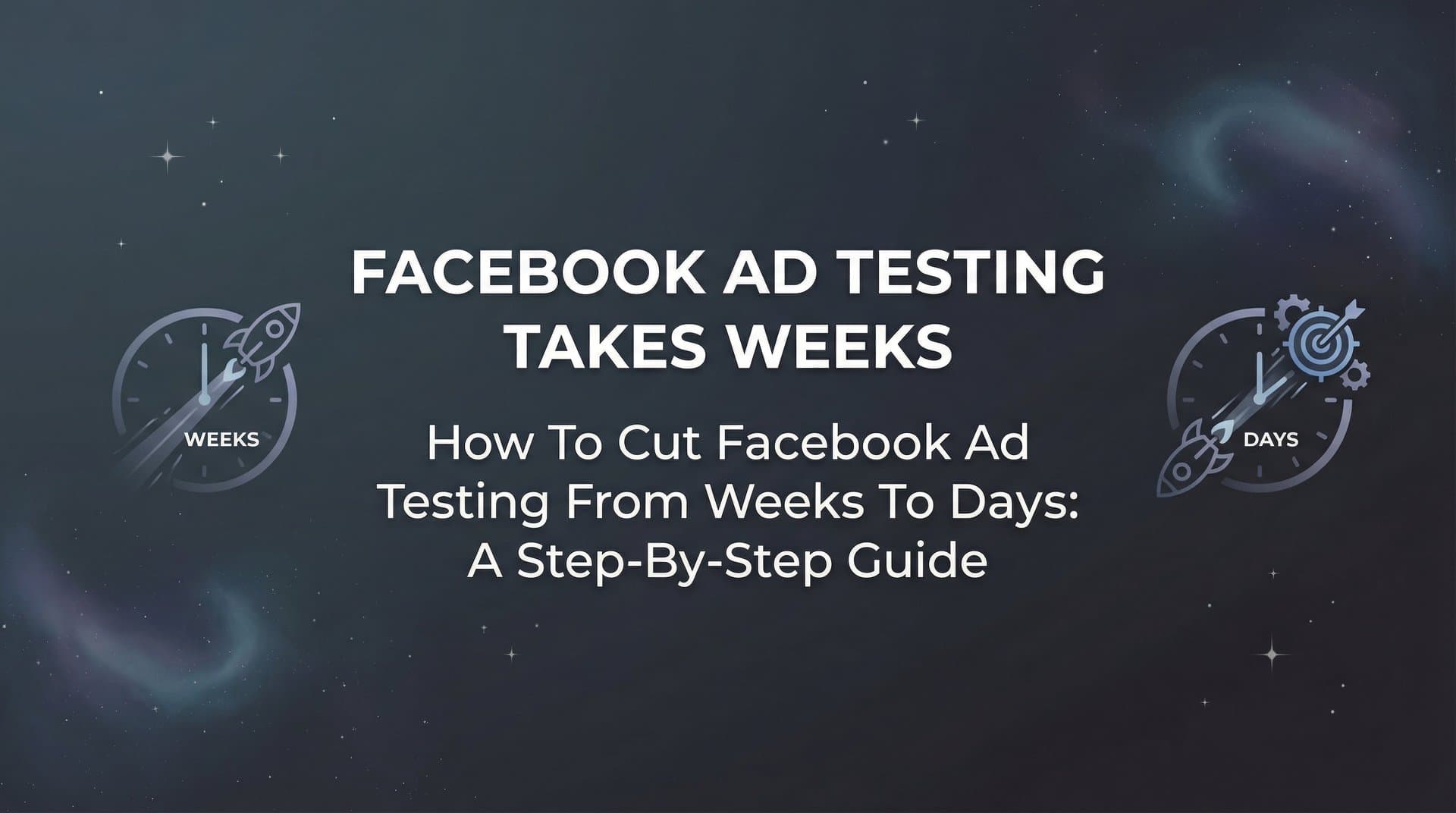
But here's what most advertisers don't realize: the weeks-long testing timeline isn't actually necessary. It's a byproduct of outdated workflows, manual bottlenecks, and sequential testing approaches that artificially slow everything down.
The testing process that traditionally takes weeks can be compressed into days without sacrificing data quality or decision accuracy. You don't need to wait longer to get better results. You need to remove the bottlenecks that make you wait in the first place.
This guide walks you through exactly how to accelerate your Facebook ad testing from weeks to days by restructuring your workflow, leveraging AI-powered creative generation, and implementing real-time performance monitoring that surfaces winners faster than traditional methods ever could.
Step 1: Audit Your Current Testing Bottlenecks
Before you can speed up your testing process, you need to understand exactly where time is being lost. Most advertisers assume the bottleneck is Meta's learning phase or insufficient data volume, but the real culprits are usually hiding in your workflow.
Start by mapping out your current testing timeline from concept to conclusion. How long does it take to produce creative variations? How many hours do you spend setting up campaigns in Ads Manager? How many days pass before you have enough data to make decisions? How long does your analysis and iteration cycle take?
The answers reveal your actual bottlenecks. For many advertisers, creative production is the biggest time sink. Waiting on designers for image ads, coordinating with video editors for video content, or hiring UGC creators for avatar-style ads can add days or weeks before you even launch. If you can only produce three to five creative variations per campaign, you're artificially limiting your testing volume and extending your timeline. This is exactly why the creative testing bottleneck remains the most common obstacle for scaling advertisers.
Campaign setup is another hidden bottleneck. Manually creating ad sets, duplicating ads across audiences, and setting up tracking parameters can consume hours for each campaign. If you're testing ten creative variations across five audiences, that's fifty individual ads to create manually in Ads Manager.
Then there's the waiting period. Sequential testing, where you test one variable at a time, multiplies your timeline. Test creative first, wait for results, then test audiences, wait again, then test copy. Each sequential round adds days or weeks to your overall testing cycle.
Calculate the true cost of your slow testing by multiplying your daily ad spend by the number of days it takes to identify a winner. If you're spending two hundred dollars per day and it takes fourteen days to optimize a campaign, that's twenty-eight hundred dollars spent before you even know what works. Some of that spend is necessary for data collection, but much of it is wasted on the inefficiencies in your process.
Document your current testing capacity honestly. How many creative variations can you realistically produce per week? How many audience segments can you test simultaneously? How many headline and copy combinations can you evaluate in a single campaign? These numbers establish your baseline and reveal where you need to scale up.
Step 2: Structure Your Tests for Parallel Execution
The single biggest shift that accelerates testing is moving from sequential A/B testing to parallel multivariate testing. Instead of testing one variable at a time and waiting for results before moving to the next variable, you test multiple variables simultaneously and let the data reveal winners across all dimensions at once.
Proper campaign structure is essential for parallel testing. Set up your campaigns with ad set level isolation for audience testing and ad level variations for creative and copy testing. Each ad set represents a unique audience segment, and within each ad set, you run multiple ad variations that test different creatives, headlines, and copy combinations. Avoiding campaign structure mistakes from the start ensures your parallel tests generate clean, actionable data.
This structure allows Meta's algorithm to evaluate performance across audiences and creatives simultaneously. You're not waiting to see which audience performs best before testing creative variations. You're testing both at the same time, which cuts your timeline in half immediately.
Determine your minimum viable sample sizes based on your average conversion rates and daily traffic volume. If your typical conversion rate is two percent and you're driving one thousand clicks per week, you need enough budget distributed across your test variations to reach statistical significance within your target timeframe. Spreading budget too thin across too many variations extends the learning phase and delays optimization.
Campaign Budget Optimization is a strategic tool for accelerating winner identification. When you enable CBO at the campaign level, Meta's algorithm automatically shifts budget toward the ad sets and ads that are performing best. This creates a feedback loop where winners get more budget, generate more data faster, and prove themselves more quickly than they would with static budget allocation.
The key is balancing testing breadth with budget concentration. You want enough variations to explore different creative approaches and audience segments, but not so many that each variation is starved for budget and data. A practical starting point is testing five to ten creative variations across three to five audience segments with CBO enabled.
Set your campaign to optimize for your actual business objective from the start. If your goal is purchases, optimize for purchases, not link clicks or landing page views. Optimizing for proxy metrics early and switching to conversion optimization later extends your timeline because the algorithm has to relearn what success looks like.
Within the first seventy-two hours, you'll start seeing clear performance trends. Some creative and audience combinations will show significantly higher engagement, lower cost per result, or better return on ad spend. These early signals allow you to make informed decisions days faster than sequential testing would permit.
Step 3: Generate Creative Variations at Scale
Limited creative volume is the single biggest bottleneck preventing advertisers from running effective parallel tests. You can structure campaigns perfectly and set up sophisticated tracking, but if you only have three creative variations to test, your timeline is still artificially constrained.
Traditional creative production is slow because it requires specialized skills and tools. Designing image ads means working with graphic designers or learning design software yourself. Producing video ads means coordinating with video editors, sourcing footage, and managing revision cycles. Creating UGC-style content means finding creators, briefing them on your product, and waiting for deliverables.
Each of these steps adds days or weeks to your testing timeline. By the time you have enough creative variations to run a meaningful test, market conditions may have already shifted. Understanding how to approach creative testing at scale is essential for breaking through this limitation.
AI creative generation solves this bottleneck by producing dozens of ad variations from a single product URL or concept in minutes instead of days. You can generate scroll-stopping image ads, video ads, and UGC-style avatar content without waiting on designers, video editors, or actors.
The process is straightforward. Input your product URL, and AI analyzes your product, identifies key selling points, and generates multiple creative variations with different visual styles, messaging angles, and formats. You get image ads with various layouts and design approaches, video ads with different hooks and storytelling structures, and UGC-style content that mimics authentic creator recommendations.
This volume unlocks parallel testing at a scale that was previously impossible. Instead of testing three creatives and hoping one works, you can test twenty or thirty variations that explore different angles, benefits, and emotional triggers. The data reveals which creative approaches resonate with your audience, and you learn in days what would have taken weeks with traditional production.
Another acceleration technique is cloning competitor ads directly from Meta Ad Library. If you see a competitor running an ad that's clearly performing well based on how long it's been active, you can clone the concept, adapt it to your brand, and test it immediately. This lets you quickly validate proven concepts in your market without starting from scratch.
Chat-based editing allows you to refine any generated creative on the fly. If an image ad is almost perfect but needs a different headline or color scheme, you can request those changes conversationally and get updated variations instantly. No more revision cycles with designers or waiting for new mockups.
Step 4: Launch Bulk Ad Combinations in Minutes
Even with AI-generated creatives ready to go, manually creating hundreds of ad variations in Ads Manager is a massive time sink. Setting up each ad, selecting the creative, writing the headline, adding the copy, and configuring the settings takes several minutes per ad. Multiply that by fifty or one hundred ads, and you're looking at hours of repetitive work.
Bulk launching eliminates this bottleneck by automating the creation of ad combinations. Instead of manually creating each ad variation, you select multiple creatives, multiple headlines, multiple audience segments, and multiple copy variations, and the system generates every possible combination automatically. This is exactly what bulk Facebook ad creation was designed to accomplish.
Here's how it works in practice. You have ten creative variations, five headline options, three audience segments, and two primary text variations. That's three hundred unique ad combinations (ten creatives × five headlines × three audiences × two copy variations). Creating these manually would take hours. Bulk launching creates all three hundred combinations and pushes them to Meta in minutes.
The power of this approach is that you're testing at a scale that reveals patterns manual testing would never uncover. You discover that Creative A performs best with Headline C for Audience 2, while Creative B works better with Headline E for Audience 1. These specific combinations emerge from the data when you test comprehensively rather than selectively.
You can mix variations at both the ad set level and the ad level depending on your testing strategy. Ad set level combinations allow you to test different audience segments with different budget allocations. Ad level combinations let you test creative and copy variations within each audience segment.
Before launching, verify your campaign structure is set up for proper attribution and tracking. Ensure your Facebook Pixel is firing correctly, conversion events are configured, and UTM parameters are appended to your destination URLs if you're using external analytics platforms. Launching hundreds of ads without proper tracking means you'll have volume but no visibility into what's actually driving results.
The time savings are dramatic. What used to take an entire afternoon of manual campaign setup now happens in minutes. You move from campaign concept to live ads faster, which means you start collecting performance data sooner and reach optimization faster.
Step 5: Set Up Real-Time Performance Monitoring
Launching hundreds of ad variations is only valuable if you can quickly identify which ones are winning. Traditional reporting in Ads Manager requires manually filtering, sorting, and comparing metrics across dozens or hundreds of ads. By the time you've analyzed the data, another day has passed.
Real-time performance monitoring with goal-based scoring changes this dynamic entirely. Instead of looking at raw metrics and trying to interpret what's good or bad, you set your target benchmarks upfront (your goal ROAS, target CPA, minimum CTR), and every ad element is automatically scored against those goals. Leveraging data-driven Facebook ad tools makes this level of analysis practical even at high volume.
Leaderboard-style rankings surface your top performers instantly. You see which creatives are driving the highest ROAS, which headlines are generating the lowest CPA, which audiences are delivering the best CTR, and which landing pages are converting at the highest rate. The data is organized by performance, not chronologically or alphabetically, so winners are immediately visible.
This visibility accelerates decision-making. Within the first twenty-four to forty-eight hours, you can identify clear winners and underperformers. Creatives that are generating twice the ROAS of others deserve more budget. Headlines that are driving CPA fifty percent above your target should be paused. Audiences that are delivering CTR below your minimum threshold aren't worth continued spend.
Establish kill criteria for underperformers before you launch so you're making data-driven decisions rather than emotional ones. Decide in advance that any ad spending more than your target CPA after fifty conversions gets paused, or any creative with CTR below a certain threshold after ten thousand impressions is cut. These rules remove hesitation and keep budget flowing to winners.
Review performance daily during the first seventy-two hours when data velocity is highest. The initial days of a campaign generate the fastest learning because you're collecting data across all your variations simultaneously. Daily check-ins allow you to catch obvious losers early and reallocate budget before significant waste occurs.
After the first few days, you can shift to less frequent monitoring as the algorithm optimizes and performance stabilizes. But those early days are critical for acceleration. The faster you identify and scale winners while cutting losers, the faster you reach optimal performance.
Step 6: Build a Winners Library for Continuous Improvement
The final step in accelerating your testing timeline isn't just about the current campaign. It's about creating a system where each testing cycle makes the next one faster and more effective. This requires organizing your proven performers so you never lose winning elements and can reuse them strategically.
Build a winners library that stores your top-performing creatives, headlines, audiences, and copy with actual performance data attached. Don't just save the assets. Save the context: what campaign they ran in, what audience they performed best with, what ROAS or CPA they achieved, what time period they were successful.
This library becomes your competitive advantage. When you're planning your next campaign, you don't start from zero. You start from a collection of elements that have already proven they work. You can select winning creatives from previous campaigns, pair them with new headlines you want to test, and launch knowing that at least some of your combinations have a track record of success.
Create a feedback loop where historical performance data informs future campaign strategy. If you know that UGC-style creatives consistently outperform product-focused image ads for your brand, you lead with UGC in your next test. If you've learned that certain audience segments always deliver better ROAS, you allocate more budget there from the start. A solid testing framework ensures these insights translate into systematic improvements.
AI-powered campaign building can analyze your historical data and automatically build future campaigns based on what has actually worked. Instead of manually selecting elements based on intuition, the system identifies patterns across your past campaigns and recommends combinations that are statistically likely to perform well based on your specific performance history.
This creates a compounding effect. Your first campaign might take the full testing timeline to identify winners. Your second campaign starts with some proven elements, so it reaches optimization faster. Your third campaign benefits from even more historical data and proven combinations. Each cycle builds on the previous one, and your time to optimization decreases with each iteration.
The winners library also protects against knowledge loss. When team members leave or agency relationships change, you don't lose the institutional knowledge of what worked. The performance data and winning elements are documented and accessible, ensuring continuity even as people change.
Moving Forward With Faster Testing
Cutting your Facebook ad testing timeline from weeks to days isn't about compromising on data quality or making reckless decisions with incomplete information. It's about systematically removing the manual bottlenecks, workflow inefficiencies, and sequential processes that artificially extend your testing cycles.
The transformation happens when you audit your current bottlenecks and understand where time is actually being lost. When you structure tests for parallel execution instead of sequential evaluation. When you generate creative variations at scale rather than being limited by traditional production timelines. When you bulk launch combinations in minutes instead of hours. When you monitor performance in real-time with goal-based scoring instead of manual analysis. When you build a winners library that makes each subsequent campaign faster than the last.
These aren't theoretical improvements. They're practical workflow changes that compress timelines while improving results. You test more variations, collect more data, identify winners faster, and scale what works before market conditions shift.
Quick checklist before your next campaign: Have you identified your biggest time bottleneck in the testing process? Are you structured to test multiple variables in parallel rather than sequentially? Can you generate at least twenty creative variations quickly without waiting on designers or video editors? Is your performance monitoring configured with goal-based scoring that surfaces winners automatically? Do you have a system for organizing and reusing proven performers?
If you answered no to any of these questions, you've identified your next opportunity for acceleration.
Ready to see how fast testing can actually be? Start Free Trial With AdStellar and launch your first AI-optimized campaign today. Generate scroll-stopping creatives, bulk launch hundreds of ad combinations, and surface your winners with real-time performance insights. One platform from creative to conversion, with the speed your advertising strategy deserves.