If you've spent any serious time inside Meta Ads Manager, you already know the drill. You open a new campaign, and almost immediately the decisions start stacking up. Which creatives go into which ad sets? How many audiences do you test simultaneously? Should you duplicate last month's top performer or start fresh? What copy variations are worth testing against each other? And underneath all of it sits a quiet, uncomfortable truth: even after spending hours on setup, you still don't really know if any of it will work.
This is the core problem with manual campaign building. It's not that marketers lack skill or effort. It's that the process itself is structurally flawed at scale. Human decision-making, no matter how experienced, introduces inconsistency when you're juggling dozens of variables at once. And the time you spend assembling campaigns is time you're not spending analyzing what's already running.
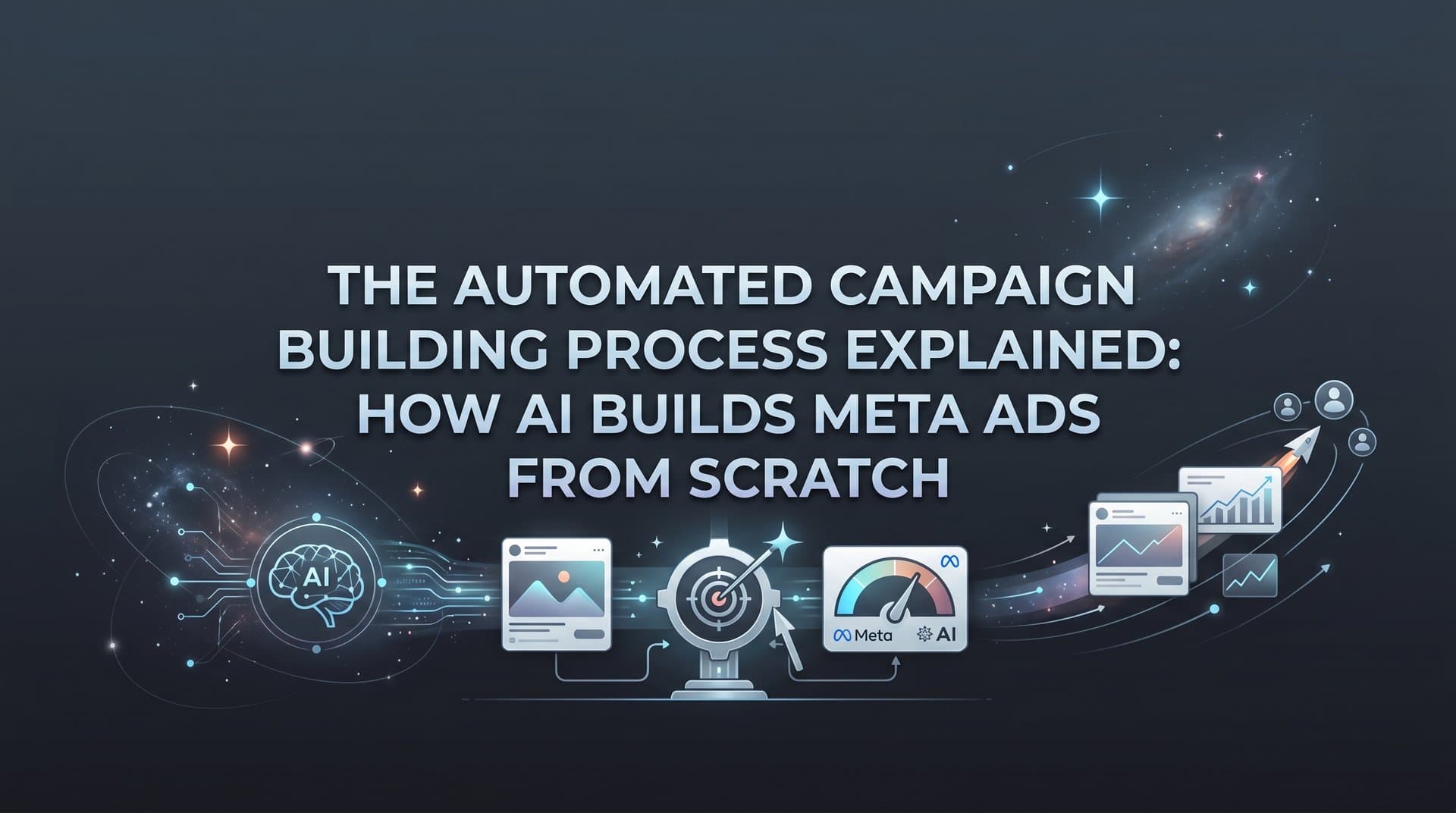
The automated campaign building process offers a fundamentally different approach. Instead of starting from intuition and assembling pieces manually, AI-driven platforms analyze historical performance data, generate creatives, structure campaigns, and launch hundreds of variations systematically. The result isn't just faster setup. It's a more rigorous, data-informed process from the first creative to the final launch.
This article breaks down exactly how that process works: what each stage involves, where AI adds the most value, and what separates genuinely intelligent automation from basic scheduling tools. If you're evaluating whether automated campaign building is worth adopting, or simply trying to understand what the technology actually does under the hood, this is the breakdown you need.
Why Manual Campaign Building Breaks Down at Scale
The complexity of building Meta campaigns manually doesn't grow in a straight line. It compounds. Start with a modest setup: five creatives, three headlines, three audiences, and two copy variations. On paper, that sounds manageable. In practice, you're looking at a combinatorial explosion of possible ad variations, each of which could theoretically perform differently depending on how those elements interact.
Now multiply that across multiple campaigns, multiple products, or multiple client accounts. The number of decisions required doesn't just double. It multiplies across every layer of the campaign structure simultaneously. And because Meta's ad system rewards testing, the pressure to run more variations only increases as your budget grows.
Here's where human decision-making starts to crack. When you're manually assembling campaigns at this level of complexity, you inevitably start cutting corners. You reuse the same audiences because building new ones takes time. You stick with creatives that performed well before, even when the data is months old. You write three headline variations instead of ten because you're up against a deadline. None of these shortcuts are irrational given the time constraints. But collectively, they introduce a kind of systematic inconsistency that makes it harder to know what's actually driving performance.
There's also an opportunity cost that rarely gets discussed. Every hour spent manually configuring ad sets, uploading creatives, and writing copy variations is an hour not spent reviewing performance data, identifying creative patterns, or refining audience strategy. Campaign assembly is largely mechanical work. It doesn't require strategic judgment. But because it's time-consuming, it crowds out the analytical work that actually moves the needle.
The deeper problem is that manual processes create a slow feedback loop. You build a campaign, run it for a week, review the results, and then start the whole assembly process again. By the time you've acted on what you learned, the market has shifted, the creative has fatigued, or a competitor has already tested the same approach and moved on.
Automated campaign building doesn't just speed up the assembly. It restructures the entire workflow so that data analysis, creative decisions, and campaign structure are all happening in parallel rather than sequentially. That's a meaningful difference, and it's worth understanding why before diving into how the process works.
Breaking Down the Automated Campaign Building Process
The phrase "automated campaign building" gets used loosely, so it's worth being precise about what it actually means in practice. There's a spectrum here, and not all automation is equal.
At the basic end, you have rule-based automation: budget caps, scheduled start and end dates, automated rules that pause ads when CPA exceeds a threshold. These tools are useful, but they're reactive. They respond to what's already happened rather than informing what should happen next.
True AI-driven campaign building operates at a different level entirely. It's proactive and strategic. Instead of waiting for performance signals and then applying rules, it analyzes historical data before the campaign is even built, uses that analysis to inform creative selection, audience targeting, and campaign structure, and then generates the full campaign with that reasoning embedded into every decision.
The core stages of a well-built automated campaign building process typically look like this:
Data Analysis: The AI reviews historical campaign performance across metrics like ROAS, CPA, CTR, frequency, and audience overlap. This isn't a surface-level review. It's ranking every element by actual performance so the system knows what has worked and what hasn't before a single creative is generated.
Creative Generation: Based on product information and performance signals, the AI generates image ads, video ads, and UGC-style creatives. This happens before the campaign structure exists, which reflects the reality that creative is the highest-leverage variable in Meta ad performance.
Audience Selection: Using historical audience performance data, the AI identifies which targeting parameters and audience segments have driven the best results, then selects and structures audiences for the new campaign accordingly.
Campaign Assembly: The AI combines creatives, headlines, copy, and audiences into a complete campaign structure, generating hundreds of variations through bulk combination logic rather than manual configuration.
Launch and Optimization: The campaign launches to Meta with all variations active. From there, AI insights continuously score every element against goal-based benchmarks, surfacing winners and informing the next iteration.
What separates this from basic automation is the reasoning layer. A well-built system doesn't just execute tasks. It explains why it made each decision, so marketers can understand the strategy rather than simply accepting the output.
Stage One: Creative Generation Before the Campaign Exists
Most campaign builders start with structure: campaign objective, budget, audience, placements. Creative comes last, often treated as something you plug in once the scaffolding is in place. This sequencing reflects how Meta Ads Manager is organized, but it's backwards from how Meta's algorithm actually works.
Creative is the primary driver of ad performance on Meta. Audience targeting matters, but the algorithm has become increasingly capable of finding the right people if the creative is strong enough to generate engagement signals. Starting with creative isn't just a workflow preference. It's the more strategically sound approach.
In an automated campaign building process, creative generation happens first and independently of campaign structure. The AI takes a product URL as its starting point and generates scroll-stopping image ads, video ads, and UGC-style avatar content without requiring a designer, video editor, or actor. The output isn't generic. It's informed by the product's positioning and the performance patterns the AI has already identified from historical data.
One particularly powerful capability is the ability to clone competitor ads directly from the Meta Ad Library. Rather than starting creative ideation from a blank page, you can pull a competitor's running ad, use it as a structural reference, and let AI generate your own version built around your product. This approach accelerates ideation significantly and grounds your creative in formats that are already proven to be running in the market.
Once initial creatives are generated, chat-based refinement allows you to iterate without going back to a design tool. Want a different color palette? A more direct headline? A variation that leads with the product benefit rather than the brand name? You can request those changes conversationally and get updated versions in seconds. This makes creative testing genuinely fast rather than theoretically fast.
The practical implication is that by the time you're ready to build the campaign structure, you already have a library of tested creative concepts ready to go. The campaign assembly stage isn't waiting on creative production. It's selecting from a set of options that have already been evaluated and refined.
Stage Two: How AI Assembles the Campaign Structure
With creatives in hand, the campaign assembly stage is where the automated process diverges most sharply from manual work. This is where the AI's analysis of historical performance data directly shapes what gets built.
Before structuring a single ad set, a well-designed AI campaign builder reviews your historical performance data and ranks every element by real metrics. Which creatives drove the lowest CPA? Which headlines produced the highest CTR? Which audiences delivered the best ROAS over the past 90 days? This ranking process means the campaign isn't being built from intuition or habit. It's being built from evidence.
AdStellar's AI Campaign Builder does exactly this. Specialized AI agents analyze past campaigns, rank creatives, headlines, and audiences by performance, and then use those rankings to inform the structure of the new campaign. Every decision comes with a rationale attached, so you understand not just what the AI built but why it made those choices.
This transparency piece matters more than it might initially seem. Many marketers are understandably skeptical of black-box automation. If a platform builds your campaign and you have no visibility into the reasoning, you can't learn from it, you can't catch errors, and you can't improve your own strategic thinking over time. Platforms that explain their AI rationale treat marketers as collaborators rather than just users.
Once the AI has selected the highest-performing elements, bulk variation logic takes over. Instead of manually creating each ad combination, the system mixes multiple creatives, headlines, audiences, and copy variations to generate every possible combination automatically. A campaign that would take hours to configure manually can be assembled in minutes, with far more variations than a human would realistically build by hand.
This matters for statistical validity as much as speed. More variations tested simultaneously means you get meaningful performance signals faster. Instead of waiting weeks to determine whether creative A outperforms creative B, you're running ten creatives against five audiences with three headline variations all at once, and the data starts flowing immediately.
The result of this stage is a fully structured campaign: complete ad sets, audiences configured, creatives assigned, copy and headlines matched, all ready to launch without manual configuration.
Stage Three: Launching, Testing, and Surfacing Winners
The launch stage is where the speed advantage of automated campaign building becomes most tangible. Bulk launching pushes hundreds of ad variations to Meta in minutes. What would previously require hours of manual ad creation, duplication, and quality checking happens in a fraction of the time, with greater consistency and fewer human errors.
But launch is just the beginning of this stage. The real value comes from what happens after the campaign goes live.
AI insights continuously score every element of the running campaign against your goal-based benchmarks. Rather than manually pulling reports and trying to identify patterns across dozens of ad variations, leaderboard rankings surface the top performers by the metrics that matter to your specific goals: ROAS, CPA, CTR, or whatever benchmarks you've set. You can see at a glance which creatives are winning, which audiences are underperforming, and which headlines are driving the most qualified clicks.
This goal-based scoring approach is important because it keeps the optimization aligned with your actual business outcomes rather than platform vanity metrics. An ad with a high CTR but a poor CPA isn't a winner by most business definitions. A system that scores against your real goals keeps that distinction clear.
The Winners Hub takes this a step further. Rather than treating each campaign's results as a one-time report that gets filed away, the Winners Hub maintains a persistent library of your best-performing creatives, headlines, audiences, and copy. Every element is stored with its real performance data attached. When you're building the next campaign, you're not starting from scratch. You're selecting from a curated library of proven elements and adding them directly to the new campaign structure.
This creates a compounding advantage over time. Each campaign you run adds to the knowledge base. The AI gets smarter, the Winners Hub gets richer, and the quality of future campaigns improves because they're built on an ever-growing foundation of validated performance data rather than fresh guesses.
What Separates a Good Automated Campaign Building Platform from a Basic One
Not every platform that claims to automate campaign building is actually doing the same thing. If you're evaluating options, here are the capabilities that separate genuinely powerful platforms from tools that just automate the tedious parts without adding strategic value.
Full-stack capability: Creative generation and campaign management should live in the same platform. Many advertisers currently use separate tools for creative production, campaign setup, and analytics. This fragmentation creates data gaps. When your creative tool doesn't talk to your campaign tool, the feedback loop between performance and creative decisions slows down significantly. A platform that handles both in one place keeps the data connected and the workflow continuous.
Learning loop quality: The platform should get smarter with every campaign, not just execute the same process repeatedly. This means the AI is continuously updating its performance model based on new data, so the campaign it builds for you in month six is meaningfully better informed than the one it built in month one. Platforms that don't have this learning loop are essentially sophisticated templates, not adaptive systems.
Goal-based scoring and attribution integration: Automation is only as good as the data feeding it. If the AI is optimizing toward platform-reported metrics that don't reflect actual conversions, you'll get campaigns that look good in Meta Ads Manager but don't drive business results. Integration with attribution tools like Cometly ensures the AI is working from real conversion data, not just the signals Meta's pixel provides. This is the difference between optimizing toward your actual goals and optimizing toward a proxy that may or may not correlate with them.
Transparent AI rationale: As discussed earlier, platforms that explain their reasoning build trust and help marketers develop better strategic instincts over time. If you can't understand why the AI made a particular decision, you can't evaluate whether it was correct, and you can't improve on it in future campaigns.
AdStellar is built around all of these principles. From AI creative generation through bulk launching to the Winners Hub and AI insights leaderboards, the platform is designed as a single connected system where every stage of the automated campaign building process feeds into the next. The AI explains its decisions, learns from every campaign, and scores performance against your actual goals rather than platform defaults. If you're comparing your options, it's worth reviewing a breakdown of campaign automation platforms to understand how these capabilities stack up across the market.
Putting It All Together
The automated campaign building process, done well, is a progression through clearly defined stages: creative generation informed by performance data, campaign assembly driven by AI ranking and bulk variation logic, and continuous optimization that surfaces winners and builds a compounding knowledge base over time.
What makes this fundamentally different from manual campaign building isn't just speed, though speed is a real advantage. It's the systematic application of historical performance data at every stage of the process. Instead of building campaigns from intuition and hoping the results validate your choices, you're building from evidence and using the results to sharpen the next iteration.
The best implementations of this process are not black boxes. They're transparent systems that explain their reasoning, connect creative decisions to campaign performance, and get meaningfully smarter with each campaign they run. That transparency is what allows marketers to stay in the loop strategically rather than simply delegating to automation they don't understand.
If you want to see the full automated campaign building process in action without a long commitment, AdStellar offers a 7-day free trial that gives you access to the complete platform: AI creative generation, the AI Campaign Builder, bulk launching, AI insights, and the Winners Hub. Start Free Trial With AdStellar and experience firsthand how a fully connected, AI-driven system builds and tests winning Meta ads from scratch.