Most media buyers have a testing graveyard—dozens of ad variations that looked promising in theory but face-planted in practice. You meticulously craft five different headlines, three audience segments, and four creative variations. Two weeks and $3,000 later, you're staring at a spreadsheet trying to figure out which combination actually worked. Was it the headline? The audience? The creative? Or just random luck during a particularly good Tuesday?
This is the reality of manual Facebook ad testing: slow, expensive, and maddeningly ambiguous. By the time you've gathered enough data to make a confident decision, your winning creative is already showing signs of fatigue, your audience is saturated, and your competitors have moved on to their next iteration.
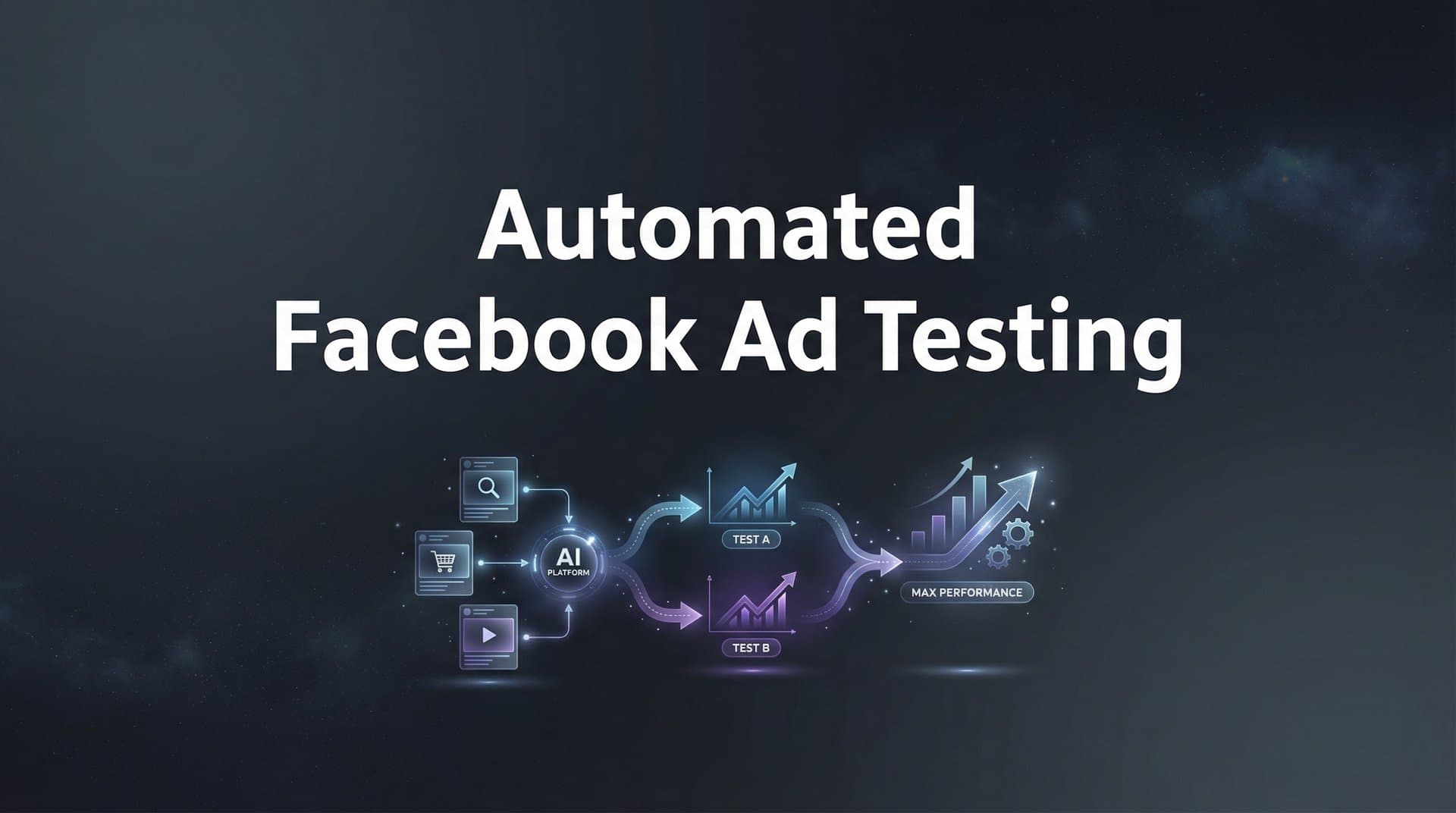
Automated Facebook ad testing flips this entire paradigm. Instead of you manually setting up tests, waiting weeks for results, and making gut-call decisions based on incomplete data, AI-powered systems continuously generate variations, monitor performance in real-time, and shift budgets toward winners—all while you focus on higher-level strategy. For marketers serious about scaling Meta advertising efficiently, understanding automated testing isn't optional anymore. It's the difference between iterating monthly and iterating hourly.
The Testing Bottleneck That's Costing You Money
Let's be brutally honest about manual testing: you're probably doing it wrong, and it's not entirely your fault.
The traditional approach looks something like this: You create three ad variations, launch them with equal budgets, check back in a few days, and declare a winner based on whichever has the lowest cost per acquisition. Seems logical, right? Except you've just made at least four critical mistakes that are quietly bleeding your ad budget.
First, the sample size problem. Three days of data rarely provides statistical significance, especially if your conversion volume is modest. That "winning" ad might just be the one that happened to catch a few high-intent users early. Scale it, and you'll watch those costs creep right back up.
Second, the iteration speed trap. Even if you're disciplined about waiting for significance, manual testing means you're running maybe two or three test cycles per month. Meanwhile, your market is shifting, your competitors are adapting, and seasonal trends are changing the game entirely. By the time you've identified a winner and scaled it, the conditions that made it successful have already evolved. This campaign testing inefficiency compounds over time, leaving you perpetually behind.
Third, the complexity ceiling. Testing one variable at a time is testing 101, but real campaign optimization requires understanding how variables interact. Does that punchy headline work better with the lifestyle image or the product shot? Does your 25-34 age segment respond differently to video than your 35-44 segment? Answering these questions manually would require dozens of isolated tests running sequentially—a timeline measured in months, not weeks.
Fourth, human bias creeps in everywhere. You have favorite creative styles, preferred audience assumptions, and pet theories about what works. These biases limit which variations you even bother testing. The breakthrough angle you never considered? It never gets a chance because it doesn't fit your mental model of "good advertising."
The hidden cost here isn't just wasted ad spend on underperforming variations. It's the opportunity cost of all the winning combinations you never discovered because manual testing simply can't operate at the scale and speed required to find them.
The Mechanics Behind Automated Testing Systems
Automated ad testing sounds like magic until you understand the underlying mechanics. Then it just sounds like common sense executed at machine speed.
At its core, automated testing is a systematic approach to variation creation and performance evaluation. Instead of you manually duplicating ad sets and changing one element at a time, the system generates combinations based on the variables you provide—creative assets, headline options, audience segments, placement preferences, and more.
Here's where it gets interesting: these aren't random combinations. Sophisticated platforms analyze your historical performance data to inform which variations are worth testing. If your account data shows that video consistently outperforms static images for your product category, the system prioritizes video-based variations. If carousel ads have historically driven higher engagement with your 35-44 demographic, that insight shapes future test structures.
The real-time monitoring layer is what separates automation from glorified batch launching. Once variations are live, the system tracks performance metrics continuously—not just once daily when you remember to check Ads Manager. As data accumulates, the platform identifies which variations are trending toward your success metrics and which are clearly underperforming.
This is where dynamic budget allocation enters the picture. Instead of every variation getting equal spend regardless of performance, the system gradually shifts budget toward winners. A variation showing strong early signals gets more exposure to validate its performance. A variation that's clearly bombing gets its budget throttled before it burns through significant spend.
The feedback loop is perhaps the most powerful component. Every test doesn't just produce a winner—it produces learnings that inform future tests. That headline structure that worked? The system notes it and tests similar structures in future campaigns. That audience segment that flopped? It gets deprioritized in future targeting recommendations.
Think of it as compound learning. Your first automated test might outperform manual testing by 20%. Your tenth automated test, informed by nine previous rounds of learnings, might outperform manual testing by 50%. The system gets smarter with every campaign because it's building a knowledge base about what works specifically for your business, your audience, and your creative style.
The technical implementation varies by platform, but the principle remains consistent: remove the human bottleneck from the testing process while keeping humans in control of strategy and creative direction. You're not abdicating decision-making to an algorithm. You're using the algorithm to execute testing strategies that would be impossible to run manually. Understanding the difference between automated vs manual Facebook campaigns is essential for making this transition effectively.
The Five Testing Dimensions That Actually Move Metrics
Not all testing variables are created equal. Some drive dramatic performance differences. Others are optimization theater—they keep you busy but don't materially impact results.
Creative Testing: Your Highest-Leverage Variable
Creative is where most performance breakthroughs happen. The difference between a scroll-stopping visual and a forgettable one can easily be 2-3x on click-through rates, which cascades into everything downstream.
Format testing matters more than most marketers realize. Static image versus video isn't just an aesthetic choice—they serve different functions in the user journey. Video typically excels at storytelling and demonstrating product usage, while static images can deliver punchy benefit statements instantly. Carousel ads let you showcase multiple products or tell a sequential story. Testing format systematically reveals which approach resonates with your specific audience. A dedicated Facebook ad creative testing platform can accelerate this discovery process significantly.
Visual style testing goes deeper than "this image versus that image." You're testing psychological triggers: lifestyle shots versus product-focused shots, people versus products, bright versus muted color palettes, text overlays versus clean visuals. Each combination signals different things to your audience and attracts different segments.
Copy Testing: The Words That Convert
Your headline is the first filter. It determines whether someone even processes your ad or scrolls past. Testing headline variations means testing different value propositions, different emotional hooks, and different specificity levels.
Consider these three headlines for the same product: "Save Time on Ad Testing" versus "Cut Your Testing Time by 80%" versus "Stop Wasting Weeks on Manual Ad Tests." Same basic promise, completely different psychological framing. The first is generic benefit. The second is specific outcome. The third is problem-focused. Each will resonate differently with different audience segments.
Primary text testing explores how much context to provide. Some audiences convert from a punchy two-sentence value prop. Others need social proof, feature details, or objection handling. Testing text length and structure reveals what your audience actually needs to see before clicking. An automated Facebook ad copywriter can generate these variations at scale while maintaining brand consistency.
CTA testing might seem trivial—how different can "Learn More" be from "Get Started"?—but word choice signals intent. "Learn More" attracts browsers. "Get Started" attracts buyers. "See Pricing" attracts comparison shoppers. Each CTA pre-qualifies your traffic differently.
Audience Testing: Finding Your People
Audience testing is where you discover that your assumptions about your ideal customer might be completely wrong. That demographic you thought was your core market? Maybe they're just the noisiest, not the most profitable.
Interest-based targeting lets you test different psychographic angles. Are you better off targeting people interested in "digital marketing" broadly, or drilling down into "Facebook advertising" specifically? Should you stack interests ("digital marketing" AND "small business") or test them separately? Systematic testing reveals which interest combinations produce qualified traffic versus tire-kickers. The right automated Facebook targeting tool can help you discover these winning combinations faster.
Lookalike audience testing is about finding your hidden markets. Your 1% lookalike might perform differently than your 3% lookalike. Your lookalike based on purchasers might attract different quality traffic than your lookalike based on email subscribers. Testing multiple lookalike sources and percentages uncovers audience segments you didn't know existed.
Custom audience segmentation testing gets granular. Does your email list segment convert better than your website visitors? Do cart abandoners respond to different messaging than browse abandoners? Testing these segments separately—rather than lumping them into one retargeting pool—often reveals dramatic performance differences.
Building Your Automated Testing Framework
Automated testing without structure is just automated chaos. Before you launch your first automated test, you need a framework that ensures clean data and actionable insights.
Define Success Metrics That Actually Matter
This sounds obvious, but most marketers skip this step and regret it later. What does "winning" mean for this specific campaign? Is it lowest cost per acquisition? Highest return on ad spend? Maximum click-through rate? Highest conversion rate regardless of cost?
These aren't interchangeable metrics. An ad that maximizes clicks might attract low-intent traffic that rarely converts. An ad that minimizes CPA might do so by attracting only bottom-funnel buyers, limiting your scale potential. Be explicit about your primary success metric before launching tests, and make sure your automation platform is optimizing toward that specific goal.
Set realistic thresholds too. If your target CPA is $50, but your account average is $75, understand that your testing goal is directional improvement, not immediate perfection. Automated testing accelerates learning, but it doesn't defy market economics. Understanding Facebook campaign optimization principles helps you set these expectations appropriately.
Structure Campaigns for Clean Data
This is where many automated testing initiatives fall apart. If your campaign structure is messy, your data will be messy, and your automation will make decisions based on noise rather than signal.
Naming conventions matter more than you think. When you're running dozens of automated variations, you need to instantly identify what's being tested. A naming structure like "Campaign_Creative-A_Audience-Lookalike1%_Placement-Feed" lets you quickly parse results. Random names like "New Campaign 7" become unmanageable fast. Learning how to structure Facebook ad campaigns properly is foundational to testing success.
Isolate your variables. If you're testing creative, keep audience and placement constant across variations. If you're testing audience, keep creative constant. Yes, this means you'll miss some interaction effects, but it ensures you can confidently attribute performance differences to the variable you're actually testing.
Attribution setup is non-negotiable. With iOS privacy changes making tracking more complex, make sure your conversion tracking is properly configured before launching automated tests. If your attribution is broken, your automation will optimize toward phantom signals that don't reflect real business outcomes.
Budget Allocation Principles That Protect Your Spend
Automated testing requires adequate budget per variation to generate meaningful data. Spread $100 across ten variations, and you'll get statistical noise. Concentrate $1,000 on testing three well-designed variations, and you'll get actionable insights.
A practical starting point: allocate enough budget for each variation to generate at least 20-30 conversions (or 500+ link clicks if you're optimizing for top-of-funnel metrics). This gives you enough data to separate signal from noise. If your average CPA is $50, that means $1,000-$1,500 minimum per variation for conversion-focused tests.
Test duration matters too. Running tests for just 2-3 days might catch weekend versus weekday performance differences rather than true variation performance. A minimum 7-day test window captures weekly patterns. For higher-consideration purchases with longer sales cycles, 14-day windows provide more reliable data.
Scaling Winners Without Destroying Performance
Finding a winning variation is exciting. Scaling it without killing performance is the real skill.
Recognizing Real Winners Versus Lucky Flukes
That ad variation that crushed it for three days? It might be a genuine winner, or it might have just caught a few high-intent users during a random hot streak. Statistical confidence matters here.
Look for consistent performance across multiple days, not just a strong single day. Check that your sample size is adequate—a variation with 5 conversions at $30 CPA isn't necessarily better than one with 50 conversions at $35 CPA. The latter has more data backing its performance.
Consider the confidence interval. Most platforms won't show you this explicitly, but the principle matters: a variation that consistently delivers $40-$45 CPA is more reliable for scaling than one that swings between $25 and $70 CPA, even if they have the same average.
The Scaling Playbook: When and How to Increase Budgets
Scaling isn't just "increase budget and hope for the best." Aggressive budget increases often trigger Meta's algorithm to re-enter learning phase, temporarily tanking performance while the system adjusts.
The conservative approach: increase budgets by 20-30% every 3-4 days. This lets the algorithm adjust gradually without resetting learning. Yes, it's slower than you'd like, but it preserves performance better than doubling budgets overnight. Mastering how to scale Facebook ads efficiently requires patience and systematic budget management.
Watch for audience fatigue signals as you scale. If your frequency climbs above 3-4 while your CTR drops, you're saturating your audience. This is your signal to either expand targeting, introduce creative refresh, or accept that you've found this audience's ceiling.
Horizontal scaling—launching new variations targeting different audiences with your winning creative—often works better than vertical scaling (just pumping more budget into the same ad set). It lets you expand reach without exhausting any single audience segment.
Building Your Winners Library for Compound Growth
Every winning variation should feed into a centralized winners library—a swipe file of proven elements you can remix in future campaigns.
Catalog what worked and why. That headline that crushed? Save it with notes about which audience and creative it paired with. That audience segment that converted efficiently? Document it with the offer and creative that resonated. That video hook that stopped scrolls? Store it for reuse in future creative production.
This library becomes your compound learning engine. Your tenth campaign doesn't start from zero—it starts with nine campaigns worth of proven elements to build from. You're not guessing which headline structure might work; you're starting with three headline structures that have already proven they work for your business.
The most sophisticated marketers treat their winners library as a strategic asset. They analyze patterns across winning variations: Do benefit-focused headlines consistently outperform feature-focused ones? Do lifestyle images work better than product shots? Do longer or shorter ad copy variations drive better results? These patterns become your testing hypotheses for future campaigns.
Your First Steps Toward Automated Testing
If you're currently doing all your ad testing manually, the idea of automating the entire process can feel overwhelming. Where do you even start?
Start with One Campaign, One Variable
Don't try to automate everything at once. Pick your highest-spend campaign—the one where improved performance would have the biggest impact on your bottom line. Within that campaign, choose one testing dimension to automate first.
Creative testing is often the highest-leverage starting point because creative typically has the biggest impact on performance. If you have five creative variations you want to test, let automation handle the launching, monitoring, and budget shifting while you focus on analyzing results and planning the next round.
Run this initial automated test alongside your normal manual campaigns. You're not betting the farm on automation from day one. You're running a controlled experiment to see how automated testing performs versus your current approach.
Measure Impact Over 30-60 Days
Give automated testing enough time to prove its value. The first week might not look dramatically different from manual testing. By week four, when you've run multiple test cycles and the system has accumulated learnings, the performance gap typically becomes clear.
Track not just performance metrics but operational metrics too. How much time did you save not manually setting up ad variations? How many more test cycles did you complete compared to manual testing? How much faster did you identify winning combinations? If you've been wasting time on Facebook ad setup, these efficiency gains become immediately apparent.
The efficiency gains often matter as much as the performance gains. If automated testing lets you run four test cycles in the time it used to take to run one, you're iterating 4x faster even if each individual test performs similarly.
Expand Systematically as You Build Confidence
Once you've validated automated testing on one campaign and one variable, gradually expand the scope. Add a second testing dimension—maybe audience testing alongside creative testing. Extend automation to additional campaigns. Increase the number of variations you're testing simultaneously.
Think of automated testing as a system you're building, not a tool you're simply turning on. Each expansion teaches you something about what works for your specific business, your creative style, and your audience. Over time, you develop intuition about which testing strategies yield the best insights and which are just noise.
The long-term mindset matters here. Manual testing is a series of discrete experiments. Automated testing is a continuous learning system that gets smarter with every campaign. The value compounds over time as your system accumulates more data, more patterns, and more proven winners to build from.
The Future of Testing Is Already Here
Automated Facebook ad testing isn't about replacing your marketing judgment with algorithms. It's about amplifying your strategic thinking with data-driven execution at a speed and scale that manual processes simply can't match.
The marketers winning on Meta right now aren't the ones with the biggest budgets or the flashiest creative. They're the ones who've built systematic testing processes that let them iterate faster, learn quicker, and scale smarter than their competition. While others are still analyzing last week's A/B test results, they're already three testing cycles ahead.
Take an honest look at your current testing process. How many variations are you testing right now? How long does it take you to set up a new test? How often do you run tests versus just running campaigns based on past assumptions? The gap between your current state and what's possible with automation—that's the opportunity sitting in front of you.
The barrier to entry has never been lower. You don't need a data science team or a six-figure ad budget to implement automated testing. You need a willingness to let systems handle the execution while you focus on the strategy, creative direction, and business outcomes that actually require human judgment.
Continuous learning systems aren't a future trend in Meta advertising—they're already table stakes for staying competitive. The question isn't whether to adopt automated testing. It's whether you'll adopt it before or after your competitors do.
Ready to transform your advertising strategy? Start Free Trial With AdStellar AI and be among the first to launch and scale your ad campaigns 10× faster with our intelligent platform that automatically builds and tests winning ads based on real performance data.