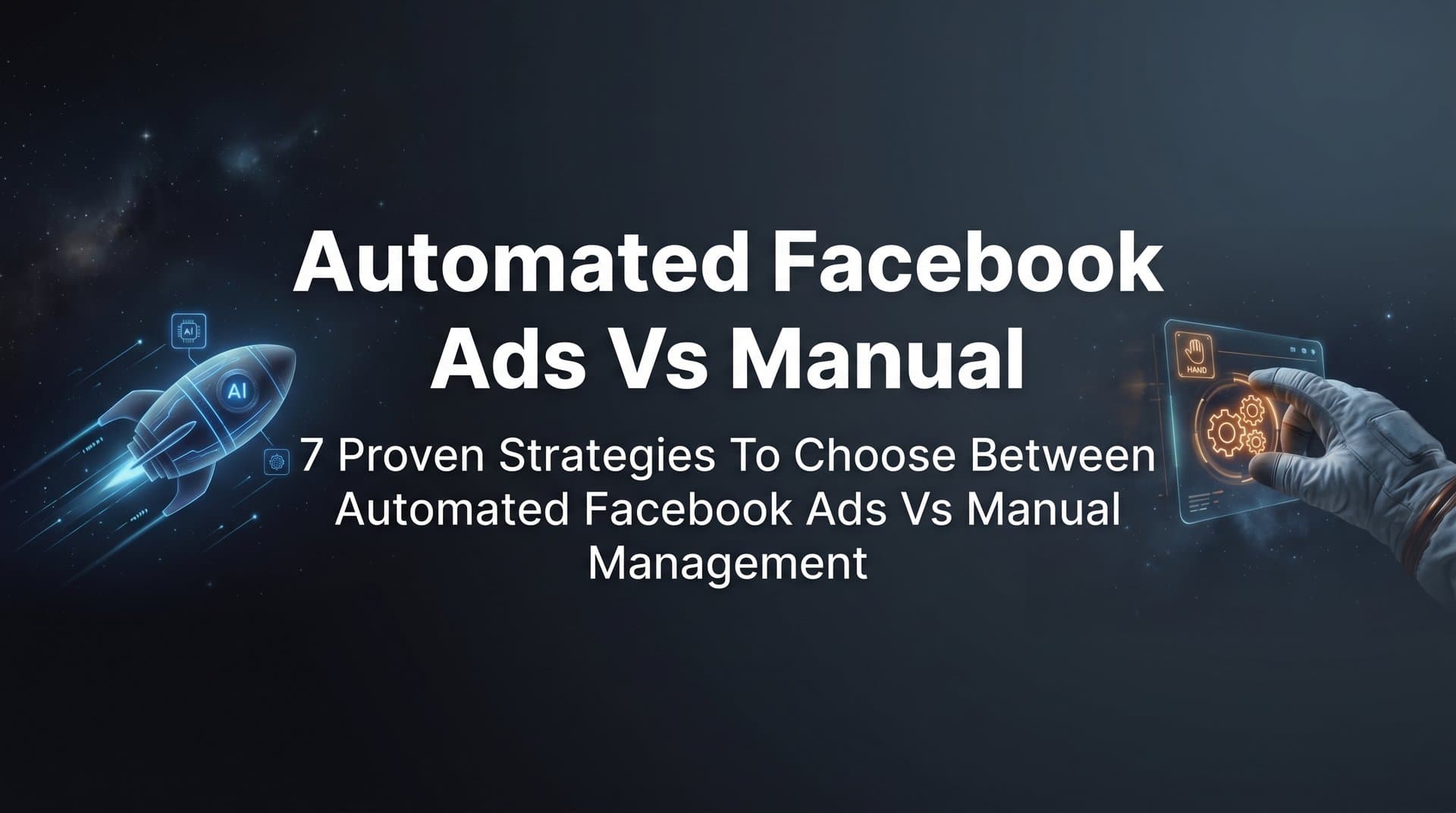
The automated versus manual debate in Facebook advertising has shifted dramatically. A few years ago, automation meant setting basic rules and hoping for the best. Today, AI-powered platforms can generate creatives, analyze historical performance, and launch complete campaigns in minutes. Meanwhile, manual management has evolved too, with sophisticated tools providing real-time insights that make human decision-making more precise than ever.
But here's what the industry conversation often misses: the question isn't which approach is better. It's which approach fits your specific situation right now.
Some campaigns thrive with full automation. Others demand careful manual oversight. Most successful advertisers use both, strategically applying each method where it delivers the most value. The challenge is knowing when to automate, when to take manual control, and how to build a system that adapts as your campaigns evolve.
This guide breaks down seven proven strategies for making that decision. You'll learn how to evaluate your campaign complexity, match your management style to your budget, leverage AI for creative testing while maintaining brand control, and build hybrid workflows that get smarter with every campaign. Whether you're running ads for a single product or managing campaigns across multiple clients, these strategies will help you achieve better results in less time.
1. Audit Your Campaign Complexity Before Choosing an Approach
The Challenge It Solves
Many advertisers jump into automation or commit to manual management without first evaluating whether their campaign structure actually fits that approach. A simple direct-to-consumer campaign with one product and clear conversion goals has completely different needs than a multi-product catalog with varied messaging angles and multiple conversion paths. Choosing the wrong management style for your complexity level wastes time and budget.
The Strategy Explained
Start by mapping out your campaign variables. Count how many products or services you're promoting, how many distinct audience segments you're targeting, and how many different messaging angles you plan to test. Consider your conversion path complexity: are you driving straight to purchase, or building awareness first? Look at your creative requirements too. Do you need five variations or five hundred?
Simple campaigns with fewer than three products, straightforward conversion goals, and limited audience segments often benefit from automation. The AI can optimize quickly when variables are limited. Complex campaigns with multiple products, nuanced messaging requirements, or multi-stage conversion paths typically need more manual oversight, at least initially. Understanding Facebook ads campaign structure helps you evaluate this complexity accurately.
Implementation Steps
1. Create a campaign complexity scorecard listing products, audiences, messaging angles, creative variations, and conversion goals.
2. Rate each element as simple (1-3 variations), moderate (4-10 variations), or complex (10+ variations).
3. If most elements score simple, automation can handle the heavy lifting. If most score complex, start with manual management and introduce automation gradually.
Pro Tips
Complexity isn't static. A campaign that starts complex often simplifies once you identify winning elements. Plan to shift toward more automation as you eliminate underperformers and focus on proven combinations. Reassess your complexity score monthly.
2. Match Your Budget Scale to the Right Management Style
The Challenge It Solves
Budget size fundamentally changes what's possible and what's necessary in campaign management. A $500 monthly budget requires different oversight than a $50,000 budget. Applying enterprise-level manual management to small budgets creates unnecessary overhead, while running large budgets on full automation without strategic oversight can burn through cash before you identify problems.
The Strategy Explained
Smaller budgets typically benefit from automation because manual management overhead becomes a significant percentage of total spend. If you're spending $1,000 monthly and investing ten hours in manual optimization, you're effectively paying yourself $100 per hour in opportunity cost. Automation handles the routine decisions efficiently, freeing you to focus on strategy.
Larger budgets justify more manual involvement because small percentage improvements yield bigger returns. A 10% efficiency gain on $50,000 monthly spend means $5,000 saved or reinvested. That makes manual analysis and optimization economically worthwhile. Learning about automated budget allocation for Facebook ads helps you find the right balance for your spend level.
Implementation Steps
1. Calculate your effective hourly rate by dividing monthly ad spend by hours available for management.
2. For budgets under $5,000 monthly, prioritize automation for routine tasks like bid adjustments and basic audience optimization.
3. For budgets over $10,000 monthly, invest in manual analysis of performance patterns, creative testing strategy, and audience refinement.
Pro Tips
Budget scale isn't just about total spend. Consider your cost per result too. High-ticket products with expensive conversions justify more manual attention per campaign than low-cost impulse purchases, regardless of total budget. A campaign spending $10,000 to generate five $2,000 sales needs different oversight than one spending $10,000 to generate a thousand $10 sales.
3. Use Automation for Creative Testing at Scale
The Challenge It Solves
Traditional manual creative testing hits a wall quickly. Creating ten ad variations manually takes hours. Creating a hundred takes days. Meanwhile, your competitors using AI-powered creative generation are testing hundreds of variations simultaneously, discovering winning combinations while you're still in design mode. The speed disadvantage compounds over time.
The Strategy Explained
AI creative generation has transformed what's possible in ad testing. Modern platforms can generate image ads, video ads, and even UGC-style content from a product URL or by analyzing competitor ads. This lets you test dozens or hundreds of creative variations in the time it would take to manually create five.
The real advantage isn't just speed. It's discovering unexpected winners. Human creative directors tend to iterate on familiar patterns. AI explores combinations you might never consider manually. Maybe an unconventional color scheme outperforms your brand guidelines. Maybe a messaging angle you thought was secondary becomes your top performer. Exploring automated Facebook ads testing platforms reveals how this process works in practice.
Platforms like AdStellar combine AI creative generation with bulk launching, letting you create hundreds of ad variations and deploy them across multiple ad sets in minutes. The system generates every combination of creatives, headlines, and copy, then launches them to Meta automatically.
Implementation Steps
1. Use AI tools to generate 20-50 creative variations for your next campaign, mixing different visual styles, messaging angles, and formats.
2. Set up bulk ad launching to deploy all variations simultaneously across your target audiences.
3. Let the campaign run for 3-7 days to gather performance data, then analyze which creative elements appear in your top performers.
Pro Tips
Don't just look at which complete ads win. Analyze patterns across winners. If five different ads all feature product close-ups, that visual style is worth emphasizing. If your top performers all use question-based headlines, that's a messaging insight to apply broadly. AI testing at scale reveals patterns manual testing might miss.
4. Keep Manual Control for Brand-Sensitive Messaging
The Challenge It Solves
Automation excels at optimization, but it doesn't understand brand nuance, industry compliance requirements, or the subtle difference between messaging that converts and messaging that damages reputation. A fully automated system might discover that sensational claims drive clicks, but those claims could violate industry regulations or undermine long-term brand trust.
The Strategy Explained
Certain campaign elements require human judgment that automation can't replicate. Brand voice consistency, legal compliance, cultural sensitivity, and strategic messaging all benefit from manual oversight. This doesn't mean avoiding automation entirely. It means building guardrails.
The hybrid approach works well here. Use AI to generate creative variations and headlines, but require human approval before launch. Let automation handle bid optimization and audience delivery, but maintain manual control over messaging and brand presentation. Understanding the difference between Facebook ads AI versus human media buyers helps clarify where each excels.
Implementation Steps
1. Identify your non-negotiable brand elements: voice, visual standards, compliance requirements, and messaging boundaries.
2. Configure your automation tools to generate variations within those parameters, or set up approval workflows for AI-generated content.
3. Assign manual review responsibility for any campaign touching sensitive topics, regulated industries, or high-stakes brand positioning.
Pro Tips
Create a brand compliance checklist that every ad must pass before launch, whether created manually or by AI. Include specific examples of approved and rejected messaging. This helps automation tools learn your boundaries while ensuring consistency. Update the checklist quarterly based on performance data and evolving brand standards.
5. Leverage AI Insights to Inform Manual Decisions
The Challenge It Solves
Manual optimization traditionally relies on gut feeling, limited data analysis, and time-consuming spreadsheet work. You might notice that Audience A performs better than Audience B, but without systematic analysis, you miss deeper patterns. Which headlines work best with which audiences? Which creative styles drive the lowest cost per acquisition? Manual analysis of these relationships takes hours and often yields incomplete insights.
The Strategy Explained
The smartest manual optimizers use AI-powered insights to guide their decisions. Instead of manually comparing hundreds of data points, let AI analyze performance across every creative, headline, audience, and landing page combination. The system identifies patterns and ranks elements by actual performance metrics.
Modern platforms provide leaderboards that rank your campaign elements against your specific goals. Want to know which headlines drive the best ROAS? Which creatives generate the lowest CPA? Which audiences deliver the highest conversion rates? Leveraging AI marketing tools for Facebook ads processes the data and surfaces actionable insights instantly. You make the strategic decisions, but you're working with comprehensive intelligence instead of limited samples.
This approach combines the best of both worlds. AI handles the data processing that humans struggle with. Humans apply strategic judgment that AI can't replicate. The result is faster, more accurate optimization decisions.
Implementation Steps
1. Set up AI-powered performance tracking that scores every campaign element against your target metrics like ROAS, CPA, and CTR.
2. Review your leaderboards weekly to identify top performers and underperformers across creatives, audiences, and messaging.
3. Use these insights to manually adjust budgets, pause underperformers, and scale winners with confidence backed by data.
Pro Tips
Don't just look at top-line winners. Analyze combinations. A creative that ranks middle-of-the-pack overall might be your top performer with a specific audience. AI insights reveal these nuanced relationships that aggregate data obscures. Use filters to explore performance by audience, placement, and time period.
6. Automate Audience Discovery While Manually Refining Winners
The Challenge It Solves
Finding new high-performing audiences manually means endless research, testing, and iteration. You might discover that outdoor enthusiasts respond well to your product, but identifying which specific outdoor interest segments perform best requires testing dozens of variations. Meanwhile, you're burning budget on underperformers while your winning audiences remain underfunded.
The Strategy Explained
AI excels at analyzing historical campaign data to identify audience patterns you might miss. The system can review thousands of data points across past campaigns, recognize which demographic and interest combinations drove results, and suggest new audiences worth testing. This accelerates discovery dramatically.
Once AI identifies promising audiences, manual refinement takes over. You apply strategic judgment about which suggestions align with your brand, which make business sense to pursue, and how to structure campaigns around these discoveries. If you're struggling with Facebook ads campaign scaling issues, this hybrid approach often provides the breakthrough you need.
The workflow becomes a continuous loop. AI suggests audiences based on performance data. You manually test and refine the best suggestions. The AI learns from those results and suggests even better audiences next time. Each cycle improves both the automation and your manual decision-making.
Implementation Steps
1. Use AI tools that analyze your historical campaign data and rank audience segments by actual performance metrics.
2. Manually select the top 3-5 AI-suggested audiences that align with your strategic goals and test them in dedicated ad sets.
3. After gathering performance data, manually refine winners by creating lookalike audiences, layering additional interests, or adjusting demographic targeting.
Pro Tips
Create a winners hub where you collect proven audience segments with their actual performance data. When launching new campaigns, start by manually selecting from this collection of validated audiences, then let AI suggest new variations to test. This approach gives you a reliable foundation while continuously expanding your reach.
7. Build a Hybrid Workflow That Evolves With Your Results
The Challenge It Solves
Static management approaches fail because campaigns aren't static. What works in month one needs adjustment by month three. A campaign that requires heavy manual oversight initially might benefit from more automation once you've identified winning patterns. Conversely, a fully automated campaign might need manual intervention when performance shifts unexpectedly. Without a flexible system, you're either over-managing mature campaigns or under-managing complex ones.
The Strategy Explained
The most effective approach treats automation and manual management as tools you apply strategically based on campaign maturity and performance. New campaigns typically benefit from automation for speed. AI can generate and test creative variations, launch campaigns with optimized settings, and gather initial performance data faster than manual setup.
As data accumulates, manual analysis becomes valuable. You review AI insights, identify patterns, and make strategic decisions about which elements to scale. You might manually adjust budgets toward winning combinations or pause underperforming segments that automation hasn't eliminated yet. Using Facebook ads campaign management software streamlines this transition between approaches.
Mature campaigns often shift back toward automation. Once you've identified your winners and established proven patterns, automation handles ongoing optimization efficiently. You maintain manual oversight for strategic decisions and periodic reviews, but daily management becomes largely automated.
Implementation Steps
1. Launch new campaigns using AI-powered tools that generate creatives, build campaign structures, and deploy tests automatically.
2. After 7-14 days of data collection, manually review performance insights and make strategic adjustments to budgets, audiences, and creative direction.
3. Once you've identified consistent winners, shift routine optimization to automation while scheduling monthly manual reviews for strategic assessment.
Pro Tips
Document your decision triggers. Define specific conditions that require shifting between automation and manual control. For example: "If ROAS drops 20% week-over-week, switch to manual review." Or: "Once a campaign maintains stable performance for 30 days, increase automation level." Clear triggers prevent both over-management and neglect.
Putting It All Together
The automated versus manual debate misses the point entirely. The question isn't which approach is better. It's how to strategically combine both for maximum impact.
Start by honestly assessing your campaign complexity and budget scale. Simple campaigns with straightforward goals benefit from more automation. Complex campaigns with nuanced requirements need manual oversight, at least initially. Your budget determines how much manual attention is economically justified.
Use automation where it delivers clear advantages: creative testing at scale, audience discovery, and processing large amounts of performance data. AI can test hundreds of variations and analyze thousands of data points faster and more thoroughly than any human team.
Maintain manual control where human judgment adds irreplaceable value: brand-sensitive messaging, strategic decisions, compliance requirements, and nuanced optimization. The goal isn't eliminating human involvement. It's focusing that involvement where it matters most.
Build workflows that evolve with your results. New campaigns need speed, which automation provides. Maturing campaigns need strategic refinement, which manual analysis delivers. Established campaigns with proven patterns can shift back to automated optimization with periodic manual review.
The most successful advertisers treat their management approach as a dynamic system, not a fixed choice. They use AI insights to inform manual decisions. They automate discovery while manually refining winners. They build hybrid workflows that adapt as campaigns mature.
This isn't about choosing sides in the automation debate. It's about building a system that leverages the strengths of both approaches while minimizing their weaknesses. You get the speed and scale of automation with the strategic oversight and brand protection of manual management.
Ready to transform your advertising strategy? Start Free Trial With AdStellar and be among the first to launch and scale your ad campaigns 10× faster with our intelligent platform that automatically builds and tests winning ads based on real performance data.